

A unique feature of Westmount Park that is one of only four in existence
By Michael Walsh
Previously published in WestmountMag.ca
The City of Westmount, at one point in time, had a large complement of gardeners working in the municipality’s potting sheds within its eight-building greenhouse. Under the direction of a superintendent of parks, playgrounds and greenhouse, they produced year-round floral displays, planted a multitude of flower beds in Westmount Park, donated flower arrangements to hospital patients, assembled an annual Chrysanthemum show and maintained a floral Union Jack outside City Hall.

In fact, in the 1950s, Westmount Park was an entirely different place than it is today. Aside from the myriad of floral displays, there were shuffleboard courts, a putting green, chess areas, rugby, soccer and cricket fields. A large bandstand hosted evening concerts that drew hundreds of residents. Victoria Hall offered meeting rooms for municipal groups and social organizations, along with many dance recitals and a wide variety of entertainment.

Although many of these unique aspects of the municipality have disappeared over time, one remains at the corner of Lansdowne Avenue and Sherbrooke Street: Westmount’s floral clock.

It was inspired by former Mayor Peter William McLagan’s visit to Edinburgh’s West Princess Street Garden. The garden featured a floral display of tens of thousands of plants shaped like a clock that also showed the correct time of day. (The mechanism needed to be wound daily). Upon returning to Westmount in July 1926, he approached Council to construct a similar floral display, arguing that, apart from Edinburgh, one outside Scarborough and another in Switzerland, no others existed.
Once approved, the task to construct the display was given to John G. McCreath, superintendent of parks, playgrounds and greenhouses. He was well qualified for the project: a native of Scotland who had spent his entire life as a gardener in both the City of Westmount and Montreal West, and he was responsible for developing the greenhouses and floral displays in Westmount Park.

The second portion of the project, designing the electrical mechanism to operate the clock’s hands, was given to the City’s Manager, G. W. Thompson. The team considered several options before deciding to use a modified Ford Model-T motor.
Unveiled in 1927, the City’s floral clock was an instant success, drawing residents, day and night, from the entire Island of Montreal to witness this marvel of botanical ingenuity and technology.
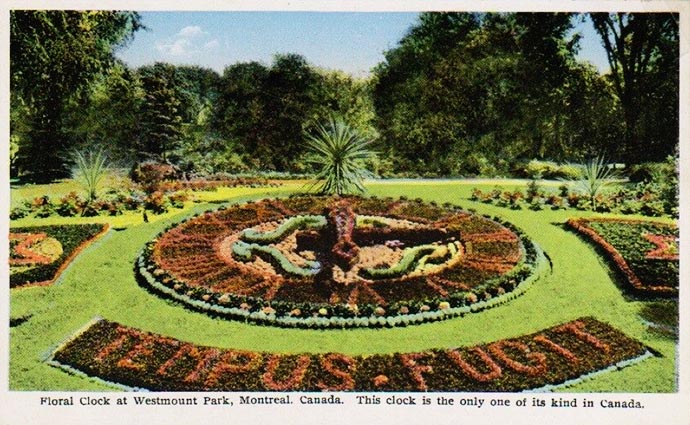
The floral clock measured 21 square feet on a sloping elevation surrounded by a low fence. The display comprised 10,000 plants (today, fewer than 5,000 are used), with an eight-foot-six-inch minute hand and a six-foot hour hand, each holding hundreds of plants and balanced by two 100-pound weights.

The outside border was comprised of mesembryanthemums (baby sun roses) with a centre setting of tall red alternantheras and echeverias. The centre of the bed ring displayed sedums with an outside circle of red alternantheras. At the foot of the clock was the floral inscription Tempus Fugit. A searchlight illuminated the entire display.
Interestingly, the clock became known as the “harbinger of summer” – with annual newspaper reports of city gardeners spending their customary two weeks installing the floral display. More famously, it was also Westmount’s most popular tourist attraction, with passersby checking their watches against the clock.
In 1964, Council adopted a “Westmount Park Rehabilitation” scheme that transformed the area into its present topography. The work was contracted using the U.S. landscape architectural firm McFadzean, Everly and Associates (designers of Angrignon and St. Emile parks in addition to the Garden of Wonders at Lafontaine Park), who recommended relocating the floral clock eastward facing Mount Stephan Avenue – allowing the redevelopment of the Victoria Hall and Library mall areas with a large rose garden. The clock’s new location would include a reflecting pool and formal garden.

Fortunately (or unfortunately), this portion of the park’s “rehabilitation” plan did not come to fruition. Frankly, the term “mall areas” implies a large concrete footprint coupled with a loss of green space.
Today, no longer a major tourist attraction, the clock adorned with 5,000 plants each summer dutifully displays the time of day as it has for nearly a century, a testament to the visionary approach and ingenuity of the city’s early leaders.


Feature image: Michael Walsh

More articles by Michael Walsh
RECENT ARTICLES

Michael Walsh is a long-time resident of Westmount. Now happily retired after nearly forty years in higher-education technology, he enjoys exploring the city on foot, uncovering its past and bringing to light the history behind its familiar places. michaelld2003@ hotmail.com • Westmount Overlooked blog

Tempus Fugit ! Very true. Nothing quite like a well kept garden.
absolutely fascinating and beautifully researched. a wonder of design
Nice article. I have an old postcard with the floral clock on it and was looking for information. Thanks/Merci.
I miss your new posts so much.
My grandfather, Neils Peter Jensen, was one of the gardeners who worked planting and maintaining the Westmount Floral Clock. He died of tuberculosis in 1930.
Hello….. I worked on the clock, from start to finish , for 7 seasons, mostly as a summer student, but also as a parks employee for a couple of years . That was 1972-1978. It be me a part of me , and still is . But last I heard , there was no more “Tempus Fugit “ , as the
motor no longer functions, and was costly to repair . Has this been resolved ?!
I remember too, as the MTC busses passed along Sherbrooke , especially early at morning rush hour, so many faces were looking out as we worked ! AG