
Co-author John Symon discusses the writing of the book and Silverman’s life and influence
By Irwin Rapoport
October 16, 2025
The launch for Bob Silverman: the Impossible Hero, a biography about “Bicycle Bob” Silverman, co-written by John Symon and Stéphane Desjardins, is being held at 5 pm on October 21 at Maison des Cyclistes (1251 Rachel E) to celebrate the 50th anniversary of the founding of Silverman’s group, le Monde à bicyclette (MàB), an organization that the authors state “radically transformed the landscape of Montreal, making it one of the most bicycle-friendly cities in the world.”
On September 8, the City of Montreal officially named the Réseau express vélo (REV) bike lanes on St-Denis Street after Silverman. This was in recognition of his efforts to promote cycling in the city.
Symon, the author of the best-selling The Lobster Kids’ Guide to Exploring Montreal, and Desjardins, who has written several best-selling personal finance guides and a science fiction novel, Le Rapporteur, both knew Silverman personally.
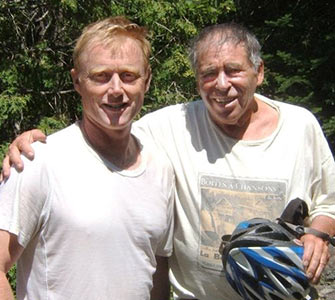
Silverman, a native Montrealer, was born in 1933 and died on February 20, 2022, in Sainte-Agathe-des-Monts. Raised in Snowdon, Silverman was “the spark of the cycling revolution in Canada,” according to Jeff Mapes, author of Pedalling Revolution. Others call him the “granddaddy of the cycling movement in Canada,” and his tactics to advance bicycling were emulated in other Canadian cities. Symon noted: “Together with his small gang at le MàB and a few allies such as Vélo Québec, he accomplished what at first seemed impossible: transforming Montreal from being a very unfriendly city for bicyclists into being the friendliest in North America.
But Silverman was about much more than just bicycles; the cast of characters in his biography includes Leonard Cohen, Bob Dylan, Armand Vaillancourt, ‘Che’ Guevara, Phyllis Lambert, Claire Morissette, Ivan Illich, and more.
Silverman called for the creation of the BIXI bike rental system in 1975 and was also largely responsible for bringing outdoor volleyball to Montreal.
“Called a ‘prophet before his time,’ Silverman was eccentric, if not wacky in his methods,” Symon added. “Even his friends describe him as dogmatic and difficult to work with, but ultimately he proved astonishingly effective. Silverman joked about preferring to attempt the impossible, as simply achieving what is possible was boring.”
Silverman, a true Montreal character, did not have an easy life. The biography points out that he struggled at school, dropping out of two universities, was fired from his father’s firm, and attempted suicide. He opened an independent bookstore in 1960, but it promptly went bankrupt. Silverman also saw his two marriages dissolve and became alienated from his family. He lived precariously for most of his life.
In 1959, he joined the “Ban the Bomb” movement, which the authors assert, gave Silverman a “new purpose in life through community service. That movement, which is still active today, advocates for peace, environmentalism, social activism, and against the use of nuclear weaponry.”
That movement led him to actively oppose the Vietnam War, organize unions, preserve Montreal’s architectural heritage, advocate for environmentalism, oppose nuclear power, promote Palestinian rights, and, of course, support cyclists’ rights.
This is the first book about Silverman destined for an adult audience, exploring what made the man tick. The authors also examine Silverman’s inspirations and what made MàB’s methodology so effective. This biography, which is entertaining and easy to read, nonetheless contains an extensive bibliography and some 400 references.
‘Silverman was eccentric, if not wacky, in his methods. Even his friends describe him as dogmatic and difficult to work with, but ultimately, he proved astonishingly effective.’
– John Symon
“Three words – Inspirational. Indefatigable. Creative,” is how British author and journalist Carlton Reid describes Silverman. Reid dedicated his book, Bike Boom, to Silverman and other bike advocates of the 1970s and 1980s.
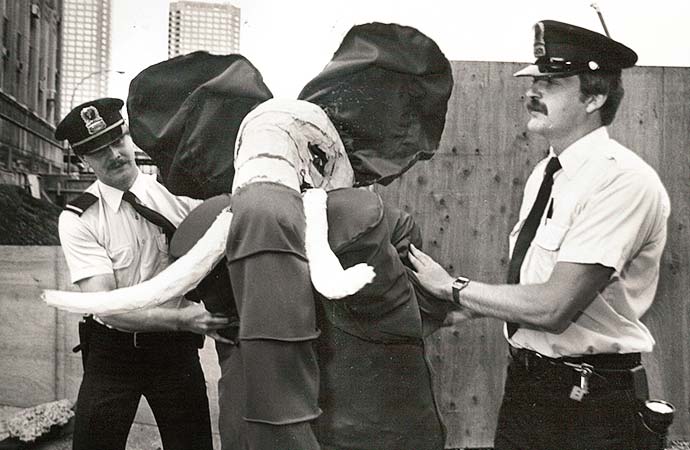
Symon describes Silverman as a master of street theatre or “cyclodramas,” showing that you don’t need a lot of money to change the world. Colourful costumes, noisy parades, cyclists with wings, civil disobedience, die-ins, and blackmailing a cabinet minister were all part of Silverman’s toolbox. He and the MàB were often in the news in the 1970s and 80s, mocking the inconsistencies in the Drapeau administration’s steadfast refusal to acknowledge that cyclists also have rights. Silverman’s sometimes wacky ideas were refined and put brilliantly into action by his colleague, Claire Morissette.”
Desjardins believes that Silverman’s legacy will eventually eclipse that of former mayor Jean Drapeau, “because Silverman’s vision of a city is more grassroots. It touches day-to-day realities. The only real Drapeau achievement in this field is the metro.”
During the book launch, the co-authors will read aloud passages from the book, take questions about Silverman, and sign copies of their book. In the Q&A below, Symon spoke about Silverman and the writing of the book:
WM: What inspired you to write a biography about Silverman, and how would you describe the research and writing process?
Symon: I first met Silverman playing volleyball in Jeanne-Mance Park. As I got to know him well, it occurred to me that he had a fascinating life story. I approached him with the idea of writing his biography, and he gave it his blessing. Unfortunately, with his passing in 2022, Silverman only ever saw preliminary versions of the first two chapters. This biography has been five years in the making; during that time, I remarried and was working full-time as a bus driver. I also fixed up the house that I am now living in. In short, five years can pass very quickly!
WM: What drove Silverman to be such an advocate for cycling and how would he react to biography being written about his life?
Symon: After bankrupting his bookstore, Silverman’s poor credit rating precluded him from financing a car, so he bought a bicycle instead. Apart from this, his childhood home was demolished to make way for the Decarie Expressway, the love of his life was killed in a car crash, and he read many authors who are critical of the car culture – Ivan Illich, Jane Jacobs, Jan Gehl, Donald Shoup, etc.
Silverman asked me to write his life story “warts and all.” I think he ultimately wanted this document to show his family and prove he had accomplished something worthwhile.
WM: How would you describe his advocacy methods and their effectiveness, and can you highlight a few aspects of his decades-long campaign?
Symon: Silverman was astonishingly effective in making societal changes. He accomplished all this with little money, making great use of street theatre. When they ignored him, Silverman liked to ridicule his opponents and sometimes also his allies.
In 1981, faced with a total ban by authorities to let cyclists onto the métro or use of bridges over the St. Lawrence, the MàB declared they knew how bikes could traverse the river and would reveal this secret at a press conference. Silverman turned up at the press conference dressed as Moses and carrying a big staff. He loudly called upon the Almighty to part the river waters while his colleagues tried draining the St. Lawrence with buckets. This stunt netted him press coverage across Quebec and Canada.
‘Silverman asked me to write his life story “warts and all.” I think that he ultimately wanted such a document to show to his family and prove that he had accomplished something worthwhile.’
– John Symon
Later stunts involved cyclists gluing wings to their backs to imitate Icarus – hoping to fly across the river – and dressing as bunnies to demand a bike path instead of a “rabbit trail” to Nun’s Island.
When René Lévesque promised funds for bike paths but then stalled on providing this money, Silverman dressed up in red as a cardinal outside the 1977 PQ convention to “exorcise” the evil spirits. This embarrassed the PQ into following through with their election promise.
Silverman was not afraid of getting arrested to make a point; he even spent time at Bordeaux Prison for illegally painting some of the first bike paths in Montreal.
WM: Can you tell us more about his bookstore and what made it unique?
Symon: Silverman’s Stanley Street bookstore was the first in Canada to include a coffee shop under the same roof. The coffee shop attracted poets and musicians, including Leonard Cohen and, in 1962, what was apparently the first Bob Dylan performance outside of the USA. The newspaper ad for it suggests that the performance was free! I suspect that the McGarrigle sisters also made their debut there, but I couldn’t find solid proof. Despite great notoriety, Silverman didn’t know how to make money; he famously discouraged customers from buying books and encouraged them instead to borrow. The bookstore soon went bankrupt!
WM: Aside from cycling, what were Silverman’s other passions, and how would you describe him as a person?
Symon: His other passions included volleyball, bike touring, Vietnamese food, and poetry. He was eccentric, a wealth of knowledge, dogmatic to the point of being impossibly argumentative, but had a heart of gold.
WM: Do you recall your last conversations with Silverman? Based on the network of bike lanes in Montreal, what would he say about his legacy?
Symon: Silverman suffered from dementia near the end, and my last conversations with him were a bit muddled. Perhaps I can use city councillor Marianne Giguère’s last conversations with Silverman instead? She suggested dedicating the St-Denis bike paths to him someday, and Bob was thrilled! That dedication was formally made by Mayor Valérie Plante this September. But his supporters had already informally named the bike path after Silverman in 2022.
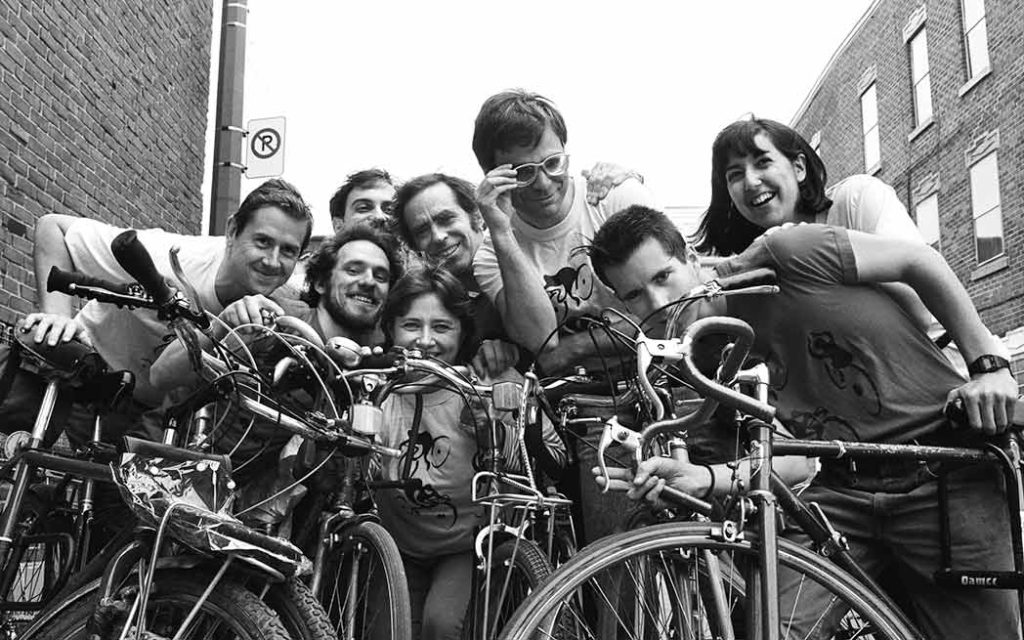
Feature image: MàB members circa 1980. Silverman is at the centre of the top row with Claire Morissette underneath. Co-author Stéphane Desjardins (bearded) is to the left of Morissette. Photo courtesy of Fonds d’archives Le Monde à bicyclette. Photographer unknown.

Other articles by Irwin Rapoport
Other recent articles
 Irwin Rapoport is a freelance journalist with a bachelor’s degree in history and political science from Concordia University.