
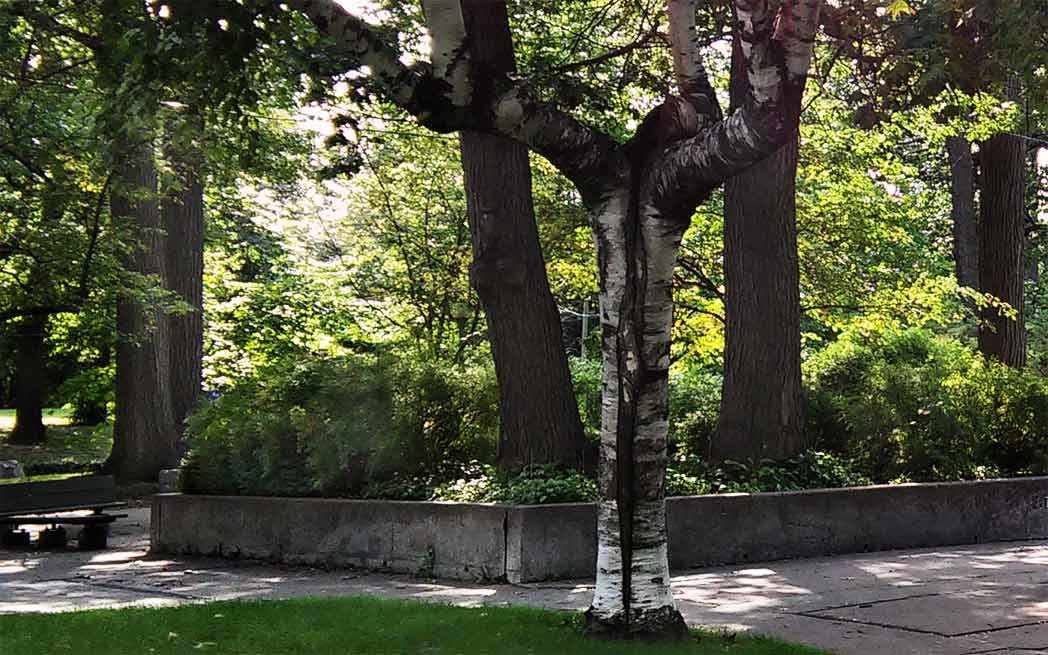
There is beauty in a neglected garden, filled with birds feeding on berries
By Michael Walsh
Previously published in WestmountMag.ca
Westmount Park is a perfect location to enjoy summer weather. Old-growth trees with huge canopies, walking paths, acres of lawns and lagoons collectively entice one to spend a quiet afternoon with a good book.
He saw the kind of beauty yellow flowers have growing over a carpet of dead leaves. The beauty of cracks forming a mosaic in a dry riverbed… The beauty of a window smudged with tiny prints, the beauty of wild weeds.
Michelle Cuevas, Beyond the Laughing Sky
My preferences are the secluded areas; in particular, the one adjacent to the remnants of shuffleboard and chess play areas. It’s an area bordered by Bur Oaks and a large, mainly neglected, raised planter. At one point, it was filled with shrubs and flowers that enhanced the park’s colours and beauty. Today, large borders of Hosta give evidence of the prior attempts to maintain this area. However, a closer look at this largely overgrown area reveals evidence of what was planted many years ago.
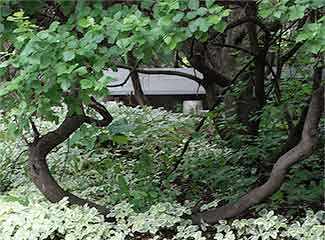 There is a unique beauty in neglected gardens – filled with birds feeding on the shrubs’ berries – where one can appreciate the variety of plants that, over time, have made this area their home.
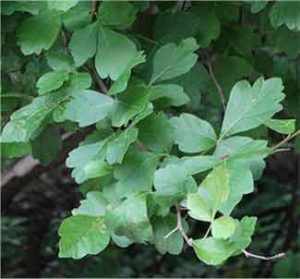
The majority of the area is comprised of Box Elders (Acer negundo), also known as Maple Ash, Black Ash, Cut-leaved Maple and Manitoba Maple. The species has a soft and lightweight wood that was used in the manufacture of boxes – hence the name’s derivation.
The species are identified by their compound leaves, comprised of three to nine leaflets. Each leaflet has notches that give it the appearance of being “coarsely toothed”.
 The trees are native to the North American prairies and are found in moist soils along bodies of water, such as streams and lakes. It was first cultivated in England, in the 1600s, by Henry Compton, the Bishop of London. (Amongst his Episcopalian career – he was also a well-known Botanist.)
Interestingly, these trees can be tapped, and syrup can be made from the sap. “It kind of tastes like marshmallows,” according to Noreen Thomas, an organic farmer who taps several Box Elder trees in the spring.
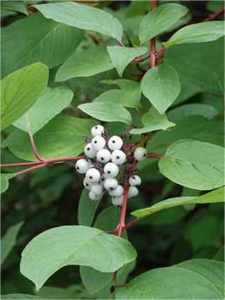 Amongst the Box Elders are bushes of Red Osier Dogwood (Cornus sericea), also known as Red Willow. Comprising a distinctive red bark (with a white pith), veined leaves and clusters of white berries, they are easy to identify. The species is native to North-Western Ontario, where it is common along roadsides. The stems were used by First Nations peoples to make baskets and to produce a red dye. First Nations people used the inner bark in tobacco mixtures for sacred pipe ceremonies. The berries were collected and, when dried, made into cakes. The stems were used to make baskets and mixed with other materials to make red or black dyes. A Cherokee legend tells the story of tiny people living amongst the dogwoods. Known as “dogwood people”, they were sent to teach the virtues of living in harmony with nature. They also protected babies and the elderly.
‘There is a unique beauty in neglected gardens – filled with birds feeding on the shrubs’ berries – one can appreciate the variety of plants that, over time, made this area their home.’
 A last look through the large planters reveals a rare woodland plant – a Meadow Parsnip, from the Apiaceae (carrot) family. With its oval leaves and tiny yellow flowers – it seems quite out of place in a city park. However, collectively, these plants add to the beauty of a quiet, secluded area of Westmount Park.
Feature image: Andrew Burlone
All other images: Michael Walsh
More articles by Michael Walsh
Other recent articles
[row cols_nr=”2″][col size=”2″]

[/col][col size=”10″]Michael Walsh is a long-time Westmount resident. He is happily retired after nearly four decades in the field of higher education technology. Today, he enjoys exploring the city’s past and sharing stories about the majestic trees that grace its parks and streets. He can be contacted at michaelld2003 @hotmail.com or through his blog Westmount Overlooked[/col][/row]
Fine article blending words and images…many of us have loved trees since youth…but to understand them as you see them is a complex thing. And a wonderful experience to convey to others !
I enjoy learning the combination of botanical and historical information about our beautiful park and how poetic and folk knowledge is infused as well.
Wonderful to learn about all these different trees that we take so for granted. Indeed, Westmount Park has a diverse collection worthy of an arboretum.
I really enjoy reading Mr Walsh’s musings about Nature and his clear and loving history about trees and plants.
Thank you and please continue,
Excellent, moving article. Good research. Thanks, Michael !