
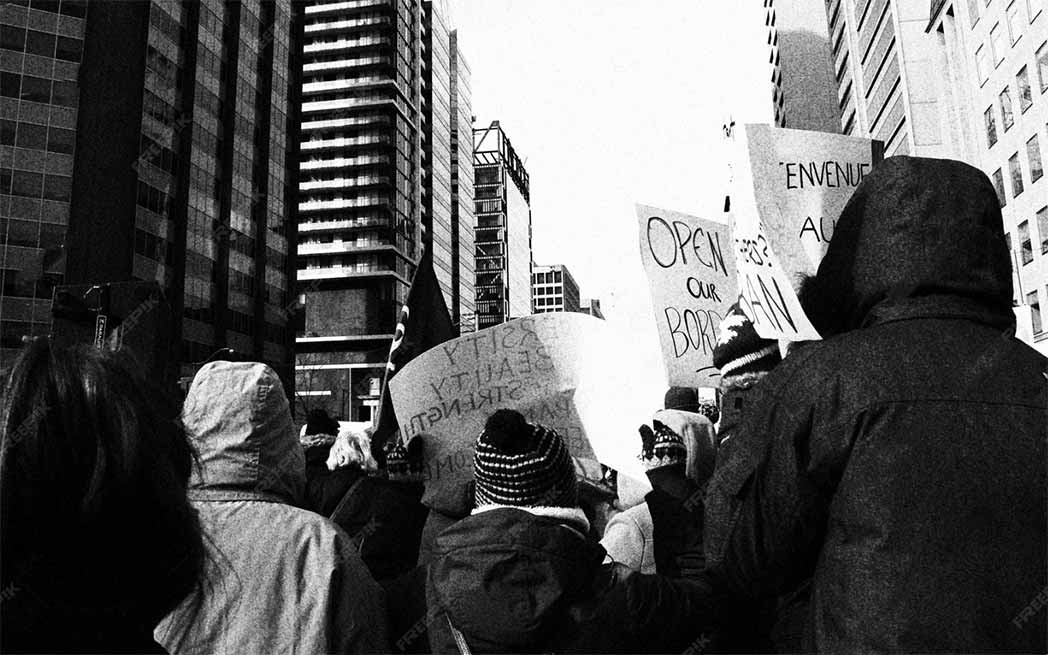
Hard Right rising,
Left out of breath
Democracies now risk dying by applause, not by tanks or coups
By Andrew Burlone
December 19, 2025
Across history, political systems have rarely died in a single night. In Antiquity, Greek city-states moved from democracy to oligarchy and sometimes to tyranny as wars, debts and social tensions accumulated. Later, Rome’s res publica – with its elected magistrates and checks and balances – slowly slid into the personal power of the emperors as promises of stability and order eclipsed civic participation. The tipping point came not from one spectacular coup, but from the gradual erosion of institutions and from elites unable, or unwilling, to respond to people’s fears and needs.
More than two thousand years later, the pattern looks disturbingly familiar in many so-called “mature” democracies across the Americas and Europe. When citizens no longer believe that elections and governments can protect their safety, status and future, they begin to look elsewhere for solutions. Institutions that feel distant, slow to respond or powerless in the face of everyday anxieties create an opening for leaders who offer something simpler: a strong hand, a clear enemy, and the promise to cut through procedure and compromise. The result is a paradox of our time: societies that often vote freely for leaders whose instincts are increasingly autocratic.
Strip away the local details and the drivers look remarkably similar: insecurity, inequality, territorial divides and a deep sense that “the system” works for someone else.
From Paris to Budapest, from Washington to Buenos Aires, the storyline repeats with local variations. Voters who once supported mainstream centre-left or centre-right parties now drift toward figures who question judicial independence, attack the press, stigmatize minorities, and concentrate power in the executive – while still presenting themselves as the authentic voice of “the people.”
In many European countries, parties that openly challenge liberal norms sit in government or shape the agenda from the opposition benches. In North and South America, leaders elected with a popular mandate have tested the limits of constitutions, packed courts, and turned state institutions into instruments of personal rule. Underneath those different national dramas runs the same current: lives marked by insecurity and inequality, regions that feel abandoned, and a growing conviction that the system serves someone else, somewhere else, not them.
The politics of “order”
A recurring element in this shift is the politics of “order.” Across the democratic world, candidates promise to restore control over crime, borders and public space through tougher policing, harsher sentencing and more aggressive migration policies. Their message lands in societies where people are legitimately afraid of violence, exhausted by rising prices and frustrated by real problems in health care, housing or schooling.
But crime, fear of the “other” and anger about the cost of living all have deep social roots in economic insecurity, weakened public services and the fracture between “winning” urban regions and “left-behind” towns and rural areas. When governments address only the visible symptoms with punitive gestures while ignoring the structural causes, they clear the way for leaders who promise “order” with fewer constraints.
‘When governments address only the visible symptoms with punitive gestures while ignoring the structural causes, they clear the way for leaders who promise “order” with fewer constraints.’
If this trend spreads, it is not just because autocratic leaders are ruthless communicators. It is also because much of the democratic camp has become strangely tone-deaf. Centre-left and centrist parties often talk like managers of a complex machine, offering charts and “road maps” to voters who are looking, first, for recognition of their frustration and fear.
Instead of starting from rent hikes, daycare queues, emergency-room waits, buses that never come and hours lost in traffic, they start from fiscal frameworks and institutional reforms. The gap between language and lived experience becomes its own form of violence. Into that gap steps the strongman who, however cynically, says: “I see you, I know you’re angry, I’ll make someone pay.”
Empathy, the key element
In that context, empathy is sometimes dismissed as a weakness – a soft luxury that keeps Western societies from making “hard choices.” In reality, what is missing in many democratic countries is a more demanding, political form of empathy that has nothing to do with excusing everything or sinking into sentimentality.
It means taking seriously the fears of a pensioner who no longer feels safe in her building, the anger of a warehouse worker who cannot afford to live close to his job, the anxiety of parents whose children struggle in under-resourced schools, and the unease of long-time residents who feel their language or customs are under strain. It also means listening to migrants who face exploitation, racialized communities over-policed yet under-protected, and young people who see no path to a stable future.
When this kind of empathy is absent, democratic politics tends to respond to insecurity with lectures: statistics where people are asking for reassurance, moral sermons where they are asking for solutions, and abstract defences of “our institutions” where they are asking whether they will still have a flat, a job or a family doctor in five years. Autocratic leaders, by contrast, offer a counterfeit empathy: they validate the feeling of being ignored, then redirect it toward scapegoats – minorities, migrants, feminists, environmentalists – and toward independent institutions that might limit their power. What they offer is recognition without responsibility.
‘What today’s autocratic leaders offer is empathy without any shared burden.’
Breaking this cycle requires more than calling out authoritarian tendencies at election time. Democracies in Europe and the Americas need to show, through visible changes, that they can still improve ordinary lives better than any strongman. That means three things at once. First, take safety seriously not only through more police and cameras but also by investing in prevention, youth work, mental-health services, and the physical fabric of neighbourhoods. People will not defend democratic norms if they do not feel safe in their own streets.
Second, attack the cost-of-living crisis head-on: ambitious housing policy, protections for renters, fair wages, accessible transit and properly funded public services. Third, handle migration and identity politics with clarity and honesty: clear rules and enforcement, yes, but also serious integration policies and a shared narrative of belonging that does not pit “natives” against “newcomers.”
Empathy is the thread that links these elements. It is what keeps a housing policy from becoming a spreadsheet exercise, a public-safety strategy from turning into pure repression, and an immigration system from hardening into either chaos or cruelty. It demands that decision-makers step out of capital-city bubbles and listen, systematically, to what people in small towns, suburbs and working-class districts are actually experiencing – and then give those people real influence over priorities, through participatory budgeting, local assemblies and meaningful consultation rather than staged town halls.
Across the Americas and Europe, the danger is no longer only that democracy might be overthrown from above. It is that, step by step, it is hollowed out from within by leaders elected to “get things done” who slowly remove the checks that make democracy more than a plebiscite. The best answer is not nostalgia for a lost “centre,” but a renewal of democratic practice rooted in empathy, material security and shared responsibility.
‘The best answer is not nostalgia for a lost “centre,” but a renewal of democratic practice rooted in empathy, material security and shared responsibility.’
The question is no longer whether democracy looks good in theory; it is whether it still works here and now for people who are tired, anxious, and angry. If democratic forces cannot answer that question in the lives people actually live, voters will go on choosing leaders who promise to act alone – and then inevitably act against the very freedoms that made their election possible.
Across Europe and the Americas, this debate no longer unfolds in a vacuum. With the real prospect of wider armed conflict looming, the cost of drifting toward illiberalism grows heavier by the day. Democracies under external pressure are always tempted to centralize power, silence dissent, and treat rights as expendable luxuries; history suggests that once these shortcuts become habits, they are rarely rolled back without upheaval.
If governments do not move quickly to restore basic security, material dignity and a sense of shared purpose, citizens will demand “stronger” leaders precisely at the moment when prudent, accountable leadership is most needed. The urgency of redress is therefore not abstract or moralistic – it is strategic: either democracies prove, now, that they can protect both lives and liberties in an age of permanent crisis, or they will wake up to find that fear has done the work of their enemies for them.
Disclaimer: The opinions expressed in this article are those of the author and do not necessarily reflect the opinion of WestmountMag.ca.
Feature image: Ligia Camargo – pexels

Other articles by Andrew Burlone
Other recent articles

Andrew Burlone, co-founder of WestmountMag.ca, began his media journey at NOUS magazine. Subsequently, he launched Visionnaires, holding the position of creative director for over 30 years. Andrew is passionate about culture and politics, with a keen interest in visual arts and architecture.


Thank you for the thorough analysis.
While I agree that one of the root of the current crisis is the increasing cost of live, I am under the impression that our government’s capacity to meaningfully address the issue is limited, and dwindling. One of the reason the cost of living has increased is that everything is simply harder to get today than it were in, says, 1970. Soils are getting exhausted by irresponsible exploitation. Hence, it is more expensive to grow stuff (you will need more fertilizers, pesticide, ect). We have pretty much emptied the seas, so there are simply less fish to eat. Easily accessible metal deposits are depleted and the industry must now make use of more sophisticated techniques. As a consequence materials are pricier. Oh, and has anybody heard about global warming? It’s on its way, and unlikely to help.
This is not to say that corruption, unfair distribution of wealth and, at times, plain stupidity do not play a part in our current predicament. Governments should seek to tackle those issues. The deeper underlying problems, however, are mostly beyond their reach. We can learn from past mistake and strive to build a better future, but dark times loom ahead, and there is no quick fix. This leaves the centre left with a difficult dilemma. On the one hand, acknowledging the situation obviously plays in the hands of the authoritarians, who promise quick, painless solution. On the other hand, false promises breed disappointment and cynicism. Personally, I would own up, but hey, I am just some chap commenting an article on the internet!
You’re absolutely right to point out that many of our current challenges stretch beyond the reach of policy or short-term fixes. What we are witnessing is, in part, the collision between our civilization’s expectations and the planet’s limits — a reckoning with the material foundations of modern life. For decades, we’ve borrowed abundantly from the future, assuming nature’s generosity to be endless. Now the debt is being called in.
Governments, for all their ambition, can only act within the physics of the world. As resources tighten and ecosystems strain, even the best intentions encounter hard constraints. This doesn’t absolve leadership of responsibility, but it does reveal how our collective predicament stems less from political will than from a deeper imbalance between human desire and earthly reality.
Perhaps the path forward is not in expecting swift redemption, but in nurturing resilience — rebuilding our relationship with scarcity, restoring meaning beyond accumulation, and rethinking what “progress” means in an age of decline. In this sense, “dark times” may not signal an end so much as a transformation: the painful but necessary shedding of illusions.
Admitting complexity, as you suggest, is indeed risky in a world hungry for easy answers. Yet, honesty — even uncomfortable honesty — might be the last refuge of genuine hope.