
Operation Epic Fury
becoming Epic Fiasco
A war sold as decisive turns mushy, costly and politically radioactive fast
By Irwin Rapoport
March 18, 2026
The United States and Israel are entering the fourth week of a war of choice against Iran that is strategically incoherent, economically ruinous, and morally reckless. Operation Epic Fury, launched on the morning of February 28 as a massive joint air and sea campaign intended to shock Iran into submission, is already reshaping the Middle East and destabilizing a fragile global economy.
This war did not simply erupt; it was chosen. It required deliberate decisions by President Donald Trump and Prime Minister Benjamin Netanyahu.
During the first week, cruise missiles, ballistic missiles, and waves of strike aircraft have struck Iran’s nuclear installations, missile and drone stockpiles, naval assets in the Persian Gulf, and key command‑and‑control nodes. Kharg Island, the country’s main oil export hub, was hit in a way that spared core infrastructure but made clear that the United States could “finish the job” at any time, while an Israeli‑led barrage in Tehran killed Supreme Leader Ali Khamenei and senior security chiefs without toppling the system that sustained them.
How the war was launched – and who failed to stop it
This war did not simply erupt; it was chosen. It required deliberate decisions by President Donald Trump, Prime Minister Benjamin Netanyahu, and their advisers, and depended on the willing cooperation of America’s military leadership. Rather than warning the president they would not endorse such an ill‑conceived campaign, the U.S. military’s top generals and admirals signed the war plan and went on to execute it. There was no coordinated threat of resignation, no public insistence that the operation lacked coherent planning or legal and strategic justification.
The contrast with the recent past is stark. During Trump’s first term, General Mark Milley, then chair of the Joint Chiefs of Staff, reportedly told associates that any attempt to use the armed forces to overturn an election would fail because “you can’t do this without the military… we’re the guys with the guns.” He even reached out to his Chinese counterpart in late 2020 to reassure Beijing that the United States would not launch a surprise attack, an extraordinary step meant to prevent miscalculation during a period of domestic turmoil.
Trump’s second term has produced a very different Joint Chiefs chair. General Dan Caine not only authorized the opening strikes of the current war but also played a key role in last summer’s Midnight Hammer bombing campaign against Iran’s nuclear infrastructure, as well as in the controversial operation to seize Venezuelan President Nicolás Maduro. Since then, he has appeared to revel in the limelight, fronting an expanding set of missions that includes an ongoing naval campaign against vessels allegedly involved in drug trafficking. Rather than serving as a brake on presidential adventurism, Caine has become its chief military enabler.
The world has reason to be alarmed by this servile posture. If Trump, whose rhetoric routinely veers into the unhinged, were to demand a surprise nuclear strike on China or Russia, would Caine have the courage to refuse or resign – and has he put safeguards in place to prevent such an order from being carried out? The opening weeks of the Iran war suggest that America’s senior military leadership has already failed the most basic test: to say no to a reckless war before it begins.
‘Rather than serving as a brake on presidential adventurism, the Joint Chiefs chair, General Caine, has become its chief military enabler.’
Nearly a month into the conflict, it is still not clear what Washington and Jerusalem are trying to achieve. Publicly, White House aides insist that Operation Epic Fury is about destroying Iran’s ballistic missiles, crippling its navy, degrading its drone and proxy networks, and ensuring it never acquires nuclear weapons. Early on, Trump also called on Iranians to seize control of their destiny, a not-very-subtle invitation to rise up and topple their rulers. But as days passed with no sign of regime collapse and intelligence suggesting the clerical state would endure, his rhetoric shifted toward indifference about Iran’s internal future.
Israel’s aims, by contrast, are more maximalist and more consistent. Netanyahu appears determined to seize the opportunity to weaken Iran as a military threat for a generation and, if possible, break its network of regional proxies. That logic helps explain the intensity of Israeli strikes on southern Lebanon and around Beirut, operations that have displaced hundreds of thousands of civilians and raised the spectre of de facto permanent control over parts of Lebanese territory.
These diverging objectives pull the war in different directions. For Israel, prolonging the campaign has obvious appeal if each additional week further degrades Hezbollah and other Iranian clients. For Trump, the calculus is more domestic and more mercurial: at any given moment, he seems to want a quick, photogenic victory, a pliant Iranian government, lower gasoline prices, and a buoyant stock market. When those goals collide, he oscillates between boasting that the war is already won and complaining that Iran, in refusing to surrender, is sabotaging his victory parade.
Strategic incoherence and clashing war aims
What is missing in both capitals is a plausible exit strategy. Iran is pursuing a deliberate strategy of imposing growing costs on the region and global economy in order to force Trump to the negotiating table, while Trump himself appears increasingly likely to abandon the rhetoric of regime change and seek some kind of face-saving deal. But neither side has articulated what such a deal would look like, or how the fighting could be wound down without leaving Iran humiliated and vengeful, or the United States exposed as a superpower that starts wars it cannot finish.
If war planners in Washington anticipated the economic shock they were about to trigger, they did not prepare the public for it. Within days of the first strikes, Iran retaliated with missiles and drones against energy infrastructure and shipping lanes and then moved to close the Strait of Hormuz, the narrow waterway through which roughly one‑fifth of the world’s oil flows. Revolutionary Guard commanders publicly threatened to “set ablaze” any ship attempting to transit without their permission, and whether because of mines, missiles, or insurance companies refusing to cover hulls, traffic slowed to a crawl.
‘These diverging objectives pull the war in different directions, and what is missing in both capitals is a plausible exit strategy. ‘
Current evidence suggests the Iran war shock is at least comparable to, and in some ways larger than, the 1970s embargo in terms of supply disruption. Brent crude prices have spiked to around $100 per barrel, but could hit $150 if the strait remains effectively closed. Global natural gas prices have surged as well, particularly in Europe, which finds itself exposed to Middle Eastern disruptions even as it tries to wean itself off Russian supplies. Consumers from Montreal to Mumbai are already feeling the pain in higher fuel, transport, and food costs.
This is not a bolt from the blue. For years, military planners and energy analysts have warned that a major war involving Iran would almost certainly disrupt traffic through the Straight of Hormuz and trigger a spike in oil prices. Yet Trump behaves as if these consequences were either insignificant or someone else’s problem. In one recent social media post, he hailed high oil prices as a boon for the United States because it is the world’s largest producer, seeming oblivious to the impact on consumers and on poorer countries that pay for oil in U.S. dollars. Advisers now caution that the longer Iran can keep the strait constrained, the more dug in the president becomes, reluctant to appear to back down in the face of what he sees as economic blackmail.
Meanwhile, the administration has been slow to level with the public about the cost of the war itself. Pentagon officials have briefed Congress that the first week alone cost billions, and outside estimates suggest current operations are consuming between $1 and $2 billion per day when Israeli expenditures are included. If U.S. Marines end up seizing and occupying Kharg Island or other strategic points to force a reopening of the strait, the bill will rise even faster. At that point, the real question will not be whether the war was affordable, but whether it was ever necessary.
Lessons from history – and what must change
None of this was inevitable. The historical record is full of examples that should have cautioned Washington and Jerusalem against assuming a quick, clean victory. The British went into the Second Boer War confident their superior firepower would crush two small republics in short order; instead, they found themselves bogged down in a three‑year conflict that inflicted heavy casualties, shocked public opinion, and damaged Britain’s reputation. Iran, like the Boers, is motivated by pride and a determination not to be dictated to by outside powers.
Germany’s slide into the First World War offers another, darker parallel. Kaiser Wilhelm II, a mercurial ruler with an inflated sense of his own judgment, authorized an invasion of France and Russia that his own generals knew would be risky and difficult to reverse. He briefly considered calling off the attack when the enormity of what he had unleashed began to dawn on him, only to be told that the military machinery was already in motion and could not be stopped. Today, a U.S. president who prides himself on instinct and improvisation is discovering that modern wars, once begun, are far harder to constrain than to tweet into existence.
‘At that point, the real question will not be whether the war was affordable, but whether it was ever necessary.’
For Iranians, there is a more immediate history that shapes their view of this war: the 1953 coup in which the United States and Britain helped overthrow a democratically elected prime minister, Mohammad Mosaddegh, who had dared to nationalize Iran’s oil. In the decades since, they have endured an autocratic monarchy, a repressive theocracy, and cycles of sanctions and isolation imposed largely from abroad. That experience has fostered both resentment of outside interference and a deep desire for a representative government that answers to Iranians, not to Washington or any other capital.
Critics of Trump’s Iran war are often accused of siding with Tehran or discounting the regime’s appalling record at home and abroad. The charge is false. One can recognize Iran’s support for armed groups, its role in regional violence, and its repression of its own citizens while still insisting that launching a hasty, ill‑planned war was a catastrophic error. The early weeks of Operation Epic Fury have already revealed that military dominance does not guarantee strategic success, that institutions meant to check impulsive leaders can fail when individuals lack courage, and that the people most likely to suffer are ordinary Iranians and ordinary consumers around the world.
It is not too late to learn from these mistakes, but the window is closing. Any path out of this crisis will require realistic war aims, a serious diplomatic effort that recognizes Iran’s capacity to inflict pain, and a re‑assertion of institutional checks on the power of any one leader to plunge the world into conflict. Above all, it will require overdue humility: an acknowledgment that hubris, not necessity, brought this war into being – and that hubris, if left unchecked, will ensure it ends in failure.
Disclaimer: The opinions expressed in this article are those of the author and do not necessarily reflect the opinions of WestmountMag.ca or its publishers.
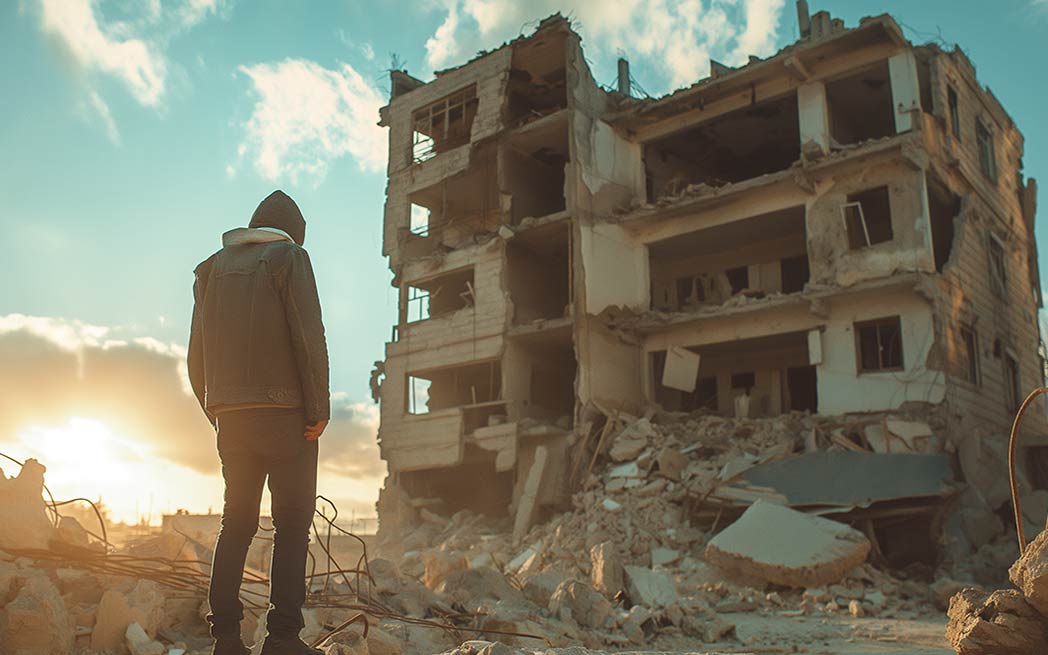
Feature image: Save_Palestine – Pixabay

More articles by Irwin Rapoport
Other recent articles

Irwin Rapoport is a freelance journalist and community advocate from Westmount with bachelor’s degrees in History and Political Science from Concordia University. He writes extensively on local politics, education, and environmental issues, and promotes informed public discourse and democracy through his writing and activism.


 March 20, 2026" />
 party, groove and flamenco" />
 How to acquire warranty" />
 becoming Epic Fiasco" />
 Montreal Museum of Fine Arts" />
 takes a stand again" />
 Mint and parsley dog cookies" />
 your public speaking skills" />
 Thornhill Avenue" />
 Glasnost & Perestroika" />
 in Quebec Stores" />
 Censorship in practice" />
 With or without warranty" />
 Oriental musical poetry" />
 in shades of the Caucasus" />
 Roasted grapes with mozzarella" />
 passive-aggressive people" />
 Surrey Gardens" />
 never seen before" />
 My work here is done" />

 Purchase process in 2026" />
 as the climate changes" />
 and business goals" />