
Live transport of horses
for slaughter must end
The federal government is still ignoring public demands
By Georges Dupras
March 19, 2026
Many Canadians are focused on Mark Carney’s efforts to reduce our trade dependence on the United States. While this is underway, our attention is diverted from other long-standing initiatives.
Despite condemnation by people across Canada, the transport of live horses to Japan for slaughter continues. During his last tenure, the Hon. Justin Trudeau formally mandated his then Minister of Agriculture and Agri-Food, Marie-Claude Bibeau, to “ban the live export of horses for slaughter.” (December 16, 2021).
The Minister dragged her feet, and the Government was prorogued soon after, with no action having been taken.
No changes
Independent sources indicate that the live shipment of horses to Japan continues unchanged. There are still deaths, injuries and illnesses that go unreported by the Canadian Food Inspection Agency (CFIA).
The file is long, and the CFIA’s denials have undermined its credibility. Independent sources have confirmed that…
- About 7000 horses were shipped last year.
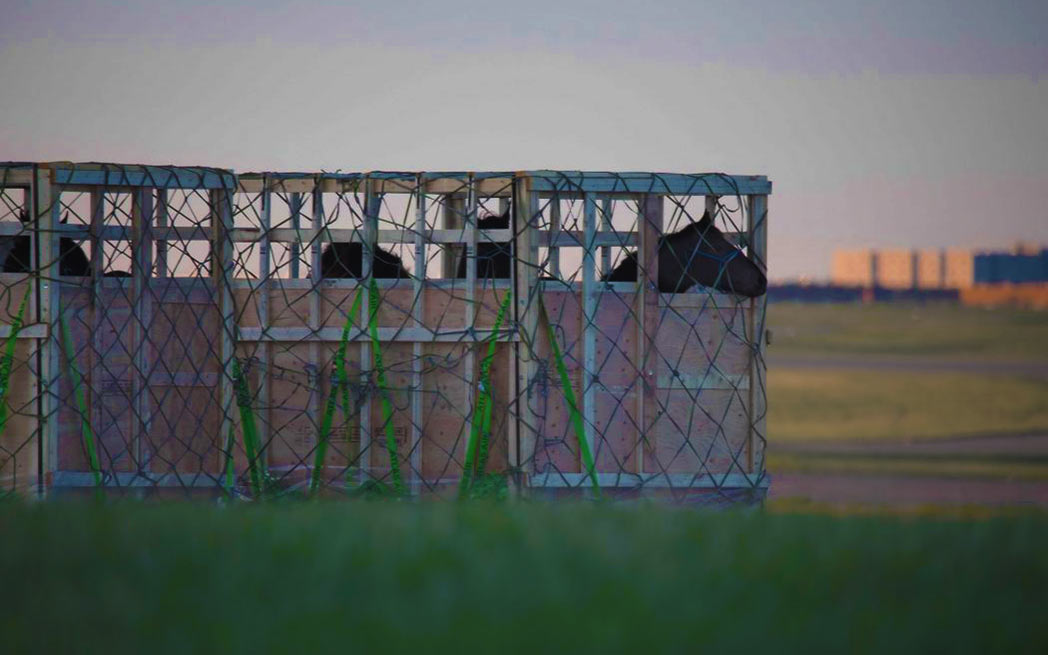
- Horses are loaded 3 to 4 per crate, and Canadian legislation prohibits the shipping of more than one horse per crate if that horse is 14 hands or more (height).
- The horse’s head must not touch the top of the crate. This legislation is not being enforced.
- Belgium draft horses weigh between 1,500 and 2,000 pounds.
- Legislation stipulates that the transportation of horses cannot exceed 36 hours without allowing food, water, and rest. Belgium and other Heavy horses require 15 to 20 gallons of water every 24 hours.
- On one flight, a horse was found upside down.
- On other flights, six horses were found dead. while others had injuries, including seriously cracked hooves, cuts, etc.
- Illnesses included fever and diarrhea.
Live shipment of horses to Japan continues unchanged. There are still deaths, injuries and illnesses that go unreported by the Canadian Food Inspection Agency (CFIA).
Cost of doing business
These incidents are not reported by the CFIA and are dismissed by industry as a cost of doing business or as collateral damage by those who profit.
One Calgary MP wants to fix the problems rather than eliminate the trade. How many times have we heard this strategy proposed by others in the animal industries without tangible results? In one case, since the practice could not meet the definition of a humane death, the industry simply argued that “humane” was defined differently for each species. In other words, “species specific”. The result – lots of talk, no change.
Time and action
In time, everything changes, and as expected, some changes will be hard-fought by those immediately impacted. Hopefully, the animal industries will be transferred from Agriculture to the Justice Ministry, but this transfer will be the equivalent of trying to change gun laws in the United States. Until that time, the transport of live horses for slaughter must be stopped.
The animal industries argue that this is the thin edge of the wedge, and that there will be no satisfying those who care about the suffering of animals. This may be true, but then everything we try in life is the thin edge.
Step by step
Moving forward, caring people should look to those big draft horses who were instrumental in opening up this Country. We can learn from them. They pulled our logs, coal, ice and rag wagons, ploughed our fields, one step at a time.
With determination, we can begin to repay them by supporting The Canadian Horse Defence Coalition (CHDC) and Animal Justice in their commitment to stop this cruel practice.
‘We can begin to repay the big draft horses by supporting The Canadian Horse Defence Coalition (CHDC) and Animal Justice in their commitment to stop this cruel practice.’
Action needed
The public’s input is also required by writing to the Prime Minister of Canada, the Minister of Agriculture and the Minister of Justice in Ottawa.
Prime Minister Mark Carney
pm@pm.gc.ca
Justice Minister Sean Fraser
Sean.fraser@parl.gc.ca
mcu@justice.ca
Agriculture Canada
aapc.minister-minister.aac@agr.gc.ca
Disclaimer: The opinions expressed in this article are those of the author and do not necessarily reflect the opinions of WestmountMag.ca or its publishers.
Feature image: horses awaiting live transport via airplane, by Vickie Colgan
Other articles by Georges R. Dupras
Other recent articles



 March 20, 2026" />
 and tears of joy" />
 party, groove and flamenco" />
 for slaughter must end" />
 How to acquire warranty" />
 becoming Epic Fiasco" />
 Montreal Museum of Fine Arts" />
 takes a stand again" />
 Mint and parsley dog cookies" />
 your public speaking skills" />
 Thornhill Avenue" />
 Glasnost & Perestroika" />
 in Quebec Stores" />
 Censorship in practice" />
 With or without warranty" />
 Oriental musical poetry" />
 in shades of the Caucasus" />
 Roasted grapes with mozzarella" />
 passive-aggressive people" />
 Surrey Gardens" />
 never seen before" />
 My work here is done" />

 Purchase process in 2026" />