Astronomy experiences during Glasnost & Perestroika
Some fond memories from my trips to Soviet observatories
By Tony Moffat
At 83 years, I am still a fairly active astronomy researcher, mainly from home, now in the LIZ just outside Westmount, even 18 years into retirement. The excitement of everything astronomical is still a real turn-on for me, especially those precious, though fleeting, moments of discovery of something truly new and awe-inspiring in the Universe. For example, the 6.5-metre-diameter James Webb infrared Space Telescope (JWST, with gold-plated reflecting surfaces), a million km beyond Earth in a special small orbit near the Lagrangian L2 point in the (Earth+Moon)–Sun system, well beyond the Moon, is quite incredible. Check out the 18 shells our team exposed around the massive, dust-making binary star WR140, which made the cover of Nature Astronomy in 2022. Each shell from a successive 8-year orbit contains warm carbon dust grains produced by the colliding winds, one of which is a WR star rich in carbon atoms that will later serve as building blocks for solid planets like the Earth.
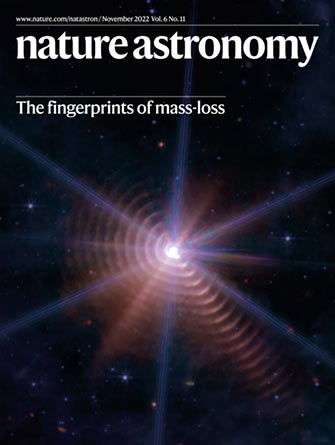
Mid-IR photo on the cover of Nature Astronomy, taken with the James Webb infrared Space Telescope, of 18 shells around the massive, hot binary star WR140
In September 1989, I flew to Crimea to use the 1.5m telescope at the old-fashioned, European-style Crimean Astronomical Observatory, not on top of a mountain as is usually the case today, but adjacent to a surrounding village of great beauty at low altitude. The lead-up to this trip lasted several months of letter exchange (pre-internet!) to signal my interest in this telescope and the squeezing in of my interest among others’ use.
The first leg of the journey was with Air Canada from Montreal to Paris. where I encountered my first real problem: Where was the next Aeroflot flight actually leaving from? It wasn’t obvious at all in the Charles de Gaulle Airport, partly due, in my opinion, to France’s lack of skills in making things easy for travellers, but still far ahead of the USSR. Finally, after no one official knew where I was to go, and with minutes to go before take-off, I found the gate by chance around some unmarked corner – my Aeroflot flight to Kiev (Russian for the now-preferred Ukrainian Kyiv).
Once there at the Kyiv Airport, I flashed my astronomical picture, and so did my Ukrainian colleague, with whom we had agreed by letter exchange beforehand to identify ourselves, having never met before. Sergey Marchenko (his father Ukrainian, mother Russian) had seen my recent publications and wanted to collaborate on areas of common interest (stellar winds from massive, hot stars), something I was also very keen on, though unrelated to my current trip. So, he took me to the pre-arranged visiting professional-scientist hotel for my almost sleepless night. Early the next morning, I had to catch another Aeroflot flight for the short hop to Simferopol, the modern capital near the middle of the Crimean Peninsula, a gift to Ukraine from the Russian president Khrushchev in 1954. After snapping a few “illegal” pictures from my flight window at Simferopol Airport, I was met by the kind Russian astronomers who would look after me for the next three weeks in a beautiful Crimean September.
In September 1989, I flew to Crimea to use the 1.5m telescope at the old-fashioned, European-style Crimean Astronomical Observatory, not on top of a mountain as is usually the case today, but adjacent to a surrounding village of great beauty at low altitude.
So, they led me to my accommodation on the Crimean Observatory site, which seemed like a castle, with a tub in the bathroom and running hot water, a certain luxury for most Soviets, including Ukrainians. Anna was my host for this part, including a jaunt to Simferopol after my allotted ten nights’ observing, where, among other niceties, I was taken to an art gallery, where I spotted a row of half a dozen fascinating ink drawings of Crimea. When I asked if any of the art was for sale, they said “yes”. So, a day or two later, I chose one of them and paid US$100 in cash to the Tatar artist, who clearly needed and deserved it. Now the black-ink sketch of the ancient Tatar capital of Crimea, Bakhchysarai, hangs in our living room and has been one of my wife’s and my favourites over the years. Its appeal is enhanced by what appears to be a close-up of a grapevine leaf. Though later getting the rolled-up picture out of the country took some smooth talking with customs at the Simferopol Airport.
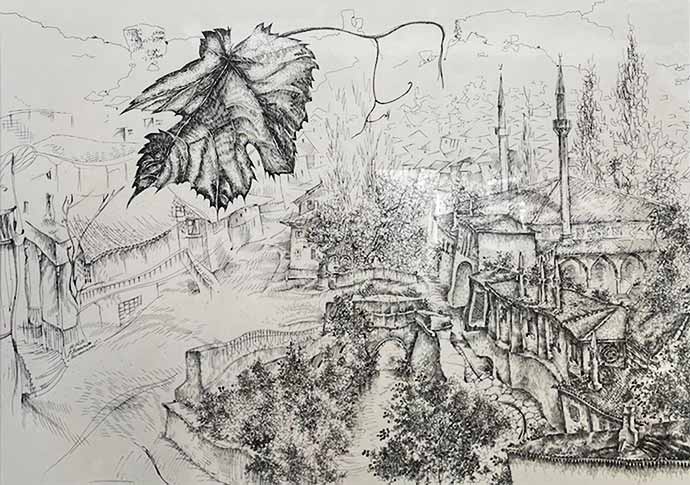
Tatar line drawing of the old Muslim Crimean capital city of Bakhchysarai
During the long nights of observing, I was not allowed to operate the telescope or the data-retrieval computer; this was done by the very capable and kind Russian astronomy colleagues, who knew the telescope and detector/computer quirks much better than I did. All I had to do was say which star would be next on the list to observe and the desired precision, which would determine the exposure time.
The instrument attached to the backend of the telescope, one of five around the world, was designed and built by Vilppu Piirola, a Finnish astronomer whom I knew well, to measure the polarisation variability of stars, in my case, of Wolf-Rayet stars, with high precision of about two parts in a thousand, simultaneously in five optical filters. The data I obtained have been used in five refereed publications, with me as a co-author along with colleagues and grad students pursuing their PhD or MSc degrees. Less than a year later, I used Vilppu’s instrument at the La Silla mountain of the European Southern Observatory in Chile under a different sky and for different stellar targets, also in a highly successful run, though I was observing alone.
During the daytime in Crimea, I read the 1940 controversial novel The Master and Margarita, in English translation, by Soviet author M. Bulgakov, went hiking with others, and reduced some data from a previous, unrelated observing run in Chile using my portable HP calculator. The hike was through the beautiful, dry Crimean countryside, including a close passage to the ancient Tatar capital with its tall, skinny Minarets.
‘During the long nights of observing, I was not allowed to operate the telescope or the data-retrieval computer; this was done by the very capable and kind Russian astronomy colleagues, who knew the telescope and detector/computer quirks much better than I did.’
The institutional meals were awful, though very cheap, so being partly Scottish, I took them anyway. (I am not fond of quark, which seemed to pervade all the meals.) BTW, the year-long Russian course I took during evenings in 1988/89 with the wonderful Ukrainian professor Alla Stein at UdeM, while great fun (especially with wife Ann, who transferred from her less interesting Russian course at McGill in the fall for the winter semester at UdeM), was unfortunately not enough to enjoy talking with the locals in their language.
One evening, I was invited for supper by my Russian host. His and his wife’s English was surprisingly good, much better than the warm local Crimean wine that they served with dinner. The wine would have been first-class if only it had been cooled!
After observing, I was taken to spend a week near Yalta on the Black Sea, the “Florida” for many Soviets. In Yalta, I visited the room where, in 1945, Churchill, F.D. Roosevelt, and Stalin divided up Europe after WWII. The table and chairs where they sat remain as then.
Upon leaving the Crimean Observatory, I received a hero’s goodbye from the friendly staff before my Russian colleagues drove me to the airport for my Aeroflot flight to Kyiv. There, I spent a full day enjoying Kyiv with Sergey and talking science. My, what a beautiful city Kyiv is, somewhat like Montreal with a central mountain peak near a big river.
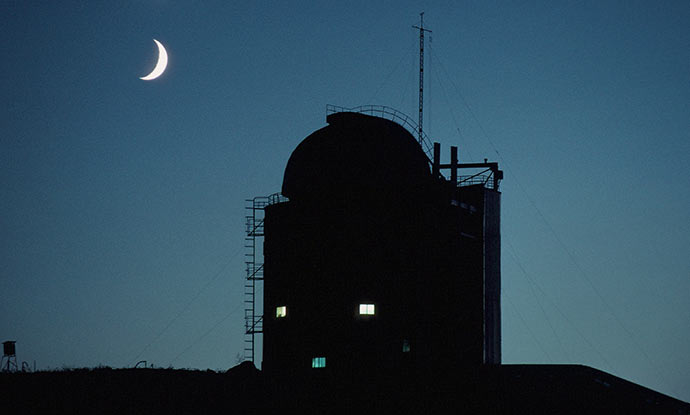
The Maidanak Observatory in Uzbekistan
Then, a year later, I followed Sergey’s invitation to go to the Russian Astronomical Observatory known as Maidanak Excursion (why Excursion, not Observatory, puzzled me) in Uzbekistan. The overnight flight from one of Moscow’s five airports to Samarkand led to confusion as to the correct gate. Even Sergey, who came from Kyiv to Moscow to help me find my way, could not find my gate and disappeared to get his flight on time at a different Moscow airport, leaving me in the lurch. But I did manage to find the gate, again by chance.
‘After observing [at the Crimean Astronomical Observatory], I was taken to spend a week near Yalta on the Black Sea, the “Florida” for many Soviets. In Yalta, I visited the room where, in 1945, Churchill, F.D. Roosevelt, and Stalin divided up Europe after WWII. The table and chairs where they sat remain as then.’
The Observatory was located a five-hour drive from the Samarkand Airport. At an elevation of over 2000 m, Maidanak reminded me of the observatories which I had frequently visited in Chile on dry treeless mountaintops, with one exception: the high desert in Uzbekistan (just north of Afghanistan and west of Kyrgystan, Tajikistan and western China) has a lot of windswept fine sand, which actually blocks some of the starlight, though at the same time reducing the atmospheric turbulence and thus improving the stability of starlight and reaching higher precision in measuring stellar brightnesses – just what we needed.
During the longish September nights, Sergey and student Viktor Khalik (now professor at Moncton University; Sergey now works at Goddard Space Flight Centre in the U.S. after not finding employment in Canada) and I used a Ukrainian spectro-polarimeter attached to the 1-m Lithuanian telescope to observe mainly a key Wolf-Rayet star, while Igor Antokhin, a colleague from Moscow, spent ten nights observing simultaneously the same star’s intensity variations at the Russian 1.5m telescope. Both of these projects led to separate published results.
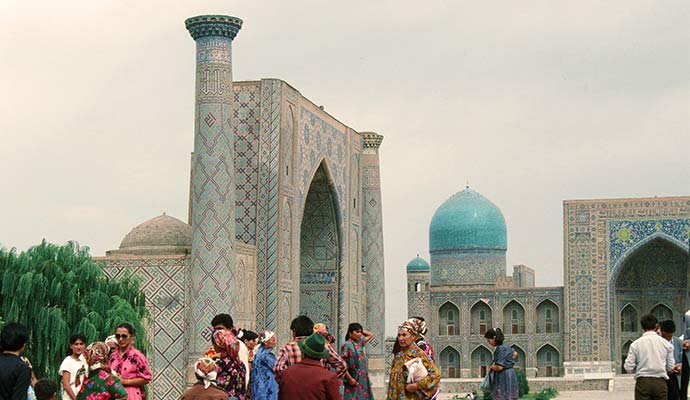
Beautiful Samarkand
Some ten years later, Sergey and his family came to Montreal, partly to escape the radioactive fallout from Chornobyl, especially for their two young children. For several years, Sergey and I collaborated on several scientific papers with other colleagues and students. Igor and his family also spent a year in Montreal when I sent him to Cerro Tololo Inter-American Observatory in Chile to spend three contiguous months non-stop – the longest ever had on the 0.6-m telescope he used – obtaining precision photometry of several southern WR stars. This also led to several joint scientific publications.
At Maidanak Observatory, Sergey got the food and did all the cooking from scratch for the three of us, including a delicious Ukrainian borscht, which we enjoyed with raw garlic buds, as we listened to Radio Moscow on an old tube radio. One day, all the astronomers decided to go on a hike along a narrow canyon about 500m below the observatory – the picnic at halfway was very tasty, though most of us found the next night’s observing somewhat tedious, every night being clear.
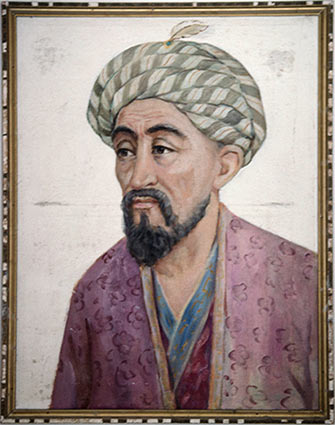
Ulugh Beg
Sergey and I spent a day exploring wonderful Samarkand, one of the oldest continuously inhabited cities in Central Asia, where the famous astronomer Ulugh Beg constructed an observatory in 1428. Its main instrument was a unique and gigantic 40-metre sextant. This instrument measured the positions of bright stars in the sky with high precision. Under Ulugh Beg, Samarkand became one of the world’s centers of medieval science.
All in all, these trips provided me with much joy, both astronomically and culturally. But it saddens me to see the chaos that prevails in that part of the world today. If only the Russian people at the time had liked the European-leaning Mikhail Gorbachev, but alas, they rejected him in favour of Boris Yeltsin as leader of the new Russian Federation. And the rest is history, still in the making…
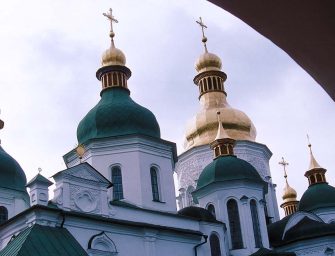
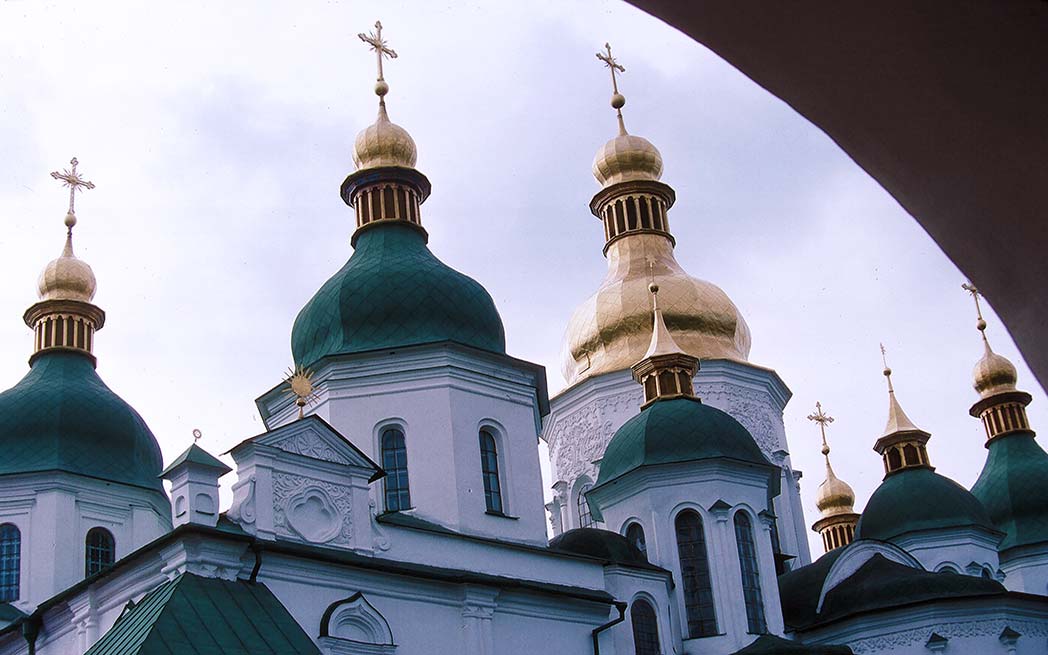
Feature image: churches in Kyiv
All images: Tony Moffat
Anthony (Tony) F. J. Moffat, Prof. emeritus (UdeM), BSc, MSc (both at UofT), Dr. rer. nat, Dr. Habil. (at the German Universities in Bonn and Bochum), FRSC, and featured in Who’s Who in Canada – former 50-year resident of Westmount.
An emeritus professor of astronomy at the Université de Montréal, Dr. Moffat was appointed as a fellow of the Royal Society of Canada in 2001. Dr. Moffat’s interests focus on massive stars (Wolf-Rayet stars in particular), stellar winds, binary stars, and the structure and dynamics of galaxies.