
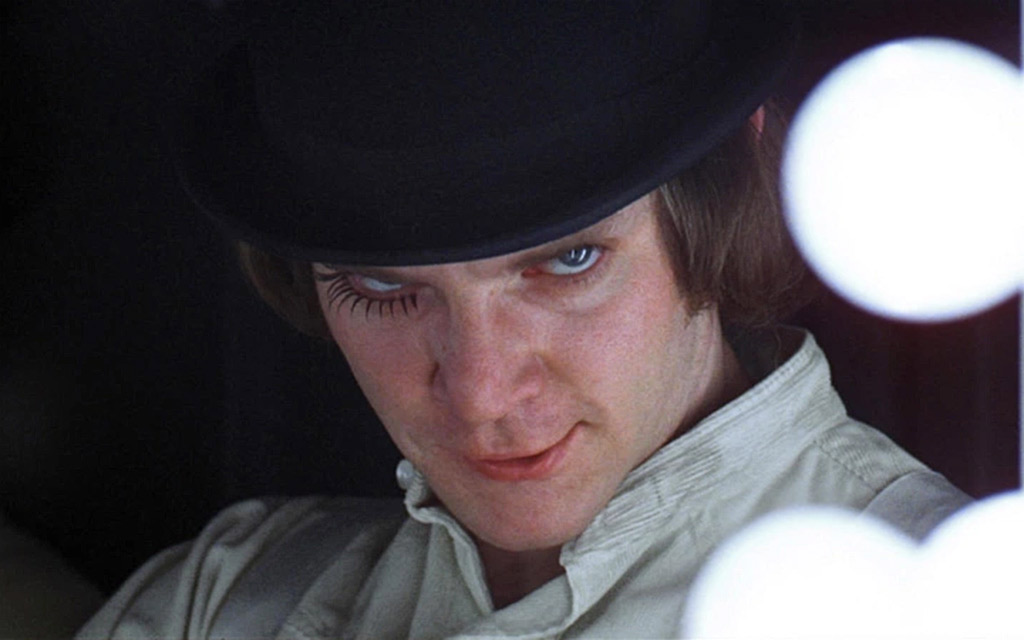
For this visionary director, every element is crucial and nothing is left to chance
By Francis Ouellet
Previously published in WestmountMag.ca
There was me, that is Alex, and my three droogs, that is Pete, Georgie, and Dim, and we sat in the Korova Milkbar trying to make up our rassoodocks what to do with the evening.
These few words began my initiation into the world of one of the most visionary filmmakers of the second half of the twentieth century. In this simple shot, several of the primordial elements of Stanley Kubrick‘s work were revealed: the obsession with photography, its symmetry and perspective of the shots, the rear tracking shot, the almost clinical coldness of certain scenes, the attention paid to faces and close-ups, and the music, haunting and always complementary to the image.
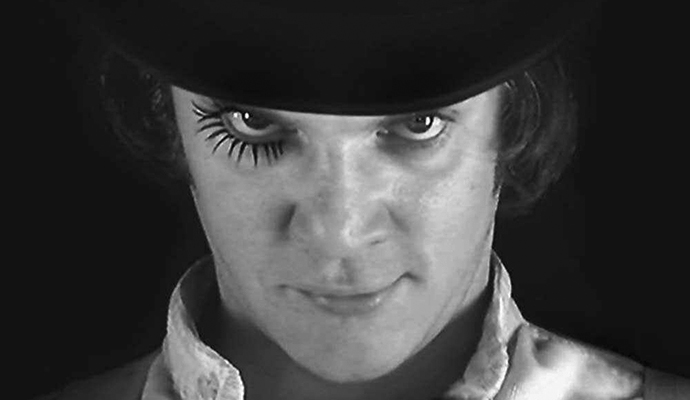
When we see the pallid face and arrogant expression of Alex, the main character in A Clockwork Orange, whose gaze aggressively glares back at us, we, the viewers, understand that nothing is left to chance. We are witnessing the work of a meticulous and attentive craftsman with a thirst for perfection.
It’s not easy to approach the work of an admired creative genius, to study it, dissect it and try to understand its inner workings. Even if I can confidently let myself go and enjoy the journey, it’s still hard work, especially when you’re dealing with a visionary of Kubrick’s calibre, and the analysis must be marked by humility.
‘We are witnessing the work of a meticulous and attentive craftsman with a thirst for perfection.’
By trying too hard to rationalize, decipher and demystify films, there is always the danger of ruining the pleasure we derive from the stories. You have to know where to draw the line, without over-intellectualising. My primary aim is to share the director’s passion for the cinema and to give others the desire to see or watch Kubrick’s films again. As far as the work is concerned, we strongly recommend viewing his films more than once.
The first thing that is striking about Kubrick’s work is the certainty that what we see on screen has been carefully thought out down to the smallest detail. You can sense Kubrick’s meticulous care in composing the images that, once assembled, bring his work to life. Each of these frames is the sum of an infinite number of details to which the director devotes his full attention.
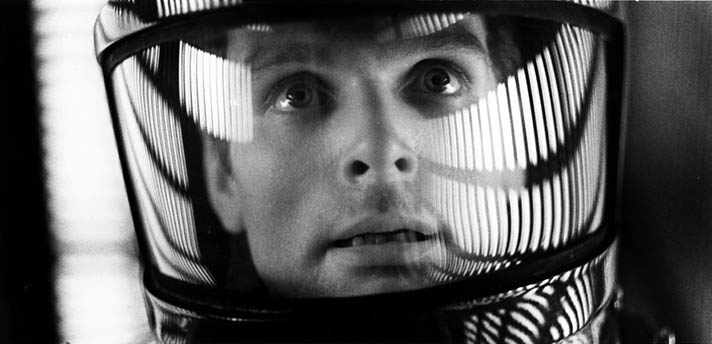
Both the purely technical aspects – shot composition, lighting, framing, perspective, camera movement – and the aesthetic or artistic aspects – sets, props, costumes, make-up, presence and acting – vary from one director to another, but for a creator like Stanley Kubrick, all these elements are essential. Nothing can be left to chance.
This working method was certainly influenced by the filmmaker’s various passions, whether photography, music or chess, all of which require a high level of perfection and reflection. The quest for the absolute and the pursuit of excellence are the qualities that distinguish the filmography of a great filmmaker from that of a lesser director.
‘The most important quality of Kubrick’s work is the brilliance of his scripts and dialogue.’
Always in the context of an intelligent dialogue or monologue, many lines stick in our minds and never leave us. Whether it’s the completely wacky and jubilant lines from the various protagonists in Dr. Strangelove or the mechanical yet touching pleas from HAL 9000, the artificial intelligence computer in 2001: A Space Odyssey.
The richness of the lines, the high quality of the scripts and the depth of the plots, which are often multi-layered and compartmentalized or in the form of puzzles, are real enigmas in which there is so much to understand and decode.
Because there is no single, immutable truth in Kubrick’s work, and as I mentioned earlier, his films require several viewings in order to decipher the different ideas and paths proposed by the filmmaker, allowing us to see the work in a completely new way.
This complexity leads us to think more deeply, forcing us to look beyond the first degree, to question ourselves. For example, what are those black monoliths in 2001: A Space Odyssey? A symbolic representation of evolution? A form of cosmic intelligence that has guided humanity since the dawn of time? Or God?
Or, let’s ask ourselves, are there really ghosts haunting the Overlook Hotel, the central location in the plot of The Shining? Are we not witnessing the disintegration of a dysfunctional family, locked up in this enclosed space where everyone proves to be more or less unstable? Do the parents and the child not contaminate each other, plunging into homicidal dementia?
‘This complexity leads us to think more deeply, forcing us to look beyond the first degree, to question ourselves.’
As we can see from these two examples, the interpretations are multiple, protean, and all valid, or at least defensible. The chess player is clearly recognizable here, with the various movements of the pieces on the chessboard and the infinite number of combinations over the course of a game.
Stanley Kubrick plays with his audience, forcing them to invest themselves intellectually in the plot that gradually unfolds on screen. The spectator has no choice but to get involved, to rack his brains, which is the mark of a great film. This is no mere entertainment or consumer product, but a work of art.
I mentioned earlier that I considered Kubrick to be a visionary. As with Eisenstein, Tarkovsky, Roeg, Malick and other visionary filmmakers, Kubrick’s filmography is relatively parsimonious, thirteen feature films in a career spanning almost 50 years. And although it is small, there is hardly a work in his filmography that we could call minor.
Stanley Kubrick, a visionary filmmaker, reveals with each new film an uncompromising dedication to precision. No detail is left to chance—whether it’s the symmetrical composition of a shot, the meticulous choice of lighting, the depth of his characters’ psychology, or the symbolic resonance of his dialogue. His work stands out for its pursuit of the absolute, a relentless quest for perfection that elevates cinema beyond mere entertainment and into the realm of art.
‘The work of Stanley Kubrick is defined by this search for perfection, a constant striving that transcends simplicity and gives rise to masterpieces.’
Analyzing Kubrick’s films demands patience and humility. His works, often complex and layered with multiple meanings, fully reveal themselves only after repeated viewings. Behind every image lies a world of deliberate intention, hidden messages, and intellectual play—inviting the viewer to take an active part in deciphering them.
Like a grandmaster of chess, Kubrick moves his pieces slowly across the board of storytelling, drawing us into an intellectual and aesthetic challenge. His body of work, though relatively compact, remains intense, dense, and unforgettable. He endures as one of the most fascinating geniuses the contemporary film world has ever produced.
Perhaps you’ll be able to unravel some of the mysteries, uncover some of the details you missed, and take a fresh look at the films of one of the most important directors in the history of cinema. At the very least, it will certainly give you the desire to see them again.
Feature image: Malcolm McDowell – Stanley Kubrick’s Clockwork Orange – Giuseppe Bognann
Other images: slagheap – StockPholio.com
 Other articles by Francis Ouellet
Other recent articles
[row cols_nr=”2″][col size=”2″]

[/col][col size=”10″]Francis Ouellet has always been madly in love with cinema, animation and comic strips. This obsession with images, movement, light and shadow led to a career in advertising and graphic communications, where, for over twenty years now. But that doesn’t stop him from continuing to work, in his spare time (when there is any), on various small animation and comic strip projects.[/col][/row]