
Featuring 20 shows, FTA 2025 is a bold exploration of contemporary stage forms
By Jacqueline van de Geer
May 29, 2025
From May 22 to June 5, the Festival TransAmériques (FTA) presents its 19th edition, offering a breath of fresh air and a renewed perspective on our cultural and artistic landscape. Featuring 20 shows, FTA 2025 is a bold exploration of contemporary stage forms.
Lacrima brilliantly opens the Festival TransAmériques!
With Lacrima, Caroline Guiela Nguyen offers a captivating and profoundly human exploration of the unexpected connections that unite the world of haute couture. Through the journey of a single dress, the play weaves a delicate tapestry between a Parisian fashion house, an embroidery workshop in Mumbai, and the lace makers of Alençon, plunging us into the heart of a creative process that, beneath its splendour, reveals poignant truths. From the very first minutes, Lacrima grips us with a rare emotional intensity.
Marion Nicolas, played by the magnificent Maud Le Grevellec, a workshop manager at the Beliana haute couture house in Paris’s first arrondissement, is on a Zoom call with her doctor, whose concern is palpable. In a dazed state, the couturier reveals extreme fragility and eventually confesses to having “done what had to be done,” implying she swallowed pills to end her life. The moment firefighters, alerted by the doctor, arrive to help her, time stops, and the action rewinds eight months earlier, to the spring of 2025, or “4688 hours of work before the tragedy.”
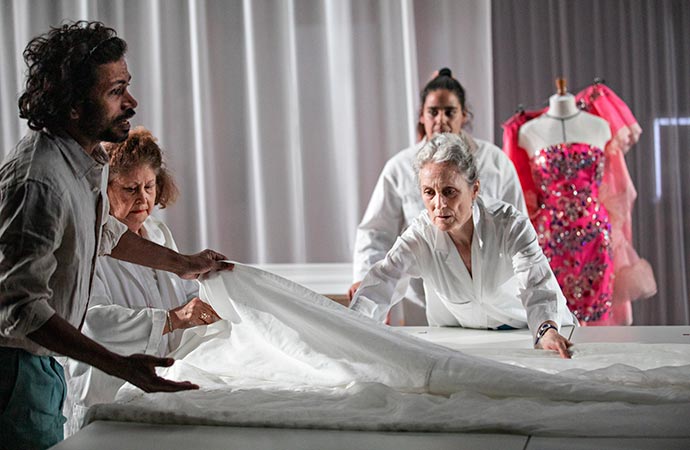
This tragedy becomes the guiding thread of a story that travels back in time, inviting us to understand the 4688 hours of arduous work preceding a devastating event: a prestigious fashion house receives a royal commission to create the future wedding dress for the Princess of England. For months, and in the utmost secrecy, seamstresses, pattern makers, workshop managers, and embroiderers work tirelessly between Paris, Alençon, and Mumbai, until their lives are irrevocably altered.
The excellence and luxury of the craftsmanship, the fruit of the meticulous “petite mains” in Paris, Mumbai, and Alençon, actually conceal the suffering of the staff and the pressure of a confidential preparation.
The staging is a true tour de force. Thanks to Jérémie Scheidler‘s ingenious video work, close-ups multiply, immersing us with remarkable clarity in Zoom meetings between Paris, Alençon, and Mumbai. This almost cinematic visual fluidity allows for seamless transitions between locations and eras, with actors changing roles with disarming ease. We are transported into the heart of the workshops, then amidst distant interactions, perceiving the human depth that gives this theatrical universe its full resonance.
Through the journey of a single dress, the play weaves a delicate tapestry between a Parisian fashion house, an embroidery workshop in Mumbai, and the lace makers of Alençon, plunging us into the heart of a creative process that, beneath its splendour, reveals poignant truths.
Caroline Guiela Nguyen‘s genius lies in her ability to expose complex dilemmas without ever resorting to judgment or moralizing. She offers the audience complete freedom of interpretation, inviting them to reflect on the inherent contradictions in the fashion world, where advertised ethical standards often contrast with the reality of underpaid and unrecognized labour. The performers of Lacrima, both professional and amateur, expressing themselves in French, English, Tamil, or French Sign Language, touch us deeply. With overwhelming authenticity, they embody the flaws of our own confinements.
Lacrima is a theatrical experience not to be missed under any circumstances. It’s a show that questions, moves, and resonates long after the stage lights have faded. Caroline Guiela Nguyen, a true artisan of emotion, delivers a powerful work that highlights the forgotten narratives and absent bodies from our stages.
Lacrima
Presented from May 22 to 25
Hatched Ensemble: A Revolutionary Performance
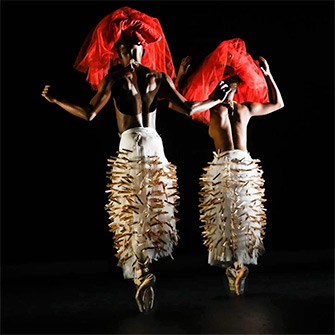
On the night of May 24, at the Monument National, South African choreographer Mamela Nyamza‘s Hatched Ensemble truly stood out. This creation features a group of bare-chested dancers in long tutus, perched en pointe, surrounded by wire sculptures evoking domestic rurality. Initially seen from behind, swaying to the sound of Camille Saint-Saëns‘ The Swan, the dancers come alive with the arrival of a singer (Litho Nqai) and a multi-instrumentalist (Given “Azah” Mphago). Voices resonate, feet break free, and costumes transform from white to red, shattering the conventions of classical dance. The bodies of Hatched Ensemble, liberated from gender constructs, joyfully reclaim the elitist world of ballet.
Hatched Ensemble delves into the juxtaposition of movement vocabularies and accompaniments from diverse cultures. The piece references both Western classical music and dance, as well as traditional African vocal scores and rooted movements. Hatched Ensemble speaks to anyone who has ever felt a conflict with their own identity and questioned their place in the face of the status quo.
This work has evolved from an intimate solo to a duo, ultimately becoming a powerful ensemble piece. In this creation, the South African choreographer merges classical ballet and traditional African dances. She explores themes of decolonization and the role of women in society, while also providing a platform for a new generation of artists.
‘In this creation, the South African choreographer merges classical ballet and traditional African dances. She explores themes of decolonization and the role of women in society, while also providing a platform for a new generation of artists.’
Mamela Nyamza also addresses issues specific to her home country, South Africa. She explores subjects such as apartheid, white privilege, and African cultures. On stage, this approach is notably reflected in the presence of sculptures, all salvaged from the street, adding a raw and authentic dimension to her works.
For nearly two decades, Mamela Nyamza has been working to decolonize bodies and dance practices, tracing an alternative history. Hatched Ensemble brings to life her dream of working with a new generation of vibrant dancers. Together, they challenge audience expectations, creating a healthy and invigorating aesthetic encounter!
Hatched Ensemble
Presented from May 23 and 24
Toi, moi, Tituba promises to leave a lasting impression
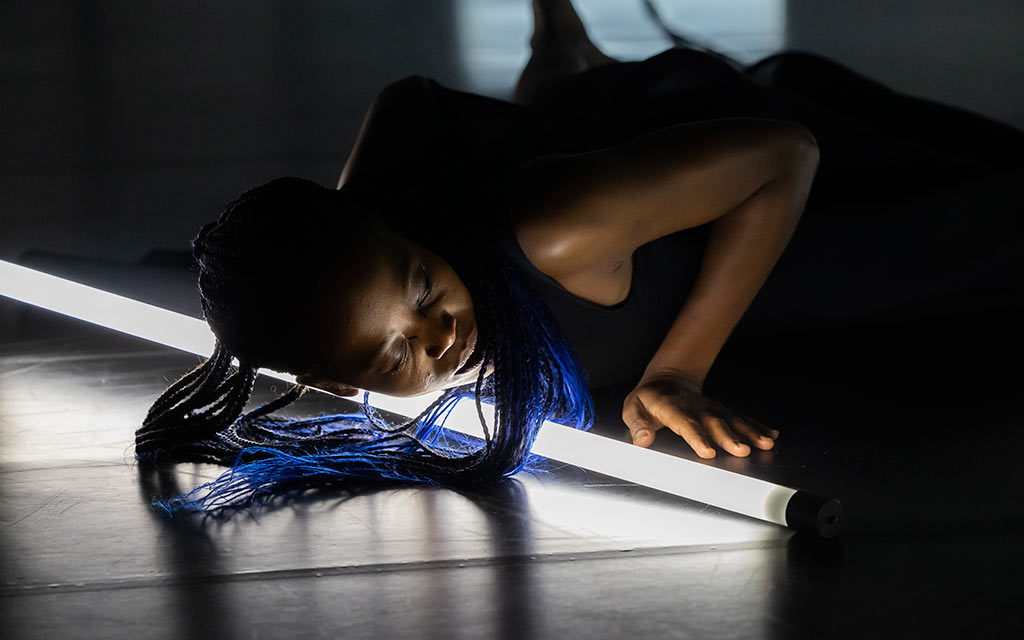
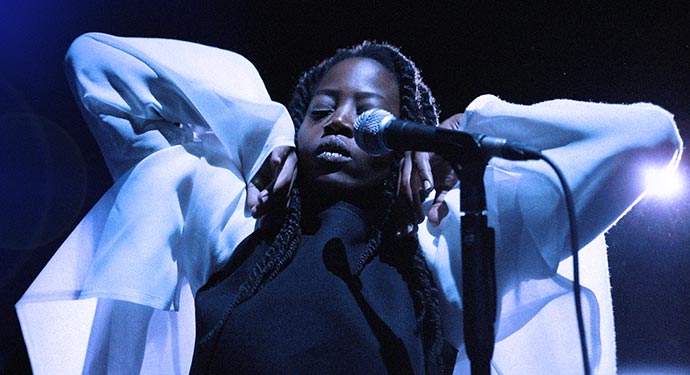
In the heart of a neon forest, Rwandan dancer-musician Dorothée Munyaneza delivered a captivating performance on May 27 in the Cinquième salle, a true invocation of the Black women whom colonial history has too long sought to erase.
Dorothée Munyaneza breathed life back into Tituba, that emblematic and tragic figure from the Salem witch trials, a young enslaved woman whose story inspired Maryse Condé‘s cult novel in 1986, I, Tituba, Black Witch of Salem.
The journey didn’t stop there: Munyaneza also delved into the luminous text by philosopher Elsa Dorlin, Me, You, Us…: Tituba or the Ontology of the Trace, weaving a rich and complex tapestry. In this striking solo, the artist uses her own body as a living archive, a vibrant and physical vessel for memories too often dispersed. Accompanied on stage by the talented composer Khyam Allami, she transforms her body into a bridge between past and present, a space where ancestral sufferings are explored to be better celebrated, repaired, and commemorated. It’s a body that stands tall, the very embodiment of history, so that oblivion never has the last word!
‘Dorothée Munyaneza isn’t just a magnificent dancer; she’s a multifaceted artist, an exceptional storyteller, and an ardent defender of silenced voices.’
Dorothée Munyaneza isn’t just a magnificent dancer; she’s a multifaceted artist, an exceptional storyteller, and an ardent defender of silenced voices. Born in Rwanda, she has forged a unique path, studying music and social sciences in England before settling in France, thus developing a unique perspective that imbues each of her creations.
This show is much more than a simple performance: it’s a powerful exploration of the blind spots in our collective history. Moving and impactful, it firmly joins the ranks of essential works that strive to mend fragmented memory and bring visibility to a history too often obliterated.
Don’t miss this experience – it promises to leave a lasting impression!
Toi, moi, Tituba
Presented from May 27 to 29
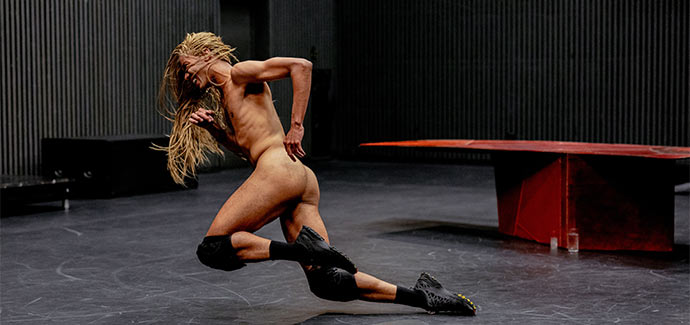
Harald Beharie’s Batty Bwoy is quite simply a tornado of energy and presence!
Perched on a red platform, Beharie, sporting a wig of white braids and clad only in trainers and knee and shin pads, spoons lube into his mouth, swallowing it with large gulps of water. This gesture is both disquieting and captivating. From the moment we enter the space, Beharie pushes his body and the audience’s expectations to their limits, using his physicality as a vessel for intense and often uncomfortable expression. Harald Beharie weaves a narrative that’s both provocative and celebratory. Through each new movement sequence or gesture, he deconstructs the myths surrounding the Black and queer body, unveiling new, vulnerable possibilities that oscillate between consciousness and naivety.
Batty Bwoy is accompanied by a discordant, electric soundtrack composed by the Norwegian band Ring van Möbius, an integral part of the performance. The music is perfectly timed and complements the intensity of Beharie’s movements, adding a depth and emotional resonance that echoes the discomfort and liberation Batty Bwoy evokes. In moments of silence, Beharie’s movements create a chilling soundscape. The transitions between noise and quiet amplify the emotional tension.
‘Beharie pushes his body and the audience’s expectations to their limits, using his physicality as a vessel for intense and often uncomfortable expression’.
At one point, Beharie scuttles around the space on his hands and knees, whipping his braids into members of the audience in a gesture of defiance and jubilation. It feels both confrontational and intimate, forcing the viewer to confront Beharie’s physicality and breaking the boundaries between performer and observer. Later in the piece, he sheds his braids and shin pads, running and leaping around the “black box” theatre with unfiltered expression. This transformation reveals a raw, unbridled energy, far removed from stereotypes and societal expectations. It’s a moment where joy, rebellion, and the sheer power of the body all converge in an exhilarating, cathartic release.
Batty Bwoy intertwines violence and cruel charm. By reclaiming the Jamaican expression “batty bwoy”, a derogatory slang term for a queer person, Harald Beharie deconstructs and subverts the myths associated with the Black and queer body. He thus unfolds a universe where potential vulnerabilities coexist, navigating between lucidity and naivety.
A must-see!
Batty Bwoy
Presented from May 28 to 31
Festival TransAmériques (FTA)
For tickets and more information:
fta.ca
Feature image: scene from Toi, moi, Tituba
Images: courtesy of Festival TransAmériques

Other articles by Jacqueline van de Geer
Other recent articles
[row cols_nr=”2″ class=”narrow”][col size=”2″]
 [/col][col size=”10″]Originally from the Netherlands, Jacqueline van de Geer crossed the Atlantic Ocean in 2005 to live and work in Montréal. She has a bachelor’s degree in visual arts and performance arts.[/col][/row]