
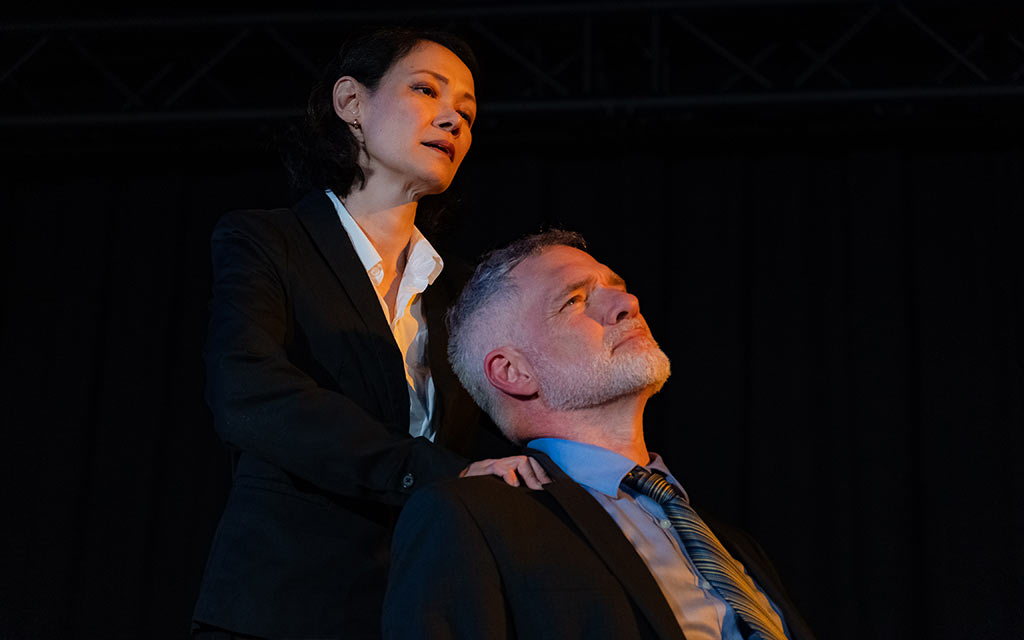
Playwright Robert Tsonos and director Sophie Gee discuss the play and its background in a Q&A
By Irwin Rapoport
September 29, 2025
Since the early 1800s, the United States and China have experienced a complicated, divisive, and perplexing relationship, and Robert Tsonos sheds light on a few aspects in his new play, It’s Time, whose world premiere will be mounted at Teesri Duniya Theatre’s Rangshala Studio on Pine Avenue between September 25 and October 6.
“The rise of China, the fall of America, cultural stereotyping, sexism, and a new world order,” states the press release for the play. “An intentionally provocative portrait of the complex, divided, interdependent and explosive relationship between these two giant nations. Large themes come in small packages in this two-hander about a Chinese businesswoman who fires an American businessman at an international financial services company in Hong Kong during the global financial crisis of 2008.”
The Sometimes Y Theatre production is directed by Sophie Gee.
The script for It’s Time was the winner of the Uprising National Playwriting Competition, took second Place in the 84th Annual Writer’s Digest Writing Competition, and secured Honourable Mention in the Herman Voaden Playwriting Competition.
“A tour-de-force showcase for actors Shiong-en Chan and Paul Hopkins, guaranteed to provoke and enrage, while entertaining and thrilling audiences with a play for, and of, our time,” further states the press release. “This award-winning script delivers interwoven narratives spanning the fallout of personal and global consequences. Gee, who recently directed the wildly well-received Three Women of Swatow at Centaur Theatre, will bring her acclaimed approach to directing this piece – the decompartmentalization of disciplines, the convergence and interaction of theatre, dance and performance.”
The script for It’s Time was the winner of the Uprising National Playwriting Competition, took second Place in the 84th Annual Writer’s Digest Writing Competition, and secured Honourable Mention in the Herman Voaden Playwriting Competition.
Tsonos, a Montreal-based playwright, director, and actor, is well-known in the theatre world. His play, The Hum, was produced in Hong Kong and published by Level 4 Press in Regional Best 2012. William & James has been produced in Toronto (Theatre Passe Muraille), New York, Montreal, and Ottawa. Other plays include In His Name, Sharnoozle!, I Am Not The One, and Running – three short plays, among others. Sometimes Y Theatre has produced theatre in Canada, Tokyo, England, New Zealand, and Hong Kong since the company’s inception 25 years ago.
“The company was the resident theatre company at the Canadian Embassy in Tokyo for three years,” states the press release. “Canadian productions include Ditch (Theatre Passe Muraille), receiving one Dora Award nomination, and William & James (in association with Theatre Passe Muraille), receiving two Dora Award Nominations.

Robert Tsonos and Sophie Gee responded to some questions about the play and the production:
WM: What were the inspirations for Its Time, and what do you hope audiences will take away from the play?
Tsonos: I lived and worked in Hong Kong from 2006 to 2009 during the Global Financial Crisis. My partner at the time worked in Financial Services, and I met a bunch of very interesting business executives. I’ve based the characters in my play on the people I met in Hong Kong. The play really started as a character study and developed from there. The executives were all very ambitious, highly intelligent, driven, and charming Type A personalities. The company they all worked for was an American company with an office in Hong Kong. The stories I heard and the people I met inspired me to write the play.
The battle between East and West, the United States and China, men and women. There are a bunch of battles going on in the play, and I hope it stirs up debate and leads to discussion. There are certainly a lot of complexities in doing business in a world marketplace, and the clash of cultures is a real challenge.
WM: How would you describe your writing style, and how do you develop your characters?
Tsonos: My writing style changes depending on the play I’m working on. This play is full of intelligent, fast-talking individuals, so the dialogue needs to reflect that. The characters are generally brutally honest, so I never shied away from uncomfortable dialogue or a blunt turn of phrase. My writing style always reflects the characters’ life experience, so should always adapt to the set of circumstances that are set out in the play.
My characters usually start off with someone in mind. Someone I’ve met or seen or heard about. It’s a launching point. After that, the characters take on a life of their own, and as the play unravels, the characters reveal themselves. I really don’t plan too much before writing and generally let the play take me on a journey to its logical conclusion.
WM: To what extent have your experiences as a director and actor influenced the way you write scripts?
Tsonos: I know what a great director (in this production Sophie Gee), and skilled actors (Shiong-En Chan and Paul Hopkins) can bring to a production. So, as a writer, I hope I allow room for interpretation and artistry. The goal of every production is to elevate the work the playwright has already done. If the play is too stiff, overly describes the movement on stage, or prescribes emotional interpretation for the actors, it doesn’t allow the artists in the rehearsal room to elevate it to something even better. It’s only because I’ve worked for so long as an actor and director that I see this clearly. That all the artists in the room need to be firing on all cylinders for a production to soar.
I lived and worked in Hong Kong from 2006 to 2009 during the Global Financial Crisis. My partner at the time worked in Financial Services, and I met a bunch of very interesting business executives. I’ve based the characters in my play on the people I met in Hong Kong. The play really started as a character study and developed from there.
– Robert Tsonos, playwright, It’s Time
WM: How did you prepare to direct It’s Time and develop the concept for the sets?
Gee: What I love about my job is that directors need to understand what was going on in society during the time the play is set, but they also need to know about what is happening in the world today, to connect to the relevance of telling a certain story today. To that end, I researched the global financial crisis, globalization, and the history of Hong Kong and China. Currently, we are seeing the U.S. initiate trade wars with many countries, but primarily China. This is all over the news, and I read up on the trade war and how linked the U.S. and Chinese economies are.
Beyond this research, of course, there is the essential preparation of digging into the text over and over again to inform design choices and prepare for rehearsal.
When set designer Maryanna Chan presented some inspirational images to me, I was drawn to an image of large stone slabs lying on the floor – to me, it spoke of two countries and cultures clashing against each other. We started from there – two land masses meeting through business, and the meeting point is the desk. With a two-hander, we initially thought we didn’t need a lot of space, but then we thought it might be interesting to use the width of the stage to explore how far apart the characters are, and how they come together through business. The play talks about how one of the American businessmen likes to dominate a room, how he likes to claim territory. What if his territory is far larger than the Chinese businesswoman’s? How can she break out of the smaller territory she has and take over? These lines of thinking lead to the set design.
WM: What drew you to directing, and how would you describe your style?
Gee: I was always into theatre; I was drawn to how a space can transform magically right in front of an audience, and I was hooked on the feeling of working together as a team on a show. I began directing simply because I wanted to put on plays I loved. As I started finding my own voice, I shifted into making my own shows. Now, I work both as a freelance director on existing texts and I create my own work through devising in a studio with collaborators.
My style and tastes have evolved over the years, but whether I am working on a documentary theatre piece, a narrative drama, or an immersive experience, I am interested in what makes a piece theatrical: why does a work need to exist in this medium and no other? For my own creations, I like to access a sort of dreaming to create a truthful, poetic moment which lifts us out of the everyday. I also love to work with dancers as I enjoy thinking physically. Sometimes, theatre can get too stuck in a realistic, narrative logic. Moving between the different logics of the body and the brain energizes me. It allows me to be associative instead of relying on the linearity of cause and effect.
WM: Who are the directors that inspire you, and are there any productions that help guide you?
Gee: Even though I love theatre, to be honest, I am more inspired by contemporary art than theatre, but the UK companies Shunt and David Glass ensemble were very influential to me. I saw Yael Farber’s Molora many years ago in Montreal, and the experience still stays with me. Not long after that, I was fortunate enough to be chosen as her student at the National Theatre School. I recently had the privilege of working with Peter Hinton-Davis, from whom I learned a lot; he is a true artist with a sharp intellect and an open heart.
Images: courtesy of Sometimes Y Theatre

Other articles by Irwin Rapoport
Other recent articles
 Irwin Rapoport is a freelance journalist with a bachelor’s degree in history and political science from Concordia University.