
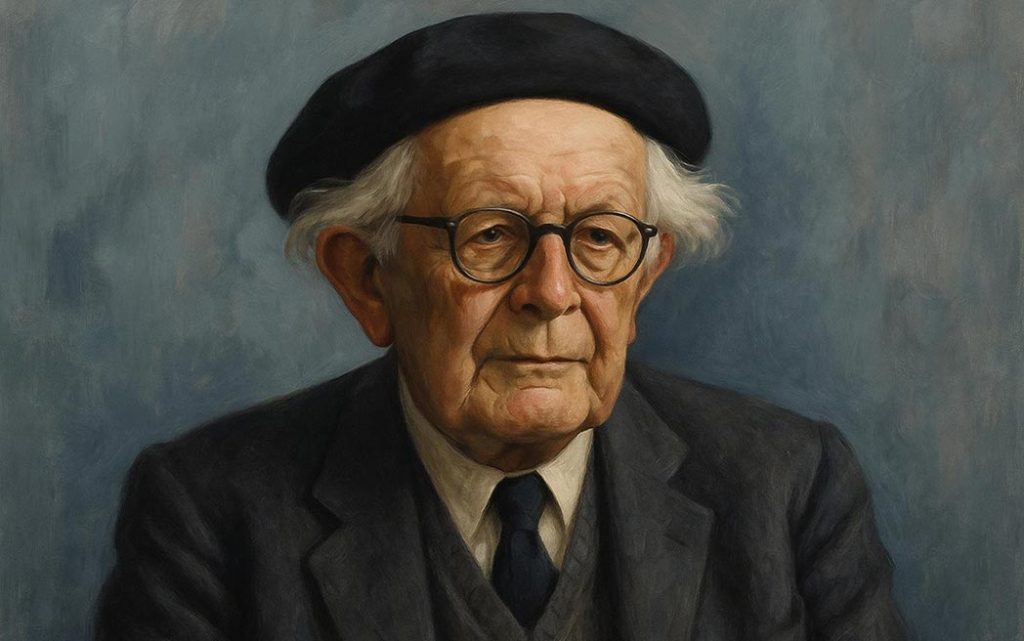
On the Piagetian scale, humankind seems to have stalled out at peek-a-boo
By Randi Hacker
October 23, 2025
Some of you might remember reading in an earlier column that the first time I saw the word taboo used in connection with the discussion of human extinction was in a conversation between two characters in the book Tasmania:
As we eat, we first talk about an article that he pointed out to me a few days before we left. The piece advocated eliminating once and for all our taboos against discussing the extinction of the human race.
Well, lately, I’ve been thinking a lot about the way we have placed that taboo on the discussion of human extinction, and what I have been thinking is this:
It’s just so typical of us, isn’t it?
I mean, throughout humans’ brief existence on the geological timeline (either 3,000,000 years or 300,000 years, depending on whether you count homo rudolfensis, which, at the moment, I’m on the fence about), we’ve always made taboo the things that we fear, in case naming them invokes them.
If we don’t name them, then we don’t have to see them; and if we don’t see them, well, then, they aren’t there.
Whether we hide behind our fingers or not, the prospect of human extinction is still there, looming. It always has been, of course, because nothing, as we are fond of saying, lasts forever.
It seems to me that this is more than just a head-in-the-sand reaction. On the Piagetian scale, humankind seems to have stalled out at peek-a-boo, never developing any extended grasp of object permanence.
Whether we hide behind our fingers or not, the prospect of human extinction is still there, looming. It always has been, of course, because nothing, as we are fond of saying, lasts forever. But, before we took it upon ourselves to aid and abet it, our extinction was accepted as being practically mythical; you know, millions of years in the future, when the sun fizzled out, and so we filed the whole idea away under “Permanent, Nothing Is.”
But now, it’s no longer mythical, and it’s no longer millions of years away (if, indeed, it ever was). When will it happen? Unknown. It could be a decade. It could be a century. It could be, as an old friend who had just become a grandmother said hopefully, two thousand years from now. Or, indeed, it could be tomorrow if that asteroid my sister is rooting for arrives or if there is a nuclear war or if Donald J. Trump has anything to say about it, which, alas, he does.
The timeline is not important. Neither is whether it’s our fault for acting outside of nature or not our fault because this could just be the natural behaviour of humans as a species, just as building dams is natural behaviour for a beaver or laying eggs in caterpillars is natural behaviour for a wasp.
What is important is that now, as Scientific American suggests, it’s more a matter of when and how than if at this point.
Recently, I started a discussion group at the local library. It’s called Extinction for Beginners. It’s meant to provide a space in which to step away from the taboo and start talking. It’s set to run for six weeks. The library designed a flyer. I dropped copies at local businesses, hung a couple on community bulletin boards, stuck one to the whiteboard at my gym, and handed one to a stranger at FedEx who promised to post it on her social media.
On the day before the first meeting, I prepared a jarful of prompt questions (e.g., What is the difference between living and survival? Is benefitting human kind the bottom line? Is extinct the opposite of instinct?) just in case the discussion lagged and printed out a copy of one of these columns: the one about transformative surrender, if you must know.
One person showed up for the first meeting, and he arrived half an hour late. He was an outspoken autodidact with very firm opinions on pretty much everything. He believed in progress and the supremacy of human beings. But he also lamented the terrible state of the world and read aloud the beginning of an article he was writing on Western civilization. Though we disagreed on who was the greatest conqueror in the world – he thought Alexander the Great; the librarian/facilitator and I suggested Genghis Khan and his son – we didn’t disagree on everything. In fact, we had a lively discussion. I hoped he would return the next week.
‘Recently, I started a discussion group at the local library. It’s called Extinction for Beginners. It’s meant to provide a space in which to step away from the taboo and start talking.’
Which he did. Along with two other people, making a total of five, including me and the librarian. We were two men and three women, and this week’s discussion covered the domestication of animals, just how smart corvids are, how difficult it is to find anyone who is willing to talk about human extinction on an authentic level, a clarification on the definition of evolution (not toward a pinnacle, but just continued change), anthropocentricity and anthrosupremacy, the value or futility of individual action, and how probably Earth will be better off without us.
There were six people at the third gathering, which included an invited guest from The Resilient Activist, a non-profit organization in Kansas City. We touched on how to maintain joy in the shadow of this existential crisis; what kind of world the children will live in; whether or not progress in farming was, in fact, progress; whether it was time for us to drop our hubris and admit ignorance; the futility of conferences on climate change; and the complicity of mass media. It was exhilarating.
When Ellie, the main character in my novella, has her epiphany about the inevitability of human extinction, she too feels exhilarated.
Ellie has had a revelation that she can only describe as tectonic, and she is still reverberating from the seismic aftershock. She wants to call someone and tell them, but she’s not sure yet whether it will be Dee or Mitzi. She needs to think.
She leans on the porch railing, chin in her left hand, cordless phone in her right. It is a gorgeous evening on Earth. The recent rain and adjunct winds of a Category 5 hurricane far east of where she stands have left the sky scrubbed and shiny. The air is fresh, the twilight pure. The setting sun illuminates the lacework of spaces between the leaves and branches and trunks of the trees in what’s left of the woods behind her house. The song of a hermit thrush anoints the moment.
Followed, thirty seconds later, by the percussive roar of an engine and two mud-splattered ATVs, one red and one blue, that churn out from between the trees. The red one has a boom box bungeed to its rear bumper that is blasting Dolly singing “Jolene.” It takes the turn onto Ellie’s driveway on two wheels, sending gravel spraying into the garden and almost tipping over before righting itself and chewing its way up to the road. The blue one follows a little more slowly, but not much. Both drivers wave to Ellie as they pass. At the top of the driveway, they turn right and move out of sight, but not out of hearing, not for quite a while, leaving the smell of gasoline and weed in the air.
Ellie gives them the finger.
In so many ways, nothing has changed since she first started advocating for the Earth more than thirty years ago. Well, not nothing. The names of the politicians have changed, but we are still shitting where we eat. Back then, she felt a calling to change the world, to influence the way that people think about how we live. She wrote letters. She wrote books. For a brief and heady time, she published an eco-activist journal for kids. She felt she held a better future in her hands. And each time there was another oil spill in the Gulf or another river in coal country that burst into flame or another creature whose existence was endangered in the name of human rights, her despair deepened, her fear increased, and she redoubled her efforts. Her stress level, as you might imagine, was very high.
‘In so many ways, nothing has changed since she first started advocating for the Earth more than thirty years ago. Well, not nothing. The names of the politicians have changed, but we are still shitting where we eat.’
But not anymore. Now, she feels light and free. The blinkers are off. Her peripheral vision has returned, and in it, she catches a glimpse of a honeybee headed, perhaps, to the lavender.
Now, who should she call?
The phone in her hand rings. How fitting. In the metaphysicality of the epiphany, the universe has decided for her.
Ellie hits Talk and says, “Hello.”
“Hi, Mom.” It’s Mitzi.
“Oh, Mitzi,” says Ellie. “I’m so glad you called.”
“What’s going on?” says Mitzi.
“I have embraced the certainty of human extinction,” says Ellie. It feels good to say it out loud. So good, in fact, that she tips her head back and flings her arms out and opens her chest in glorious surrender. Oh, she could float, she could just float away; that’s how unburdened she feels.
She hears Mitzi’s voice, far away and tiny, and she brings the phone back to her ear. “Say that again, please,” she says.
“I said: When you say you’ve ‘embraced the certainty of human extinction,’ what do you mean, exactly?” says Mitzi.
“I mean, I’ve surrendered to its inevitability,” says Ellie. “Everywhere you look, there are signs. And despite our genius for denial, even we can no longer deny it. I believe that the time to do something about it is past. Our turn is almost over, Mitzi, dear.”
“Humans’ turn, you mean,” says Mitzi.
“Yes, dear,” says Ellie. “Although we will be taking plenty of other species with us.”
“And this is something you’ve embraced, you say?” says Mitzi.
“Yes, dear,” says Ellie. “It’s all about perspective. Periodically, over the course of geologic time, the Earth has taken out some lifeforms and gone on to create others. Extinctions are the Earth wiping the slate clean and starting a new project. We humans are part of the coming slate cleaning, which, I might add, we are complicit in in a way that no other species has ever been.”
There is a short silence, and then Mitzi says, “And you’re okay with this?”
‘Periodically, over the course of geologic time, the Earth has taken out some lifeforms and gone on to create others. Extinctions are the Earth wiping the slate clean and starting a new project. We humans are part of the coming slate cleaning, which, I might add, we are complicit in in a way that no other species has ever been.’
– Ellie
“Oh, I’m more than okay, dear,” says Ellie. “There are days when I positively look forward to it, usually right after I read the news.”
“You’re saying that you’re looking forward to the extinction of your grandchild?” says Mitzi.
“Oh, stop it,” says Ellie. “That’s not what I’m saying at all, and you know it. I’m just saying that I think the Earth will be much better off without us. We’ve been nothing but trouble since the invention of the wheel. Probably before that, too, just not as efficiently.”
“Is that Granny?” It appears that Rae has come into the room. “I want to talk to Granny.”
“Not a word about this to Rae,” says Mitzi.
And before Ellie can say, “As you wish,” Rae is on the phone saying, “Not a word about what to Rae?”
“How’s my favourite grandchild?” asks Ellie.
“I’m your only grandchild, Granny,” says Rae. “Not a word about what to Rae? Tell me.”
“No,” says Ellie. “Seen any surprising birds lately?”
“Yes,” says Rae. “A scarlet tanager.”
“Your first sighting?” asks Ellie.
“Yes,” says Rae. “They migrate up here from South America in the spring. Have you ever seen one?”
“Once, years and years ago, in the backyard,” says Ellie. “Brilliant. Absolutely brilliant.”
“How about you? Have you seen any surprising birds lately?” asks Rae.
“Well,” says Ellie, “yesterday, I counted twenty turkey buzzards circling around the same area of sky at the same time.”
“I wonder what died,” says Rae.
“Exactly my thought,” says Ellie.
‘Ellie leans on the porch railing… She considers calling Mitzi back but decides not to. Clearly, the idea of extinction is not as acceptable to Mitzi as it is to her. It’s understandable. Mitzi is thirty-five. She has a good job. Rae is happy in school. They live in Park Slope. Better to let it go for now.’
“Okay, Granny,” says Rae, “I’m going to give you one more chance to tell me what you’re not supposed to say a word about to me.”
“And then I’m out of chances?” says Ellie.
“Yes,” says Rae.
I can live with that,” says Ellie.
“Oh, Granny!” says Rae. “You’re funny. Bye.”
And before Ellie can say, “Put your mother back on,” Rae has disconnected.
About five seconds later, Ellie’s phone rings.
“I lunged for the phone,” says Mitzi, “but I was too slow.”
Neither one speaks for a moment, and then Mitzi says, “Look, I’m sorry that I said what I said. I know that’s not what you want.”
“Thank you for apologizing,” says Ellie.
There is another brief silence, and then Mitzi says, “Okay then. Well, talk to you soon.”
And Ellie says, “Yes,” and Mitzi says, “I love you,” and Ellie says, “I know.” And they hang up.
Ellie leans on the porch railing. She lets the phone dangle from her hand. She considers calling Mitzi back but decides not to. Clearly, the idea of extinction is not as acceptable to Mitzi as it is to her. It’s understandable. Mitzi is thirty-five. She has a good job. Rae is happy in school. They live in Park Slope. Better to let it go for now.
The horizon is striped, indigo and gold and orange, though the dome of the heavens is already quite dark. A bat flits above the treeline. The air takes on a slight chill. Ellie goes inside.
As for my discussion group? Well, peek a boo: We’ve moved on to object permanence. And breaking the taboo didn’t immediately rain extinction down on our heads. What’s more, we found that even in the shadow of this existential crisis, we can still, as Mary Oliver instructs in stanza four of her poem Sometimes:
“Pay attention.
Be astonished.
Tell about it. “
I can still be amazed at just how quickly a caterpillar sheds its skin and becomes a chrysalis (I only turned away for minute!); I can still feel the tears prick my eyelids at the sight of those shafts of sunlight slicing so biblically through the dawn clouds, flamingo and gray, on the eastern horizon; I can still revel in the imagined sound of all those clicks cancelling Disney accounts to the tune of a more-than-$4-billion loss.
Even – maybe even especially – in the face of object permanence, every day is a beautiful day on earth.
Disclaimer: The opinions expressed in this article are those of the author and do not necessarily reflect the opinions of WestmountMag.ca or its publishers.
Feature image: Jean Piaget – Public Domain

Other articles by Randi Hacker
Other recent articles
 Randi Hacker has been a writer and editor since the 20th century, and she’s been writing about the environment for more than thirty years, mostly to empower young people to take agency in their future. Satirical essays written with a partner appeared in the New York Times Book Review, Punch and Spy, among other publications. Her YA novel, Life As I Knew It, (Simon & Schuster) was named one of the Books for the Teen Age by the NY Public Library, and her TV show, Windy Acres, written with Jay Craven, was nominated for a New England Emmy for Writing. She just retired from her position as the resolutions copy editor for the State of Vermont, a job that has forever damaged her relationship with the comma. randihacker.com
Very interesting article.
Would you know if the discussion group will be given again, and if so when ?