
Theatre festival presents bold, boundary-pushing performance premieres
By Irwin Rapoport
January 29, 2026
While the weather outside may indeed be frightful and is most definitely ice cold, the Centaur Theatre‘s annual WinterWorks festival, dedicated to adventurous, experimental, and cutting-edge performances, is the perfect antidote to warm you up with five productions being performed from February 4 to 22.
“Formerly known as the Wildside Festival, WinterWorks has evolved into a dynamic showcase of what’s next in Canadian performance – bringing together fully realized productions by established artists alongside Pay-What-You-Can readings by exciting emerging voices,” stated the festival web page. “With accessible ticket prices, festival passes, and a program that spans dance-theatre, live electronic music, immersive technology, and daring new writing, WinterWorks is a must-see event for audiences eager to experience the future of theatre.”
I think of WinterWorks as a perfect tasting menu of theatrical delicacies, offering Montrealers the very best of ambitious and boundary-pushing performance.
– Rebecca Gibian, WinterWorks Curator
Here is the schedule:
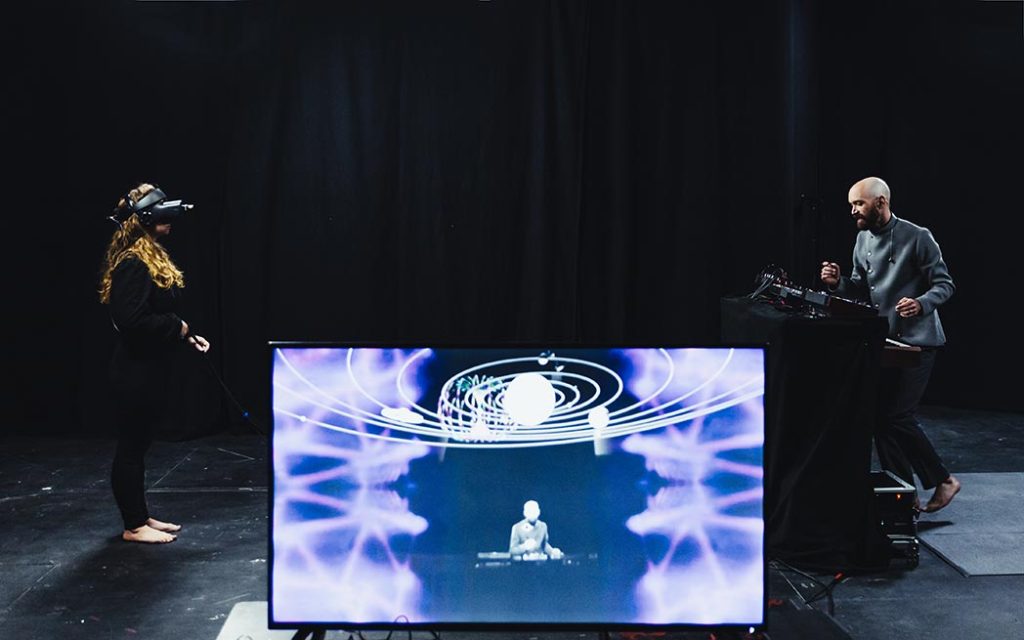
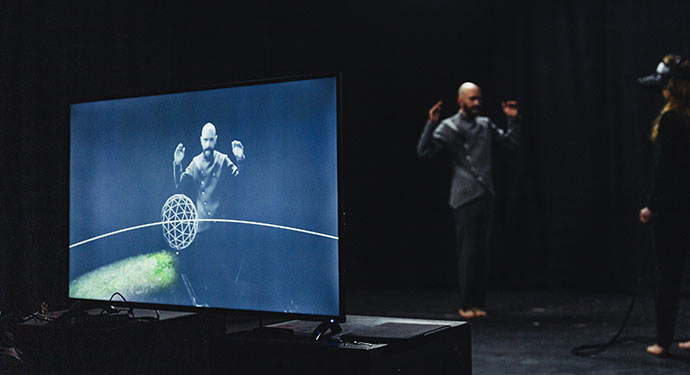
- Frequencies (February 4 to 8): A live electronic music and VR performance exploring grief, memory, and the connection between two brothers.
- The Healing (February 17 to 22): Immersive dance-theatre tracing a woman’s journey from a difficult childhood to adulthood, examining identity, inheritance, and letting go of the past.
- Holes (February 8): A staged reading about love, madness, and survival, following an amnesiac struggling to make sense of his life.
- Lay Down All Dogs (February 21): A tense new play about two sisters confronting family secrets and the cost of protecting their home.
- Confabulation Presents: The Shortest Story (February 14): A fast-paced evening of two-minute true stories shared by up to thirty Montreal storytellers.
Last year’s festival drew record-breaking audiences, and this season’s bill is expected to be just as popular.
centaurtheatre.com/winterworks-2026
In the Q&A below, Rebecca Gibian speaks about the festival. Marie Barlizo, who wrote The Healing and its choreographer Hanna Kiel; Jojo O’Neil, who penned Holes and director Christopher Morris; and Carter Gulseth, the director of Lay Down All Dogs, speak about their productions and how they are preparing them for the stage.
WM: What was your vision for WinterWorks 2026?
Gibian: WinterWorks, as the evolution of Wildside, has become about showcasing ambition and innovation in performance. Every year we receive a wide-range of applications, and I let that mandate – to give our audiences a chance to see theatre in perhaps a brand-new way – guide me. This year’s lineup is a great example of that, with Frequencies being part live techno music concert, part autobiographical confessional, part VR creation; or Aaron Jan‘s setting of Marie Barlizo’s The Healing, expressing her play through pre-recorded audio as underscoring for contemporary dance.
‘WinterWorks, as the evolution of Wildside, has become about showcasing ambition and innovation in performance. Every year we receive a wide-range of applications, and I let that mandate – to give our audiences a chance to see theatre in perhaps a brand-new way – guide me.’
– Rebecca Gibian, WinterWorks Curator
WM: How do you choose which shows to include in the festival?
Gibian: Above all, I look for performance projects that seem to – whether deliberately or not – be engaging with what the form of theatre is, or could be. How is this story told? I find myself drawn to work that feels enticing from that perspective, and I can get excited about introducing our Centaur audiences to it, as well as our growing WinterWorks audience.
WM: What connects these diverse works under one festival umbrella?
Gibian: Above all, they are linked through this engagement with the form, but from there, other connections are made organically – often without my intentional curation – like two very different dishes, from different places and processes, that somehow complement each other perfectly. This year, our two main productions explore family connections and the impact of one particular family member on the artists’ lives. Our readings are then offered as a kind of amuse-bouche for the avid theatre enthusiast; a kind of double-feature that allows our audiences to get the chance to discover the work of two exciting emerging playwrights, also engaging with this question of form, before the performance of either production.
WM: What inspired you to write this play?
Barlizo: The Healing is inspired by my challenging relationship with my dad, who was an alcoholic and suffered from mental illness. Almost losing my dad forced me to confront my anger and resentment towards him. Now that I’m a parent, I realize how much I inherited my dad’s fears. With The Healing, I examine what we inherit from others, what we need to confront in ourselves to move forward and release. In exploring this experience, I hope to draw attention to the taboos and stigmas and cultural norms of secrecy around mental health and addiction in Asian culture.
WM: How closely did you partner with the choreographer in shaping the show?
Barlizo: I was first introduced to Hanna Kiel, the choreographer, by Aaron Jan, the director of The Healing, two years ago, when I workshopped the play for a week with a director, a choreographer, a dramaturg, actors, and designers at Native Earth Performing Arts in Toronto. Aaron wanted to do a dance show of The Healing, with two contemporary dancers, scored by my text over pre-recorded audio. Since mental illness and addiction are rarely explored on Canadian stages from an Asian perspective, and when they are, it’s usually through traditional realism. But with dance, it’s more sensorial and oppressive.
‘With The Healing, I examine what we inherit from others, what we need to confront in ourselves to move forward and release. In exploring this experience, I hope to draw attention to the taboos and stigmas and cultural norms of secrecy around mental health and addiction in Asian culture.’
– Marie Barlizo, playwright, The Healing
Part of the process with Hanna was embodying the characters of my play through the movement she choreographed, and I was able to connect more deeply with my work. Before, I felt a little disconnected, and the work lived in my head. Since the play is an autobiography, I wanted perspective, but in doing so, I wasn’t getting to the heart of my story. But being in the room with Hanna and Aaron and moving physically through the scenes allowed me to get to the truth and dive deeper into my work.
WM: How would you describe the creative process of developing the choreography for this production?
Kiel: The process begins with Aaron’s vision. He describes the movement style, imagery, and intention, and when needed, I ask questions to clarify – such as what words define a specific moment, or whether the movement should be abstract or literal. From there, I propose a movement draft, and Aaron responds, and we continue building through exchange.
WM: How did movement and music work together to amplify the play’s message?
Kiel: With Healing, Aaron, Ashley, and I work collaboratively to balance each element. We consider how movement, music, and text can each serve the purpose of a section, allowing the combined layers to support Aaron’s vision and deepen the play’s emotional arc.
WM: Unlike words, dance conveys emotion physically. What is the key to expressing complex ideas through movement?
For me, it begins with understanding the intention behind difficult-to-articulate emotions. Text can describe feelings, but often the body reveals the opposite truth. Movement becomes not just texture within the play – it becomes a form of bodily text that expresses what words cannot.
WM: How did you prepare to write Holes?
O’Neil: I began writing this play during my second year studying Playwriting at the National Theatre School of Canada. The writing process for me began in early/mid 2024, though I would say the play has changed many times, with massive rewrites over the past two years. I was struggling to write, unable to articulate exactly what I wanted to say in the piece. I remember sitting down with my dramaturge, Andrea Romaldi, during one session early in the process, saying, “I just want to write something that makes everyone angry”, though I didn’t understand at the time why that was, or where those feelings were emerging from. Slowly, I realized I was angry, and I didn’t want to be alone, wrestling with my own shadow. I wanted to use this play as a space to shine a light on something I couldn’t look at on my own.
‘My anger stemmed from the recent passing of my paternal grandmother to a combination of Alzheimer’s and Dementia… I’ve long struggled with a fear of “going crazy”, and experiencing her passing propelled that fear to the point of obsession. This play became a space for me to explore some of these feelings.’
– Jojo O’Neil, playwright, Holes
My anger stemmed from the recent passing of my paternal grandmother to a combination of Alzheimer’s and Dementia. Towards the end, she stopped recognizing who I was and fell into psychosis. I’ve long struggled with a fear of “going crazy”, and experiencing her passing propelled that fear to the point of obsession. This play became a space for me to explore some of these feelings. As a trans woman, I’m often curious about the space between my perceived reality and the “common” or “shared” reality of those around me. My ears swell from the volume of anti-trans rhetoric, claiming that trans people like myself are experiencing delusions, living in a state of psychosis, or have neurological disorders. My grandmother’s passing fueled these anxieties, sending me into a full-blown panic. Writing this play was both cathartic and maddening, but I think it was necessary.
The play was first presented as a staged reading in 2025 at The National Theatre School. Christopher Morris played Murphy, who no longer appears in the script. Following the reading, he approached me about pitching the play for Winterworks, taking on the role of director and dramaturge for this staged reading at The Centaur.
WM: What do you hope audiences will take away from the show?
O’Neil: The play is a love letter for those who have been deemed “crazy,” for those who have been made to feel unlovable for the shadows that trail behind them. Theatre is a place to lean into fear – not only to confront or question it, but to sit with it, together, in a dark room full of strangers sharing a story. It’s a space to imagine truth in all of its (sometimes) horrific forms.
This play, for me, at this time (as it is still in development), asks how we can protect ourselves and the ones we love in a world that offers us none. Using memory, especially fraught memory, as a structure, I’m exploring how we can not only live in a world that deems our lives unlivable or “deluded,” but also prosper and thrive in a world that seems hopeless.
WM: How did you prepare to direct the reading?
Morris: During the 2024/25 school year, I taught the playwrights at the National Theatre School. Jojo was one of my students, and I got to become familiar with Jojo’s work and how she views the world. During that year, I was hired as an actor to participate in a reading of an earlier draft of Holes. Experiencing the play from the inside gave me an understanding of what it’s like to live inside one of Jojo’s characters. During the readings, I also had the chance to hear the play read aloud numerous times, which is important for understanding a play. Plays are unique forms of writing because they are meant to be heard; they’re spoken texts. Hearing Jojo’s powerful words revealed the play’s structure and the dynamic way Jojo is choosing to tell her story. These experiences are influencing how I’ve prepared to direct this reading.
‘I was hired as an actor to participate in a reading of an earlier draft of Holes. Experiencing the play from the inside gave me an understanding of what it’s like to live inside one of Jojo’s characters.’
– Christopher Morris, director, Holes
WM: How is directing a staged reading different from a full production?
Morris: Whether directing a reading or a full production, the goal is to make the story as clear as possible for the audience. In Holes, the audience goes on a journey with the protagonist, who is trying to make sense of the fractured world around him, and sees the world as Andrew does. Therefore, they’re also trying to make sense of the play’s world, and there’s a tension in the writing between what information is revealed to them and when. In a full production, you may have four weeks with the actors to really craft this journey for an audience. You can also use the visual language of design to enhance this. Jojo and I feel strongly that lighting will play a powerful role in a future production. But with a reading, we may have only six hours total of rehearsal time and little to no design elements. So as a director, it’s important to be very direct and clear when talking with the actors. To use economical language. And to give the actors one large, clear objective they can play for the whole reading. Doing this can help make the reading an exciting experience for the audience.
WM: How did you work with the play and actors during this process?
Morris: I have yet to work with the actors, but we have a five-hour rehearsal next week. As Jojo continues to explore this text, I have read a recent draft, and last week we had a meeting to discuss what Jojo has written. Jojo will share a new draft with me this week, and we will discuss it again. Writing a play is a long process, punctuated by readings like these that inform the writing of new drafts. I see this reading as an extension of the work I’ve been doing with Jojo throughout the year I taught her. I’m honoured to be included in this part of Jojo’s journey in her play.
WM: How did you prepare to direct Lay Down All Dogs?
Gulseth: I participated in a workshop for this play while I was a student at the National Theatre School. That was when I first started to think about how a staging of Lay Down All Dogs might look. As such, I have spent a lot of time examining the text to determine what is essential to the audience and what isn’t. What we’re putting on, after all, is a staged reading, not a full production. The work then becomes about what is needed. Which sound cues can evoke the fully built set we do not have, and so forth. Our reading will be about giving the audience the chance to imagine a fully staged production without fully staging it.
WM: Can you describe the play in your own words?
Gulseth: The play is a mediation on what is owed, and to whom. It asks how much we can actually lay claim to the stories we have been told of our past, both recent and distant. By examining the long-deferred reunion of two sisters in the wake of their father’s death, this play is about responsibility: who is responsible for the sins of the past, and on whom should the burden of cleaning them up fall?
By examining the long-deferred reunion of two sisters in the wake of their father’s death, this play is about responsibility: who is responsible for the sins of the past, and on whom should the burden of cleaning them up fall?
– Carter Gulseth, director, Lay Down All Dogs
WM: How did you collaborate with the playwright during this process?
Gulseth: As a very close friend of the playwright and an actor in the reading, I have spent a lot of time with her discussing the morality of each character. That seems to me to be the most essential component of the story. We’ve done a lot of work mapping out these characters, their motivations, and how they all fit into the universe she has created. We’ve had many passionate arguments about morality and who the villain is. In my personal opinion, nobody in the world of this play is acting out of malice, but there are a lot of questions to be asked about who is right and who is not. Sometimes the people who have the most right to something are the least palatable, which can be an uncomfortable truth if you’re the sort of person who believes that goodness and truth are always the same thing.
Images: Scenes from Frequencies – James MacLean Photography

Other articles by Irwin Rapoport
Other recent articles

Irwin Rapoport is a freelance journalist and community advocate from Westmount with bachelor’s degrees in History and Political Science from Concordia University. He writes extensively on local politics, education, and environmental issues, and promotes informed public discourse and local democracy through his writing and activism.