
From factory floors
to feminist mobilization
The JOC helped pave the way for Quebec’s Quiet Revolution by nurturing generations of young organizers
March 29 2026
At a time when so much public debate revolves around the housing crisis, precarious work and an uncertain future for young people, a Quebec documentary brings back into the spotlight a movement that, starting in the 1930s, taught thousands of young people how to organize, speak out and change society.
Voir – Juger – Agir : L’histoire de la JOC au Québec (See – Judge – Act: The History of the JOC in Quebec), directed by Annie Deniel and produced by André Vanasse, is now playing in theatres across Quebec. Over nearly a century of commitment within the Jeunesse ouvrière catholique (Young Christian Workers, JOC), the film shows how young people, often from modest working‑class backgrounds, helped to prepare modern Quebec – long before anyone spoke of the “Quiet Revolution” – acting as forerunners of the major labour and feminist mobilizations to come.
The film tells the story of how young people, often from humble origins, helped lay the groundwork for modern Quebec well before the Quiet Revolution began.
It takes us from church basements – where meetings, study circles and cultural activities were held – to labour struggles, union assemblies and feminist mobilizations. Drawing on previously unseen film and photographic archives from BAnQ, as well as testimonies from former Jocists, scholars and activists, it reconstructs a network of local initiatives that, taken together, left a profound mark on Quebec society.
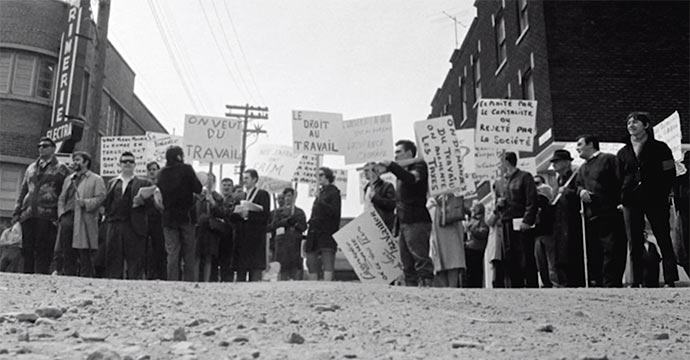
Image from the film Voir – Juger – Agir : L’histoire de la JOC au Québec
Underneath it all, a genuine culture of protest starts to emerge: questioning injustices at work, criticizing power relations in both the Church and the factory, and asserting a young working‑class voice that refuses resignation.
A movement born in workshops and factories
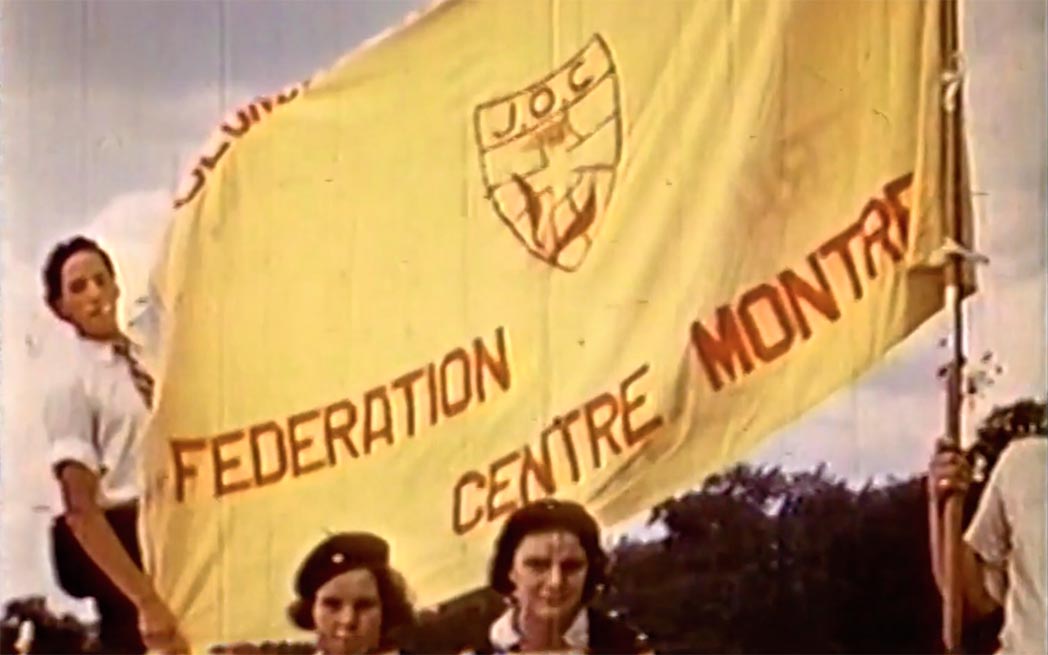
The JOC was founded in Belgium in 1925, in the turbulent years between the two world wars, under the impetus of Father Joseph Cardijn. The movement quickly spread, especially to France and then to Quebec, where it took root as early as 1932. At the time, many young people left school early to go and work in workshops, factories, construction sites and small shops. Working conditions were harsh, social protections were limited, and the working class was often pushed to the margins of economic, political and religious power.
‘At that time, a large proportion of young people left school early to join workshops, factories, construction sites and small shops.’
It was precisely to these young workers that the JOC reached out. Its key insight was summed up in a phrase: “the apostolate of like toward like.” No longer would notables or clergy speak on behalf of working‑class youth; instead, young workers themselves would train one another, learn to speak out and organize to defend their rights. The goal was not primarily to fill the churches, but to “Christianize the workshop before making Christian workers in the workshop” – in other words, to humanize the workplace, fight exploitation and insist on dignity.
From church basement to public square
Although it is often absent from the grand narratives of our history, the JOC nonetheless planted decisive seeds: the birth of a more modern trade‑union movement, greater awareness of inequality, the promotion of social justice, and the emergence of leaders who would go on to play key roles in unions, community organizations and politics.
From parish church basements to bargaining sessions, the documentary shows how this school of popular education helped prepare the ground for a more combative, more democratic kind of trade unionism, centred on the dignity of workers. Many of the key figures of the Quiet Revolution first learned, in the JOC, how to chair a meeting, write a leaflet, carry out a survey in their workplace or stand up for a co‑worker in front of a stubborn employer.
Over the decades, the spirit of contestation carried by the Jocists – against exploitation, low wages and substandard housing, but also against the roles imposed on young women – gradually linked up with other centres of mobilization. It began to nourish struggles that went far beyond the strictly Jocist framework and helped shape the practices of many unions and social movements, as large numbers of activists trained in the JOC and in the JOCF went on to play active roles in major labour federations and workers’ associations, weaving from within strong, lasting ties between the Jocist movement and Quebec’s major union organizations.
At the heart of the movement lies a simple but remarkably effective method, which gives the film its title: see – judge – act. It starts from concrete reality: unfair working conditions, inadequate wages, substandard housing, the isolation of young people, and discrimination. Time is taken to “see,” to observe, to collect and analyze facts, often through surveys carried out by young people themselves in their neighbourhood, factory or store.
Next comes the time to “judge,” in the sense of examining what has been observed in light of one’s values – the Gospel for those who are believers, but also the major social questions of the day. The goal is to understand why these injustices persist, who benefits from them and what changes might be possible; then the group moves to action by developing a common strategy, whether that means a public campaign, putting pressure on an employer, union action or a community initiative.
This pedagogy of action makes the JOC a true school of popular education. Commitment here is not about applying instructions handed down from above, but about building shared responses to lived injustice. For many young people, it is their first chance to learn how to speak in public, work as a team, take on responsibilities and discover their own capacity to act.
From mass movement to international stage
After the Second World War, the JOC became a mass movement in several countries. Huge gatherings brought together thousands of young people, and an international coordinating body was created: the Jeunesse ouvrière chrétienne internationale (International Young Christian Workers, JOCI). Activists from Quebec played an active role, bringing with them their experience of local struggles, particularly in industrial and urban sectors.
The documentary shows how the Quebec JOC helped build bridges between North and South, raising young people’s awareness of global issues such as colonialism, development and human rights, and exporting its know‑how in collective rights defence, negotiations with employers and democratic participation in the workplace.
At a time when economic globalization was just beginning to take shape, these international networks were already foreshadowing new forms of cross‑border solidarity. This way of confronting reality with a socially engaged reading of the Gospel would later inspire, especially in Latin America, a current of “popular Church” deeply involved in social struggles.
When young women find their voice
One of the JOC’s most important contributions, highlighted in the film, is the role of its women’s branch, the Jeunesse ouvrière catholique féminine (JOCF). In a context where women were largely confined to domestic roles or low‑status jobs, the JOCF offered a new space for expression and political learning. There, young women spoke about work, but also about family life, sexuality, access to education and personal freedom.
‘Women activists from Quebec played an active role there, bringing with them their experience of local struggles, especially in industrial and urban settings.’
By encouraging young women to become socially involved, to speak in public and to challenge stereotyped roles, the JOCF directly contributed to the feminist mobilizations that would mark the following decades. Once again, the movement acted as a kind of nursery: many activists who later played important roles in women’s organizations, unions or community groups first learned the basics of organizing within JOCF teams.
Several young women who passed through the JOCF would later leap into politics, some becoming members of provincial legislatures, cabinet ministers or mayors. Trained early in debate, negotiation and organizing work, they brought into parliamentary and municipal arenas the habits they had acquired in the JOCF: starting from the lived reality of working‑class communities, building collective demands and defending, from within institutions, a more just vision of relations between women and men.
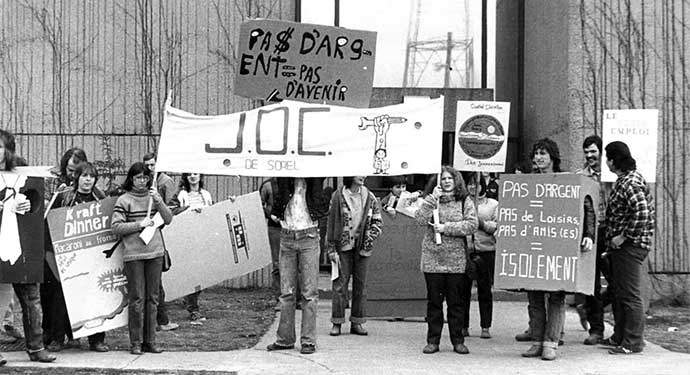
From the 1980s onward, the JOC, like many other movements rooted in the industrial working class, saw its membership decline. De‑industrialization, the rise of the service economy and increasingly individualized life paths profoundly transformed the world of work. But the film shows that, far from disappearing, the JOC reinvented itself in response to new forms of precarity: temporary jobs, involuntary part‑time work, the gig economy, long‑term unemployment and early school leaving.
A living memory for today’s audience
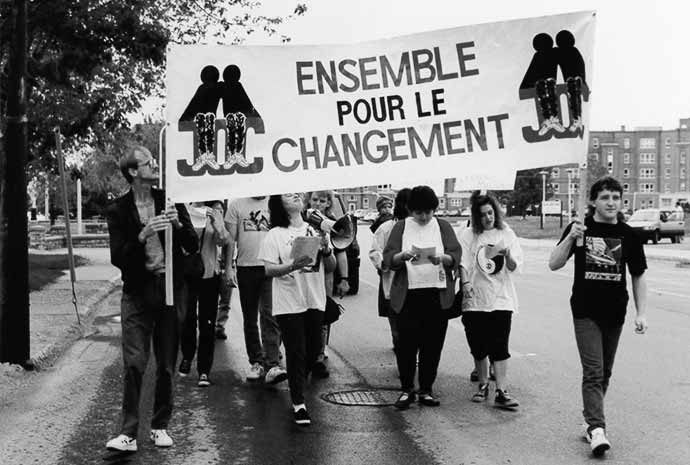
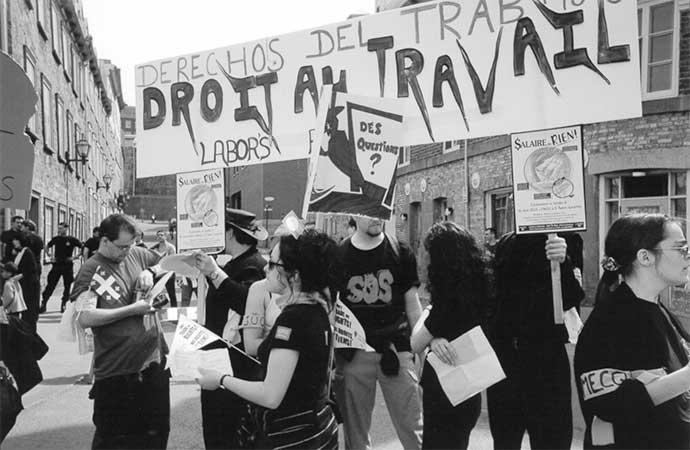
Collective engagement has refocused on defending decent work and a dignified life for young people, whether they are employed, studying, unemployed or in transition. The movement’s gatherings and its campaigns on dignity at work or on the rights of unemployed youth fit into a clear continuity: giving a voice to those who are rarely heard, building demands, putting pressure on decision‑makers and maintaining a critical eye on changes in the labour market.
‘Far from disappearing, the JOC has reinvented itself in response to new forms of precarity: temporary jobs, involuntary part‑time work, the gig economy, long‑term unemployment and early school leaving.’
The film does not simply tell the story of the past; it also raises a very contemporary question: what does it mean, for a young person today, to see, judge and act in a world marked by the climate emergency, widening inequality and the erosion of social protections?
In the background, it suggests that the Jocist method remains surprisingly relevant: looking with clear eyes at what is happening in one’s neighbourhood, school or workplace, putting words to the injustices that shape everyday life, and then, together with others, finding ways to move from diagnosis to collective action – whether by organizing for better working conditions, defending the right to housing or engaging in ecological struggles.
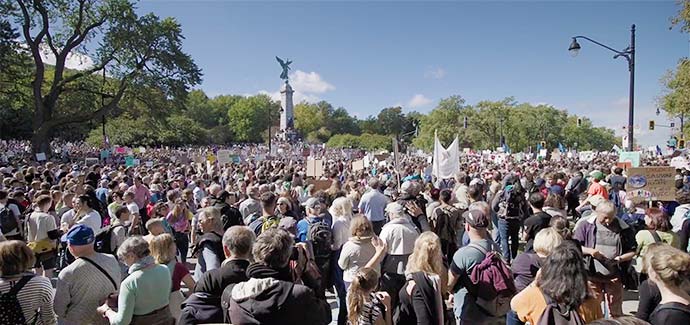
Image from the film Voir – Juger – Agir : L’histoire de la JOC au Québec
By letting former and current JOC members tell their stories, the film underlines that real social change rarely comes from dramatic top‑down gestures, but from steady, low‑profile work in ordinary places where young people compare experiences, call injustice by its name and learn to act together.
A legacy that still matters
Over the past century, the JOC has been far more than a youth group for thousands of young people: it has been a genuine school of civic, union, community and even church‑based engagement. It has helped connect faith, social justice and collective action, and has allowed many participants to develop a political awareness and self‑confidence that have lasted well beyond their years in the movement.
At a time when many people are wondering how to rekindle a sense of the common good and solidarity between generations, the story of the JOC – and the film that tells it – invites us to reconsider our own relationship to engagement. See – Judge – Act reminds us that there is no age limit on learning how to turn indignation into action, and that the experiences of young workers from the last century still have much to say to today’s youth and to society as a whole.
Images : Fonds Jeunesse ouvrière catholique, Bibliothèque et Archives nationales du Québec




 March 31, 2026" />
 Southern Italian Retreat" />

 tomorrow’s leaders" />
 to feminist mobilization" />
 Brooke Avenue" />
 Literary Festival" />
 Inspection process" />
 A month of music in April" />
 A field report on aging" />
 be more independent" />

 Windsor Avenue" />
 groove and flamenco" />
 becoming Epic Fiasco" />
 horses for slaughter" />
 How to acquire warranty" />
 and tears of joy" />
 Montreal Museum of Fine Arts" />
 takes a stand again" />
 Mint and parsley dog cookies" />
 your public speaking skills" />
 Thornhill Avenue" />
 Glasnost & Perestroika" />