Will Monday’s election revive referendum politics or deliver a Liberal minority government?
By Irwin Rapoport
October 2, 2026 • Opinion
In 1348, as the Black Death (bubonic plague) was spreading throughout Italy and killing thousands of people by the day, a priest jotted in his journal that the plague would soon hit his parish, and all he could do was prepare for its arrival to give last rites for the dying and comfort the families of the deceased. A few weeks later, the disease claimed his life and devastated his flock and community.
That feeling of dread and helplessness mirrors the feelings of the 70 percent of decided Quebec voters who fear Parti Québécois leader Paul St-Pierre Plamondon will succeed in forming a minority or majority government on Monday and fulfill his vow to hold a referendum for Quebec to separate from Canada after American President Donald Trump’s second term ends in January 2029.
The Parti Québécois remains ahead in recent polls, but its support has generally remained below 30 percent of decided voters. That does not diminish the PQ’s prospects under Quebec’s first-past-the-post electoral system. It does, however, underline the central dilemma facing voters who want Quebec to remain in Canada: should they rally behind Charles Milliard’s Quebec Liberal Party, Éric Duhaime’s Conservatives, Christine Fréchette’s Coalition Avenir Québec, or simply vote for the party that most closely reflects their broader political convictions?
For many voters, particularly in the English-speaking, cultural and business communities, that question has become more urgent because St-Pierre Plamondon has been unequivocal. Should the PQ form government, he intends to hold a referendum on Quebec sovereignty during its first mandate—after U.S. President Donald Trump’s second term ends in January 2029.
The PQ’s position is not new. What has changed is the party’s apparent capacity to turn a plurality of votes into a majority of seats.
A fragmented election
Late-September polling placed the PQ at approximately 29 to 30 percent among decided voters. The Liberals were generally in second place, though their support varied significantly from one survey to another. The CAQ and the Conservatives were competing for third place, while Québec solidaire remained in the low teens.
The variation between polls is important. Quebecers are not marching toward Monday’s vote in lockstep. One recent survey found that roughly 40 percent of respondents were either undecided or said they could still change their minds. That makes the race more volatile than the topline numbers suggest.
Monday’s provincial election has become a test of whether Quebecers opposed to another sovereignty referendum can overcome the fragmentation of the federalist vote.
Still, the seat projections should concern those who oppose a third referendum. A recent QC125 projection cited in media coverage gave the PQ 67 seats—three more than the 64 required for a majority in the 125-seat National Assembly. The Liberals were projected to win 37 seats, the Conservatives 15, Québec solidaire eight, and the CAQ none. The PQ’s projected range was broad, from 54 to 77 seats, demonstrating both its potential strength and the uncertainty still hanging over the campaign.
A projection is not a prediction. Yet it illustrates the danger for federalist voters: a party with less than 30 percent of support can still win a majority government when its opponents divide the remaining vote among four parties.
The key question is whether enough francophone voters who oppose sovereignty will cast strategic ballots for Liberal candidates in ridings where the Liberals are competitive—or support Conservative candidates in areas where Duhaime’s party is the strongest alternative to the PQ.
The Liberal and Conservative cases
Charles Milliard has framed the election as a referendum on whether Quebecers want another referendum. In a recent Corner Booth podcast, he told voters that the referendum vote is “Monday, not in three years.” It is a simple and effective message. Whatever voters may think of the Liberals’ past record, party organization or campaign missteps, Milliard is asking them to concentrate on what he considers the immediate political danger: a PQ government with a mandate to reopen the constitutional and national-unity debate.
Milliard has also sought to distinguish the Liberals on language policy. He has said a Liberal government would repeal or amend portions of Bill 96 that have created uncertainty for English-language educational institutions, businesses and minority-language communities. He has specifically criticized restrictions affecting enrolment in English CEGEPs and universities, as well as measures that could affect funding and tuition arrangements for English universities.
On Bill 21, the Act respecting the laicity of the State, and Bill 94, he has said he would await the Supreme Court of Canada’s ruling before deciding on further action. That position may disappoint some voters who want an immediate commitment, but it at least recognizes that constitutional litigation and legislative action must be approached carefully.
A projection is not a prediction. Yet it illustrates the danger for federalist voters: a party with less than 30 percent of support can still win a majority government when its opponents divide the remaining vote among four parties.
Duhaime, meanwhile, is making a different case. His campaign has been disciplined, energetic and consistent. He is seeking to become the balance of power in a minority National Assembly, while presenting himself as a defender of Quebec autonomy, lower taxes, reduced government intervention and greater private-sector participation in health care and economic development.
In a CTV News interview, Duhaime said he would support a minority government on a case-by-case basis, while opposing a sovereignty referendum. He has also reached out directly to Quebec’s English-speaking community, arguing that the Conservatives—not the Liberals—are now the strongest anti-PQ alternative among francophone voters.
That may be true in some regions and some ridings. But it is not a province-wide certainty. The Conservatives can gain support from CAQ and PQ voters drawn to Duhaime’s nationalist, anti-establishment message, while the Liberals remain the principal federalist party in Greater Montreal and in many communities where language rights, education, health care and institutional stability are central concerns.
The political risk for both parties is obvious. If Liberal and Conservative supporters keep trying to make a statement rather than assessing the local race, they may help the PQ win seats by pluralities rather than majorities.
Minority-government scenarios
A PQ minority government would create an unpredictable National Assembly. Duhaime has made clear that he would oppose a referendum. If the Conservatives held the balance of power, they could complicate St-Pierre Plamondon’s plans and force the PQ to negotiate issue by issue. A Conservative caucus of 10, 15 or more MNAs could become a serious parliamentary force, particularly if the PQ fell short of a majority.
Québec solidaire presents a different calculation. The party is pro-independence, but it also has a distinct progressive agenda and has often sought to differentiate itself from the PQ on social, environmental and economic policy. A PQ minority government could not assume QS support on every issue. Still, if QS held enough seats to influence confidence votes, it could seek major policy concessions in exchange for supporting legislation or allowing a PQ government to survive.
The political risk for both parties is obvious. If Liberal and Conservative supporters keep trying to make a statement rather than assessing the local race, they may help the PQ win seats by pluralities rather than majorities.
The CAQ is fighting for political survival. Some projections have placed it at or near zero seats, an extraordinary possibility for a party that won two successive majority governments under François Legault. Even a small CAQ caucus, however, could matter in a narrowly divided National Assembly.
Fréchette has described herself as an autonomist. During the campaign, she declined to say how she would vote in a PQ referendum, arguing that her personal position was not the issue before voters. That may be politically understandable, but it leaves an important question unanswered: how would a reduced CAQ caucus respond if a PQ government sought legislative support for a referendum process?
A province facing fiscal realities
The referendum question has dominated the final stretch of the campaign, but Quebec’s next government will face substantial fiscal challenges regardless of who wins. The Quebec government’s 2025–26 budget projected an accounting deficit of $11.4 billion. After deposits of dedicated revenues in the Generations Fund, the deficit under the Balanced Budget Act was projected at $13.6 billion, or 2.2 percent of GDP. The government also projected debt-servicing costs of $9.7 billion.
These numbers are not abstract. Every dollar spent servicing debt is a dollar unavailable for hospitals, schools, housing, infrastructure, municipal partnerships, cultural institutions and support for vulnerable Quebecers. Milliard has emphasized his business background, practical values and the Liberal Party’s historical emphasis on economic management. He has also argued that the CAQ squandered the fiscal room it inherited from Philippe Couillard’s government.
That criticism will be debated. The CAQ can point to the pandemic, inflation, health-care pressures, infrastructure needs and economic uncertainty. But the larger point remains: the next government will not have unlimited resources to finance election promises, new programs, tax cuts, private health-care initiatives, language-policy enforcement or a major constitutional campaign.
The election promises made during the campaign must eventually confront the province’s balance sheet.
Monday’s choice
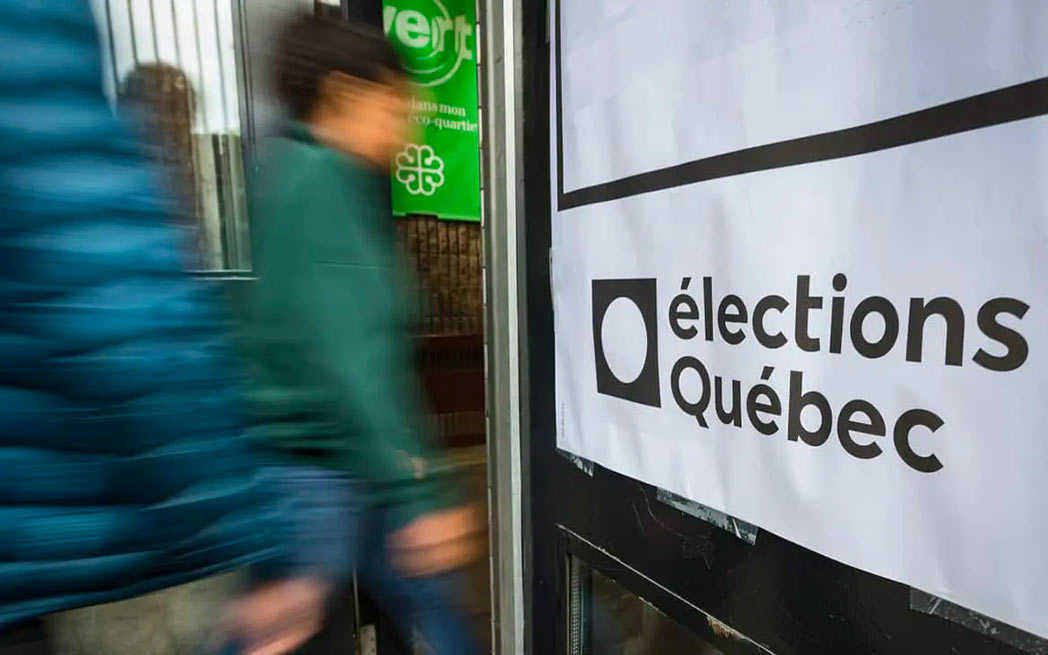
More than one-quarter of eligible voters have already cast ballots in advance polling. Élections Québec reported that 25.59 percent of eligible voters voted early between Sept. 25 and Oct. 1, a higher advance-voting level than in the 2022 general election.
The remaining voters will decide whether the PQ turns its poll lead into a majority government, whether the Liberals can form a minority administration, whether the Conservatives become a significant parliamentary force, or whether Quebec enters a period of unstable minority government and difficult negotiations.
Quebec has lived through this kind of political drama before. On Nov. 15, 1976, René Lévesque’s Parti Québécois won 71 seats with 41.37 per cent of the vote, while Robert Bourassa’s Liberals fell to 26 seats. Voter turnout was 85.27 per cent. The PQ government then held the May 20, 1980 sovereignty-association referendum. The “No” side won with 2,187,991 votes, compared with 1,485,851 votes for the “Yes” side. Turnout was 85.61 percent, with 3,738,854 Quebecers casting ballots.
The referendum question has dominated the final stretch of the campaign, but Quebec’s next government will face substantial fiscal challenges regardless of who wins.
The circumstances in 2026 are not identical to those of 1976 or 1980. Quebec’s party system is more fragmented, the electorate is more diverse, and the fiscal and economic environment is far more constrained. But the historical lesson is clear: elections can produce consequences that extend well beyond the platforms, personalities and controversies of a single campaign.
On Monday, Quebecers will not be voting directly on sovereignty. They will be choosing a government. Yet the referendum question is inseparable from that choice. If the PQ wins a majority, St-Pierre Plamondon will argue that he has been given a mandate to pursue his project. If the Liberals form a minority government, Milliard will say Quebecers rejected that path. If no party wins a majority, the province could enter a period in which every confidence vote, budget and legislative initiative becomes a test of political survival.
By 10 p.m. Monday, Quebecers should know whether the province is heading toward a PQ government, a Liberal minority, a Conservative breakthrough—or a divided National Assembly in which no party can claim a clear mandate.
Disclaimer: The opinions expressed in this article are those of the author and do not necessarily reflect the opinions of WestmountMag.ca or its publishers.
Feature image: Elections Québec

Other articles by Irwin Rapoport
RECENT ARTICLES
 Irwin Rapoport is a freelance journalist and community advocate from Westmount with bachelor’s degrees in History and Political Science from Concordia University. He writes extensively on local politics, education, and environmental issues, and promotes informed public discourse and democracy.