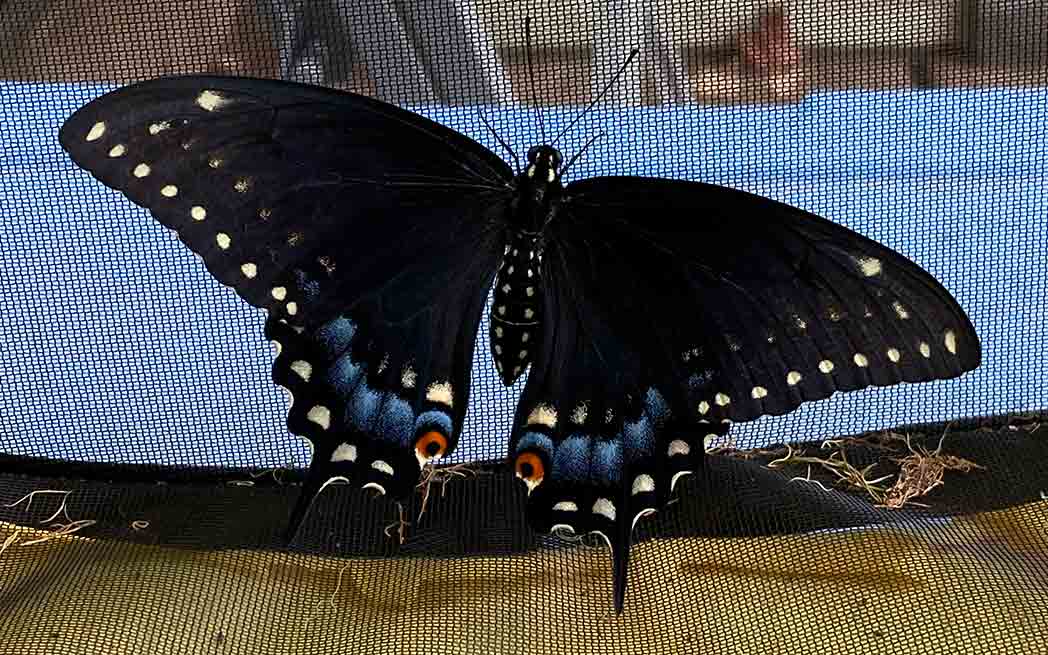
I never knew I could be so emotionally involved with an insect
By Randi Hacker
October 8, 2026
Here’s a story for you.
The Wasps
One day last year, I noticed a black swallowtail caterpillar on my parsley. It was pretty big. Big enough, I now know, to have been perhaps one day away from pupating. But I didn’t know anything about that back then.
So, the next day, when I couldn’t find the caterpillar on the parsley, I naturally thought that someone had eaten it, and, in fact, a quick internet search revealed that black swallowtail caterpillars, unlike monarch caterpillars, are tasty little morsels, delectable to birds and skinks and the occasional fox. Their toothsomeness arises from the fact that their diet consists entirely of culinary herbs, such as parsley and dill and fennel, and not, like the diet of monarch caterpillars, of toxic and bitter milkweed.
A word on pronouns: I use the pronoun “it” to refer to this caterpillar and to other caterpillars mentioned later in this story. This is because, even though a caterpillar’s gender is fixed the moment its egg is fertilized, a caterpillar’s genitalia are not readily discernible. In some species, whose caterpillars are more see-through, little red or yellow testicles of the males can be discerned through the skin if the light is just right.
The thought that my little caterpillar had been eaten before it could become a butterfly made me sad. So, a few days later, when I found a couple of other caterpillars on the parsley, I thought I would protect them, and I brought them inside. I set them up with a parsley buffet and let them eat. Which they did. Defoliating that parsely almost completely in a matter of days. I had to buy more from the local co-op.
The thought that my little caterpillar had been eaten before it could become a butterfly made me sad. So, a few days later, when I found a couple of other caterpillars on the parsley, I thought I would protect them, and I brought them inside. I set them up with a parsley buffet and let them eat.
Several days later, they started to crawl restlessly around the enclosure: trekking across the floor, up the walls, across the ceiling, up and around and down the cups that held what was left of the parsley. They were single-minded. They were relentless. They were fast. They were looking for the perfect place to pupate, and, apparently, the enclosure I had them in simply wasn’t meeting their needs. I felt guilty about that.
I had watched a video in which a woman placed an old egg carton in her enclosure, and her black swallowtail caterpillar pupated on it. So I put an old egg carton in my enclosure, but my caterpillars crawled right over it and kept on going. Next, I put a piece of cardboard in at an angle. They crawled up it and then back down. I felt guiltier.
Now, I know that, at a certain genetically mapped point, a caterpillar stops producing juvenile hormones. As I understand it, juvenile hormones send signals to the caterpillar: Eat. Molt. Grow. Poop. Repeat. After about two weeks, the juvenile hormone runs out, and the caterpillar enters the change of life. It stops eating and starts looking for the perfect place to pupate. In this quest, a caterpillar can travel as far as 60 feet in search of that idyllic spot.
 In a small enclosure, that means covering the same ground countless times before settling down.
All that evening, they crawled and crawled. I checked on them often. I went to bed. I slept fitfully, and, when I woke up, I found that each one had attached itself to a part of the enclosure, purged its digestive tract, taken on the pupa hook shape, shrunk to about half its size, affixed itself to its spot with silk it spun itself, and shed its skin. Not long afterward, they became chrysalises, and there was no more movement in the enclosure.
Outside a chrysalis, all is still.
Inside a chrysalis, however, all is whatever the opposite of still is. Inside a chrysalis, if all is going according to plan, a caterpillar’s body reduces itself to cytoplasmic jelly and, in time, reassembles itself into a butterfly’s body.
This metamorphosis can take from six days to a month or more. Or, if the days get too short, the chrysalis might decide to overwinter and open in the spring, when conditions are a bit more favourable for nectar and warmth.
My chrysalises stayed dormant more than a month. And then, one day, I came back from work and found something flying around in the enclosure.
A wasp.
A sleek, aerodynamic, beet-red wasp.
My first thought was “How did that wasp get in there?” and my second thought was “Get that wasp out of there.”
It seems that caterpillars are very attractive to parasitoid wasps, who lay an egg (or many eggs, depending on the species) in the caterpillar’s body and, when that caterpillar pupates, the wasp egg hatches; the wasp larva eats the butterfly pupa, then emerges from the chrysalis as a well-fed adult, ready to go out, pollinate, and, if it can find a mate, infect other caterpillars.
Which I did.
It seems that caterpillars are very attractive to parasitoid wasps, who lay an egg (or many eggs, depending on the species) in the caterpillar’s body and, when that caterpillar pupates, the wasp egg hatches; the wasp larva eats the butterfly pupa, then emerges from the chrysalis as a well-fed adult, ready to go out, pollinate, and, if it can find a mate, infect other caterpillars. In many species, this type of wasp has no stinger, its stinger having transformed into an ovipositor.
I pinned my hopes on the second chrysalis.
Alas.
It, too, produced a wasp.
At which point, I told myself I would never do this again, and I folded up the butterfly enclosure and put it in the garage.
But that’s not the story.
The Wanderer
This year, I found two caterpillars on my parsley. Since I now had an official black mesh butterfly enclosure that I’d purchased from the local Monarch Watch affiliate, I thought, okay, I’ll give it another go. I just wanted one butterfly. Just one. If I could have one butterfly, I’d be satisfied.
And though I couldn’t be sure they hadn’t already been infected by a wasp, I brought the caterpillars inside and put them into the enclosure with a bunch of garden parsley, and I put the enclosure on a shelf by the kitchen window.
Two days later, there were five caterpillars, three very tiny, clearly just hatched from eggs I hadn’t noticed on the leaves of the parsley they’d come in on.
But that was only the beginning. A couple of days later, there were twelve caterpillars in there: eleven who had come in on my parsley, and one who had come in on a bunch of organic parsley I’d bought from the market to shore up my dwindling supply.
It was too many caterpillars for a one-bedroom apartment with a no-pets clause
So I gave six to the local Monarch Watch. And while I was there, I bought a tall enclosure, thinking that, maybe, I’d move them all over to a bigger space.
But before I could do that, I, for some reason that I can’t recall, decided I’d put a couple of fennel plants in the garden. Black swallowtail caterpillars love fennel.
This year, I found two caterpillars on my parsley. Since I now had an official black mesh butterfly enclosure that I’d purchased from the local Monarch Watch affiliate, I thought, okay, I’ll give it another go. I just wanted one butterfly. Just one. If I could have one butterfly, I’d be satisfied.
But there wasn’t any room for it in my garden because the tomatoes and cucumber had pretty much taken over, so I transplanted the fennels into a bigger pot, put the pot down to go get the hose, and in under a minute – I kid you not – while I watched from the outdoor spigot, a black swallowtail found it, laid an egg on it, and fluttered off. I immediately grabbed that fennel and put it in the tall enclosure, because I knew that by doing so, I could successfully prevent a wasp infection.
Six days later, there were four caterpillars on that fennel. Clearly, that butterfly had gotten three by me.
I now had ten caterpillars across two enclosures.
I have to say at this juncture that I never knew I could be so emotionally involved with an insect. And yet, there I was, worrying about whether they were happy, whether they had enough fresh parsley or fennel to eat, whether the sun was too bright coming in the window, whether turning on the kitchen light before the sun rose would bother them, whether playing Mozart would have any effect on their brains and temperament, and oohing and aahing over their cunning little orange horns that emerged when something annoyed them, like my finger or another caterpillar crawling too close.
That said, as fond as I am of my caterpillars – especially when they are miniature versions of themselves, perfect, and colourful, and tiny – when you have six fifth instars, big bruisers, each an inch-and-a-half of pillowy green and yellow and black, gathered in one place, it’s a bit icky. Especially their undersides.
So I wasn’t that sorry when they started their restless pacing in search of the perfect spot to become a chrysalis.
Around the floor, they went, up the walls, across the ceiling. They crawled onto what was left of the parsley. They crawled around the edge of the cottage cheese containers that held the parsley. Then they did it all again. And even though I was prepared, it still gave me agita.
But eventually, they each found their spot, and, one at a time, they settled, they pupated, and they chrysalized.
The small enclosure got quiet.
In the tall enclosure, there was still a whole lot of eating going on, and a second fennel plant had to be brought in.
Meanwhile, outside, several caterpillars were living on and defoliating some potted parsley on the table on my deck. One of them had reached the restlessness phase and, after crawling around the perimeter of all the pots on the table and wandering up and down the parsley stalks, it disappeared altogether.
I have to say at this juncture that I never knew I could be so emotionally involved with an insect. And yet, there I was, worrying about whether they were happy, whether they had enough fresh parsley or fennel to eat, whether the sun was too bright coming in the window, whether turning on the kitchen light before the sun rose would bother them…
I wanted it to pupate on my deck, and I didn’t want it to be eaten. So my daughter and I searched for it and, a few minutes later, my daughter found it, a neon green slash, bright among the darker green blades of grass, making its way toward the house next door. Think about it: It had crawled off the table, across the deck, down four steps, across a cement pathway, and onto the lawn. My daughter picked it up, and we decided to put it in the enclosure.
Which move was immediately understood to be a mistake. This caterpillar was too peripatetic: it walked around the floor and up the walls and used the chrysalises as stepping stones. At one point, it even perched briefly on top of a chrysalis, which got annoyed and began to twitch.
We took that caterpillar out of there. But where to put it? Back on the table seemed unsafe.
As it happened, my neighbour had a big pot of parsley perched on a stand several feet off the ground and right near an exterior wall and a little garden with a broad-leafed plant on which she and I had earlier found an empty chrysalis. All of her caterpillars had taken off, so I put my nomad in the parsley in the pot. It was climbing along a tall stalk when I left it. I wish I could tell you that I saw a black swallowtail fly up from a spot nearby, but I didn’t.
This is not the story either.
The Constipated Caterpillar
Not too much later, three of the four caterpillars in the tall enclosure began, one by one, trekking. Soon they found their spots, purged, and became chrysalises. I actually saw one shimmy out of its skin and morph into its chrysalis form. It was so sci-fi.
The fourth, who had hatched last, continued to eat for another day or two, then started its own pacing. But rather than crawl relentlessly, searching, questing, seeking, it stopped periodically and ate some more. Then it took up its pacing once again.
With my newfound caterpillar knowledge, I thought that perhaps this caterpillar’s juvenile hormones simply weren’t shutting down completely, leaving it confused about whether to eat or pupate. I wondered if it would die.
The next morning, I came into the kitchen only to find the little fellow lying on the bottom of the enclosure on the floor, legs in the air.
“A caterpillar is dead,” I texted my daughter.
But when I reached in to remove it, it got up and climbed onto the edge of the flowerpot and just languished there.
“Not dead,” I texted. “But something’s wrong.“
I did an internet search for “lethargic caterpillar” and, in a stunning example of deus ex machina IRL, I found a blog about a caterpillar rancher, like me, whose own caterpillar (not a black swallowtail) had been lethargic and whose lethargy was caused by constipation.
I did an internet search for “lethargic caterpillar” and, in a stunning example of deus ex machina IRL, I found a blog about a caterpillar “rancher”, like me, whose own caterpillar (not a black swallowtail) had been lethargic and whose lethargy was caused by constipation. Caterpillars poop all the time, little round balls of sweet-smelling frass. I can only guess that this guy must’ve noticed that his caterpillar had not pooped and came to that conclusion. Anyway, he wrote, he soaked the caterpillar’s hind end in warm water, which released the poop, and that caterpillar pupated, chrysalized, and emerged a perfect butterfly.
Okay. I thought. I can try that. Why not? The caterpillar had begun to look bloated, inflated, just unhealthy.
I took the caterpillar outside but couldn’t get its rear end into the water, so I just squeezed it very gently, and do you know what? A square poop was ejected. Square and hash-marked. Like the poop of a Sphinx moth. A blockage, I thought. I put the caterpillar back in its enclosure, where it climbed a little way up one of the back walls and promptly pooped six more little frass balls in a row before letting loose its diarrheic purge. The bloating was gone, the caterpillar looked svelte, and it began crawling all over that enclosure. When I went to bed, it was still trekking.
In the morning, I found it in pupa position, hanging on the bottom side of a fennel stalk. Later that day, it shed its skin, and a few hours after that, it became an emerald-green chrysalis.
One by one, five of the chrysalises in the small enclosure emerged and flew away. South by southwest. All of them.
One by one, three of the chrysalises in the tall enclosure eclosed and, one by one, they, too, flew away: two of them south by southwest; one of them onto a tree branch to rest before it flew off. I’m afraid I didn’t see in what direction.
As for gender: We’d had three males and five females so far.
My constipated caterpillar’s chrysalis was the only one left in the tall enclosure. I watched it closely. Until it opened, I couldn’t be sure that the constipation cure hadn’t in some way harmed the genetic material or jiggled it around enough to cause feet to grow on its antennae. This is a real thing. It’s known as antennapedia.
The days passed. I began to see the wing spots through the chrysalis wall as it became more and more transparent.
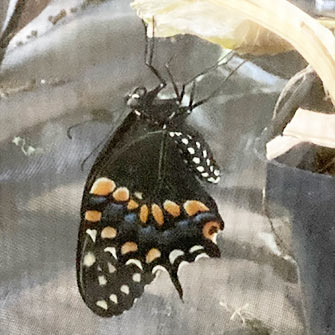
And then, one morning, I turned away for a second; I don’t remember why – toast? coffee? – and when I turned back, the nascent butterfly was there, hanging by its slender black legs from its stalk, letting its wet and compacted wings unfurl and warm up and harden. A perfect female.
An hour later, she flew away. South by southwest.
Until it opened, I couldn’t be sure that the constipation cure hadn’t in some way harmed the genetic material or jiggled it around enough to cause feet to grow on its antennae. This is a real thing. It’s known as antennapedia.
Later that day, I told the story to the young man who I’d been buying my fennel plants from. “I’m a caterpillar gastroenterologist,” I said.
And he said, “It’s a narrow field.”
And that’s the story.
Epilogue(s)
The Circle of Life
Not long after that, I walked out to check on the many caterpillars who were defoliating the fennel and parsley in my raised bed, and what did I see? A common skink with a bright green and orange and black caterpillar in its mouth. That brazen skink just stared at me as it swallowed one of my little wards.
And not long after that, I caught a parasitoid wasp, its beet-red, aerodynamic body depending from the underside of what appeared to be a caterpillar in its fifth instar, laying an egg in the little fellow’s body. The caterpillar’s horns were fully extended, but this defence mechanism was useless against such a violation. Two days later, the caterpillar was gone, either having become a snack for another skink or pupating, soon to send another wasp into the world. They’re pollinators, you know, and they also have to live.
And, finally, just last night, when I went out to check on my five remaining black swallowtail caterpillars, I found a black swallowtail butterfly hanging by its slim and delicate legs from the denuded stalk of a fennel plant. It did not fly away when I approached or when I moved. At one point, it adjusted its grip. At another point, it opened its wings, and I could see that the vibrant blue spots that marked her as a female had faded; that the blackness of her wing was uneven and, in some spots, translucent; that one of her swallowtails was gone. She folded her wings and moved no more. I’ve read in a couple of places that black swallowtail butterflies have a memory of where they were born. My fantasy? That this was one of my caterpillars who had come home to die.
She was hanging in the same spot the next morning, moving slightly in the gentle, warm breeze. And she was still there at about noon, though now her wings were wide open, something I attributed to the air current. I blew on her. Her body shivered with my breath, but she made no movement on her own. I thought, I’ll bring her in and put her in a clear container when I get back from my meeting.
But when I got back from my meeting, she was gone. Bits of tattered wing weren’t lying on the earth, the way I’d once seen bits of tattered wings lying on sidewalks and brick walls at other times. She wasn’t on the grass either. It appeared that she had flown away.
So I revised my fantasy: She hadn’t come home to die, after all; she had come home to rest, and recover, in a place that was safe. Lovely.
Oh. And as for the sixth chrysalis from the small enclosure? Well, I thought it had died too, but a butterfly expert squeezed it (gently), and it wiggled. Still alive then, and waiting to overwinter in its snug little chrysalis rather than emerge now. Given the current state of the world, can you blame it?
Oh. And as for the sixth chrysalis from the small enclosure? Well, I thought it had died too, but a butterfly expert squeezed it (gently), and it wiggled. Still alive then, and waiting to overwinter in its snug little chrysalis rather than emerge now. Given the current state of the world, can you blame it?
It’s possible that I could have one of the first black swallowtails of the spring.
Images: Randi Hacker

Other articles by Randi Hacker
Other recent articles
 Randi Hacker lives in the American Midwest.