
US tariffs on Canadian goods rise to 7.5% as trade tensions put the Canadian dollar in focus
November 17, 2026 • Advertorial
US tariffs on Canadian goods have climbed to an average of 7.5%. Here is what it means for the loonie, snowbirds and US investments. The Bank of Canada‘s latest Monetary Policy Report contains a figure that deserves more attention around Westmount dinner tables than it likely will. The average US tariff on Canadian goods is now estimated at 7.5%, up from 5.0% when the Bank last published its outlook in July. On paper, the increase looks modest. In practice, it is the clearest sign yet that trade with Washington has entered a less forgiving phase.
For Montrealers with a condo in Florida, a US brokerage account, or a child studying in Boston, all of this ultimately comes down to what the Canadian dollar will buy south of the border. Surprisingly, that number has barely moved even as the trade fight escalated. Why the loonie has held steady, and what could still knock it off course, is worth a closer look.
What changed over the summer
In July, the United States announced it would use Section 338 of the Tariff Act of 1930, a provision unused for nearly a century, to impose a 50% tariff on a range of Canadian goods. When trade talks between Ottawa and Washington collapsed, those tariffs took effect on August 22. Unlike many earlier US tariffs, they apply even to goods that qualify under the Canada-United States-Mexico Agreement.

According to the Bank’s tariff assumptions, affected categories include machinery and equipment, plastics, furniture, and wood and paper products. Washington also announced import bans on some alcohol and dairy products.
Few provinces read that list more closely than Quebec. Furniture making and pulp and paper have long been pillars of the regional economy, and the province is home to more than a third of the country’s dairy herd. Ottawa, for its part, answered with counter-tariffs on about $28 billion of US goods, aimed mostly at intermediate inputs such as steel and aluminum rather than items on store shelves.
Still, the damage is narrower than the headline suggests. Around 80% of Canadian goods exports to the United States still cross the border tariff-free, and crude oil, potash and critical minerals are exempt from the new tariffs. The pressure is real, but it falls on specific industries rather than the whole economy.
A currency that has kept its composure
Given the escalation, a sharp slide in the loonie might have seemed inevitable, but so far that hasn’t happened. The Bank noted that the Canadian dollar weakened somewhat as the US dollar strengthened, then recovered to around 71 US cents, exactly where its July projections had placed it. Early November trading kept it in the same neighbourhood.
Anyone following USD/CAD on a forex trading app, rather than waiting for the rate posted at a bank branch, will have watched this unfold in real time. When Canada’s retaliatory measures took effect in September, the loonie dipped to its weakest level in about three weeks before steadying.
Oil is part of the story, though not in the usual way. Crude remains expensive, and a commodity-linked currency like the loonie would normally get a lift when energy exports earn more. This time, the Council on Foreign Relations noted that the loonie has remained near historic lows even as oil prices have climbed.
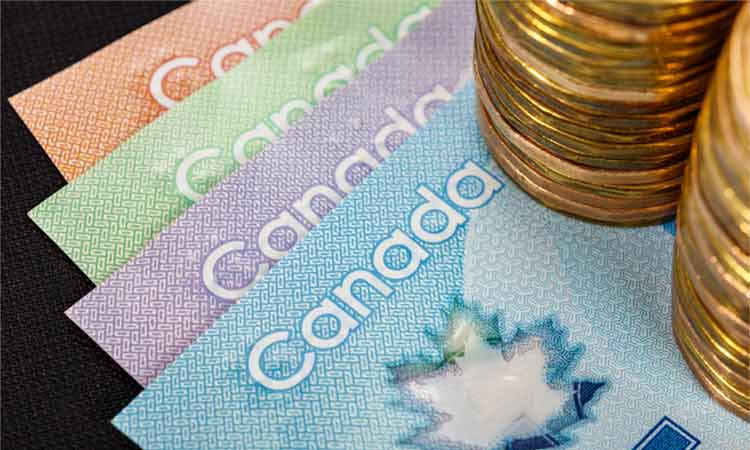
A weaker loonie isn’t all bad news, though, as it makes Canadian goods cheaper for American buyers, which helps cancel out part of what US tariffs add to their price. The Council on Foreign Relations pointed to Windsor, Ontario, as a telling case. Unemployment in the auto-dependent city jumped three percentage points after the first round of tariffs in 2025, then largely recovered as manufacturers adapted, with the weak currency helping to offset the cost of duties.
Why the Bank of Canada’s hike matters for the loonie
The loonie has also had help from the Bank of Canada. In late October, rather than cutting rates to cushion the tariff blow, the Bank raised its policy rate by a quarter point to 2.5%, its first increase since 2023.
The motive was inflation, which high fuel prices have pushed to around 3%, and the Bank expects it to reach about 3.5% by year-end. For the currency, though, the effect is what counts. Exchange rates tend to follow the gap between Canadian and American interest rates, and for much of the past year that gap has weighed on the loonie. A higher Canadian rate narrows it, making Canadian deposits and bonds a little more attractive to global investors. The Bank also signalled that a further increase is possible, which could add to that support.
The US Federal Reserve complicates the picture, however. It raised its own rate in September to a range of 3.75% to 4% and has signalled more increases, so even after the Bank’s move, US rates remain 1.25 to 1.5 percentage points higher.
That leaves the Bank in an awkward position, since the same tariffs that threaten exporters are expected to slow growth this quarter, and a weaker economy would normally argue for lower rates. For now, though, the Bank has made bringing inflation down its priority, even at the risk of further slowing the economy.
What it means closer to home
For most households, the clearest effect is that the Canadian dollar buys less in the United States than it did at the start of the year. Snowbirds heading to Fort Lauderdale or Hallandale for the winter, for example, will find that C$1,000 now converts to about US$710, compared with roughly US$740 in January, when the loonie touched 74 cents.
On the other hand, Canadians holding US stocks have benefited since a weaker loonie boosts the Canadian dollar value of American investments. Anyone planning a large conversion, such as a property purchase or tuition, may prefer to spread it over several months so the rate averages out rather than relying on a single day when the loonie might be weak.

How long the loonie stays at this level will depend largely on the trade talks, which have intensified in recent weeks. Recent reports suggest negotiators are close to a deal, even as Ottawa insists its position has not changed since August. Prime Minister Mark Carney said on November 3 that both sides had made progress, adding, “We haven’t finished.”
An agreement rolling back the Section 338 tariffs could lift the loonie, while a further breakdown would likely test it again.
Signals worth watching into the New Year
A few signals are worth watching in the months ahead. The trade talks are the most obvious, but oil prices matter too, as does the Bank of Canada, which will make its next rate decision on December 9 and publish a fresh outlook in late January. The Federal Reserve’s next moves will also count, given how much the gap between Canadian and US rates weighs on the loonie.
None of these will settle the question on its own, but together they will go a long way toward deciding whether 71 cents proves to be a floor, a ceiling or simply a resting place for a currency that has weathered more than its share of uncertainty.