
Downtown Montreal
needs a new public school
Young families in the Peter McGill district continue their campaign for an elementary school
By Irwin Rapoport
December 4, 2025
Over the years, recent City of Montreal administrations have formulated policies to increase the number of residents living in the downtown area (Ville Marie Borough), which includes families with school-age children, elementary and high school. These initiatives have succeeded to a certain extent with the construction of new condo towers on repurposed parking lots and vacant lots.
The Ville Marie Borough extends from the border with Westmount to The Village at the eastern edge. The Peter McGill District at the western end has a large residential population centred in areas such as the Shaughnessy Village, the many apartment buildings along de Maisonneuve and Sherbrooke between Atwater and Concordia University’s downtown campus, and the duplexes and apartment buildings along the side streets. We have also witnessed the condo building boom on streets such as Crescent, Bishop, and McKay.
At one point, the downtown area was home to several schools. One such school was the iconic and historic red-brick Victoria Elementary School, now leased by Concordia from the English Montreal School Board.
It was designed by architects Hutchison and Steele, and featured excellent building materials and fine craftsmanship with a no-nonsense red-brick exterior. When the cornerstone was laid in 1887, the school was named to commemorate the Jubilee of Queen Victoria. It opened in 1888 with a capacity of 700 students. An extension was constructed in 1911, and it served as an elementary school until 1979. The last school tenants were FACE (Fine Arts Core Education), a public school emphasizing the arts, which moved to the former High School of Montreal Building in 1979.
In the Peter-McGill district, in the heart of downtown Montreal, families have no nearby public elementary schools. As a result, children have to travel long distances every day to get to school, while the only institutions in the area are private schools.
– Peter-McGill Community Table press release
My mother, Shirley Freedman, who lived on Mayor Street, attended the High School of Montreal on University Street, and my father, Ralph, who grew up in the Mile End neighbourhood, studied at the Commercial and Technical High School on Sherbrooke, just a few blocks away. Montreal’s downtown district has substantially changed since the 1950s, and many historic schools serving the English and French communities have withered away, with the bulk of the buildings taken over by universities and CEGEPs.
A renewed call to establish a new elementary school to serve a growing population of young families began in 2018, driven by the Peter-McGill Community Table, a vibrant community organization.
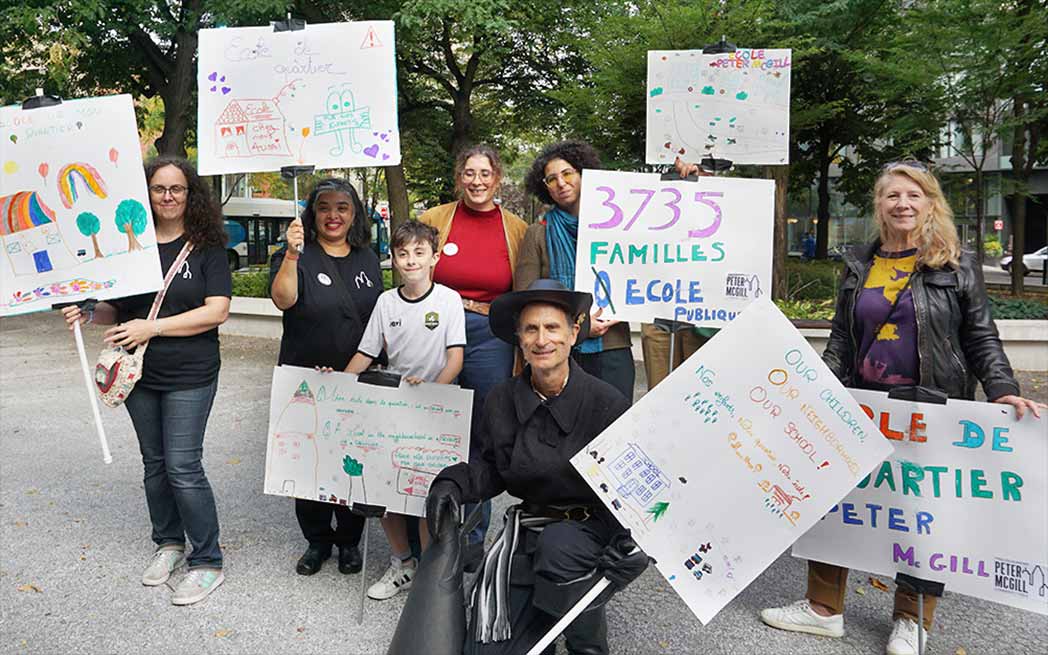
On September 26, the organization held an open-air school event at Cabot Square in Peter-McGill for a public elementary school to raise awareness of the pressing need to create a school to meet the growing demand from frustrated families.
“In the Peter-McGill district, in the heart of downtown Montreal, families have no nearby public elementary schools,” stated a press release. “As a result, children have to travel long distances every day to get to school, while the only institutions in the area are private schools. The Peter-McGill Community Table is organizing the Open-Air School event to highlight the urgent need to build an accessible public elementary school for families in the Peter-McGill neighbourhood.”
Despite the rain and an STM work stoppage, several families and downtown residents participated in the event featuring a variety of speakers, including Councillor Robert Beaudry and Westmount-St. Louis MNA Jennifer Maccarone.
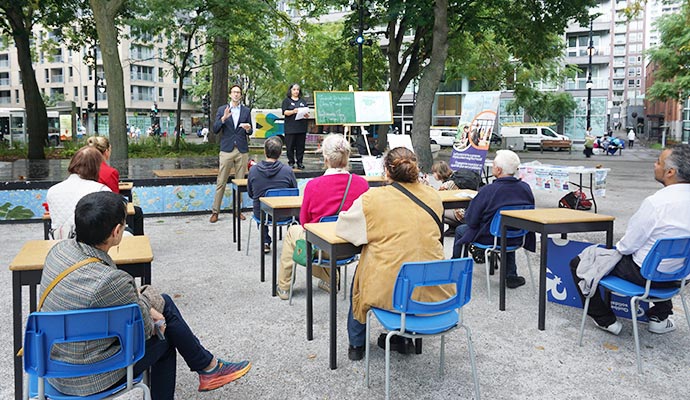
Naoual Belouah, the Peter McGill Community Table’s Youth and Family Project Coordinator, answered several questions about establishing a local elementary school and the initiative’s history.
WM: How many young families are residing in the Peter McGill district, and which schools are their children currently attending? What is the average length of the bus journeys to these schools?
Belouah: According to our latest neighbourhood profile (2024), there are 3,735 families/parent(s) with at least one child. Most children in the neighbourhood attend Saint Léon School and FACE School for French-language education, while a small proportion attend Michèle Provost Academy. English-speaking children attend Westmount Park, Roslyn Elementary School and FACE School.
Depending on where they live, it can generally take about 30 minutes (bus and walking) to get to school. For example, if a family lives at the far end of the neighbourhood, it can take about 45 minutes to walk there.
WM: If an elementary school were to be established in the Peter McGill District or in the greater downtown area, how many students would the school accommodate overall, and how many in Grade 1?
Belouah: Annually, there would be more than 350 students. Ideally, we would need a school for at least 700 students. This is one of the reasons why construction of the school on Rue de la Montagne was halted: the CSSDM informed us that this project would not provide sufficient classroom space. We do not have exact data on the number of students in Grade 1 – the CSSDM would be best placed to answer this question. Still, in our opinion, it would be logical to have 40 students in Grade 1, given that there are 20 students per class and there are generally two or three classes per grade.
WM: Montreal’s downtown area has had schools in the past. Are there any vacant buildings in the downtown area that could house twelve classrooms, a library, a teachers’ lounge, and administrative offices? Could an agreement be reached with a university to utilize its facilities for sports and physical education?
Belouah: Most were not in the Peter McGill neighbourhood (Commercial High School, Montreal High School, and Thomas D’Arcy McGee), although very close to the district limits. Unfortunately, we cannot answer this question as we do not have any relevant and reliable information to share with you on this subject. We have identified a few buildings that would be suitable for a school, but none of them are vacant at the moment. Many residents have mentioned the Notre Dame congregation building or the downtown YMCA, recently put up for sale, as suitable locations for a possible school. We also still have hope for one of the first considered, the Sulpiciens site on Sherbrooke Street, already home to several schools, but with enough room for a new elementary school with 700 students.
Unfortunately, we cannot answer this question regarding universities. It would be interesting to establish a link with a potential school. However, depending on the location and space chosen for the school (e.g. the YMCA), this may not be necessary.
‘For several years now, we have observed a kind of exodus of families as soon as their children reach school age. Many leave the neighbourhood because of a lack of schools or a supportive environment for families…’
– Naoual Belouah, Peter McGill Community Table Youth and Family Project Coordinator
WM: To what extent are the Ministry of Education, City of Montreal, and the School Service Center de Montréal helping to establish a local elementary school, be it a rented or owned facility?
Belouah: The City of Montreal supports our efforts, notably by contributing to our demands, but finds itself powerless because the Peter McGill neighbourhood is the only one in Montreal that is entirely dependent on the Quebec government (both financially and in terms of land). We have no support or connection with the Ministry of Education. As for the CSSDM (Montreal School Board), we receive occasional updates throughout the year that generally lead to no changes. We also have the strong support of our MNA, Jennifer Maccarone (Westmount-St. Louis), with whom we launched a petition last year regarding schools. Over 200 people have signed this petition.
We also held an open-air school advocacy event at the end of September 2025, which our MNA attended along with Ville Marie Councillor Robert Beaudry and the CSSDM’s communications officer, Ms. Dauphinais. Ms. Maccarone and Mr. Beaudry had the opportunity to speak publicly about the importance of having a public elementary school in the neighbourhood. The CSSDM attended as an observer.
WM: How many years has the community been calling for a local elementary school, and how would you describe the progress of the discussion and actions?
Belouah: For over 10 years now, Peter McGill’s team has been fighting for an elementary school in the neighbourhood. In 2018, an event and an agreement were reached between the Ville Marie Borough and the school board to construct a school on Rue de la Montagne, with classes scheduled to begin in September 2024. Unfortunately, following announcements from the provincial government, the project had to be put on hold due to a lack of funding. Since then, we have been trying to get the project back on track, at least to secure this school on Rue de la Montagne. The community, family organizations, and especially the families are tired of waiting indefinitely for this school. The number of families in the neighbourhood grows every year, and the existing schools can no longer meet the demand for our school. Classrooms are becoming overcrowded and unsuitable for proper development and learning. That is why it is so important for us to have this school as soon as possible! We continue to mobilize with the residents as best we can, and we plan to send a letter, co-signed by the parents and the organizations involved, to the Ministry of Education to request a direct discussion with a member of the ministry, which could lead to an agreement.
WM: Are you seeking to establish a regular elementary school or a combination of a regular school with specialized programs, such as an International Program?
Belouah: We envision the best for this school, with programs best suited to the neighbourhood; however, we haven’t reached that stage of planning yet.
WM: If a school is not established within the next four years, how would this impact the community?
Belouah: For several years now, we have observed a kind of exodus of families as soon as their children reach school age. Many leave the neighbourhood because of a lack of schools or a supportive environment for families (limited green spaces, communal living areas, sports facilities, etc.), which affects the sense of belonging and community life. It is difficult for families to build a sense of community in this area, just as it is difficult for us to build and maintain a stable community of families in our neighbourhood. Furthermore, we have a large number of newly arrived immigrant families who have other priorities besides primary school, which makes community engagement more difficult. For example, the families who participated in the 2018 initiative are no longer in the neighbourhood at all due to the lack of schools.
Images: courtesy of the Peter-McGill Community Table

Other articles by Irwin Rapoport
Other recent articles
 Irwin Rapoport is a freelance journalist and community advocate from Westmount with bachelor’s degrees in History and Political Science from Concordia University. He writes extensively on local politics, education, and environmental issues, and promotes informed public discourse and local democracy through his writing and activism.


 January 6, 2026" />
 through digital innovation" />
 looks back at 2025" />
 online betting rules?" />
 a film by Andrés Livov" />
 for its 16th edition" />
 Passion fruit meringue verrine" />
 playful clownish escapade" />
 World rhythms on stage" />
 management mistakes" />
 Kensington Avenue" />
 Vegan Chili Chocolate Cake" />
 Bethune tunnel" />
 Left out of breath" />
 of business strategy" />
 damage before it starts" />


 into a professional career" />

 plumbing issues at home" />
 embraces bold cinema" />
 Red snapper papillote" />
 the Legend of Pepita" />