
Human rights and
human extinction
We still can’t separate what matters from what makes money
By Randi Hacker
Updated July 21, 2025
Here’s a headline that sums it all up for me: N.C. Has Allowed a Likely Carcinogen Into Three Rivers Serving 900,000 People
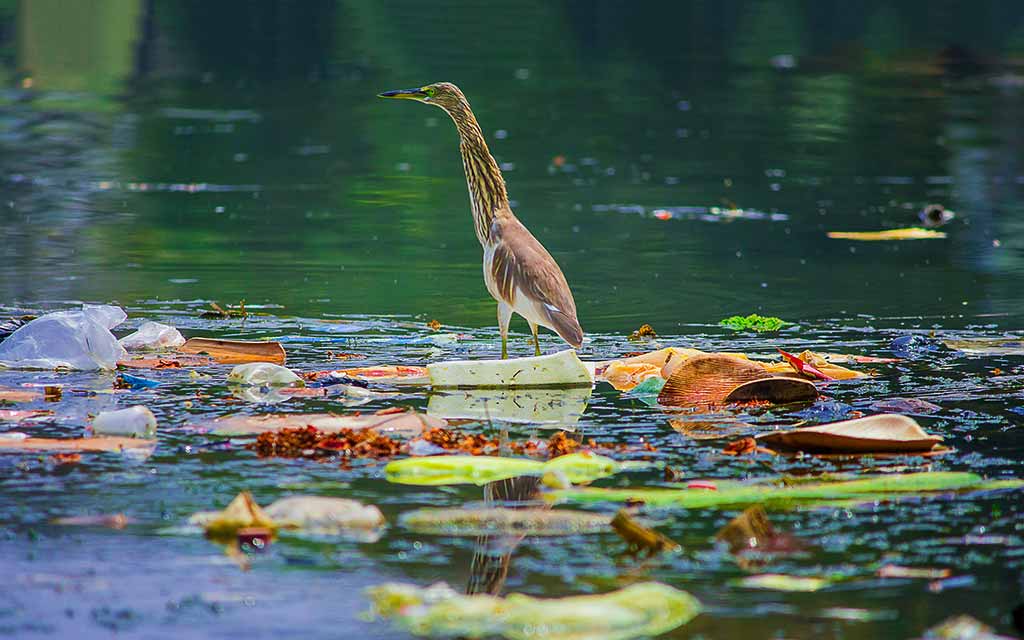
Nine hundred thousand people and countless herons and frogs and aquatic insects and fish and charismatic mega- and micro- and all-sizes-in-between fauna, and all kinds of flora. The river serves those, too.
Secondly, we’ve been on Earth for roughly 300,000 years, and we still can’t separate what matters from what makes money.
I have this fantasy. Long after we’re gone from the face of this planet, millions of years hence, the word “human” will become anathema, the ultimate insult among the contemporary lifeforms of Earth, who know all about us from unearthed bunkers and fossilized promotional merchandise and documents preserved in amber. In this fantasy, it would not be at all unusual to hear an argument in which one of these lifeforms says to the other, “You’re such a fucking human! I don’t know how anyone can live with you!”
In Alison Bechdel’s most recent graphic novel, Spent, the character Alison-who-is-not-Alison watches coverage of a protest on a computer monitor. The narration panel at the top reads:
Why this craze for autocracy? She can only assume that humans are going mad because of their encroaching self-extinction.
At first, I was taken by the idea that someone else was acknowledging our complicity.
The problem, as I see it here, is that we are confusing two concepts: rights and privileges. Clean water is not a right: it is a privilege, as is having the great good fortune to live on this planet.
And then two things started bothering me.
First, extinction’s pronoun is not “their”; it’s “our,” and by using the third-person plural instead of the first-person plural, Alison-who-is-not-Alison — and maybe even Alison-who-is-Alison — is othering extinction, i.e., it doesn’t involve her.
And second, this statement presupposes that, at some point in human evolution, we were not mad, though even a cursory look at human history instantly illustrates that that premise is patently false; we have always been mad.
Our self-extinction could, however, drive us madder. The question is how mad can we be driven before we drive ourselves out of existence.
Some of our madness, I think, is tied up in the idea of human rights. I mean, take a look at this story whose title includes the words “Right to Water.” It seems that strawberry farmers in Northern California haven’t had safe water for decades. Biden promised to get them clean water, and Trump, of course, revoked that promise. (What Biden did and what Trump does because Biden did it is the subject of an entirely different essay, not by me. The issue here is “right to water.”)
The problem, as I see it here, is that we are confusing two concepts: rights and privileges. Clean water is not a right: it is a privilege, as is having the great good fortune to live on this planet.
In addition, there is a real cognitive dissonance for me between us asserting our right to have clean water while at the same time asserting our right to knowingly contaminate our water and blame the budget for it.
A read-through of the United Nations’ International Bill of Human Rights makes it clear that the idea of human rights is an anthropocentric construct intended to codify us, humans, as the center of everything. Among other rights outlined in this declaration are our right to life, liberty and personal security (Article 3), our right to choose our work and be paid for it (Article 23), our right to go wherever we want (Article 13), our right to breed (Article 16), our right to own property (Article 17) and, of course, our right to be amused (Article 24).
‘A read-through of the United Nations’ International Bill of Human Rights makes it clear that the idea of human rights is an anthropocentric construct intended to codify us, humans, as the center of everything.’
It didn’t take long for lawyers to realize that each of the concepts outlined in these articles – and in all the other articles that comprise this declaration – is open to interpretation and that any one of them can be challenged in a court of law. Does the human right to medical care include experimentation on animals to find cures that benefit us? Does the human right to security of person include nuclear weapons? Does the human right to reap the benefits of scientific advancement include dumping toxins in the aquifer? Does the human right to realize the economic benefits of the resources of the state include selling rare earth rights to the highest bidder? Does the human right to own property include ski lifts and clear-cutting, and highways built through wetlands? Does the human right to happiness include Carnival cruises or destination weddings, or bird cams in eagles’ nests? At what point did human rights become the only thing that matters?
What, I wonder, gave us such an exalted opinion of ourselves? Is it linked to music? The kind of music that makes you stop wiping the counters, fling the dishtowel over a shoulder, and stand, sponge in hand, listening and maybe weeping, but just a little. To have music like Pietro Mascagni’s Cavalleria Rusticana or Antonin Dvořák’s Rusalka’s Song to the Moon or the largo maestoso movement of Florence Price’s Symphony No. 1, to have those sounds playing in your head and to be able to produce it so others can hear it, well, that could certainly contribute to a human’s sense of self-exaltation.
But how do you exalt humans who are claiming the right to clean water out of one side of their mouths while spewing sewage out the other; who don’t see the need for gun control; who stand in air-conditioned buildings and whine about microplastics, the eco-cause du jour? How do you exalt humans who still support Donald J. Trump?
Even New Zealand’s Whakaputanga Moana (Declaration for the Ocean), which designates whales as legal persons with legal rights, is still all about us, because we are the ones deciding what the whale rights are and because by “legal persons,” of course, we mean that whales can bring lawsuits, or rather, that humans can exalt themselves for litigating on behalf of the whales. It’s still all about us.
‘But how do you exalt humans who are claiming the right to clean water out of one side of their mouths while spewing sewage out the other; who don’t see the need for gun control; who stand in air-conditioned buildings and whine about microplastics, the eco-cause du jour? How do you exalt humans who still support Donald J. Trump?’
In my novella, Ellie, the main character, has something to say about human rights.
Henry thinks that machines will save us. I could not disagree more, and he knows it.
The way I see it, machines are the single greatest contributors to our cavalier attitude toward our upcoming extinction. Each machine iteration represents a minimum of one degree of separation from the natural world. And the more time we spend on our devices, the smaller and narrower our purview of the world becomes.
Instead of looking at a map, we are listening to an AI voice tell us where to turn and when to turn. But we have no idea where we are cartographically. We no longer take in the whole world.
And these degrees are cumulative, like compound interest was in the days when that actually meant something. So, from the wheel forward, we have moved further and further away from the natural world and our place in it. Not just moved further but convinced ourselves that it’s the other way around: that the natural world has a place in our world.
And not much of a place, either. Especially if it gets in the way of human rights.
Which I don’t believe in.
Neither do I.
I believe in the human privilege that allows us to continue to live on a planet that offers the flash of striped skink on the driveway, the taste of the first cucumber harvested from a raised bed gone berserk, the daily task of sweeping squirrel turds off the deck railing, which is my fault because I feed them there; they’re so cute.
Every day that our human rights have not yet driven us to extinction is a beautiful day on earth.
Disclaimer: The opinions expressed in this article are those of the author and do not necessarily reflect the opinions of WestmountMag.ca or its publishers.
Feature image: Pavan Prasad – Unsplash

Other articles by Randi Hacker
Other recent articles
 Randi Hacker has been a writer and editor since the 20th century, and she’s been writing about the environment for more than thirty years, mostly to empower young people to take agency in their future. Satirical essays written with a partner appeared in the New York Times Book Review, Punch and Spy, among other publications. Her YA novel, Life As I Knew It, (Simon & Schuster) was named one of the Books for the Teen Age by the NY Public Library, and her TV show, Windy Acres, written with Jay Craven, was nominated for a New England Emmy for Writing. She just retired from her position as the resolutions copy editor for the State of Vermont, a job that has forever damaged her relationship with the comma. randihacker.com


 January 6, 2026" />
 through digital innovation" />
 looks back at 2025" />
 online betting rules?" />
 a film by Andrés Livov" />
 for its 16th edition" />
 Passion fruit meringue verrine" />
 playful clownish escapade" />
 World rhythms on stage" />
 management mistakes" />
 Kensington Avenue" />
 Vegan Chili Chocolate Cake" />
 Bethune tunnel" />
 Left out of breath" />
 of business strategy" />
 damage before it starts" />


 into a professional career" />

 plumbing issues at home" />
 embraces bold cinema" />
 Red snapper papillote" />
 the Legend of Pepita" />