

Play explores Sri Lankan
intercultural tensions
Montrealers have a few days to catch final performances of the riveting White Lion, Brown Tiger
By Irwin Rapoport
October 16, 2025
The world premiere of Vishesh Abeyratne’s White Lion, Brown Tiger at Rangshala Studio at Cité-des Hospitalières began on October 11, with the final performance taking place on October 23. The Teesri Duniya Theatre production, directed by Michelle Soicher, is the first Sri Lankan-Canadian play produced in Montreal.
“This darkly witty and action-packed piece takes place in 2019 in a thrift shop, where a heated exchange between two Sri Lankan employees – Lasantha, a Sinhalese-Canadian, and Rishan, a recent Tamil immigrant – breaks out into a fight,” states the press release. “Their manager, Tiffany, tries to defuse the situation, bringing intercultural tensions and racial politics to the fore. However, there is more to the conflict than the two men are letting on… Audiences will shift from laughing at the absurdity to shocked silence.”
White Lion, Brown Tiger is a charged exploration of workplace, systemic and internalized racism; toxic masculinity; sexual harassment; the complex nature of male friendships; performative allyship; and the ripple effects of inherited, unprocessed and weaponized trauma in the aftermath of the 26-year civil war, which finally ended in 2009. The cast features Natasha Fagant as Tiffany, Keith Fernandez as Lasantha, and Matt Lacas as Rishan.
For Abeyratne, as fascism and far-right racism run rampant in the USA and begin to gain ground in Canada, staging White Lion, Brown Tiger means participating in an act of creative rebellion. “This play asks audiences to consider its racialized characters as human – sometimes deeply flawed and at times quite unlikable – and not in the warm, fuzzy, heartwarming and dare I say, ‘Canadian’ sense that eases the liberal conscience. I grew up isolated from the larger Sri Lankan community in the suburbs of Côte Saint-Luc; for much of my youth, race was not terribly significant to my identity. I, however, became drawn to the damaging effects of the model minority myth and the burden of representation.”
“When I lived out in Victoria, BC, I worked at a thrift shop much like the one I depict in the play. I met a lot of Sri Lankans there from all walks of life, both young students and older immigrants. This environment unlocked something in me and finally allowed me to write about this community and my place in it. The process involved eight years of not only fleshing out the characters but also determining my own relationship to them as well as to the nature of identity itself. The search has been engaging and full of surprises. The only way to write this play is by incorporating humour. As novelist Shehan Karunatilaka points out, black comedy and gallows humour come naturally to Sri Lankans, not just in Canada but all over the world. When your people have been through enough disasters – colonial rule, civil war, government corruption – jokes become cathartic and laughter becomes liberating. I knew I wanted to be a writer when I was ten years old. Then I discovered theatre in high school and was drawn to its particular magic. At the moment, I am developing a science fiction-horror tragedy called The Agony Market. While the wide reach of television is tempting, I feel the need to retain as much creative control over my own work as possible.”
This play asks audiences to consider its racialized characters as human – sometimes deeply flawed and at times quite unlikable – and not in the warm, fuzzy, heartwarming and dare I say, ‘Canadian’ sense that eases the liberal conscience.
– Vishesh Abeyratne, playwright, White Lion, Brown Tiger
One of director Michelle Soicher’s challenges was how to level the playing field. “We worked on how to have the characters swap from hero to villain throughout the play. The script presented the opportunity to discuss sexism in the context of other cultural issues rather than in a vacuum. I am fascinated with how these two men hold multiple truths at once, the way all people do. For a precious few moments in the play, these combatants relate and empathize with one another. When they stop fighting between each other, they can focus on the real forces working against them.”
Soicher stylized the fisticuffs, having the characters fight with the clothing around them. “It’s like a food fight but with socks, bras and sweaters,” she reveals.
The cast is enthusiastic about the play, which grapples with intense feelings and emotions. “Everyone will see something they probably don’t like about themselves in this show, and it’s something we need to talk about,” said Natasha Fagant. Keith Fernandez notes, “In the Western world, people from Asia are often homogenized into one clump. This piece is a reminder that South Asian cultures are extremely diverse, nuanced and rich.” Matt Lacas identifies deeply with themes in the play. “Although over the years I’ve worked hard to learn about the culture,” he said. “I grew up without a true connection to my heritage and still fear I’m not brown enough to authentically tell these stories. To enter the characters’ mindset, figuring out what Rishan’s goals and desires are is my first in. Once I understand what lengths he’ll go to achieve these goals, things start to fall into place fairly naturally. To remember that we, as humans, are always in search of getting what we want. Whether it’s altruistic or selfish or anything in between, knowing what my character wants the outcome to be of any given moment helps drive pretty strong emotions and intensity between characters.”
White Lion, Brown Tiger runs until October 23
TALKBACKS AFTER THE SHOWS BELOW:
October 19 matinee, 2 pm – Stages of Healing: How Story Becomes Solidarity
This post-show panel discussion brings together voices from academia, activism and the arts. The conversation will explore the role stories play in healing fractured communities. Together, they’ll explore how migration, race, and gender intersect in both art and everyday life – and what it means to build solidarity in divided spaces. With: Ishita Tiwary, Kavitha Culasingam, Dipti Gupta (moderator)
October 22, 7 pm – Beyond the Stage: Imagining Tamil Futures Through Activism and Art
This conversation explores the future of activism within Tamil communities. It brings together artists, humanitarians, and social leaders who examine how storytelling, theatre, and creative practices can build solidarity, amplify voices, and inspire social change. With: Brintha Koneshachandra, Tabasum Abdul-Rasul, Asmina Thirunavukarasu, Gaïna Clara Paul (moderator)
Tickets are pay-what-you-can on October 21, with a suggested minimum of $10.
There is a mandatory masked show on October 22 (masks provided).
There will be a free clothes mending workshop (to go with the thrift shop setting) on October 18.
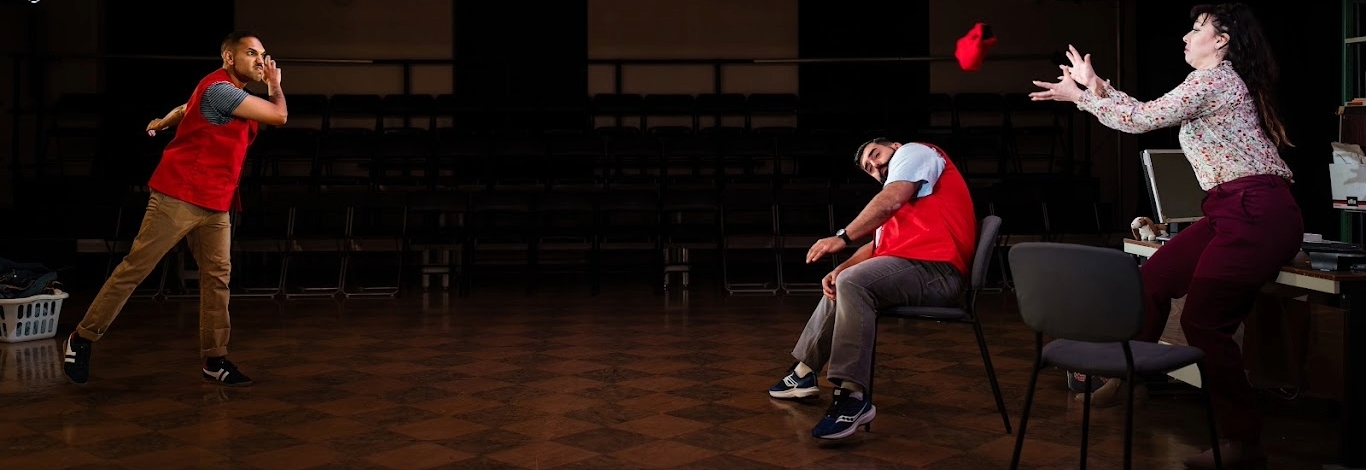
In the Q&A below, director Michelle Soicher and actors Natasha Fagant and Keith Hernandez discuss the play and how they prepared for it.
WM: How did you prepare to direct the play and select the cast?
Soicher: I was able to work with the playwright Vishesh Abyratne on and off for two years. We dug through the play together, searching for the moments that were hyper culturally specific to Sri Lanka and those moments which we could expand to fit the narratives of other minorities. I hope many different people will see themselves in Rishan and Lasantha. It was important to cast South Asian actors. We were so lucky to find Keith Fernandez and Matt Lacas, who are generous and interrogative actors. They dove into the text with me and their cast-mate Natasha Perry-Fagant, and we questioned it endlessly. They brought so much of themselves and their experiences into the rehearsal room. I learned from them, and we were able to put it all into the play.
WM: Many plays have conflicts as a central theme. The tension and trauma of the Sri Lankan civil war are still fresh. What was the key to channelling the tension?
Soicher: Conflict and tension are inevitable. The play is almost an hour of continuous fighting, so there was no shortage of tension. The challenge was finding moments where we could take the lid off the pressure-cooker and find moments of calm. South Asian people and other visible minorities have to stay guarded against the dangers of white supremacy. The constant work of self-protection can cause tension and anger. At some point, that tension demands a release.
‘I was able to work with the playwright Vishesh Abyratne on and off for two years. We dug through the play together, searching for the moments that were hyper culturally specific to Sri Lanka and those moments which we could expand to fit the narratives of other minorities. I hope many different people will see themselves in Rishan and Lasantha.’
– Michelle Soicher, director, White Lion, Brown Tiger
WM: Who are some of the directors and productions that inspire you?
Soicher: I’m a big fan of Donna-Michelle St. Bernard. She’s just so smart. She’s a playwright and has an excellent handle on language. But more than that, the communication she directs on stage is straightforward in the best way possible. The performances are vehicles for the story/the text, and the actors never need to push. She also does a great job of mixing darkness with fun. Her characters are always able to play through the muck.
In 2013, I saw David Harrower’s Blackbird, directed by the late Harry Standjofski. The older man in the story is a villain, but he promises he has learned, repented and moved past his wrongdoings. The play is short, but it spins the moral arguments around and around until the audience is dizzy. The play doesn’t tell the audience explicitly who is good or bad. It’s messy and confusing. I appreciate the play, the actor and Harry’s directing because you have to be brave to portray a “monster” with complexity and with humanity. White Lion, Brown Tiger also has an act of irrefutable wrongdoing. As a director, I have a responsibility, along with the actor, to hold this character accountable without robbing him of all redeeming qualities. The audience is free to feel empathy or contempt towards all of the characters. They are deeply flawed and deeply human, so it’s difficult.
I have seen Old Stock: a refugee love story, by Hannah Moscovitch, Christian Barry and Ben Caplan three times. It follows a narrative story very gently and uses it as a vehicle to illustrate the refugee experience. It is incredibly dark, but it’s also tremendously fun. It captures the Jewish experience and sensibility better than anything else I’ve seen. It blends music and storytelling, and Ben Caplan as the Wanderer guides the audience the whole way. So incredibly human and complex. The music is amazing.
WM: How did you prepare to portray your character?
Fagant: All of the characters in this play have a very unpleasant side to them, and living as those people has been very difficult. It’s hard to see traits that I recognize in myself played out in a character who says and does some pretty heinous things. I keep doing the work because I know that it’s a good way to confront my own internalized racism and that it can potentially help others do the same. On the worst days, I remind myself of a quote from one of my favourite teachers, Cristina Iovita, “Even the tragic actor is joyful to step on the stage.”Even when grappling with atrocities and injustices on stage, the play of it all and the joy of a theatrical back and forth fuel me to want to get onstage with my fellow actors.
Fernandez: One of the reasons I was excited to audition for the show is that the character is very different from me. It allowed me the opportunity to build a nuanced human with complex relationships to home, friendship, morality and life in Canada as an immigrant. I enter the character Lasantha’s mindset by continually chasing the truth of what I want in every scene and remembering the bigger arc in the play. Understanding where we begin and where it all ends helps me go on the journey. The sassy side of Lasantha with his sharp tongue… hmmm… is it too far from Keith? I’ll let you decide…
Images: David Wong

Other articles by Irwin Rapoport
Other recent articles
 Irwin Rapoport is a freelance journalist with a bachelor’s degree in history and political science from Concordia University.


 January 6, 2026" />
 through digital innovation" />
 looks back at 2025" />
 online betting rules?" />
 a film by Andrés Livov" />
 for its 16th edition" />
 Passion fruit meringue verrine" />
 playful clownish escapade" />
 World rhythms on stage" />
 management mistakes" />
 Kensington Avenue" />
 Vegan Chili Chocolate Cake" />
 Bethune tunnel" />
 Left out of breath" />
 of business strategy" />
 damage before it starts" />


 into a professional career" />

 plumbing issues at home" />
 embraces bold cinema" />
 Red snapper papillote" />
 the Legend of Pepita" />