
Spain has many delights
well worth a visit
Early July marks the start of the annual running of the bulls in Pamplona
By Irwin Rapoport
July 10, 2025
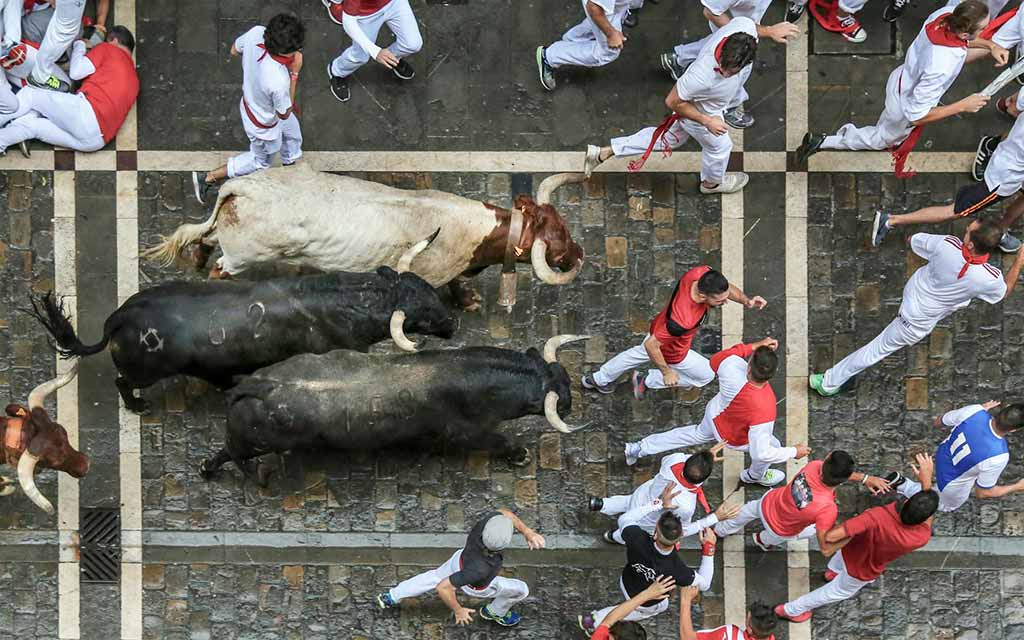
Last Monday, July 7 marked the start of the week-long, world-famous Festival of San Fermin and its Running of the Bulls in Pamplona, Spain, made world famous by acclaimed American author Ernert Hemingway‘s 1926 novel The Sun Also Rises, an early modernist novel that remains in print and is taught in countless English literature courses.

The groundbreaking novel was on the reading list for a Vanier College humanities class, Death, taught by Professor Cassidy, who has since passed. Cassidy was an engaging lecturer, and he introduced us to classic texts and recent writings on the subject, including John Irving’s The World According to Garp, published in 1978 and made into a movie in 1982 starring Robin Williams, John Lithgow, and Glenn Close. That course, which I took in 1983, introduced me to many concepts and philosophical viewpoints.
Hemingway’s novel chronicled American and British expatriates living in Paris, who travel to the festival.
“Hemingway presents his notion that the ‘Lost Generation’ — considered to have been decadent, dissolute and irretrievably damaged by World War I — was in fact resilient and strong. Hemingway investigates the themes of love and death, the revivifying power of nature, and the concept of masculinity. His spare writing style, combined with his restrained use of description to convey characterizations and action, demonstrates his ‘Iceberg Theory’ of writing.”
– Wikipedia, The Sun Also Rises
It was thanks to Cassidy that I found myself in Pamplona on July 7, 1987. I backpacked across much of Western Europe, ending my travels in Greece, aided by my $600 Eurail Youthpass. I was not going to miss the festival, and via Bordeaux, I made my way to Pamplona with Steve, a British backpacker I ran into in the wine city. We arrived in the early evening, and the city was packed. City officials, knowing it was a destination for so many young travellers, set up a tent encampment where we could stay at a very modest price. It was there that we met a gang of Americans, British, and New Zealanders with whom we hung out for several days, including the nearby beach resort of San Sebastián, which was also mentioned in the novel. I had already spent a few days in Paris, the hub for so many American expatriates following The Great War.
Our hearts were pumping, and those few seconds in the fray seemed like hours. While the closest bull was five feet away from us, we felt like champions and thanked our lucky stars we escaped unscathed.
Walking around the encampment, I realized I was not the only one beckoned by Hemingway. Quite a few brought along their copies of the novel, including a woman from New Zealand in our group. We had much in common, literary-wise, and we heartily, as Hemingway would have desired, partook in the local culture. Steve and I adorned ourselves in white shirts, red sashes, and red bandanas, the traditional garb for the festival.
We were keen to run with the bulls, which we ended up doing twice. This required finding the widest point of the narrow streets where the bulls ran, ending inside the arena where bullfights are held. With that knowledge, we placed ourselves accordingly. We had no desire to be gored, and when the moment arrived, we jumped in as did many young men and experienced runners. Our hearts were pumping, and those few seconds in the fray seemed like hours. While the closest bull was five feet away from us, we felt like champions and thanked our lucky stars we escaped unscathed.
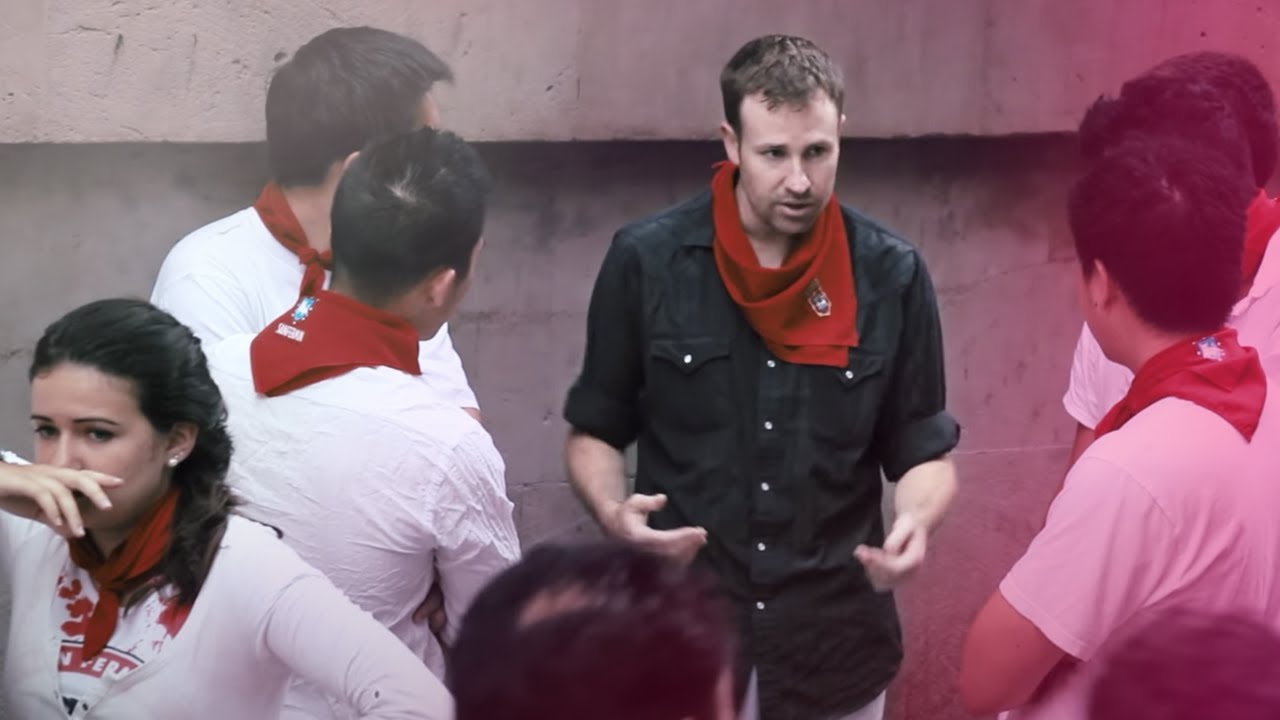
This informative video presents a history of the event, takes you along the route, and provides useful advice on how to participate safely:
This was part one of the adventure. We then joined several hundred runners inside the arena, where younger bulls were let loose and for about ten minutes, chasing us. You had to be quick on your feet to avoid being trampled by the participants and the bulls. It was an exhilarating moment, something one does not forget. We celebrated our courage and repeated our foolish and irresponsible actions the next day. The time I spent in Pamplona was most certainly a “feast of friends,” which we carried to the beaches of Pamplona. The water wasn’t too cold, so we splashed about in the Atlantic. In both cities, we caught some local bands playing traditional music, and the food was excellent. In San Sebastián, we had some tapas and vendors in Pamplona offered a wide array of olives and local dishes. The cerveza and local wines were pretty good.
I arrived in Pamplona in firm opposition to bullfighting, a choreographed dance of death for the bulls who have zero chance of “winning,” and even when they escape death in the ring, are slaughtered afterwards. Hemingway, who was enthralled by bullfighting, wrote about it in his 1932 non-fiction book Death in the Afternoon. I attended a bullfighting show in Pamplona, and it was a spectacle of death. I left halfway. It was similar to gladiator shows that were a staple of the Roman Empire. The duets between the bulls and matadors were at first exciting, but the smell of death and disrespect for the animals who had no choice but to play their part was ever present. I was rooting for the bulls. After two “fights,” I left disgusted and to this day, am unable to comprehend the minds of those who defend the public mistreatment of these animals.
‘I attended a bullfighting show in Pamplona, and it was a spectacle of death. I left halfway. It was similar to gladiator shows that were a staple of the Roman Empire. The duets between the bulls and matadors were at first exciting, but the smell of death and disrespect for the animals who had no choice but to play their part was ever present. I was rooting for the bulls.’
My visit to Spain also took me to Madrid for three days and Barcelona, also for three days. Madrid was full of history, magnificent architecture, and culture. It was there that I met two women from Montreal. It was one of many chance encounters with Montrealers, and we toured the Spanish capital, checking out museums, restaurants, cafes, and landmarks. We had a great time.
The visit to The Prado, Spain’s national art museum, was an eye-opener. To me, it is finest art museum in the world and it introduced the works of Flemish artists Hieronymus Bosch, Pieter Bruegel the Elder, and their contemporaries, El Greco, Goya, Diego Velázquez, and so many others. I made two long visits to The Prado, as well as a visit to the Museo Nacional Centro de Arte Reina Sofía, which exhibits paintings by modern painters such as Salvador Dali and Pablo Picasso, including his 1937 painting Guernica. He painted it after viewing the aftermath of the bombing of the city during the Spanish Civil War by Luftwaffe pilots aiding Francisco Franco’s fascist movement.
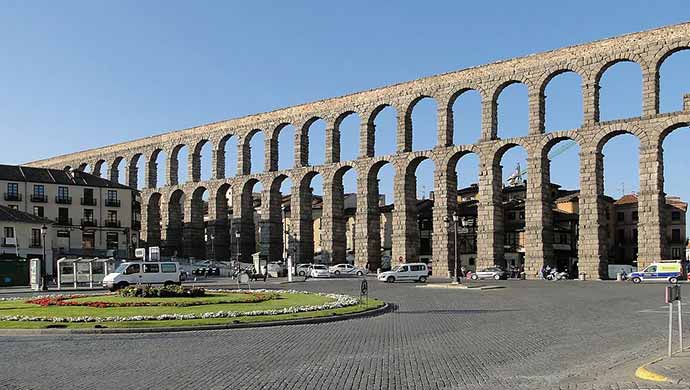
Roman aqueduct in Segovia – Image: Bernard Gagnon, CC BY-SA 3.0, via Wikimedia Commons
While in Madrid, I took a side trip to Segovia, home of the famous Roman aqueduct that still stands. Visiting Roman sites was a critical part of my agenda for my Grand Tour of Europe, and the structure was majestic and imposing. This marvel of architecture and engineering increased my appreciation of the Romans and their legacy. The city also has many medieval structures – castles and churches. I visited as many as I could in the few hours available to me..
Several things stood out in Madrid. The city was full of many pork sandwich shops – there seemed to be one at every corner – and I got the impression that most Spaniards were short and chain smokers. Although few spoke English, we found our way about. I truly felt like a foreigner.
Barcelona was chaotic and expensive. To avoid staying at a youth hostel for one night, I took the train to Valencia and back. The midnight train from Madrid to Valencia was a four-hour journey, and luckily, a train heading back to Madrid was leaving a few minutes after arriving. It was on the return train that I ran into Michael, a traveller from Austria. We got along well, and when I mentioned that I would be in Austria a few weeks later, he generously invited me to stay at his family’s Vienna apartment.
‘Barcelona was experiencing a heat wave when I arrived. By pure chance, I found a cool refuge in the Canada Bar, which appeared out of the blue. There were some cool art museums, and I spent some time on the beach.’
Many backpackers, as I discovered, organized their schedule based on night trains. On a couple of occasions, there were six to eight of us in a cabin. This was a perfect way to meet fellow backpackers, share useful information, and have a small party as the train rolled on. The second-class cabins were comfy, and on some nights when sleep was a necessity, I was able to find empty cabins and lie down.
Barcelona was experiencing a heat wave when I arrived. By pure chance, I found a cool refuge in the Canada Bar, which appeared out of the blue. There were some cool art museums, and I spent some time on the beach.
Although I enjoyed Spain, had I done my research, it would have been a more positive experience. I am very grateful that The Prado expanded my appreciation of art, which came in useful as I visited must-see museums in Amsterdam, Munich, Cologne, and Vienna. The British Museum, Tate Gallery, and National Portrait Gallery in London had exceptional collections. The Louvre was pretty good, but after London, I found it to be a second-rate art museum cluttered with paintings and sculptures which had a blurring effect. I saw the Mona Lisa, looking at it for a few seconds and then moving on. Just to make sure I didn’t miss anything, I went back to the Mona Lisa and was unmoved.
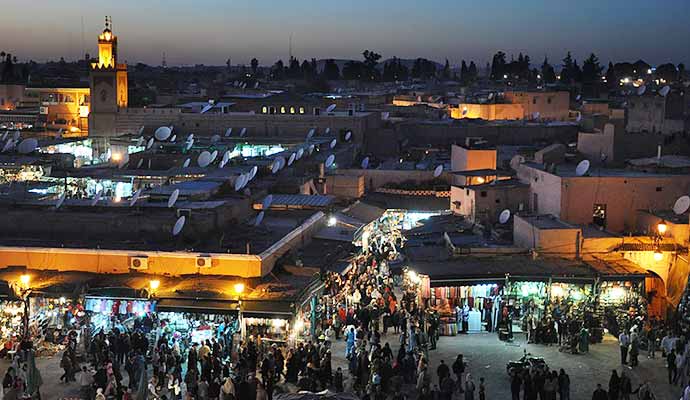
Jamaa el-Fnaa – Image: Jorge Láscar from Australia, CC BY 2.0, via Wikimedia Commons
In comparison, I spent at least half an hour in the Flemish room at The Prado, pondering The Triumph of Death and many famous paintings, admiring the themes, dazzling visuals, and painting styles. The Triumph of Death, one of my favourites, contains several hundred characters that are very alive. The paintings of Goya dealing with the Napoleonic occupation of Spain were haunting.
During the Christmas holidays of 1992-93, I visited Morocco with a high school friend, Andre. We took a side trip to Gibraltar, taking the ferry from Tangiers to Algeciras in Spain. From here, it was a short bus ride to the British colony where we spent three days, including New Year’s Eve. Gilbraltar did not disappoint. We visited all the sights, including the extensive British fortifications, the Moorish castle set on a rocky crag, the Battle of Trafalgar graveyard, the town defined by its Britishness and its many pubs, walked along the airfield below the Rock of Gibraltar, and saw the Barbary macaques. After spending a few days in Morocco, Gibraltar provided a much-needed break.
The New Year’s Eve celebration stands out. At one pub, we ran into a group of Royal Air Force personnel, and that led to an epic pub crawl. We must have visited every pub in the colony. Andre turned in early, but I lasted until around 8 am. It was after my enth or eleventh pint of cider that I had to bow out – they ordered another round and I couldn’t take another sip. The lads refused to let me purchase a round for myself or them, which was very generous of them. They spoke about being in the RAF and their experiences in Gibraltar, and I brought them up-to-date on my travels in Morocco. It was an unforgettable evening out, and when I got back to the hotel room, I immediately crashed.
‘Marrakesh was magical, and I wandered around the iconic Jamaa el-Fnaa square and adjacent souks (markets), and explored the city. The area encompassing the square had retained its charm, and it was like going back in time.’
We said goodbye to Gibraltar, taking the ferry from Algeciras to Ceuta, one of two centuries-old Spanish enclaves along the Moroccan coast. It was here that we parted ways until we met a week later at Casablanca to catch the flight home. Cueta is an old city with a wealth of interesting architecture and alleys to explore. Andre went to Fez and other destinations, while I made my way to the inland city of Meknes. The highlight of the Moroccan trip for me was Marrakesh. I had hoped to take the train via Meknes to the fabled city, but ended up on a crowded night bus, catching it with only minutes to spare. It was a bewildering experience, and I was glad to be on board for the long journey. Somehow, I was able to sleep.
Marrakesh was magical, and I wandered around the iconic Jamaa el-Fnaa square and adjacent souks (markets), and explored the city. The area encompassing the square had retained its charm, and it was like going back in time. The cafes were well situated – you could sip your mint tea and watch life unfold. I was reminded of my visit to the city of Jaisalmer, the desert fortress/city in the Indian State of Rajasthan, in the summer of 1992. I reached it by a train that took me through the Thar Desert. Both cities are World Heritage sites and have delights, architecture, and scenic vistas that attract millions of tourists annually.
For both Morocco and India, I relied on my trusty Lonely Planet guidebooks, which never let me down. For the 1987 trip, I used Let’s Go Europe.
Moroccans appeared to be indifferent to tourists, but when you needed information, they were obliging. In India, the people were friendly, and many spoke English. Although inundated with tourists, the people of England, France, Germany, Spain, Italy, the Netherlands, Belgium, Switzerland, Austria, and Greece were friendly and helped you out. It was a question of mutual respect.
As I watch the news reports of the running of the bulls, my mind wanders back to those days in Pamplona. It was insane to risk injury and death to run with the powerful animals, but I was young and felt invincible. Despite the risks, I do not regret my decision.
This summer is a perfect time to re-read or experience The Sun Also Rises for the first time, and between now and next June, plan a trip to Paris, Pamplona, and San Sebastián. Whether or not you run with the bulls, it’s an excursion that follows in the footsteps of Hemingway and the Lost Generation.
Feature image: running of the bulls, San Fermin Pamplona – Pexels

Other articles by Irwin Rapoport
Other recent articles
 Irwin Rapoport is a freelance journalist with a bachelor’s degree in history and political science from Concordia University.


 January 6, 2026" />
 through digital innovation" />
 looks back at 2025" />
 online betting rules?" />
 a film by Andrés Livov" />
 for its 16th edition" />
 Passion fruit meringue verrine" />
 playful clownish escapade" />
 World rhythms on stage" />
 management mistakes" />
 Kensington Avenue" />
 Vegan Chili Chocolate Cake" />
 Bethune tunnel" />
 Left out of breath" />
 of business strategy" />
 damage before it starts" />


 into a professional career" />

 plumbing issues at home" />
 embraces bold cinema" />
 Red snapper papillote" />
 the Legend of Pepita" />

.jpg)
What a wonderful descriptive travelogue! It is always fun to travel when young – backpacks, humble accommodations and friendly encounters.
However I wish you had taken a stronger stand against bull fighting. I love Hemingway’s style of writing but unfortunately his macho personality did much to glorify this sadistic activity. Today, it is the tourist industry that keeps the industry alive. Many Spaniards would like to see it banned – as it clearly should be! Watching a magnificent creature slowly tortured to death says much about those who attend such events – and this is scary!
I am disappointed that Mr Rapoport seems to feel the running of terrified and confused bulls in the streets is a suitable form of entertainment and I have read of bulls being stabbed and otherwise abused; the running of bulls is clearly a Macho event which exploits helpless animals. This event along with the brutal bull fights should be permanently banned. I cannot understand humans who actually enjoy watching animals die in agony. And shame on Spain for turning a blind eye to this sadistic event.
Anne Streeter,
Thank you for your kind words. My backpacking trips to Europe and other parts of the world were exciting, eye-opening, and educational. I emerged a better person because of them.
You are correct in that my opposition to bullfighting in the piece was inefficient. A growing number of Spaniards oppose bullfighting and the industry of death is hopefully on its way out. Bullfighting is cruel from the start, beginning with the farm where bulls are bred to their death in the ring, and if they are not killed in the “fight,” slaughtered afterwards.
The animals that are used for the running of the bulls are scared, terrified, and bewildered. The festival sit is, and those emulating it, should be banned. Pamplona and the Basque region are beautiful and have much to offer visitors. No doubt the festival can be transformed into a more positive event.
I mentioned that there are Spaniards opposed to bullfighting. Here are some inks:
https://www.youtube.com/watch?v=K6rQNEh1CT8
https://www.youtube.com/watch?v=YprDRJJrbQk
https://www.youtube.com/watch?v=P4-DYbIIt4A
https://www.youtube.com/watch?v=EyIPRZUagn0