
Urgent call for a halt
to live horse export
An important issue gathering dust in the current Agricultural Minister’s files
By Georges R. Dupras
Setember 25, 2025
Like many others, I have my favourites in the horse world. I am drawn to heavy horses, but not necessarily to the more popular breeds such as Clydesdales, Belgians or Percherons. I feel a debt to those big horses of mixed breed, who toiled in our fields, and pulled coal, logs, ice and even rag wagons through the streets of our cities and towns.
After years of work, in all kinds of weather, when they could no longer serve, they were rewarded with a trip to the slaughterhouse. There are those who would argue that the quarter horse opened the West. I would counter that by saying the standard American heavy horse opened this continent for the invading Europeans.
I thank Sinikka Crosland of the Canadian Horse Defence Coalition (CHDC) and Jann Arden for their expertise and commitment. I will focus on heavy horses that are bred and shipped “live” to Japan for the meat trade. This practice not only represents a betrayal by some consumers but also a serious violation of trust by the Canadian Food Inspection Agency (CFIA).
This practice not only represents a betrayal by some consumers but also a serious violation of trust by the Canadian Food Inspection Agency (CFIA).
Background
Presently, and for some years now, draft horses have been purposely bred in Canadian feedlots, like cattle. These horses are then shipped, live, to Japan and slaughtered. The purpose is to cater to a discerning market for raw meat, thinly sliced and served in a dish called “basashi,” in high-end restaurants. The live horses are selected from quarantine feedlots by Japanese buyers.
Bouvery Exports
In years past, those horses not selected were slaughtered domestically at Bouvery Exports in Fort Macleod, Alberta. It is possible that some horses are either kept in local feedlots or shipped to Les Viandes Richelieu in Quebec.
Shipping
Presently, the horses are flown out of Edmonton and Winnipeg, but Calgary was a popular airport for shipping live horses.
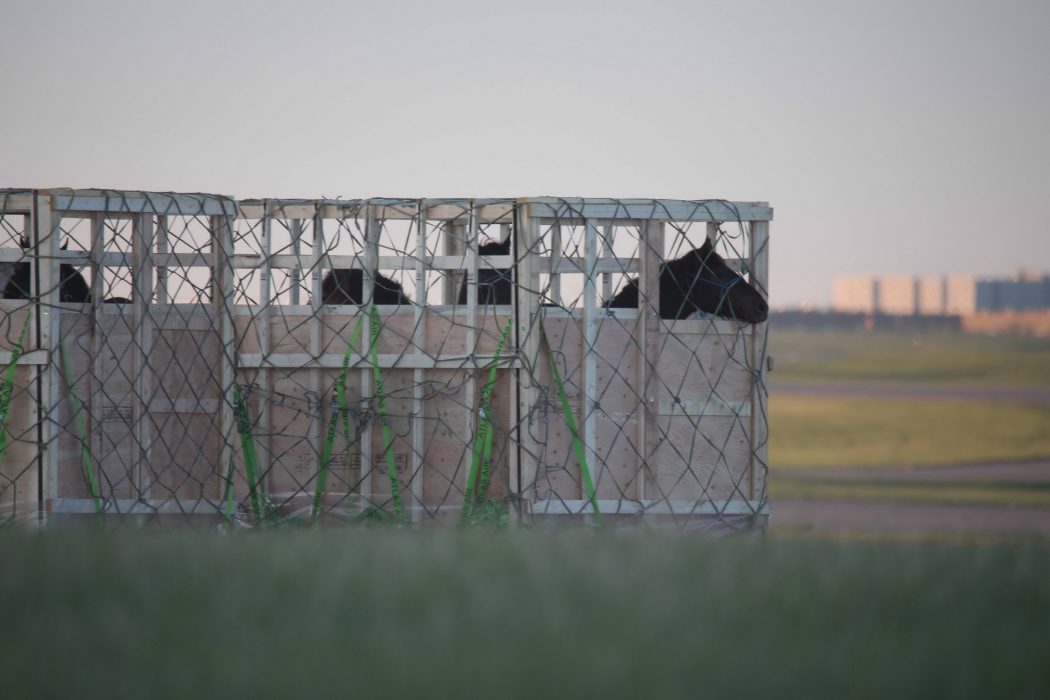
Generally, horses are between one and a half and three years old and can weigh up to 2000 pounds. They can be 16 to 17 hands high, or 64 to 68 inches at the shoulder. They are crammed three to four horses per crate. It is to be noted that these crates are smaller than a conventional single-horse box stall.
They can, and have spent up to 28 hours without food, water or rest. Issues with the aircraft or scheduling have caused delays which exceed what is permitted by law. In June 2021, the time the horses went without food, water, or rest due to a delayed flight was 31 3/4 hours.
The regulations state that the horses should have been let out of their crates for rest, food and water when the delay was first anticipated. That did not happen. It was stated that there was a “departure delay” and the situation was “out of their control.”
‘They [horses] can, and have spent up to 28 hours without food, water or rest. Issues with the aircraft or scheduling have caused delays which exceed what is permitted by law.’
Joint investigation
Recently, a joint investigation conducted by Animal Justice and a Japanese animal protection group, supplemented by Access to Information documents obtained by the Canadian Horse Defence Coalition, revealed that numerous shipments violated the maximum time allowed by law. It also confirmed that fatalities, injuries, and illnesses were more widespread than had previously been reported by the Canadian Food Inspection Agency (CFIA).
Access to information
Access to information documents revealed an incident where a suffering dying horse kicked through the confinement crate and damaged the fuselage of the aircraft. There can be 33 crates per flight containing 90 to 120 horses. On arrival, the horses are further fattened in Japanese feedlots.
Canadian laws and regulations do not have jurisdiction in Japan or any other country that receives live horses.
Concerns – feedlots
Contrary to what is often depicted on horse meat websites that show horses grazing in idyllic pastures, horses destined for slaughter exist in desolate, barren feedlots where they are fed to the point of obesity. As a rule, they do not see a veterinarian for illness or injury, nor a farrier for overgrown hooves. Due to health regulations, certain drugs are withheld for injured and ill horses designated for human consumption.
Exposed to the elements
An investigative video has captured dead foals left unprotected in cold winter prairie feedlots.
‘Access to information documents revealed an incident where a suffering dying horse kicked through the confinement crate and damaged the fuselage of the aircraft. There can be 33 crates per flight containing 90 to 120 horses.’
History of live horse transport to France
Though I have long since discarded my files, I recall the tireless efforts of Tom Hughes of the Ontario Humane Society (OHS). Tom Hughes worked on numerous issues during his tenure as head of the OHS in the 1960s, but his efforts to halt the transportation of live horses by sea were what he was best known for.
In those days, horses were shipped live in the holds of freighters. They, too, were cramped into crates to keep them from falling due to heavy seas. I’m certainly no expert, but the infiltration of diesel fumes, coupled with the pitch and yaw of the ship, must surely have had a profound, nauseating impact on these horses. Records show that smaller and weaker horses fell and were trampled by those that remained standing. It was said, by mariners who served on those freighters, that some sick and injured horses were merely hoisted and thrown overboard – live.
What difference is there between air turbulence over the Pacific and rough seas crossing the Atlantic? The Government of Canada, largely due to the sustained efforts of Tom Hughes and others, finally outlawed the practice.
Government betrayal
The Right Hon. Justin Trudeau, Prime Minister, through the efforts of Federal Liberal MP Nathaniel Erskine-Smith and others, promised to stop the live shipment of horses by air. Regrettably, due to bureaucratic politics, a change in leadership and an election, this important issue now gathers dust in the current Agricultural Minister’s files.
What are the minister’s priorities?
What are the present Minister of Agriculture’s priorities? The Canadian Food Inspection Agency (CFIA) has been derelict in its responsibilities. Budget cuts and shortages of qualified inspectors are no excuse. No pledge of confidentiality justifies the CFI’s silence and staunch defence of this betrayal. Officials of the CFIA must understand that their first obligation is to the truth and to the people of Canada.
The people of Canada expect that this betrayal be stopped. It is not essential to reinvent the wheel when common sense is guiding it in the right direction.
We can all put our shoulders to that wheel by writing to our elected representatives, the media and to the Prime Minister’s office and demand immediate action.
Disclaimer: The opinions expressed in this article are those of its author and do not reflect the opinions of WestmountMag.ca, its publishers or editors.
Feature image: Vickie Colgan
Other articles by Georges Dupras
Other recent articles




 January 6, 2026" />
 through digital innovation" />
 looks back at 2025" />
 online betting rules?" />
 a film by Andrés Livov" />
 for its 16th edition" />
 Passion fruit meringue verrine" />
 playful clownish escapade" />
 World rhythms on stage" />
 management mistakes" />
 Kensington Avenue" />
 Vegan Chili Chocolate Cake" />
 Bethune tunnel" />
 Left out of breath" />
 of business strategy" />
 damage before it starts" />


 into a professional career" />

 plumbing issues at home" />
 embraces bold cinema" />
 Red snapper papillote" />
 the Legend of Pepita" />
As per Mr. Dupras’ suggestion of writing to the government on behalf of the horses, here are the relevant links for Prime Minister Mark Carney, the agriculture minister Heath MacDonald, and one’s own MP. To find your MP use the third link here and then enter your postal code in the relevant field.
mark.carney@parl.gc.ca
aafc.minister-ministre.aac@agr.gc.ca
https://www.ourcommons.ca/en