

Verona Sorensen’s
Words Beyond the Canvas
The painter’s latest exhibition is inspired by the writing of her late father, David Sorensen
By Irwin Rapoport
November 26, 2025
Verona Sorensen‘s latest exhibition, Words Beyond the Canvas, a project inspired by the writing of her late father, David Sorensen, is on display at Galerie L’Onyx until December 10. And this Friday, November 28, you can meet the contemporary abstract painter at the vernissage from 4 pm and 7 pm.
“My father was best recognized for his painting and sculpture, but was also an avid writer,” says Verona. “His deep dedication to letter writing – and to staying in touch with artist friends and family over the decades – inspired this body of work. His letters are filled with meandering thoughts and stream-of-consciousness writing, interwoven with sketches and doodles that animate the pages and infuse them with creative energy. Excerpts from these letters, together with my personal response and the feelings they evoked, guided the imagery in the paintings.”
 Through this personal project, Verona sought to create paintings inspired by her father’s writing and to compile a book of his letters.
“Through 2024 and 2025, I have been exploring how the visual arts and his written archives can meet and honour his creative world in a new way,” she explained. “His writing reflects his inquisitive and enthusiastic mind, and provides a deeper understanding of his life and artistic spirit,” said Verona. “It also illuminates the lifelong camaraderie he shared with his closest artist friends. Because of his dedicated letter writing, he leaves behind a vibrant archive of stories, reflections, and moments — enduring traces of a creative life well lived.”
Verona Sorensen was born in Montreal to a Filipino nurse and a West Coast Nordic painter. Her earlier years were spent between the Eastern Townships and Mexico. After completing her Bachelor’s in Fine Arts at Concordia University, she was invited to apprentice with the Dormice art collective in Austria and Italy. Her technical approach of blending wax, sand and oil into her paintings matured in Mexico, where she studied encaustic painting. Sorensen currently lives and works in Quebec.
My father was best recognized for his painting and sculpture, but was also an avid writer. His deep dedication to letter writing – and to staying in touch with artist friends and family over the decades – inspired this body of work.
– Verona Sorensen
Personally, abstract art has long resonated with me, and I have been fortunate to experience the work of many artists in this genre at several museums, be it in Montreal, New York City, and Europe. I look forward to attending the vernissage to view the paintings I saw on the exhibition website. Verona’s work, from my perspective, caught my attention with its vibrant colours and imagination. The many variations and use of forms, lines, and perspectives hooked me.
* * * * *
In the Q&A below, Verona Sorensen discusses the exhibition, her artwork, and her painting style.
WM: Can you tell us more about the inspiration for the paintings featured in the exhibit and more about your dad’s passion for writing?
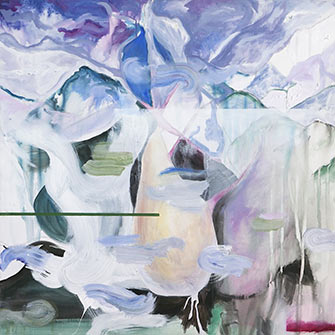
Birthday Orbs
Sorenson: The Words Beyond the Canvas‘ paintings are inspired by the letters my father wrote to his closest friends, family, and artist peers. His correspondence was a kind of daily journaling – deep, quirky, and often decorated with sketches ranging from detailed and realistic to playful and cartoonish. Letter writing was his way of staying connected with dear ones and checking in with himself.
Through these pages, he shared his thoughts, concerns, inspirations, and small daily wins and challenges, revealing a lighter, more intimate side. Although he was primarily recognized as a serious painter and sculptor – exhibiting at Expo ’67 and later teaching at Bishop’s University – his letters showed a playful, warm, and reflective dimension.
For years, I hoped to compile a book of these letters and drawings. Last year, with funding from CALQ (Arts et Lettres en Estrie – Partenariat Territorial), I finally began developing this project, which includes creating fifteen paintings that translate his words into abstract imagery. This first version of the book focuses mainly on his correspondence with his sculptor friend in Holland, Peter Knigge.
This prototype book will be on display at the exhibition. Additionally, excerpts from it will be shared in a reading at La Maison de la Culture Marie-Uguay at 6052 Blvd Monk, on December 6 from 4 pm to 5 pm. It is preferable to visit the gallery beforehand, as it will be closed after the reading. Don’t miss this opportunity to experience the art before the event!
WM: How would you describe the creative process that led to the paintings being exhibited? Did you work on several simultaneously?
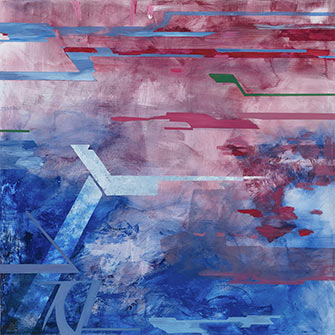
Edges in the Clouds
Sorensen: Initially, the process of creating these paintings began as an exercise in translating my father’s words and writing into abstract imagery. I aimed to capture the essence of his thoughts – not merely in form, but in feeling. This translation was a way to honour his voice while reinventing it through my own artistic lens.
As the work evolved, it seemed to become an expression of the feelings his letters invoked in me. Many shades of pink kept emerging in the paintings, and I thought this was not really realistically representative of particularly large-scale sculptors/painters. Maybe it is more reflective of the feelings I have towards both of them and the friendship that existed between them.
I often do work on multiple paintings at once, even in smaller studios. I find it gives me the distance and perspective to keep moving forward and not get too locked in obsessively. Keeping several canvases going helps the whole process stay fluid.
WM: What is your process for beginning a painting? When you see a blank canvas, are there occasions when you see the forms and colours in your mind?
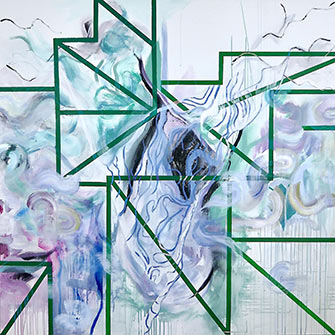
Morphing Structures
Sorensen: There is a pleasure in looking at a blank canvas, especially after gessoing it, almost with the feeling of having contributed to this pure, clean slate. When I see a blank canvas, I think it is beautiful and pristine, and it takes a lot to put the first mark on it – to give this space of unlimited potential a direction. But when the impulse does arrive, I follow it.
I suppose I see forms and colours in my mind before beginning the painting, in the sense that I may have a few floating ideas or directions I’d like to explore, before putting an initial mark down on the canvas. But more often than not, I begin painting intuitively and discover what the painting is about as it unfolds before me. I try to let it reveal itself, which in turn often reveals some of what is going on within.
My experience as a figurative painter, before moving into abstraction, felt very concentrated – almost like meditation – focused and anchored to a reference point, attempting to capture some aspect of what I saw. Painting abstractly, however, feels more like a dance with the unknown, where there is no reference point: I make a mark, wait to see how it mingles with the rest of the canvas, and then respond again. Back ’n’ forth it goes. I’m often searching for a certain balance in the painting, but recently I’ve noticed I’ve been intentionally trying to break it. The process of diving into abstraction brings me into close contact with my intuition, as I feel my way through the unknown dark towards some shiny, vaguely promised destination.
WM: What attracted you to painting and, specifically, the abstract genre? How would you describe the atmosphere of being in the studio?
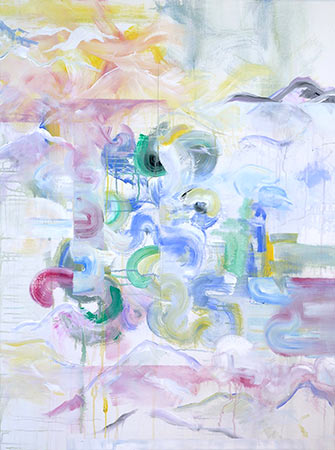
Calming the Mind
Sorensen: I think it’s the solitary nature of it – the autonomy of being able to keep creating without anyone else’s permission. In theatre, for example, you have to pass auditions to be given the chance to act in a play or film. But the creation of a painting is entirely my own. Getting the work out into the world is another matter and does require others, but the time in the studio is really wholly mine. It’s a sacred place, where magic can happen – a kind of inner alchemy that, if I’m lucky, spills out onto the canvas.
WM: How did your dad feel about you becoming a painter?
Sorensen: It took him some time to believe I was serious about it, mainly having studied and engaged in theatre for so many years. But once he saw I was sticking with painting, he got behind it and was very supportive, and I think happy. I mean, maybe a bit worried, because there is this romantic idea of becoming a painter, but it also comes with a lot of hardship and struggle, and he probably didn’t want me to have to endure all of that, but it seems it is just a part of the package. I’m primarily referring to the challenge of making a living. One has to be resourceful and resilient – but those are valuable traits to cultivate over a lifetime.
WM: Who are some of your favourite abstract painters, and are there any specific paintings that inspire you and why?

Black Tourmaline Mountains
Sorensen: There are so many. But I especially love Matisse. I think it is his playful approach to his works that captivated me. And his light and his incredible sense of colour. Joan Mitchell is another painter whose works I really appreciate. Cecile Brown is great too – so bold and expressive – her marks have this raw, energetic quality that inspires me not to hold back.
I’m also drawn to Anselm Kiefer for the way he builds layers and textures, almost as if he were embedding memory into the surface. – it makes me think differently about materiality and depth in my own work. Gerhard Richter inspires me with his tension between control and chance, abstraction and realism.
WM: What advice would you give to those interested in exploring abstract themes and features?
Sorensen: Go for it! Over time, it is bound to connect you more deeply with your intuition, offering a welcome respite from the continuously engaged mind. Don’t worry about making it “right” or following any rules. Let your marks, your colours, your gestures guide you. The process itself can be transformative, teaching openness and trust in your own instincts. And sometimes, you’ll be surprised by what shows up when you’re not trying to control everything.
‘Painting abstractly… feels more like a dance with the unknown, where there is no reference point: I make a mark, wait to see how it mingles with the rest of the canvas, and then respond again. Back ’n’ forth it goes.’
– Verona Sorensen
WM: Do you ever have others come by your studio to look at your work?
Sorensen: Yes! This past year, a few painters came by the studio, and their feedback was so helpful. It made me realize how much I’ve been craving that kind of conversation. Sharing work in progress and hearing how someone else experiences it brings energy and insight that you often can’t get alone. It’s not just about constructive critiques – it’s about connection, inspiration, and learning from each other.
WM: Do you ever take commissions?
Sorensen: I haven’t taken one in a while, but I have in the past, such as for company boardroom projects, like with Jameson Inc. I’m open to the idea of commissions – as long as there’s enough creative freedom. With abstraction, especially, it’s important to have room to follow the process wherever it leads. Commissions work best when the client trusts the creator’s instincts and is comfortable giving them space to explore. When that’s the case, it can be a delightful collaboration.
Words Beyond the Canvas
Galerie L’Onyx
6400 Monk Boulevard, Montreal
until December 10, 2025
The contemporary abstract painter will meet the public on Friday, November 28, from 4 p.m. to 7 p.m.
Images: courtesy of Verona Sorensen

Other articles by Irwin Rapoport
Other recent articles
 Irwin Rapoport is a freelance journalist and community advocate from Westmount with bachelor’s degrees in History and Political Science from Concordia University. He writes extensively on local politics, education, and environmental issues, and promotes informed public discourse and local democracy through his writing and activism.

 January 6, 2026" />
 through digital innovation" />
 looks back at 2025" />
 online betting rules?" />
 a film by Andrés Livov" />
 for its 16th edition" />
 Passion fruit meringue verrine" />
 playful clownish escapade" />
 World rhythms on stage" />
 management mistakes" />
 Kensington Avenue" />
 Vegan Chili Chocolate Cake" />
 Bethune tunnel" />
 Left out of breath" />
 of business strategy" />
 damage before it starts" />


 into a professional career" />

 plumbing issues at home" />
 embraces bold cinema" />
 Red snapper papillote" />
 the Legend of Pepita" />