
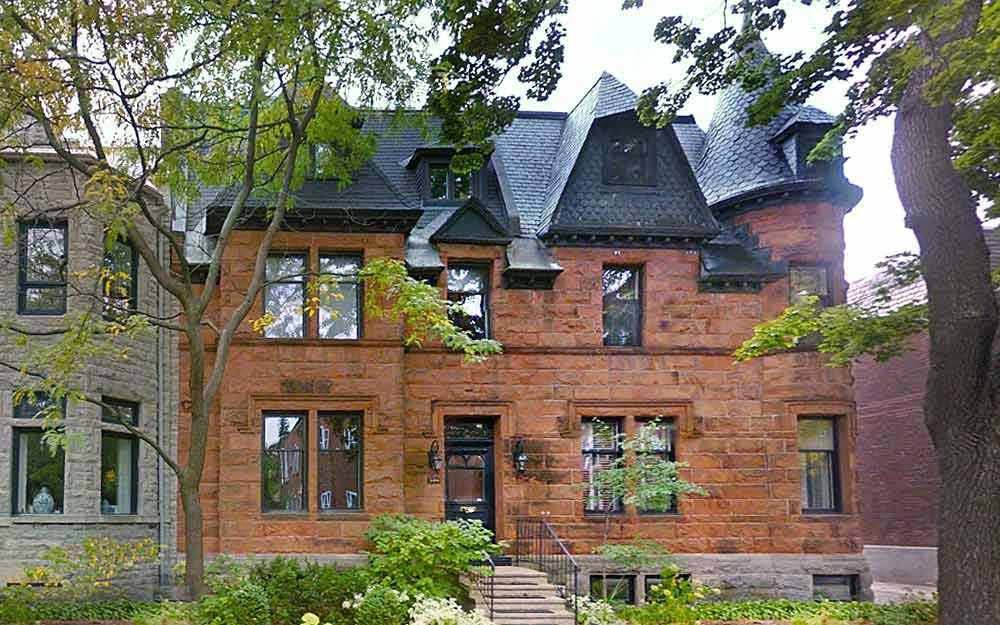
Westmount places
and their stories
Places and objects that reflect the true social fabric of Westmount
By Michael Walsh
Previously published in WestmountMag.ca
Imagine you are sitting in an airplane, going on a trip, and the person beside you strikes up a conversation. “Where are you from?” they ask; you reply, “Westmount, Quebec” — to that they counter, “Where is that?” Another person, in an adjoining seat, replies, “It’s a place that everyone knows where it is and is also somewhere where each one of them would like to live!”
There are aspects of small town life that I really like — the routine nature of it, the idea of people knowing you and your likes and dislikes.
Cress Williams
And the reasons are varied: it’s a place where families feel safe and belong. There is also a comforting routine of annual events that celebrate community belonging. There is also the historical aspect evident throughout the city: the houses, street names, and plaques installed to mark important events. What follows is a glimpse of the places, the people who lived there and the objects that reflect the social fabric of Westmount. What follows is a glimpse of the places, the people who lived there and the objects that reflect the social fabric of Westmount.
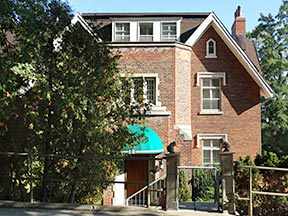
61 Rosemount
61 Rosemount
Andrew Rutherford, William Rutherford and Sons (1900).
“Westmount Loses Prominent Citizen In W. Rutherford / Former Mayor and Alderman of Suburban City Dies in 68th Year / Leading Industrialist / Was Director of Lumber Business Bearing Family Name – Had Various Sporting Associations.
Over the city hall of Westmount, a flag flew at half-mast yesterday. It signified that the municipality is mourning one of its most distinguished sons – William Rutherford, ex-alderman, former mayor, and widely known businessman, who died on Saturday evening at his home, 458 Mount Stephen Avenue. He was 67 years of age and had been ill for a long time.
Always interested in civic affairs, Mr. Rutherford was elected by acclamation to the highest post the municipality could offer, that of chief magistrate. He occupied the mayoral chair for the term of 1911-12 and, previous to that, had been an alderman for three years.”
– Montreal Gazette, February 29, 1932
His business activities were centred in the Rutherford Lumber Company, formerly known as the William Rutherford and Sons Company, Limited. This firm was founded by Mr. Rutherford’s father. At the time of his death, he was a director of this firm, having served for many years as treasurer.”
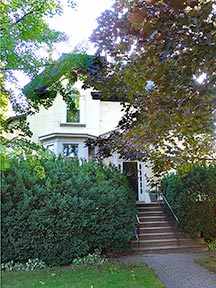
44 Rosemount
44 Rosemount
Arthur Lyman, Lyman Sons & Co. (1900).
“The main operations of the firm as chemists and druggists were located on St. Paul Street, where extensive premises were erected in 1855 (burnt 1888). Both wholesale and retail operations were carried on until about the confederation, when the retail side was dropped. Manufacturing of pharmaceutical products, linseed oil, paints, and oils took place at a separate location on the south side of the Lachine Canal basin. These products won medals at several exhibitions, including those in Paris in 1855 and 1878. In addition, the Lymans were importers of drugs, seeds, oils, dye stuffs, and painters’ colours.”
– Canadian Bibliography
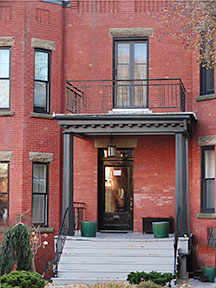
470 Strathcona
470 Strathcona
Edmond McMahon, coroner (1899).
« Edmond McMahon. Choirmaster, vocalist, lawyer, and coroner (Sainte-Rose, now part of Laval, near Montreal, October 18, 1852 – Westmount [Montreal], February 2, 1942) was admitted to the Montreal Bar in 1881. He subsequently served as coroner (1892) and later as justice of the peace (1894) for the city of Westmount. He held successive posts as choirmaster at Saint-Joseph Church, at the Cathedral of Montreal (1888–93), and later at Notre-Dame (1897–1906).
McMahon was editor-in-chief of L’Album littéraire et musical de La Minerve and contributed regularly to L’Art musical (1896–99). He authored Méthode élémentaire de plain-chant romain (Montreal, 1880), a work lauded by Ernest Gagnon for its scholarly precision and pedagogical clarity:
“On every page of your book, one perceives the depth of erudition necessary to expand your work further, and it is apparent that you have deliberately chosen to remain within the boundaries you have set. You were wise to restrict yourself to an elementary treatise, for it is essential to popularize the study and practice of plainchant, and it is not through lengthy dissertations that this goal will be attained” (letter of August 25, 1880, to the author, published in Le Canada musical, April 1, 1881). »
– The Canadian Encyclopedia
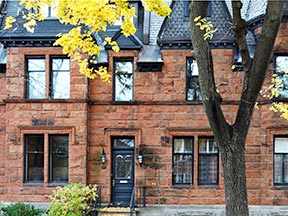
96 Columbia
96 Columbia
T. M. Todd – Manager, Allan Line (1899).
“Allan Line was a Scottish-Canadian shipping company founded by Captain Alexander Allan (1780-1854) with his newly purchased brigantine, Jean, which sailed from Greenock, Scotland, to Québec in 1819. In 1826, his second son, Hugh Allan, came to Montréal and developed a successful shipping business there; in 1839, Hugh was joined by a younger brother, Andrew. Two other brothers established offices in Greenock and Liverpool. In 1854, the Allan consortium incorporated the Montreal Ocean Steamship Company, which in 1856 won the government mail contract from Montréal to Liverpool.
With innovative engineering and design, the Allan ships prospered on the Atlantic and other trade routes. The first steel liner to sail the Atlantic was the Allan Line’s Buenos Ayrean in 1880. After the turn of the century, the company had difficulty financing new ships and was sold to Canadian Pacific Steamships Ltd in 1909.”
– The Canadian Encyclopedia
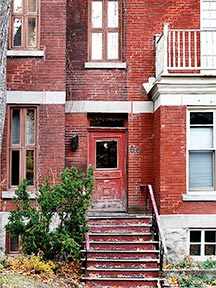
69 Columbia
69 Columbia
C. E. Wolfkill – Dominion Bridge Co. (1899)
“The Dominion Bridge Company, founded in Toronto in 1879 under the name Toronto Bridge Company, moved to Lachine in 1883 to manufacture iron and steel superstructures for bridges and buildings. Attracted by the vast expanses of low-cost land along the canal, the company was directly linked to Lachine’s development. It gradually expanded its complex, buying more land and adding a machine shop in 1897, then making more additions between 1925 and 1935.
A major employer in Lachine, Dominion Bridge built numerous skyscrapers and bridges across Canada, including the Reversing Falls railway bridge in Saint John, New Brunswick, and the bridge between Kanahwake and Lachine. The company and its subsidiary, Davie Industries, went bankrupt in 1998, and following concerted union efforts and protests, the assets were bought by Group ADF Inc and the FTQ Solidarity Fund. In 2003, the ADF threatened to close down the facilities, which were then bought by Cintube, a former partner of Dominion Bridge, specializing in the precision bending of tubes, pipes, beams, and channels.”
– Canadian Heritage

Westmount Park’s Crows
Westmount Park’s Crows
They are an interesting species of birds. An interview with Kevin McGowan, an ornithologist from Cornell University, provides a fascinating insight into their behaviour:
What is a group of crows called?
“The poetic term used in literature is a ‘murder’.Scientists would call them a flock.”
Why do crows roost in cities?
“Urban living offers crows several possible advantages. Cities are often 5 to 10 degrees F warmer than rural areas, an advantage in cold weather, and may offer protection from human hunters. Great horned owls, which frequently prey on crows, presumably occur in fewer numbers in urban areas. Artificial light may assist crows in watching for owls at night, and cities may provide some of the largest roost trees in a given area.”
How can you attract crows?
“Crows have an endearing characteristic that apparently is not shared by other birds — they can identify people as individuals. While you can get chickadees to eat out of your hand, any old hand will do, and I suspect the chickadees do not know you as an individual. Crows will! If you regularly toss them peanuts (preferably unsalted, in the shell), they will wait and watch for you. Not just any person, but you. If you do this often enough, they will follow you down the street to get more, even if you’re in your car.”
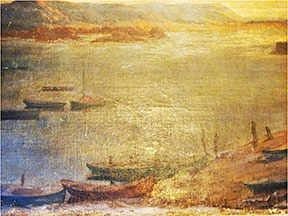
Artwork in the Richelieu Apartments
The Richelieu Apartments
I am not certain how far west Westmount’s border extends on Claremont Avenue. There is, however, an interesting apartment building on 418 Claremont Avenue facing this boundary. It’s named The Richelieu – built in 1926 and designed by C. P. Tetley.
The stairs are made from Italian marble, and their banisters are solid mahogany. The hall floors are covered with French ceramic tile.
More interestingly, there is original artwork (although deteriorating) in the halls and lobby. One story relates to a tenant who, many years ago, faced financial difficulties and created the paintings in lieu of paying rent.
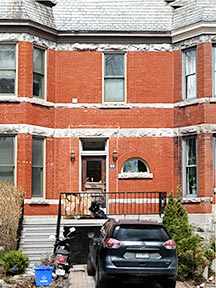
65 Arlington
65 Arlington
James Crankshaw, advocate (1897)
J. Crankshaw.
“The profession of the Law is one, the importance of which cannot be overrated, and in this work, where the commercial and industrial enterprises of the City of Montreal are described, the Local Bar comes within its scope.
Among this profession’s members, Mr. J. Crankshaw deserves a passing tribute. This popular barrister began practice in 1883, and his practice has steadily increased, having during the intervening period drawn about him a very extensive and influential clientele.
Mr. Crankshaw has always taken a high stand in his profession and has had many years’ experience in this country as well as in England, where, for many years, he was manager of a Law firm in Manchester, thus equipping him to handle all the details of law.
During his professional career in this city, he has successfully handled many difficult cases, and his advice on all legal matters is widely recognized as authoritative; clients visit him from various parts of the Province.
He has at all times identified himself with the best interests of the city, and has for many years been a Commissioner for Ontario. He was admitted to the Bar of Quebec in 1883, and has ever since kept up with the times.”
– Gazetteer of Montreal
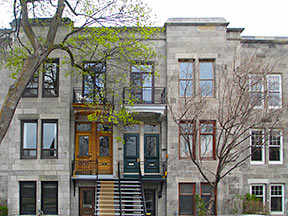
263-265-267-269-271 Melville
263 Melville
J. Marshall, manufacturing agent (1900)
265 Melville
George Johnston, conductor Intercolonial Railway (1900)
The Intercolonial Railway of Canada was in operation between 1872 and 1918 as one of Canada’s first Crown corporations.
267 Melville
Alfred D. Thornton, assistant manager, Canadian Rubber Co. (1900)
“The Canadian Consolidated Rubber Company was headquartered in Montreal, and opened a branch in Edmonton in 1911 to serve as a distribution point for its products, which were manufactured in Ontario and Quebec… supplied rubber belting, packing, hoses, waterproof clothing, felt footwear, automobile and carriage tires, and druggists’ rubber sundries”.
– Philips Lofts
269 Melville
Arthur Shibley, secretary-treasurer City of Westmount (1900)
‘To govern a territory spanning much of British North America, Simpson had to be more than an effective businessman; he also needed to be a skilled politician and diplomat.’
271 Melville
Mrs. Louisa A. Simpson, daughter of Sir George Simpson (1900).
Sir George Simpson was the governor of the Hudson’s Bay Company (1820-1860).
“The governor of a territory stretching over most of British North America, Simpson had to be more than an efficient businessman. He had to be a politician, and, since part of the HBC’s domain was disputed by the United States and Russia, a diplomat as well. The conflict with the Russian American Company over trading territory on the northwest coast dated back to the HBC’s reorganization during the 1821 merger. Simpson and HBC governor John Henry Pelly travelled to St. Petersburg (Leningrad, U.S.S.R.) in August 1838 to negotiate an agreement with Baron von Wrangel, the most influential director on the board of the Russian company.
These talks became the basis for a contract between the two companies, signed in 1839 by Simpson and Wrangel, by which the Russians leased the Alaskan panhandle to the HBC. In return, the British company undertook to provide the Russians, based at Sitka, with foodstuffs at favourable prices. The strength of this arrangement, which ceded de facto control over Russian territory to the HBC, was such that in 1854–55 during the Crimean War, the terms were respected and, at the suggestion of Simpson, both the British and the Russian governments agreed to exclude the northwest coast from the theatre of war.”
– The Canadian Encyclopedia
27 Chesterfield
Charles Redlich, Cigar manufacturer – Reliance Cigar Factory, 5 & 7 Bresoles Street (1900).
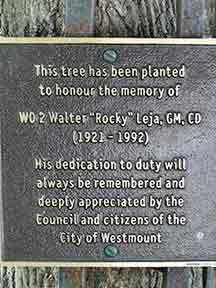
Memorial Plaque
Memorial Plaque – Westmount & Grosvenor
A largely overlooked plaque dedicated to Sgt. Major Leja. He was seriously injured while defusing a bomb (one of several), planted by the FLQ, in a letter box (on Westmount & Lansdowne Ave.) On May 17, 1963.
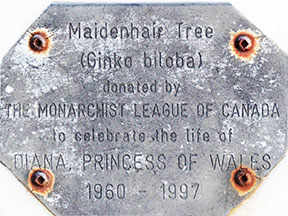
Diana Memorial
Diana, Princess of Wales Memorial
A memorial plate inWestmount Park next to a Gingko tree planted by the Monarchist League of Canada in memory of Diana, Princess of Wales. (Located next to the children’s wading pond).
Images: Michael Walsh
 Other articles by Michael Walsh



 January 23, 2026" />
 Westmount—Saint-Louis" />
 and their stories" />
 Trump backs down" />
 celebrates its 34th season" />
 Commercial financing" />
 smart answer to tariffs" />
 Thai cauliflower florets" />
 legacy with purpose" />
 Lewis Avenue" />
 resistance and unity" />
 Sovereignty Project" />
 to be infallible that fail" />
 A look at self-confidence" />
 Abbott Avenue" />
 Flourless Almond Cake" />
 for real estate sales" />
 authorities must act" />
 Michael Hawkes /98" />
 looks back at 2025" />
 online betting rules?" />
 a film by Andrés Livov" />
 for its 16th edition" />
Very nice and interesting article. Thank you Maurice