
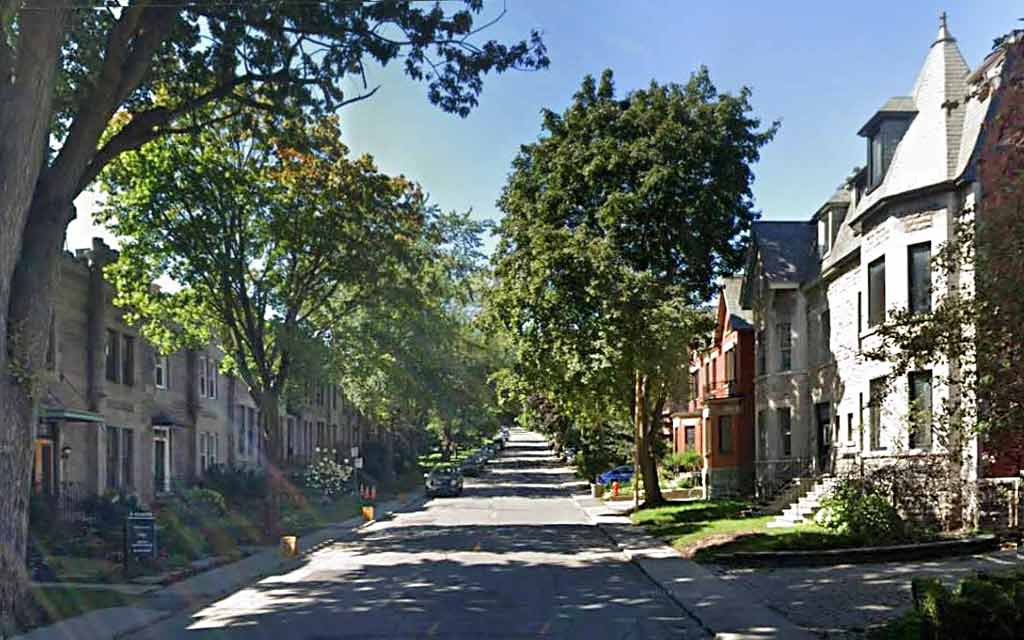
Westmount places:
Arlington Avenue and Lane
The history behind the familiar: the former residents who called the street their home
By Michael Walsh
September 22, 2025
Given the word “Arlington,” how many proper nouns come to mind? Perhaps one would reply “avenue”, “lane” or even “cemetery”, which leads us to a larger question: do they commemorate the same person or place? The answer is no. Virginia’s Arlington National Cemetery is named after Arlington, in Gloucestershire, England, which was the family location of George Washington’s adopted son.
The first cup of tea drunk in England was made at Arlington House, a residence which occupied the present Buckingham Place. The tea was brought to England by the Earl of Arlington, who gave 60 shillings a pound for it in Holland.
– The Daily Inter Ocean, May 28, 1896
Westmount’s Arlington Avenue and Lane commemorate Henry Bennet, 1st Earl of Arlington. He does, however, have an association with Virginia. In 1673, King Charles II gave a 31-year grant to Bennet and Lord Culpeper for the entire territory of Virginia at a nominal rent of thirty shillings per annum.
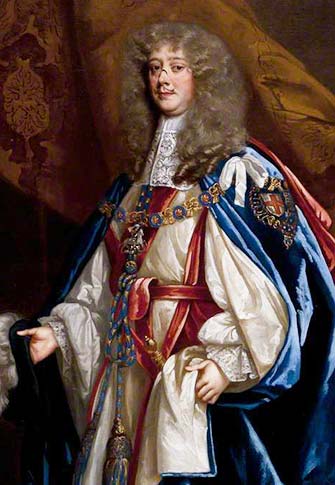
Portrait of Henry Bennet, 1st Earl of Arlington (1618-1685) • Image: Public Domain
Interestingly, Arlington’s name is incorporated in the word “cabal” (a secret political clique or faction). Strictly speaking, the word is an acronym formed from the initials of five ministers of Charles II’s Cabal cabinet noted for their secrecy: Clifford, Ashly, Buckingham, Arlington and Lauderdale. These ministers were credited with having sold England to France through the Treaty of Dover. In short, the treaty ensured England’s support for French policy in Europe by going to war against the Dutch and adopting Roman Catholicism. In return, Charles II would receive an annual subsidy from King Louis XIV, freeing him from any dependence upon the British Treasury.
Another interesting fact is Henry Bennet’s residence in central London, known as Arlington House. In 1703, the Duke of Buckingham (one of the “cabal”) purchased the house and renamed it “Buckingham House”. It was purchased in 1762 for Queen Charlotte and is known as the “Queen’s House”. George IV eventually rebuilt it, and today it is known as Buckingham Palace.

Buckingham House in London, circa 1710 • Image: Public Domain
Finally, Arlington’s legacy also lives on at St. James’ Park adjacent to Buckingham Palace. He is credited as assisting Charles I in designing the 57-acre central London green space.

Original layout of André Mollet’s design for St. James’s Park in Charles II’s time • Image: Public Domain
Armed with this background, let us focus on the street (and lane) that also bears his name. The more interesting story lies within the lane, which many of us know, dates back many centuries.

François Vachon de Belmont (1645 –1732), 5th superior of the Montreal Sulpicians (1700- 1731) • Image: Public Domain
Arlington Lane was first named Belmont Avenue in honour of François Vachon de Belmont. Originally, a First Nation’s footpath originating at Bethune Avenue and ending at the mountain. Used for centuries, it is one of Westmount’s first roads. Surprisingly, although widened over time, it escaped being divided into saleable lots during the early years of land speculation. That accounts for its lasting charm that exists to this day. It has been described as:
“…the most picturesque back alley in Montreal. The lane is a popular playground with Westmount children… of special note is the southernmost house on your right, with its wrought iron gate and flower-filled gargoyles…”
– Montreal Gazette, October 11, 1974
In 1890, Belmont Avenue was widened at the request of the fronting proprietors. In addition, they requested that the street be opened to traffic and made at least fifty feet wide, from Côte St. Antoine Road to the proposed Boulevard. Council refused by stating this proposal would require expropriation of land from proprietors who have previously objected to the street’s opening.
Surprisingly, three years later, Council erased Belmont Avenue from the municipal plan. They reasoned that the street was never ceded and, as such, the Corporation had no rights therein. Further to the point, in 1882, a case was before the Court of Queen’s Bench involving a Mrs. Smith, the appellant, who had purchased two lots from Francis Dolan. They were described as bounded in the rear by Belmont Avenue. The purchaser paid the first installment and subsequently discovered that Belmont Avenue was not a street at all. Instead, it was a narrow piece of land that had been closed up by Mr. Graves, her neighbour. (Incidentally, Mrs. Smith ultimately lost on appeal.)
Unexpectantly, Council’s decision also affected By-Law 20 concerning the assessments for Arlington Avenue. The proprietors demanded a reduction on their houses forming part of Belmont Avenue, arguing that the street was no longer a part of the municipality.
‘…the most picturesque back alley in Montreal. The lane is a popular playground with Westmount children… of special note is the southernmost house on your right, with its wrought iron gate and flower-filled gargoyles…’
– Montreal Gazette, October 11, 1974
At this point, the municipality’s attention was focused on opening another street, also called Belmont Avenue. To avoid confusion with two streets having the same name, the Council approached Donald W. Ross (son of the architect George Allen Ross), who owned several houses on the street, about changing the road’s name. Not receiving a satisfactory response, Council referred the matter to the Town Solicitor with the instructions to “protect the interests of the Town in every possible way…” (Council Minutes, November 1896). Today’s Belmont Avenue was opened in 1890 and entirely ceded in 1900.
How the Town resolved this dispute is not documented in the Council minutes. One can speculate that the Town took the issue to the Queen’s Bench, which granted a favourable judgement. To avoid any similar recurrences, the avenue was referred to as a lane (or a large alley) adjacent to its neighbouring street – hence, Arlington Lane. A decision that, unfortunately, buries all historical connections with the road’s original usage as a First Nation’s footpath to the mountain.
We will now turn our attention to the lane’s neighbour, Arlington Avenue. In 1890, the street was named Matilda Avenue, perhaps reflecting the Germanic roots of the original proprietors. In 1895, the street was renamed Arlington Avenue. Interestingly, at that time, the street was only 750 feet long and contained a total of two residences: civic numbers 41 and 43, which are still extant. During that period, the street was owned by J. Stevenson Brown (a realtor) and Messrs. Miburn and Yeoman. Collectively, they ceded the street to the Town in 1885.
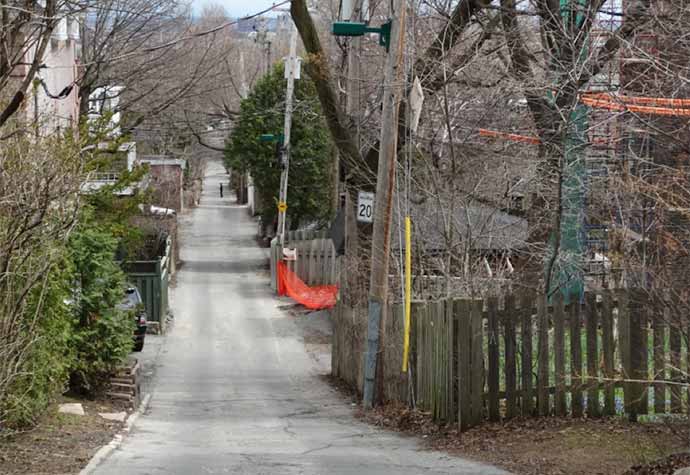
Former First Nations’ path to the mountain. Originating at Bethune, it traversed Westmount Park towards what are now Belmont and Lansdowne Avenues, ending on the mountain.
With the street now part of the municipality, an entrepreneurial contractor proposed the installation of an electric railway track along its length. This proposition faced strong opposition from the proprietors, who were facing the expropriation of five-foot strips along the length of the street. Additionally, the town’s engineer reported that the street’s grades and curves rendered it unsuitable for the street railway. As such, by 1899, the private contractor looked elsewhere to install railway tracks.
That same year, the municipality fully extended the street to Côte St. Antoine Road. This involved expropriating 4,588 feet from the Rutherford Estate and traversing through several greenhouses owned by a Mr. Graves. In addition, land was ceded by Messrs. Milburn and Yeomans and Misses Agnes and Mary Rutherford. The extension was paid by the fronting proprietors at the rate of sixty cents per foot.
In 1909, the YMCA purchased a lot 120 feet along Sherbrooke Street and 120 feet on Arlington Avenue for their Westmount branch. Described as:
“…The building will contain about twenty-five rooms to rent as dormitories, and it will provide a much-needed club for Westmount men, both young and old. There will be gymnastic equipment of the most approved type, and the swimming bath will not be omitted.”
– Montreal Gazette, July 15, 1910
‘… an entrepreneurial contractor proposed the installation of an electric railway track along its length. This proposition faced strong opposition from the proprietors, who were facing the expropriation of five-foot strips along the length of the street.’
Beyond that period, the street matured, no different than any other municipality – houses were built, families celebrated births and marriages. Some residents moved away, others died in their homes, creating a cycle common to all residential streets.
One final fascinating legacy from the residents of Arlington Avenue lies in the City’s current weekly collection of compostable materials. Spearheaded, in 1999, by a group of Arlington Avenue residents, a petition was presented to Council requesting that municipal composting be incorporated as an integral part of the City’s waste management programme. Council agreed, and by 2009, the “Green Bin Programme” was implemented throughout the City. Municipal wheels move slowly; however, today the programme’s success can be measured by the annual diversion of hundreds of tons of food waste from landfills.
At this point, let us step back in time while taking a leisurely walk along the elegant houses that grace Arlington Avenue and listen to the forgotten stories hidden inside their walls.
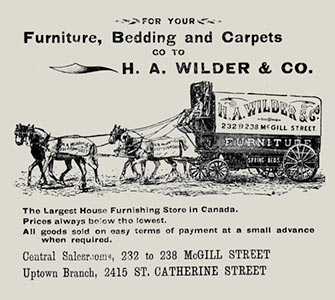
Ad for H. A. Wilder & Company, 1897 • Image: Public Domain
20 Arlington
J. E. Wilder, H. A. Wilder & Company, furniture dealers (1904)
22 Arlington
Charles C. Corneille, wholesale paints and oils (1900).
26 Arlington
F. Watson, agent, Grand Trunk Railway (1900)
J. E. McKenna, Redpath and Company, stockbrokers (1915)
As a Lieutenant with the Irish Rangers, he received wounds during World War I. Corporal Adrian McKenna, 24th. Battalion was killed in action in January 1916.
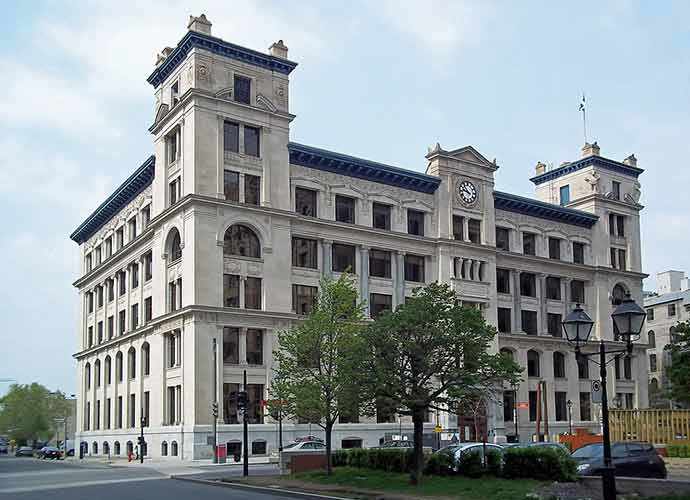
Grand Trunk Building, 360 McGill, Montreal • Image: Creative Commons
32 Arlington
George H. Archibald, Secretary, Steamship Union (1897)
Henry D. Metcalf – H. D. Metcalf & Company – grain exporters (1904).

Calling card for J. A. Mathewson • Image: Public Domain
33 Arlington
J. A. Mathewson, J. A. Mathewson & Company, tea importers and wholesale grocers (1900)
J. E. Dickson, Manager, Law Union & Crown Insurance Company (1904)
“This company was established in 1854 as the Law Union Fire and Life Insurance Company. In 1892, it acquired the Crown Life Assurance Company and changed its name to the Law Union and Crown Fire and Life Insurance Company. In 1898, the Company’s name was changed to the Law Union and Crown Insurance Company. In 1909, it acquired and amalgamated with the Rock Life Assurance Company and was renamed as the Law Union and Rock Insurance Company Limited.”

34 Arlington
“Its head offices were at 45 Pall Mall, 1854-6; 126 Chancery Lane, 1857-1912; and 7 Chancery Lane (“Old Serjeants Inn”), from 1912. In 1919, the Company was acquired by, and allied with, the London and Lancashire Fire Insurance Company, which in 1961 was acquired by, and allied with, the Royal Insurance Company Limited.”
– Archives in London and the M25 area
Norman Macfarlane, President, Macfarlane Shoe Limited (1930)
C. Laurendeau. The property was converted into a two-family dwelling (1940)
34 Arlington
Judson A. Eaton, Classics Professor, McGill College (1900)
George Cooke, former councillor and secretary-treasurer of the City of Outremont, Belding-Corticelli Company (1935)

Ad for Corticelli Limited • Image: Public Domain
35 Arlington
Charles E. Scarff, druggist (1900)
C. Laurendeau. The property was converted into a two-family dwelling in 1942.
Mrs. May Wilcox, killed by a fall from the home’s third-story window (May, 1942)
H. Notman, assistant general passenger agent, Canadian Pacific Railway (1897)
John W. Hopkins, architect (1900)
“After receiving his architectural training in England, Hopkins emigrated to Canada in 1852. After he arrived in Montreal, Hopkins became the partner of James Nelson (1830-1919); Frederick Lawford (1821-1866) became a partner in 1856, and the firm remained in operation until 1860. At this time, Hopkins worked on his own until 1893, when his son, Edward C. Hopkins (1857-?), became his partner. John W. Hopkins was the first president of the Province of Quebec Association of Architects (1890-1).”
“Known works include: Allan Building (rue de la Commune ouest, 1858), Montreal Rolling Mills (1873), Custom House/Royal Insurance Building (rue Notre Dame and Place d’Armes, 1865), Montreal Telegraph Building, Unitarian Church of the Messiah (rue Beaver Hall Hill, 1857), Stores for Beniah Gibb (rue Notre-Dame), Presbyterian Church (rue St-Joseph, 1862) and the Montreal Street Railway Company Office Craig Street and Place d’Armes, 1894).”
– Industrial Architecture of Montreal

41 Arlington
41 Arlington
R. W. Fowler, dry goods merchant. Their son, Hamilton Gordan Fowler, 73rd Highlanders, was killed in action in October 1916.
42 Arlington
Charles F. Babcock, Babcock & Son (1904)
C. S. Babcock (1918)
The residence was also used by the Ypres Club (1918)
“…members who have knitted socks which they have sent to France. Other work… is the sending of comforts to prisoners of war, and before Christmas, they helped in giving dinners to the returned men. On Saturday, the rooms were crowded with interested patrons of the club. Tea was served in the dining room, the table being decorated with the early spring flowers and pussy willows, and lighted by candles with yellow shades…”
– Montreal Gazette, January 21, 1918

43 Arlington
43 Arlington
F.C. Silcock, manager, Bovril Company (1897).
Bovril was initially manufactured in Montreal from 1879 to 1884 until a fire destroyed their operations. In 1884, the company relocated to London, England.
46 Arlington
J. H. Gallagher, commercial traveller, represented Silber & Fleming, London jewellers (1897)
C. L. Lynch. Residence converted into a two-family dwelling (1947)
52 Arlington
Reverend Dr. Henderson (1918)
Parsonage for St. James Methodist Church, today named The Saint James United Church.

53 Arlington
53 Arlington
James Lang, Lang Manufacturing Company (1904)
Their company was the largest manufacturer of biscuits in Eastern Canada.
“The Lang Manufacturing Co. Biscuits and Confectionery, St. Monique Street, Montreal – this business had its origin in 1879 when it was established by Henry Steinson and others… These gentlemen… have succeeded… in building up and maintaining undoubtedly the largest trade in plain and fancy biscuits in Eastern Canada. They are also manufacturers of every description of confectionery and do an immense business in this line as well.”
– Industries of Canada, City of Montreal, Leading Firms and Moneyed Institutions, 1886
R. Lawrence Cross, Sun Life Insurance Company (1951)
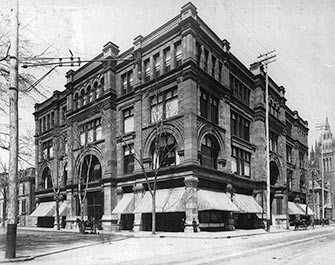
Morgan’s downtown department store, c 1890 • Image: Public Domain
57 Arlington
William Morgan, superintendent, Henry Morgan & Company (1904)
Purchased in 1960 by Hudson’s Bay Company.
Patrick W. Dubee, Secretary-treasurer, Montreal Tramways Company (1944)
Miss D. Stone, business manager, St. Genesius Players Guild Radio Workshop (1946)
The guild was an amateur drama group presenting a weekly series of dramatizations on the radio station CJAD.
 59 Arlington
M. Ingress, professor, McGill University (1900)
Hubert C. Kemball, Mather and Pratt, engineering manufacturers (1929)

The Order of the Bath • Image: Public Domain
60 Arlington
J. W. Hopkins (1904)
Major-General A. E. Walford, First Canadian Army, awarded Order of the British Empire, Companion of the Most Honourable Order of the Bath (1944)
“Returning to the world of business, Major-General Walford headed Henry Morgan Company Limited of Montreal, a large conglomerate with interests in finance and real estate. In 1947, he accepted the appointment of Honorary Colonel of Headquarters 3rd Canadian Division. An active leader in his community, he held several positions: Governor of McMaster University, Treasurer of the Montreal Board of Trade and Commissioner of the Montreal Metropolitan Area Boy Scouts. He became the first Canadian President of the Federation of Commonwealth and British Chambers of Commerce. Major-General Walford died at age 94 in Montreal after a life of service to his country and to his Regiment.”
– The Royal Regiment of Canadian Artillery
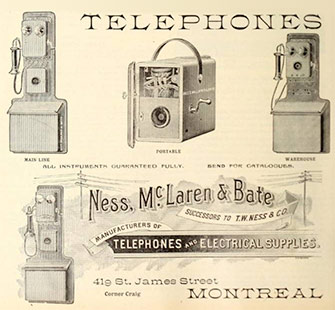
Ad for McLaren and Bate • Image: Canadian Electrical News, August 1900
62 Arlington
N. W. McLaren, Ness, McLaren and Bate, manufacturers of telephones, telegraph instruments, annunciators, electrical house furnishings, and general electrical supplies (1903)
63 Arlington
August Boeckh, Charles Boeckh and Sons, manufacturers of brushes, brooms and woodenware (1897)
A. T. Porter, Porter, Conrad Importing Company (1900)
65 Arlington
James Crankshaw, Advocate (1897)

63 Arlington
“The profession of the Law is one, the importance of which cannot be overrated, and in this work, where the commercial and industrial enterprises of the City of Montreal are described, the Local Bar comes within its scope. Among members of this profession, Mr. J. Crankshaw deserves a passing tribute. This popular barrister began practice in 1883, and his practice has steadily increased, having during the intervening period drawn about him a very extensive and influential clientele. Mr. Crankshaw has always taken a high stand in his profession. He has had many years’ experience in this country as well as in England, where for many years he was manager for a Law firm in Manchester, thus fitting him for conducting all the details in Law.”
“During his professional career in this city, he has successfully handled many difficult cases, and his advice on all legal matters is widely recognized as authoritative; clients visit him from various parts of the Province. He has consistently identified himself with the best interests of the city and has served as a Commissioner for Ontario for many years. He was admitted to the Bar of Quebec in 1883 and has ever since kept up with the times.”
– forgottenbooks.com

65 Arlington
78 Arlington
James Brophy, Brophy, Cains & Company, dry goods merchants (1904)
Ardrey W. Downe, M.D and Professor (1916)
79 Arlington
Henry C. Telfer, livestock agent (1897)
Nursing Sister Mrs. Henry Weller, superintendent, Continental Hospital, France (1918)
Awarded the Médaille de la Reconnaissance by the President of France.
G. P. MacLaren, general tie and timber agent, Canadian National Railways (1938)
Douglas Charles Abbott, Canadian Member of Parliament, federal Cabinet Minister, and justice of the Supreme Court of Canada (1945)

Ad for Brophy, Cains & Company • Image: Public Domain
81 Arlington
M. Hutchinson, Hutchinson & Oughtred (1900)
“Born in Musquodoboit, Halifax County, Nova Scotia, on 20 October 1843, son of William Scott Hutchinson, farmer, and Sarah Martha Archibald. He was educated at London Grammar School in London, Ontario, at McGill University in Montreal and at the Military College in Toronto. Recipient of the Elizabeth Torrance Gold Medal in 1873. Called to the Bar of the Province of Quebec on 13 January 1874. Appointed Queen’s Counsel on 19 May 1899.”
“He was a member of the law firm McMaster, Hutchinson and Knapp in 1874, then of McMaster, Hutchinson and McLennan, and subsequently partnered with Mr Oughtred. In 1877, he joined McGill University, where he lectured until 1880, then was Assistant Professor from 1880 to 1888, Professor of Roman Law from 1889 to 1893, and Emeritus Professor from 1893 to 1926. He was, for one year, Master of the Prince Consort Lodge. He was also Grand Master of the Independent Order of Oddfellows and a member of the Canada Club.”

Médaille de la Reconnaissance française • Image: Public Domain
“He served as alderman of Westmount from 1885 to 1890, then as mayor from 1891 to 1893. He was also a school commissioner in Westmount for three years. Elected unopposed as Liberal Member of the Legislative Assembly for Montréal no. 5 in 1900. Did not stand for re-election in 1904. Appointed puisne judge to the Superior Court of Quebec on 16 November 1904. Died in Westmount on January 22, 1926, at the age of 82 years and 3 months. Buried in Montreal at Mount Royal Cemetery on 25 January 1926.”
– Assemblée nationale du Québec
William Mackay, assistant manager, Royal Insurance Company (1904)
Frederick Wilson-Smith, Publisher of the Insurance and Finance Chronicle (1938)
84 Arlington
L. J. E. Latulipe, President, Corkolite Linoleum Company (1935)
87 Arlington
J. J. Fiske
Their son, Private Kenneth R. Fiske, Calgary Battalion, was killed in action in September 1916.
John J. Fiske. In 1944, at the age of 100, was McGill’s oldest living graduate.
89 Arlington
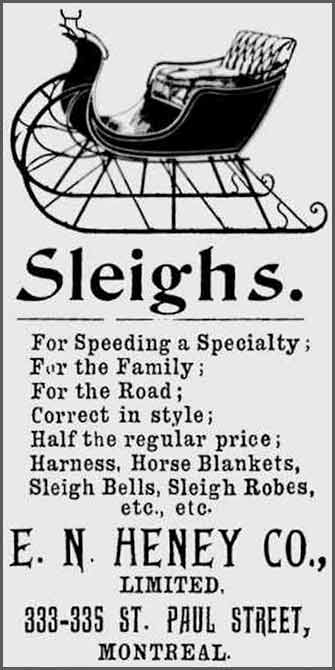
George Arthur Perry, E. N. Heney Company Limited (1909)
94 Arlington
Converted into a duplex home in 1929.
 95 Arlington
Sarah J. (Sally) Aitken, Director, Municipal Housing Bureau of Westmount, Alderman, City of Westmount (1983)
99 Arlington
L. Gerald Smith, Managing director, Vapor Car Heating Company of Canada (1940)
The company manufactured heating, ventilation and air conditioning equipment for streetcars, railroads and tramways.
100 Arlington
William Alexander Baker, W. E. Baker automobile and garage service (1938)
108 Arlington
S. A. Watt, inspector, Guardian Fire and Life Insurance Company (1904)
“A dog’s loud barks heard early yesterday morning led to the discovery in a yard at 108 Arlington avenue Westmount, of a box of silverware, ladies’ dresses, furs, an umbrella, a flashlight, and a bottle of perfume, the whole valued at $400, which had evidently been abandoned by thieves put to flight by the animal’s baying…”
– Montreal Gazette, July 13, 1926

Ad for W. R. Brock Company • Image: Wikimedia Commons
110 Arlington
W. P. Slessor, W. R. Brock Company, wholesale dry goods, woollens, carpets, smallwares, ladies’ furnishings, men’s furnishings (1904)
Carl T. Mead, resident manager, Standard Stoker Company of Canada (1943)
112 Arlington
Frederick Morley Fry, Physician in charge of the children’s ward at the Royal Victoria Hospital (1935)
Dr. Fry was responsible for Montreal’s free milk stations for disadvantaged children and the establishment of Montreal’s Milk Commission that ensured adequate milk safety standards.
“Another link with pioneer days in Canada was broken yesterday when Mrs. J. G. Waldock died after a long illness at the home of her daughter, Mrs. F. M. Fry, 112 Arlington Avenue. Mrs. Waldock, nee Agnes Nesbitt, was in her 90th year. Born in Woodstock, Ont, Mrs. Waldock joined her rancher-husband near Birtle, Alta, in 1881. She later resided at Shoal Lake and in Medicine Hat. When her husband died in 1908, she came to Montreal… ”
– Montreal Gazette, September 14, 1938
116 Arlington
John Rice O’Neil, railroad contractor (1928)
“…entering the services of William Davis and Sons, with whom he was associated in the building of the Cornwall and Cardinal canals, and afterwards with M. P. and J. T. Davis on the Quebec Bridge contract and the building of the Quebec dry dock. In 1915, Mr. O’Neil entered the railroad contracting business… and was identified with the building of the Quebec and Saguenay Railway and various large divisional yard contracts…”
– Montreal Gazette, August 23, 1928
In 1993, the front garden won third place in Westmount’s Concours Maisons Fleuries Contest. The following year, the garden won second place.
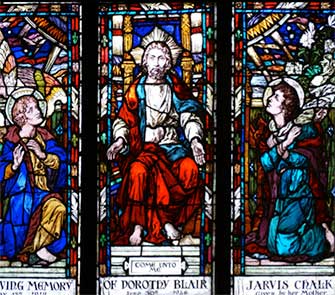
Stained glass, Westmount Park United Church
117 Arlington
George H. Cornell, Accountant, Crathern and Caverhill, hardware firm (1925)
“A Mechanical Curiosity! Each Mouse Caught resets the Trap for another. This ingenious trap has proved itself to be PERFECTION. It is simple and effective, catching the Mice alive, leaving no blood or dead Mice to frighten others. In fact, the appearance of the Trap is such that it seems to offer inducements for Mice to enter, and when once caught, they reset it while passing to the Reception Room.”
“A clean, attractive mousetrap with a mechanism that automatically resets after each mouse is caught: too good to be true? Not according to the representatives of Crathern & Caverhill, the legendary Montreal hardware wholesaler and distributor of a multi-catch mouse trap with a swinging door. In the late 19th century, a time when domestic sanitation and rodent control were growing concerns, this innovative device, dubbed the “Catchemalive Mouse Trap,” claimed to be a veritable technological breakthrough.”
“Crathern & Caverhill, which had been run by brothers John and Thomas Caverhill and their partner James Crathern since 1854, was at that time one of Canada’s largest wholesale hardware firms. It was absorbed by Caverhill, Learmont & Co. in 1897, a company that remained in the hands of the Caverhill family until 1970. Still in operation today, the business now operates under the name Caverhill Learmont Inc.”
– McCord Museum
Callum Thompson, Minister, Westmount Park-Emanuel Church, today known as Westmount Park United Church (1955)
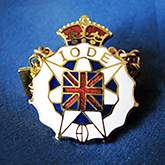
I.O.D.E. badge • Image: Public Domain
118 Arlington
James H. Webb, Secretary-Treasurer and Director, Dominion Textile Company
His daughter, Mrs. Edna Watson, survived an Imperial Airways plane crash in the Atlantic Ocean while travelling between New York and Bermuda. For her acts of heroism during this incident, she was awarded the Royal Humane Society’s silver medal. (January, 1939). In 1946, Edna Watson and Mrs. Robert Aiken, both residents of Bermuda, were elected to the Parliament of Bermuda, becoming the first two women to hold that post. In that position, she advocated for the betterment of conditions for women and children as well as compulsory education throughout the British colony.
Residence used by the I.O.D.E. Nolan-Cornell Chapter (1925)
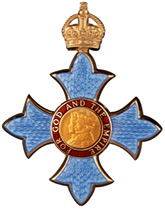
Most Excellent Order of the British Empire • Image: Public Domain
120b Arlington
Frederick S. Jones, awarded Member, Civil Division of the Most Excellent Order of the British Empire (1946)
122 Arlington
Paul Earl. The Property was converted into a two-family dwelling in 1937.
123 Arlington
Residence used by the Laddie Millen Chapter (1918)
Established by Mr. J. Ernest Millen in memory of his son, Laddie Millen, killed during World War I. Today, known as the Laddie Millen Memorial Prize, it provides partial funding for undergraduate students enrolled in Bachelor of Commerce programmes.
125 Arlington
W. R. Hughes, J. W. Hughes and Son (1904)
A plumbing business located at 732 St. Antoine Street
132 Arlington
Frank Meade Gilman, Justice of the Peace, District of Montreal (1914)
134 Arlington
Hon. F. E. Gilman, K.C., Queen’s Councillor practicing as a commercial lawyer (1917)
“…He was the first one to introduce a measure to permit parties in a civil suit to testify on their own behalf, and also a measure in favour of compulsory voting. He, likewise, moved for the abolition of the Legislative Council…”
– Montreal Gazette, May 25, 1917

Dominion Coal Company’s Reserve Mines Colliery, Cape Breton County, Nova Scotia, c 1900 • Image: Public Domain
Wilfrid Laurier Murray, Dominion Coal Company (1938)
“The Dominion Coal Company (DOMCO) began in Cape Breton in the late 1800s, with 99-year mining grants being issued by the Province of Nova Scotia. With the mines came rail lines, which were needed to transport the coal to piers in Sydney & Louisbourg. In 1910, the railway lines were incorporated as the Sydney & Louisbourg Railway. By 1912, DOMCO operated 16 collieries, and 40% of Canada’s coal production came from Cape Breton. The coal mines would also spur the creation of Dominion Iron & Steel Company (DISCO), which began steel production in Sydney. The coal mines and steel interests would later be combined into the Dominion Steel & Coal Corporation (DOSCO).”
“Although there would be several name changes and corporate reorganizations, the last underground coal mine on Cape Breton Island closed in November 2001. Presently, efforts are underway to reopen some of the abandoned coal mines.”
– Lost Cod Clothing Co., Halifax, NS
137 Arlington
Louis Soloman, President, S. and G. Boys’ Clothing Company Limited (1931)
The business was located at 961 Inspector Street.
Images: Michael Walsh, unless indicated otherwise

Other articles by Michael Walsh
Other recent articles



 January 6, 2026" />
 through digital innovation" />
 looks back at 2025" />
 online betting rules?" />
 a film by Andrés Livov" />
 for its 16th edition" />
 Passion fruit meringue verrine" />
 playful clownish escapade" />
 World rhythms on stage" />
 management mistakes" />
 Kensington Avenue" />
 Vegan Chili Chocolate Cake" />
 Bethune tunnel" />
 Left out of breath" />
 of business strategy" />
 damage before it starts" />


 into a professional career" />

 plumbing issues at home" />
 embraces bold cinema" />
 Red snapper papillote" />
 the Legend of Pepita" />