
The making of Westmount Park and the possibilities that slipped away
By Michael Walsh
Previously published in WestmountMag.ca
Where does one begin to describe Westmount Park? The answer depends on whom you ask—and when the question was posed. In 1919, a promotional publication entitled Westmount, the City Beautiful, issued by the Westmount Realties Company, celebrated the park as one of the island of Montreal’s beauty spots: a place for gardens, relaxation and summer sports, as well as skating and other winter activities:
“…The main park, situated in the centre of the lower level, is one of the beauty spots of the island of Montreal, and on any fine summer day, hundreds of people may be seen there, admiring the gardens, sitting on benches under the trees, or indulging in sports. In winter, it is the centre for skating and other winter sports…”
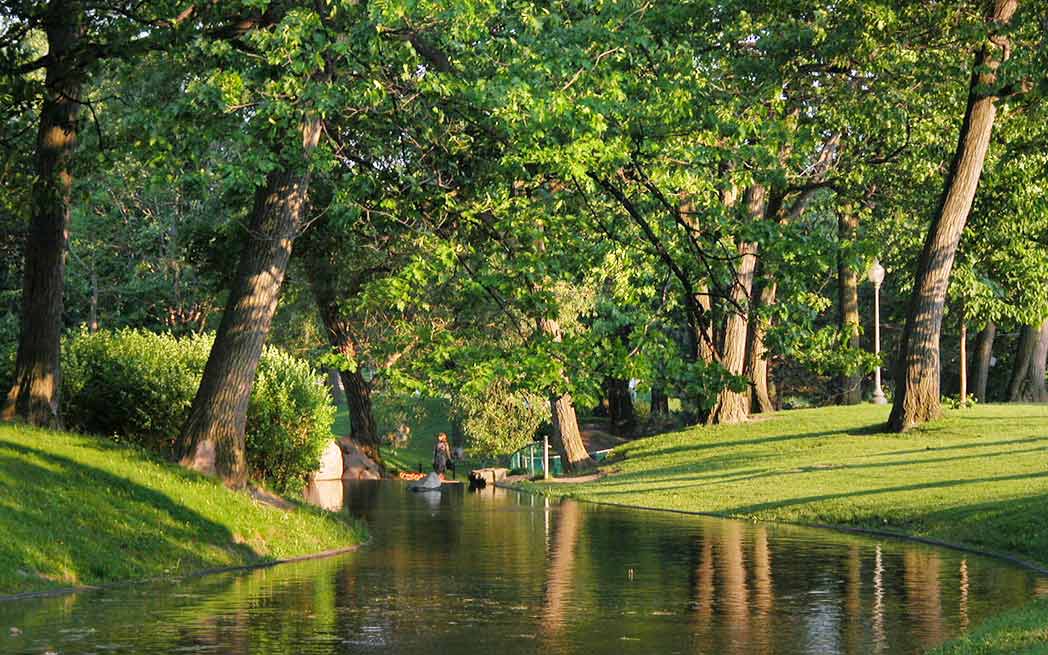
More than a century later, visitors can still appreciate the appeal of this approximately 26-acre green space. Its lawns, mature trees, winding paths and water features offer a welcome retreat within the city. Recreational facilities, the public library, the adjacent conservatory, and Victoria Hall contribute to its distinctive character.
Many are surprised to learn that parks are an artifact conceived and deliberated as carefully as public buildings, with both physical shape and social usage taken into account…
– Galen Cranz, The Politics of Park Design
Who you ask depends on their relationship with the city. Visitors are often taken with the inner-city beauty of this approximately twenty-six-acre green space. In summer, it offers sprawling lawns, a wading pool, winding walkways shaded by mature trees, and the peaceful sounds of a stream flowing into a lagoon frequented by mallard ducks.
The Park also contains tennis courts, a recreation centre with indoor ice rinks, and an outdoor swimming pool. It also boasts a dog run. It also features the historic public library and adjacent conservatory, along with the city’s distinctive Victoria Hall.
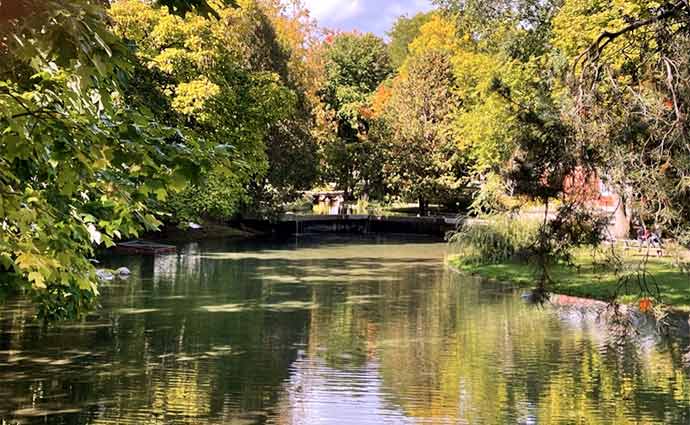
What is there not to love about the Park? Ask a longtime resident, however, and the response may not be tinted by “rose-coloured glasses.” In my experience, the Park has suffered from neglect despite substantial spending on its improvements. My concerns include asphalt patches on old brick walkways, trees and shrubs that appear to need attention, benches needing repair, problems with the lagoon, large patches of lawn denuded of grass, and issues with the wading pool’s accessibility.
I, for one, having lived across from Westmount Park for decades, have watched these changes with concern. A neglected park risks becoming a less inviting destination for residents. I miss the former variety of gardens, the cannons in their earlier setting, and the bandstand that was never replaced. I also question whether the Park receives the dedicated staffing and oversight that its upkeep requires. As of September 2023, parks fell under a broader municipal portfolio rather than being the sole responsibility of a council member. In my view, the Park deserves more focused attention.
How did we get to this point? I recall the area as one of the island of Montreal’s most beautiful parks, maintained year-round by experienced staff. The 1960s “modernization” scheme marked, in my view, an unfortunate turning point. By September 2023, further proposals to renew the Park raised new questions about its future. Before we get too far ahead of ourselves, let us follow the Park’s timeline and try to understand Council’s rationale for creating a recreational park for its residents.
The formative days of the Town of Westmount were blessed with councillors who possessed good business acumen and considerable foresight.
The formative days of the Town of Westmount were blessed with councillors who possessed good business acumen and considerable foresight. This is reflected in their acquisition of property not for development, but to create spaces for residents’ enjoyment. More importantly, they created these green spaces for future generations. Their decisions reflected an understanding that Council’s responsibility was not merely to acquire public land but to maintain it for those who would follow.
If budgetary constraints prevented the Council from immediately purchasing property, It could rent tracts of land for public use. This approach helped establish Westmount Park. Council proceedings dated September 12, 1895, record proposed ten-year agreements with William Smith and Elizabeth Watson and with the Estate of William Murray: “… That a notarial agreement be entered into between the Town of Westmount and William Smith and Elizabeth Watson to rent for 10 years an area of 501,480 feet of land… area of Athol Avenue included – (closed in 1903) bounded on the south side by Western Avenue on the east by a line of Murray Avenue, on the west by Lot 233, and on the north by the property of the Estate Murray, said land to be used as a Public Park with an option to purchase the same at the price of 25 cents and 40 cents per foot…”
“…That a notarial agreement be entered into between the Town of Westmount and the Estate of William Murray to rent for 10 years an area of 157,571 feet of land, ($2,620.50 per annum) bounded on the north by Sherbrooke Street, on the east by the line of Murray Avenue, on the west by a lane and on the south by the property of William Smith and Elizabeth Watson, said land to be used as a public park…”
– Council Proceedings, September 12, 1895
These agreements expressed the areas in square feet. Leasing the land, opening it to the public, and subsequently purchasing it were distinct stages in the Park’s establishment.
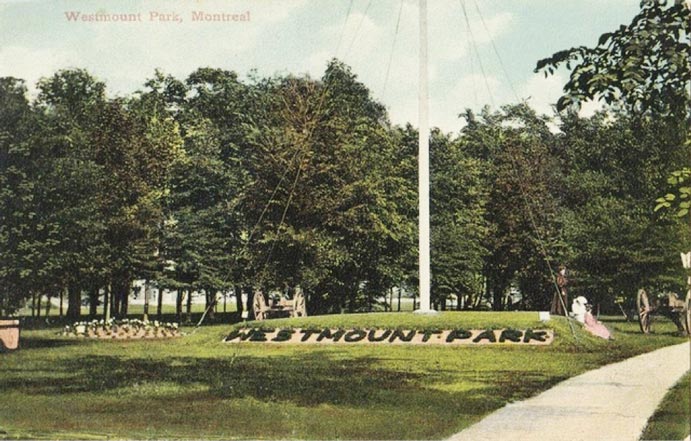
In July 1896, amidst the raising of the Union Jack and a fireworks display, Mayor Fred W. Evans officially opened the area, naming it “Westmount Park” for the enjoyment of all present and future residents. Two years later, Council faced a City of Montreal attempt to annex the Town of Westmount. Against this background, councillors suggested they “might as well look for all desirable improvements in the meantime.”
In July 1896, Mayor Fred W. Evans officially opened the area, naming it “Westmount Park” for the enjoyment of all present and future residents.
Council passed a bylaw authorizing a $350,000 loan, a substantial portion of which was intended to purchase the land comprising Westmount Park. The proposed expenditure also included funds to acquire additional land to square the Park. The City’s historical account identifies 1898 as the year the City acquired the grounds. Whether intended as a deterrent to annexation or primarily as an investment in municipal amenities, the borrowing was not universally welcomed. Some residents felt the funds should instead improve the Town’s water supply and scavenging services. One resident stated: “…this $350,000 loan is an impudent job of the worst kind. Of what use, say to the residents of Greene Avenue is the Westmount Park, situated near Victoria Avenue, and costing $250,000? Is it fair, or even honest, that they should be asked to pay for this extravagance, to say nothing about a conservatory costing $25,000?”
– The Gazette, April 15, 1898
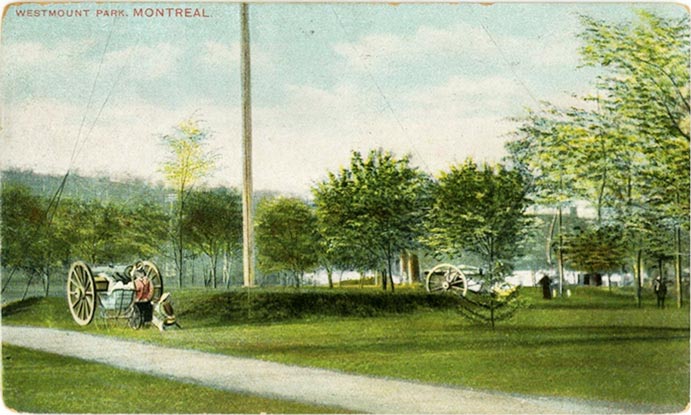
The City of Montreal’s attempt at annexation, the first of many in years to come, failed largely because of the Town’s annexation committee, whose primary task was to retain the Town’s autonomy. Westmount retained its autonomy, and Council continued to develop the Park and its public amenities. Specifically, the Town installed two cannons in the Park. They were fired on June 21, 1897, under the auspices of the Sons of England and the Second Regiment, Canadian Artillery, on the occasion of Queen Victoria’s Diamond Jubilee. The ceremony was followed by the installation of tablets near the cannons, commemorating the event.
In September 1899, Victoria Jubilee Hall, the original predecessor of today’s Victoria Hall, opened on Park property. Designed by Robert Findlay, the building provided space for recreational and community activities. It was later destroyed by fire in 1924 and replaced by the present Victoria Hall in 1925. The Westmount Public Library, also designed by Findlay, was formally inaugurated on June 20, 1899, by Mayor James R. Walker.
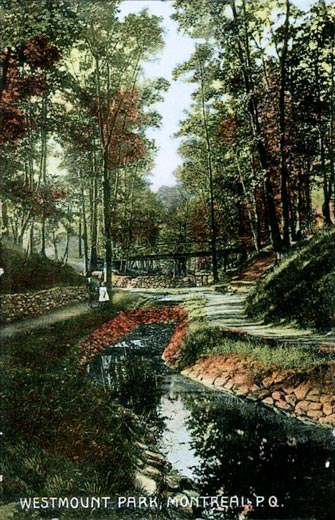 That same year, the Town commissioned the American landscape architecture firm Olmsted Brothers to assess Westmount Park. A favourable report, dated August 1, 1899, was submitted to the chairman of the Town’s Park Committee, praising the use of the available space and the Park’s appearance
“…with the exception of one or two minor details, the available space could not have been used more effectively or to better advantage, and that, altogether, the Town possesses a public recreation ground of which it may be justly proud…”
There was, however, a problem that remained after the Park was laid out. On the southwest corner, just above Western Avenue—today De Maisonneuve Boulevard—and behind the Methodist church, there was a stagnant, water-filled hollow. Much to the chagrin of Park police and parents, children found this area highly amusing.
To resolve the problem, Council created a 70-by-30-foot “swimming bath.” Its design resembled a log cabin, with small changing rooms along both sides. Admission required a ticket from Town Hall, and a caretaker supervised the facility and taught children to swim.
In 1900, Councillor and Chairman of Roads (and former Mayor) James Henry Redfern supported extending the Park northwards across Sherbrooke Street to Côte-Saint-Antoine Road. The Town was offered this area, known as the Murray estate block, for use at no charge for one year, with the option to extend the arrangement at a low rate for another two years. Councillor Redfern, a true visionary, argued: “I am convinced that we would be only doing our duty to the people, as it would be almost a crime to let the opportunity slip, and we would be open to heavy blame in succeeding years.”
Redfern understood that the Park’s existing size might not meet the needs of a growing population. He added: “The present Park contains about 18 acres. About three are occupied by public buildings and their precincts and must be kept for necessary enlargements. The cricket and football fields, tennis courts and ponds occupy most of the other space and demands for further playground uses can scarcely now be met”.
One must agree, in 1900, that fifteen acres comprise a small park and would not suffice in total area into the next one hundred years. His main concern was that once houses were built on the Murray estate block, this expansion scheme would be impossible to implement. Having spent $250,000 on the present Park, some Councillors were reluctant to allocate an additional $100,000 for its expansion. Redfern argued, “…These are no doubt large sums, but such expenditures must look relatively large during the youth of a town, and will seem proportionately small as the valuation continues to increase… the money is simply invested in a valuable asset… The effect of such a feature, a good liberal-sized Park, would be beneficial to property…”
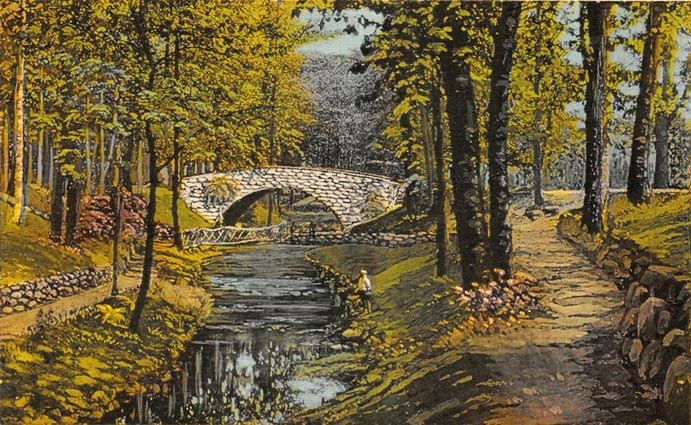
Redfern’s arguments did not sway all his colleagues. Councillor and former mayor Fred W. Evans publicly stated: “I am entirely opposed to the project and will cast my vote against it when it comes before the council…” He also enlisted the support of James R. Walker (and former Mayor) in his opposition. Their objections centred on the potential burden on ratepayers and the Town’s other financial obligations. One statement of opposition acknowledged the appeal of expansion while questioning its timing: “I would gladly see Westmount Park’s area doubled… I am of the opinion that it is not expedient to spend more money in that direction for some time to come…” As the Town’s population increased, they argued, demands on roads, scavenging, policing, and lighting would also grow.
Mayor W.D. Lighthall, however, recognized that Redfern was looking towards a future in which land needed for municipal improvements might be difficult or impossible to obtain. He commended both Evans and Redfern for their foresight in real estate: Evans for helping acquire the existing Park, and Redfern for anticipating future expansion needs. He added: “… In Montreal, the evil results of original sins in this respect have cost the community some ten million of dollars without correcting half the trouble, while the one conspicuous exception, the acquirement of Mount Royal Park… I am convinced from observations that our present Park will not suffice for the needs of even twice the population at present.” Lighthall also argued that the purchase costs would not be incurred immediately and that growth in municipal revenues could help meet the eventual expense.
In 1900, Councillor and former Mayor James Henry Redfern supported the idea of extending the Park northwards, across Sherbrooke Street to Côte-Saint-Antoine Road.
In the end, Council declined the offer to use the additional property temporarily without charge, along with an option to purchase it. This was not an offer of outright ownership at no cost. The proposed purchase price was reported as 27 cents per square foot. “…That in the opinion of Council, the Town has already incurred sufficient obligations for the purchase of Park property, considering its population, area and present wealth and, while thanking the several citizens for their offer, they must decline the same as it involves either an injudicious present outlay or an obligation to purchase an expensive property…”
– Council Proceedings, September 17, 1900
Nevertheless, the Park remained a favourite destination for residents and visitors alike. The Council planted trees to mark ceremonial occasions. In June 1902, Council proposed a tree planting: “…It was resolved to proclaim a public holiday on the occasion of the coronation of His Majesty King Edward VII on Thursday, June 26 instant and otherwise mark the event by the planting of a tree in Westmount Park…”
– Council Proceedings, June 23, 1902
The Park’s history also includes more sombre episodes. Contemporary newspapers reported deaths by apparent suicide within its grounds: “Shortly before 6 o’clock in the morning, two men passing in the Park noticed a man in a recumbent position on a rustic bench near the artificial lake. At first, they believed him to be under the influence of liquor, but upon going closer, they saw that his face was covered with blood from a bullet wound in the temple. Near the bench, they found a thirty-two calibre revolver with one of the chambers empty… The men notified the Westmount police, who had the body sent to the Morgue… ”
– The Gazette, May 30, 1905
A further report in The Gazette in April 1908 described the discovery of a man’s body in the Park: “With a bullet wound in his head and a revolver beside him, the dead body of William Sydney Hartley…was found in Westmount Park.”
– The Gazette, April 1908
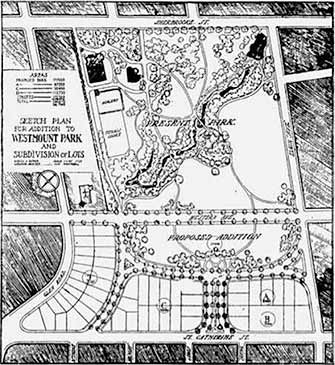
Westmount Park proposed expansion, 1910
One little-known feature was the park’s zoological garden, a collection of captive wild animals. Accounts describe two bears, while a council resolution records the proposed purchase of seven foxes:. By 1909, the City’s Sanitary Inspector condemned the animal cages and recommended concrete floors be laid to prevent the dissemination of diseases. At this point, Council began questioning the merits of keeping wild animals for the public’s amusement. “…it was resolved to authorize the purchase of seven foxes to be placed in the Park at a cost not to exceed fifty dollars – and that the City Surveyor be directed to make provision for the care of the animals in a proper habitation in the Park.”
– Council Proceedings, November 10, 1908
Another resolution acknowledged an offer to supply additional animals: “That a suitable acknowledgment be made of the offer of Mr. A. Pierce to donate to the Corporation any wild animals obtained by him to be added to those now installed in the Park.”
– Council Proceeding, December 19, 1908
By 1909, concerns about the animals’ accommodation reportedly prompted the City’s Sanitary Inspector to recommend concrete floors for the cages to reduce the risk of disease. Council also began questioning the merits of keeping wild animals for public amusement.
In November 1911, the Parks Committee proposed extending the Park westwards by purchasing land between Elgin Avenue—today Melville Avenue—and the Park’s western boundary. The proposal involved financing the acquisition through the sale of Park property facing St. Catherine Street.
The following year, the City sold land facing St. Catherine Street to the School Commissioners of Westmount. Accounts of the transaction identify an area of 120,000 square feet and refer to the sale of an additional seven lots at $1 per square foot.
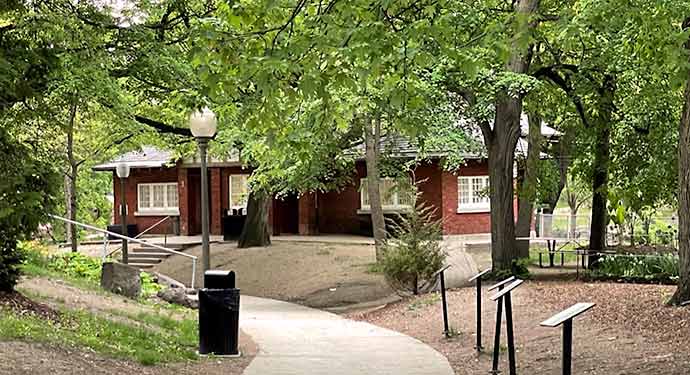
In 1913, the city awarded a contract to Robertson Brothers to build a greenhouse in Westmount Park. This earlier structure should be distinguished from the later conservatory, designed by Lord & Burnham and dating from 1927. Two years later, MacGregor and Reid installed a comfort station in the Park. The project drew controversy, with some residents insisting the building be placed underground rather than intrude on the landscape.
The dispute reflected a recurring question in the Park’s history: how could the Town provide public amenities without compromising the natural beauty it had sought to preserve? “The council of twenty years ago went to some trouble to ensure that the Park which nature provided should be secured to the people of all time, but it remained for the twentieth-century council to make a public convenience of natural beauty spot…”
Feature image: © Andrew Burlone
Postcard images from Michael Walsh’s collection

More articles by Michael Walsh
RECENT ARTICLES

Michael Walsh is a long-time resident of Westmount. Now happily retired after nearly forty years in higher-education technology, he enjoys exploring the city on foot, uncovering its past and bringing to light the history behind its familiar places. michaelld2003@ hotmail.com • Westmount Overlooked blog

the brilliant epigraph sets the stage for this excellent essay. i look forward to reading the second part
Sharing knowledge is a charity of knowledge that constitutes the ways of a beautiful life.
Thank You!