Into the 20th century and a major upheaval for the park
By Michael Walsh
Previously published in WestmountMag.ca
In the 1920s, Westmount Park had a large bandstand with an artistic railing and a pagoda roof. During the summer months, military bands staged evening concerts that attracted upwards of 6,000 spectators. They sold ice cream during these events to support the Westmount Social Services Association.
In 1921, another annex to Westmount Park was an area (the former Smith farm) between St. Catherine Street and Western Avenue, stretching east of Grosvenor Avenue to the west of Melville Avenue. The city purchased this parcel of land in 1906, and a portion was sold ten years later to James Maher, who resold it several times until the Academy Apartment Company acquired it. They constructed a residential hotel with fifty-two apartments, a large ballroom on the ground floor and a cafeteria offering full hotel services.
A fire destroyed the original Victoria Hall (named Victoria Jubilee Hall) in 1924 and, quite remarkably, it was rebuilt one year later.

That same year, an Armoury was constructed at the southern end of the park. Designed by Ross and Macdonald, it stretches to the western boundary of the park. A large portion of the level ground in front of the high school provided a parade ground for the Royal Montreal Regiment (14th Battalion C.E.F.).
Two churches abutted the park’s property. The Westmount Park Methodist Church, later the Westmount Park United Church (Lansdowne at Western Avenues) and the Melville Presbyterian Church amalgamated in 1925, forming the Westmount Park-Melville United Church. The Westmount Park United Church was a centre for community gatherings, offering musical concerts, talks, and various activities for everyone from the very young to seniors.
A fire destroyed the original Victoria Hall (named Victoria Jubilee Hall) in 1924 and, quite remarkably, it was rebuilt one year later.
In the 1920s, the park offered band concerts, field hockey, cricket, softball (hardball was not allowed), English rugby, football and a wide variety of division games.
“…The shady lawns of Westmount Park, its rustic stone bridges over small rivulets, its horseshoe lake… Then there is the pond, a small Round Pond of Kensington, where the small boys sail boats and fathers are boys again. There is a cricket field in the park and, on Saturday afternoons, the long row of benches, shaded from the declining sun, is occupied by devotees of the games, who regard the playing as a serious matter indeed and punctiliously commend with a ‘Well played, Sir.’ ”
– Ian MacPherson, February 14, 1936
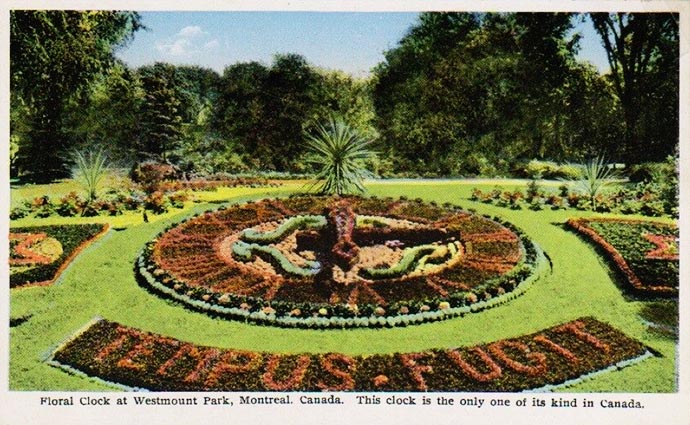
In 1926, a water hole in the park was transformed into a decorative lily pond. A concrete footpath was added with cobblestones, and the pool’s banks were filled with plants and flowers. At the head of the pool was an artificial waterfall with a fountain added in the pool’s centre. Named the “fountain pool,” it was used as a racecourse for miniature yachts, canoes and sailboats. The various ravines in the park were graded and sodded. Park staff added rocks and flowers bordered by large numbers of irises to add a colourful effect. At the same time, a floral clock, one of three in the world, was installed on the western end of the park.
In addition, the City acquired a Northern Electric “music reproducer.” Victrola records were played at Victoria Hall, and the sounds were transmitted by wire to the park’s bandstand over eleven speakers. To accommodate visitors who enjoyed winter skating, the city built a large shelter south of Western Avenue to provide warmth and a place to change skates.
In the 1930s, the city inaugurated its Annual Westmount Playgrounds Sports Day. Sponsored by the Westmount Rotary Club, it provided a day of activities for children aged 5 to 16 who were Westmount residents. The programme included a concert by the Royal Montreal Regiment, model yacht races, races for children, and over 200 outdoor handicraft displays.
Interestingly, in 1934, the city entertained a proposal to use Lafontaine and Westmount parks as a waterfowl refuge. This followed a similar project in Oakland, California, and Orlando, Florida, where thousands of birds overwinter starting in September. Six years later, the Verdun and District Sportsmen Association introduced pheasants in today’s Summit Woods. Westmount Park staff cared for them and described them as “making a very attractive addition to the city’s parks.” Residents were less than enthusiastic when flocks of pheasants began nesting on their property.
The 1930s saw the inauguration of the city’s Annual Westmount Playgrounds Sports Day. Sponsored by the Westmount Rotary Club, it provided a day of activities for children aged 5 to 16 who were Westmount residents.
The 1930s also saw numerous fly-fishing tournaments held by the Anglers Association of Quebec in the park’s lagoon. (Unlike today, the lagoon and duck ponds were over 10 feet in depth). The Model Airplane League of Montreal would use the playing fields as runways as their gliders soared over the park. In addition, the greenhouses held spectacular Easter and Christmas floral exhibitions, as well as large displays of tulips in front of Victoria Hall in the Spring. During the holiday season, giant Christmas trees would grace both Victoria and City Halls. In winter, the Westmount Figure Skating Club and the Winter Club held competitions on a specially built outdoor rink that the Quebec Amateur Hockey Association also used.
During the war years, the park became a training ground for the City’s various militia and cadet units. In 1942, the Associated Screen News filmed Air Cadets in Training in the park, featuring the No. 1 Westmount Squadron Air Cadet League of Canada. Interestingly, in 1946, the Montreal Shipping Co. Ltd., whose routes included Europe and the Mediterranean, named one of their ships the “Westmount Park”.
In addition, park events focused on various fundraising activities, specifically those sponsored by the Westmount Rotary. These events raised funds for the Julius Richardson Convalescent Home of Chateauguay, the Montreal Children’s Hospital and the construction of the Unity Boys’ Club (today, Centre Greene) on Greene Avenue. By 1953, it had become an annual event lasting a full week and attracting thousands of visitors.
In 1951, the City and the Royal Astronomical Society sponsored an annual “Star Night”. It featured an array of homemade telescopes that allowed visitors to view the constellations and planets. The event was a huge success, attracting over 700 participants.
At this point, dark clouds began to grow over the city’s beloved park. More specifically, a divide in mindset emerged between the Council and the residents. The former deemed the park as, “out of date,” and the latter were satisfied with the status quo.
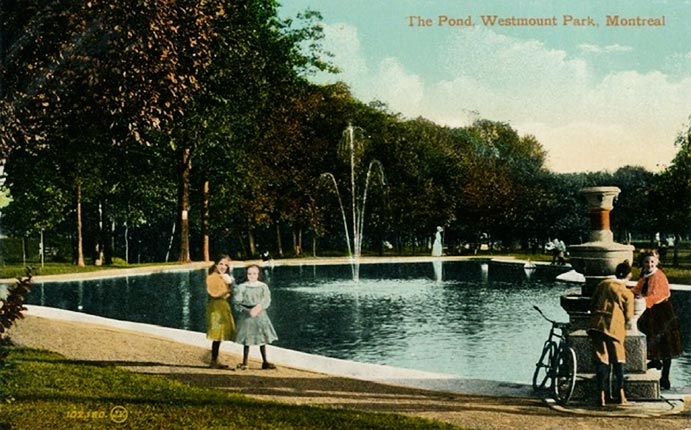
Further, in 1956, the city called for tenders to construct a 355-foot-long artificial ice rink in Westmount Park. This would include a regulation hockey rink and a 100-foot ice surface for figure skating. The location, however, was the corner of Sherbrooke Street and Melville Avenue. Not surprisingly, the proposal drew a large protest from residents. They argued that this location would deface the park, destroy stately old trees, and remove the sailing pond and fountain.
Mayor A. S. Bruneau countered by stating, “A sailing pool is out of date; it’s Victorian,” adding, “It was good in the days of Shelley.” (Someone should have reminded His Worship that Percy Shelley was born decades before the incorporation of the Village of Notre-Dame-de-Grace). Thankfully, Council heeded the citizens’ concerns, and one year later, the rink’s location moved to the southeast corner of Lansdowne and Western avenues. (The outdoor swimming pool was added in 1962.) With that battle won, the war to retain the park’s current configuration was far from over. For some reason, perhaps in spite, Council was determined that the park was “due for a facelift.”
“We are studying the question with a view of improving the recreation equipment and doing away with those things that have become ancient…”
– City Council, 1959
As such, McFadzean & Evenly (Canada) Ltd. ($960) was retained to develop plans to improve Westmount Park. Charles Duranceau Limited ($103,364.00) was the contractor, and Bau-Québec Enrg. ($28,662.05) contracted for plants and planting.
The firm of McFadzean & Evenly (Canada) Ltd…was retained to develop plans for the improvement of Westmount Park… Not surprisingly, critics claimed the park will be sixty percent lakes and pools and thirty-five percent parking spaces.
The plans included redesigning the duck ponds and waterways. Popular pastimes such as the outdoor checker’s boards and putting greens will be retained with a more modern appearance. At the same time, an extension to the public library was being built.
In 1964, Charles Duranceau Limited began work by filling the park’s lily pond, reconstructing paths, and grading near the public library. Other features included creating earth mounds, building wooden bridges (replacing those with decorative stones), and major excavations for the pond complexes. One major focus was on watercourses. More specifically, this involved restoring a series of ponds and gullies that formed a natural watercourse from Melville Avenue and Sherbrooke Street, extending diagonally to Lansdowne and Western Avenues.
In addition, a reflecting pool and formal garden would be installed on Sherbrooke Street facing Mount Stephen Avenue with a floral clock as a centrepiece. Other features would include redeveloping the children’s play area, rebuilding the sailing pond with a fountain, and adding a large rose garden in the mall area of Victoria Hall and the public library. Not surprisingly, critics claimed the park will be sixty percent lakes and pools and thirty-five percent parking spaces.

For some reason, perhaps due to budgetary constraints, the completed project did not include all the features in the design. As such, residents were left with an unfinished product that opened to little (if any) fanfare. It was almost as if the park had lost its soul or meaning.
Not surprisingly, many sports teams and leagues looked elsewhere to hold their tournaments. Without a bandstand, evening concerts in the park that attracted thousands of spectators ceased. These changes, coupled with a decline in sponsored community events, led to fewer visitors using the park as a recreational area.
For some reason, perhaps due to budgetary constraints, not all the features in the design were included in the completed project. As such, residents were left with an unfinished product that opened to little (if any) fanfare.
The park became “picturesque” rather than a much-needed piece of countryside within a metropolitan city. Residents lost interest in the park, and Council followed suit. In 1968, the city discontinued its “Park Rangers,” who provided park security, as well as the attendants responsible for the comfort stations, putting greens, and outdoor chess areas. In addition, after the retirement of full-time park gardening staff, these positions were contracted seasonally to external landscape companies.
By 2000, the budget for annuals in the park was a mere $7000. (In comparison, one piece of playground equipment costs more than $10,000.) The area used for outdoor chess and shuffleboard was repurposed as an outdoor “Youth Centre,” open from 6 pm to 10:45 pm on Mondays, Fridays, and Saturdays. The city would engage a person selected by the youth to run the kiosk, and the salary would be $40 per week. Its use was short-lived because of many noise complaints.
By 1975, Council focused on a section of Boulevard de Maisonneuve that ran horizontally through the park. In July of that year, it closed the section between Melville Avenue and Academy Road, removed the roadbed, and landscaped the surrounding areas, creating a footpath between the two streets. This, however, was a temporary improvement to the park. In 1979, Council voted 4-1 in favour of a bicycle path between Greene and Prince Albert Avenues with a spur through Westmount Park.

Interestingly, Mayor Brian Gallery cast the one dissenting vote, arguing the bicycle path would serve non-residents more than Westmount residents and questioning the city’s suitability as a bicycle path location. Many residents agreed with the Mayor and urged Council to relocate the bicycle path along St. Catherine or Sherbrooke streets. The final decision, to maintain the path year-round through the park, was included in the City of Montreal transportation plan – a document in which the City of Westmount was not consulted.
The 1980s brought summer concerts (initially sponsored by the Y.M.C.A.) near the park’s lagoon, and the baseball fields adjacent to Westmount Park School were in constant use on weekends and civic holidays. That same year, issues began to emerge from the park’s previous “rehabilitation”; specifically, the park’s watercourses needed urgent attention. The City contracted Membrex Limited to reconstruct the waterways (for $190,891.10). Unfortunately, this did not resolve the issue of water leaking through the watercourse’s membrane – resulting in a civil suit between the city and the contractor.
This was just the “tip of the iceberg” – in the ensuing years, the city poured vast sums of money into issues that would never have occurred if the park’s rehabilitation scheme had not been adopted. For example, the park’s water lines were replaced ($6,600) in 1985; $130,000 was allocated to a feasibility study on reconstructing the park’s paths in 1986; and $275,000 was given to Mr. Ron Williams, Landscape Architect, to cover “certain reconstruction in Westmount Park.”
The ensuing years saw the city pouring vast sums of money into issues that would have never occurred if the park’s rehabilitation scheme had not been adopted.
By the 1990s, the park was used for a myriad of meetings and events: religious services (including AA delegations from Westmount Baptist Church); Arts Westmount Festivals; a wedding destination for photographs; the Westmount Toastmasters Club; Shakespeare in Park (subsidized by the city); Family Day; the Westmount Winter Carnival; annual Scout-A-Thons; St. Jean Baptiste celebrations (inaugurated in June 1999 and described “as a genteel garden party”); Canada Day celebrations; Poetry in the Park; and the Montreal Millennium Melon Festival that raised funds to rehabilitate the vacant train station.
Surprisingly, in June 1986, fifty percent of the park was temporarily fenced off for a private fundraising celebration for The Study School Foundation. The event drew 800 guests, including Pierre Trudeau, Mayor Brian Gallery, Charles Bronfman, and David Johnson. The park’s use for private events drew heavy criticism and, to date, has never been repeated. One novel use of the park occurred in April 1989. One scene for the movie Jacknife (starring Robert De Niro and Kathy Baker) was filmed in the field adjacent to Westmount Park School.

The park’s duck pond was closed in 1993. Before then, Brome Lake Ducks Ltd. donated ducks to the city. Following a senseless massacre of the park’s ducks in 1986 and in 1993, the city banned their use in the park’s lagoon.
One year later, the city removed the two cannons in the park for repairs. Council reported that the repairs were to take about a month; the cannons then returned to the park. Unfortunately, this did not happen.
In 2004, the Westmount Rugby Club was denied use of the park’s football field because only a few members were Westmount residents.
Three years later, Council decided to reconfigure the park’s playing fields. This would involve eliminating the three baseball diamonds in the lower field and creating two soccer fields. Their options included resodding the entire area or using synthetic turf in part. The latter option drew over 1,000 signatures on a petition to preserve the grass fields. By the end of 2007, Council dropped the artificial turf option and (in a petulant mood) fenced one of the soccer fields with a lock and key (for $23,726.33) to “prevent overuse.”
One can argue that the city did spend a fair portion of its budget on park improvements – however, were they allocated properly? The bigger question, echoed by many residents is, “Why is the park still looking so tired and shabby?
On a positive note, 2013 saw the inauguration of the Westmount Recreation Centre. One of the finest facilities on the Island of Montreal that, architecturally, conforms seamlessly with the city’s streetscape and is constructed to provide residents with recreational enjoyment well into the future.
In 2015, the dog run relocation controversy created the “Southwest Dog Run in Westmount Park.” (One could compile an entire book chapter on the controversy surrounding this scheme.)
Two years later, the city allocated $177,127.56 to replace the park’s playground equipment – and in 2018, $94,664.67 was spent on adult exercise equipment in the former outdoor chess and shuffleboard area.
One can argue that the city did spend a fair portion of its budget on park improvements – however, were they allocated properly? The bigger question, echoed by many residents, is, “Why is the park still looking so tired and shabby?”
In true municipal form, the city allocated more funds to answer these questions. In 2019, the city publicly opened tenders for professional services and a feasibility study to restore Westmount Park. The city awarded the contract to Stantec Experts-Conseils Ltée for a maximum of $206,470.96.

One year later, Stantec released their report in a public presentation and received (at best) a “lukewarm” reception. To elicit more citizen involvement, the city conducted a paper-based survey and launched an online discussion platform (Engage Westmount). Unfortunately, both methods had obstacles. The survey required a “unique code” before it could be submitted – not surprisingly, only 100 responses were received. The online forum requires a user ID and password. (Don’t we have enough passwords in our lives?)
The big question still remains: What type of park will future residents inherit? Will we be remembered as good custodians or a generation of neglect?
As of 2023, there seems to be little interest in Stantec’s proposal – and even less visible improvements in the park’s infrastructure. From my perspective, this latest scheme had two casualties: the park itself and the Councillor who championed the idea but did not seek re-election.
In the end, we are paying for our sins when the park was regarded as “ancient.” In fact, the current city administration admits that it might not be legally allowed to operate the park’s watercourses in their current condition. In addition, the paths contain cracks (temporarily repaired with asphalt) that make walking dangerous. Furthermore, the park needs to address accessibility in all areas.
The big question still remains: What type of park will future residents inherit? Will we be remembered as good custodians or a generation of neglect?
Feature image: © Andrew Burlone
Postcards images from Michael Walsh’s collection, unless indicated otherwise

More articles by Michael Walsh
RECENT ARTICLES

Michael Walsh is a long-time resident of Westmount. Now happily retired after nearly forty years in higher-education technology, he enjoys exploring the city on foot, uncovering its past and bringing to light the history behind its familiar places. michaelld2003@ hotmail.com • Westmount Overlooked blog