
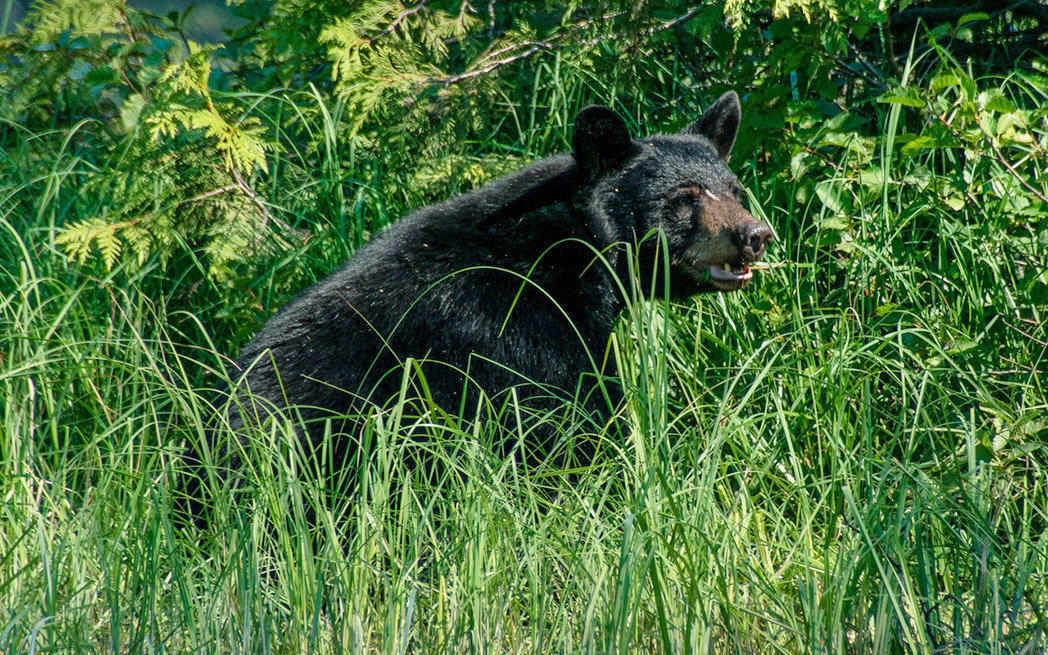
This month is the beginning of the spring bear hunt in Ontario and Quebec
By Georges R. Dupras (with an addendum by Irwin Rapoport)
May 22, 2025
May 1, for many, is the beginning of the summer, for others, dreams of long, lazy walks in the woods or by a lake. Still, there are those fingering through gardening magazines in search of that perfect accent that will highlight their garden. This month, however, is one of the cruellest and most senseless slaughters of the year. This month is the beginning of the spring bear hunt in Ontario and Quebec.
Anything but a hunt
We are constantly reminded that we in La Belle Province are distinct in many ways, but rarely do we define some of our more questionable activities. The bear hunting season in Quebec extends from May 15 to the end of June. There is also a fall hunt, but one disgrace will suffice for this report. Hunters, and I use that term guardedly, are entitled to kill* one black Bear, except in zones 20 and 22. The fall hunt occurs in select zones. To their credit, the government of Quebec explicitly prohibits the use of dogs to hunt black bears, moose or white tail deer (so does Ontario).
How terribly sporting
French Canada boasts world-class opportunities. The seasoned practitioner can hunt black bears and fish as well. If he is fortunate enough to take advantage of a 7-day package, he will be assigned a bait site (so much for required skill).
May 1, for many, is the beginning of the summer… This month, however, is one of the cruellest and most senseless slaughters of the year.
Lactating females
In this province, there are strict regulations regarding the hunting of females with cubs. While female bears are not completely off limits, there are restrictions (unclear to what they are) in place to protect reproductive females. Even the seasoned bear hunter is greatly challenged to identify lactating females unless the target is standing upright over a bait site. That said, restrictions imposed by the Ministry of Natural Resources appear more cosmetic than effective.
Specific kill ratios are “sometimes” used for polar bears in certain zones.
Authorities in this province, as well as Ontario, state that it is not possible to determine how many lactating females were killed, as not all are reported. In Quebec, the data they receive is general in content and includes poaching, car strikes, black bear, deer and moose killings. They have no specific data on cubs, and unreported kills are a problem. Quebec seems somehow oblivious to the issue of cubs left orphaned due to the spring hunt.
While the exact number of rescued cubs varies (reports by private citizens), the actual number of orphaned cubs is unknown. Authorities in Quebec claim to ensure the well-being of cubs they are aware of, but I have personal experience of cubs being shot by authorities in western Quebec.
Wolf and bear hunting with hounds
By the grace of whatever powers look over us, neither Quebec nor Ontario have sunk so low as to allow the sadistic practice of bear hunting with dogs. Dogs in the lower United States are used to harass, chase and finally tree an exhausted bear, allowing the hunter to finally kill it. In the case of a cub, the dogs would often kill it themselves.
During the tenure of the Hon. Jean Charest, then Premier of Quebec, Electoral District of Sherbrooke, and an avid hunter, it was reported that his District had received permission to hunt Eastern Wolves using dogs**. This was a study conducted cooperatively, with Authorities from Ontario. At that time, the media had reported only about bears being hunted by dogs. I called M. Sebastien Lefort from the Ministry of Natural Resources (MNR). Sebastien was then responsible for overseeing Big Game in this province, including bears and the Eastern Wolf. He assured me that not one biologist in his department was in favour of this trial hunt.
‘Most Canadians did not see wildlife as a resource, nor that hunting is a conservation tool. Exceptions applied to natives pursuing a subsistence lifestyle.’
Hunting with hounds in the U.S.
The States of Alabama, Arkansas, Florida, Georgia, Louisiana, Mississippi, both Carolinas and New Hampshire allow both bear and deer hunting with dogs. Some of these hunts can be seen on YouTube, but be warned, they are not for the faint of heart.
Duck blinds, bait hunting, canned hunts, and bow hunting with the new compound bows all add to the stresses these animals face. While this goes on, taxpayers are cautioned to curtail outdoor activities in hunting regions.
Most Canadians, when asked how they felt about hunting in general, did not see wildlife as a resource, nor that hunting is a conservation tool. Exceptions applied to natives pursuing a subsistence lifestyle.
As for the author, I do not accept that hunting is a sport. I define sport as a competition, Mano-a-Mano, between two willing and equal participants. Should you share my concerns, I urge you to contact your premier or state governor.
Georges R. Dupras
* * * * *
I want to thank Georges for permitting me to contribute to this article. He is very aware of my passion for nature and protecting biodiversity and wild spaces.
Bears, wolves, mountain lions, deer, and other self-aware creatures, be they large or small, are not resources to be managed and controlled. We don’t own them, and they have every right to lead normal lives without fear of being hunted and trapped for their fur and feathers. They certainly must not be kidnapped from the wild for private collections and personal zoos.
A mother bear wears many hats as she raises her cub. She is the loving mom, protector, teacher (from kindergarten to high school), guide and mentor. Bear families consist of two to four cubs, and moms cherish each one. Family groups last for roughly 2.5 years.
The tightly-knit family plods along until mom believes the young adults have learned the necessary skills to survive on their own. And then, without warning, she lets them know they are their own. This is a disconcerting moment for the cubs, and they usually travel together for a few months.
‘A mother bear wears many hats as she raises her cub. She is the loving mom, protector, teacher (from kindergarten to high school), guide and mentor. ‘
Sport and trophy hunters choose to forget the effort these mothers put in raising their children and the many travails they experience daily. Every bear that is killed is a son or daughter. How would these hunters feel if one of their children were victims of a serial killer?
Bears spend the winter months in their dens, and when they awake, they are hungry. Male bears only have to fend for themselves, but a female bear, which gives birth during hibernation, must rapidly find food to provide much-needed milk.
There is no valid reason to hunt bears, be it in the Spring or Fall, and it is particularly cruel to slaughter bears which made it through the winter. I cannot imagine what type of euphoria these people feel from killing a bear with a rifle. They certainly don’t need the meat and fur for a rug or blanket, and the body to be stuffed as an ornament for a trophy room or a head mounted on a wall. This applies to all bears – endangered polar bears, grizzlies, and black and brown bears.
A Spring bear hunt is pure murder and cruelty, and they must be ended.
Bears are not a resource, but are certainly more valuable alive than dead. If sport and trophy hunters want to ensure they can stalk and shoot bears annually, why not just take a picture? Let the camera be their gun, and the button to take the picture be the trigger. This way, hunters could “triumph” over bears and pursue them over and over again. This would be a win-win for all concerned.
The presence of bears in an ecosystem is a sure sign that it is healthy and thriving. Like wolves, mountain lions, and wolverines, bears are apex predators and a keystone species. That we are able to see bears in their natural habitat is awesome. I’ve never seen one, but at our country house in St. Agathe des Monts, I saw a moose with her two calves, deer, loons, mallards, frogs and toads, and a variety of birds.
Several years ago, a preliminary study covering several parts of Canada determined that black bears not only communicate, but also have a language. The researchers focused on mother bears and their cubs, recording the sounds they uttered. Despite the geographic distances, the words and phrases were similar. Mothers spoke softly and more assertively when necessary. The words and phrases ranged from “climb up the tree”, “do not eat that plant,” “it’s okay to eat that plant now”, “come back,” and other crucial commands and suggestions. Further research on a larger scale is required, but the initial findings are promising. That bears communicate via growls, words, facial expressions, grunts, clicking of teeth, and claw marks on trees is a given.
We know that bears of all species, be they in the Americas, Asia, Europe, and the Middle East, have cultures and a sense of community. They have rituals and customs. Black, brown, and grizzly bears gather in spots along the coastlines of British Columbia, Alaska, and Russia to eat their fill when salmon travel up the rivers to spawn.
Mothers bear are devoted to their cubs. The same researchers followed a black bear mom and her three cubs. One was sickly and had trouble keeping up with its siblings, often lagging. While mom discouraged the two healthy cubs from eating certain vegetation, she encouraged the sickly cub to eat. Georges, who related the story to me, concluded that the mother wanted the sickly cub to regurgitate, possibly dislodging whatever was making him sick. The mother tried everything to cure it, but nothing worked. Eventually, the cub died, and for three days, the mom hung around a tree in a period of mourning.
Orcas and dolphins mourn their calves by carrying the bodies for several days, so why not bears?
Bear moms are fierce protectors of their cubs, which is why it is dangerous for anyone to get between a mother and her cubs. There is one viral video of a black bear mom crossing a rural road with her four cubs. Cars on both sides stopped, giving the bears ample space. Two cubs followed their mom, but the other two were not listening and stayed behind. It took roughly three minutes for her to corral all the cubs and move on. Mom recognized that the onlookers were keeping their distance and did not pose a threat.
We have ample evidence of smaller bear moms standing up to larger males who could have threatened the cubs. These moms are courageous, and cubs are abandoned only in extreme situations. We can learn a lot from them.
And speaking of learning, bear moms teach the cubs what is safe to eat and how to hunt. Save for polar bears, bears are omnivores, and it is estimated that close to 90 percent of their diets are plant-based. Cubs have to know which plants are safe to eat and when, and when berries are ripe. Knowing how to find and dig a den, how to fish, predators to avoid, and how to get along with fellow bears are essential skills. They learn by watching their moms intently and emulating them. They see her hunt and catch fish. Bears cubs wrestle for play, but also to develop defensive skills and when to use their claws.
One documentary follows the Spirit bear (Kermode bear). These white-coloured black bears live in the central and northern coastal regions of British Columbia. The filmmakers witnessed the mom bringing the cubs to a secret fishing spot known only to the family. Generations of that bear’s family passed on that knowledge, which could be a matter of life and death as these bears depend on salmon to fatten up for the winter hibernation.
Being a bear is not easy, and some cubs, despite their mother’s utmost effort, do not make it. But once they get through the initial period of being separated from mom, they can live long and fulfilling lives. That sport and trophy hunters believe it is necessary to validate their manhood by murdering a bear displays a complete ignorance of the multi-faceted phases in the life of a bear. If they want to kill, may I suggest volunteering with the Ukrainian Army and serving on the front lines?
Sport and trophy hunting must be ended once and for all, be it with guns, bows, or packs of dogs. We are better than this, and with so many natural areas and ecosystems threatened by human development and global warming, we are obliged to do everything possible to protect biodiversity in all its forms, especially the majestic and awe-inspiring bears, which have lived on this planet for millions of years.
Irwin Rapoport
* I use the term kill because, contrary to public conditioning, you cannot harvest a sentient being. The word harvest is of German stock and refers to fruits, vegetables, roots, fungi and nuts.
** Bear Baiting May Exacerbate Wolf Hunting Dog Conflict – Sherbrooke Record, April 2013, volume 8, issue 4, e61708
Disclaimer: The opinions expressed in this article are those of its author and do not reflect the opinions of WestmountMag.ca, its publishers or editors.
Feature image: Enric Cruz López from Pexels

More articles by Georges Dupras
Other recent articles
[row cols_nr=”2″ class=”narrow”][col size=”2″]
 [/col][col size=”10″]Georges R. Dupras has advocated for animals for over fifty years. A member of the International Association for Bear Research and Management (IBA) and past Board member of the Canadian SPCA, he worked on the original Save the Seal campaign in 1966 that culminated in the foundation of the International Fund for Animal Welfare (IFAW) in 1969. Georges Dupras has published two books, Values in Conflict and the eBook Ethics, a Human Condition, and currently lives in Montreal, Canada.[/col][/row]
Banning spring bear hunts is a necessary step towards creating an ethical society. These hunts are among the most egregious violations against wildlife.
Even if a hunter avoids intentionally targeting a sow with cubs, it’s often impossible to tell from a distance—resulting in orphaned cubs that cannot survive on their own. These cubs then die slow deaths as they cry futilely for their mothers.
It’s time we prioritize responsible behaviour towards animals over gratuitous recreational killing.
Doris,
Thank you for your poignant words and thoughts. They certainly said it all, especially “Even if a hunter avoids intentionally targeting a sow with cubs, it’s often impossible to tell from a distance—resulting in orphaned cubs that cannot survive on their own. These cubs then die slow deaths as they cry futilely for their mothers.” Sadly the situation you highlighted has happened countless times and will be a reality for so many bear cubs this year.
We must own up to the horrific actions we take in regards to animals, be they wild or livestock.
Irwin
It is shameful that Quebec still allows bear hunts. You say the season is May 15 to June 30. … what can we do to get that killing season shortened to at least protect newborn bears and their mothers? How does this 45-day long murder extravaganza compare with the time allowed in other places in the world?