
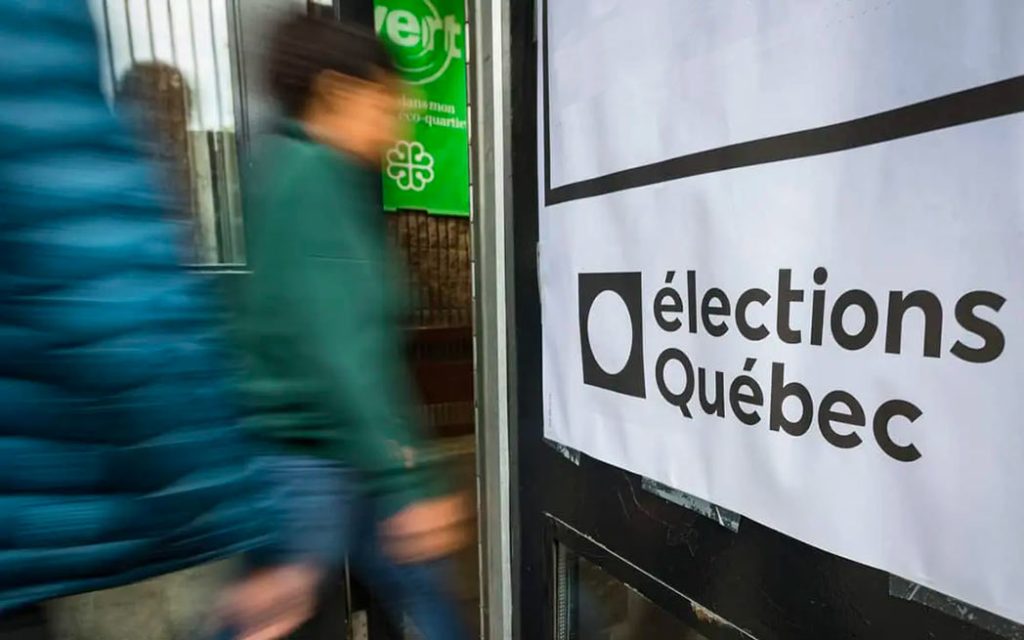
Will overall voter participation increase, or apathy rule the day yet again?
By Irwin Rapoport
October 30, 2025
If recent polling is correct, Ensemble Montréal‘s Soraya Martinez Ferrada should be elected as the City of Montreal’s new mayor, ending eight years of Projet Montréal rule via outgoing Mayor Valérie Plante and her majority on city council that enabled her party to implement its progressive agenda defined by imposition of bike lanes without a public consultation process at a cost of $500 million.
Whether one supports or opposes this initiative, Projet Montréal is synonymously linked to bike lanes, in addition to annual property tax and agglomeration tax increases, fiscal irresponsibility and record-breaking municipal budgets ($6.9 billion for 2025), the plan to close Camillien Houde Way to motorists despite a massive opposition, and a deliberate policy of running roughshod over local opposition in many boroughs to implement controversial transformational projects, including homeless shelters and drug injection sites.
If recent polling is correct, Ensemble Montréal’s Soraya Martinez Ferrada should be elected as the City of Montreal’s new mayor.
However, Projet Montréal leader and mayoral candidate Luc Rabouin attempts to differentiate himself from Valérie Plante and her legislative agenda and legacy. This election has been defined as a call for change at City Hall and is essentially a referendum on Projet Montréal. While I give Soraya Martinez Ferrada a minimum 10% margin of victory, the November 2 municipal election could have another low voter turnout, possibly even lower than the 38.32% in 2021, which was a drop of 4.15% from 2017.
Elections Montreal reported that only 9.3% of eligible voters cast ballots last Sunday. Reduced public transit service on voting day may lead to fewer votes cast. Projet Montréal has a dedicated and loyal voter base throughout the city that cannot be dismissed, and the party’s ground game is highly effective; thus, we cannot rule out a neck-and-neck outcome.
Every vote will count, which is why the Projet Montréal and Ensemble Montréal campaign teams are ramping up for an intense Sunday. Three minor parties are also running: Transition Montréal, led by former Projet Montréal Councillor Craig Sauvé; Futur Montréal, led by Jean-François Kacou, a party formed by supporters of Balarama Holness‘s Mouvement Montréal; and Action Montréal, led by Gilbert Thibodeau. The polling numbers for Transition Montréal are at best 5%, with Futur support even lower. In 2021, Action’s leader received only 1.03%.
There are about four swing boroughs where either of the two leading parties can secure control of the Council and the mayor’s seat, with the CDN-NDG Borough being one of them. In 2021, Projet Montréal‘s Gracia Kasoki Katahwa squeaked by with a 161-vote win (37.56%) over Ensemble Montréal‘s Lionel Perez to become mayor. Ensemble Montréal‘s Sonny Moroz won the Snowdon District with 48.84% and Stephanie Valenzuela took the Darlington District with 58.56%. Likewise, Projet Montréal‘s Peter McQueen was re-elected in the NDG District with 58.16% and Magda Popeanu, who has retired from politics, took the CDN District with 55.29%. The race for the Loyola District was also tight, with Projet Montréal’s Despina Sourias defeating Ensemble Montréal‘s Gabriel Retta by 101 votes (30.23%).
‘To effectively control the borough council, a party requires three councillors and the mayoralty.’
Before presenting my predictions, consider these factors:
- According to friends who have knocked on doors throughout NDG (the Loyola and NDG districts), about half of the people were unaware that an election was underway. In contrast, the other half are aware of the policies of Ensemble Montréal and Projet Montréal and intend to vote.
• - In the 2017 and 2021 elections, there was considerable voter apathy, especially among single-family and condo owners, duplex residents, and tenants in multi-unit buildings. This has been attributed to a belief that voting does not make a difference and a distrust of parties and their policies.
• - Projet Montréal’s support, especially in NDG, is strong and largely silent, although the party has some very vocal supporters. These adherents base their views on decent and well-meaning liberal and community values. Projet Montréal began activating these voters several months ago.
• - Ensemble Montréal‘s support consists primarily of middle-class homeowners and professionals, seniors on fixed income, entrepreneurs, and those who hold a combination of liberal and conservative values. The Ensemble Montréal base is not ideological; common values, cost-of-living concerns, and other factors drive it. Activating this voting block requires more persuasion.
• - The CDN-NDG Borough contains large English- and French-speaking communities, as well as substantial multicultural communities, including Filipino, South Asian, Persian, and other visible minority groups. It also has a sizeable Jewish community in the Snowdon and Darlington districts, as well as a growing Muslim community.
Projet Montréal should hold onto the NDG District, with McQueen seeking a fifth term, while Ensemble Montréal is expected to retain the Snowdon and Darlington districts easily. In 2021, he garnered 5,022 votes, easily surpassing Ensemble Montréal‘s 1,601 votes. Despite opposition to the imposed Terrebonne bike path and unpopular property tax increases, McQueen can afford to lose 1,000 votes and still win with a comfortable lead. Ensemble Montréal‘s Peter Shatilla is is looking for a surge in voter turnout in the area between Grand and Girouard, north of Sherbrooke; the Vendome Village area; and on the streets north of Sherbrooke between Decarie and the Westmount border.
‘Ensemble Montréal is expected to easily retain the Snowdon and Darlington districts.’
Projet Montréal has held the CDN District since 2013 via the popular Popeanu. Her party is running Émilie Brière, a professor of French literature at the Université de Montréal, who, I am told, is focusing her efforts on French-speaking residents and university students living in the district. Yvonne Nguyen, an immigration lawyer and Vice President of External Affairs for the Vietnamese Community of Canada, is running for Ensemble Montréal. Projet Montréal will likely retain this seat with a diminished majority.
Fierce opposition to the Terrebonne bike path, tax increases, damage caused by flooding to several hundred homes due to inadequate underground infrastructure, and a decline in services such as snow removal for streets and sidewalks and everyday services, should assure Ensemble Montréal a win in the Loyola District, which borders the municipalities of Montreal West and Côte Saint Luc. This district has a large English-speaking, multicultural community, along with many single-family homeowners, duplex and condo residents, and numerous large apartment buildings on Fielding, Somerled, and Sherbrooke.
Despite the many factors favouring Ensemble Montréal, I am convinced this race will be tight. Sourias is campaigning hard to be re-elected, despite receiving negative feedback as she goes door-to-door. Her vote in favour of the Terrebonne bike path, a flashpoint for voters in the Loyola and NDG districts, is helping her Ensemble Montréal opponent and driving overall dissatisfaction with Projet Montréal.
Sourias won in 2021 with 2,205 votes, while Rhetta took second with 2,104. This was a hotly contested race with Annalisa Harris who ran for former Projet Montréal Borough Mayor Sue Montgomery‘s Courage Party garnering 700 votes (9%); Mouvement Montréal 1,123 votes (15.4%); Team CDN-NDG 370 votes (5.08%); EMSB Chair Joe Ortona, running as an independent, 708 votes (9.71%); and Action Montréal 84 votes (1.15%).
‘Despite the many factors favouring Ensemble Montréal, I am convinced this race will be tight.’
Sourias is being challenged by Ensemble Montréal‘s Alexandre Teodorescu, who is going door-to-door, putting forward policy initiatives for Loyola and NDG as a whole, and is active on social media. I doubt Transition Montréal will split the Projet Montréal vote in the Loyola and NDG districts, and Futur Montréal does not have the same brand power as Holness. Ortona supporters will likely vote for Ensemble Montréal, and Courage voters will likely vote for Projet Montréal. Despite visceral anger towards Projet Montréal, Ensemble Montréal will have to initiate a full-court press to bring out its supporters, and will either squeak by or win with a 10% minimum lead.
For borough mayor, I foresee Valenzuela winning by 12-15%. In 2021, Projet Montréal‘s Katahwa won with 11,964 votes. Placing second was Ensemble Montréal‘s Perez with 11,803 votes. Montgomery received 3,115 votes, which should go to Projet Montréal. Mouvement Montréal had 3,569 votes, most of which should be going to Ensemble Montréal rather than Futur Montréal. Action only acquired 263 votes, which may decline. Alex Montagano, the leader of the defunct CDN-NDG party, had 1,135 votes. These people should be in Ensemble Montréal‘s camp. Should the overall voter turnout remain unchanged or decline by a few points, every vote will be significant. A 10-12% increase in voter turnout would guarantee an Ensemble Montréal victory.
Valenzuela, who represented Darlington from 2021 to 2025, is running a solid campaign. Soft-spoken and confident, Valenzuela is passionate, knows her facts and dossiers, is a good listener and exudes empathy, and is a fierce defender of her positions and concerns, such as the impacts of excessive rent increases on tenants throughout the borough. She and Katahwa have engaged in several debates at the borough council, with Valenzuela ably defending her views and constituents. The relationship between Katahwa and the two Ensemble Montréal councillors is frosty and divisive, with Moroz frequently challenging the mayor and Sourias on points of order and policy differences during borough council meetings. Having attended borough council meetings regularly since Fall 2023, I’ve witnessed the rancour and hostility.
Katahwa, who serves on the city executive committee, is also passionate about her issues, including the dossier on racism and associated matters. A former nurse and union official, she ran in Projet Montréal‘s leadership race to replace Plante, coming second to Rabouin. Katahwa is a dedicated Projet Montréal member. During her leadership bid, she defended Plante’s record and advocated an additional tax on single-family homeowners. If elected, Rabouin says he will appoint her as chair of the executive committee. Her character is such that the more she is questioned about an unpopular policy decision, the more determined she is to see it through. This was demonstrated in the fight against the borough’s plan to replace a natural grass soccer field with an artificial turf field containing hazardous forever chemicals at Mackenzie King Park, which was opposed by thousands of CDN residents.
‘Both Valenzuela and Katahwa believe they are acting in the best interest of borough residents, despite their policy differences and leadership styles.’
It was repeated with the struggle against the Terrebonne bike path, which thousands of residents continue to reject. The engineering report, which was considered to be biased and flawed, was publicly released on October 30, 2023. Thirty days later, at a public information meeting—not a public consultation meeting —Katahwa told the predominantly opposed audience that they could only ask technical questions directed to borough engineering officials. The next morning, December 1, Katahwa told CBC Radio that the bike path would be ratified by the borough council with minor changes. It was approved at the February 2024 borough council meeting. Since then, despite many complaints from NDG residents, Katahwa has defended the late June/early July 2024 installation and dismissed concerns and problems associated with it.
This is just a taste of the fractured politics and division in the CDN-NDG Borough that should be reflected in the vote on November 2. The results in the borough could have wide-ranging implications. It could tip the scales on whether Ferrada or Rabouin becomes the next mayor of the city, who controls the city council, and who controls the borough.
I live in the Loyola District and voted in the advance poll. I am hoping for an overall increase in voter turnout in the borough. If Projet Montréal wins, it will be more of the same. If Ensemble Montréal wins, we can expect major reforms. Voters will determine the future, and apathy is not an option. If you live in this borough, take the time to vote and urge your friends and neighbours to follow your lead.
Disclaimer: The opinions expressed in this article are those of the author and do not necessarily reflect the opinions of WestmountMag.ca or its publishers.
Feature image: Elections Québec

More articles by Irwin Rapoport
Other recent articles

Irwin Rapoport is a freelance journalist and community advocate from Westmount with bachelor’s degrees in History and Political Science from Concordia University. He writes extensively on local politics, education, and environmental issues, and promotes informed public discourse and democracy through his writing and activism.