
When ICE brutality
becomes Reality TV
Smartphones, protesters and journalists provide an unblinking witness to state power
By Irwin Rapoport
February 4, 2026
ICU nurse Alex Pretti was shot dead at 9:03 a.m. (Central time) on January 24, after being violently pinned to the ground by Immigration and Customs Enforcement (ICE) and Border Patrol agents, with two of them firing ten bullets into his chest at point-blank range. He had been filming their actions during Operation Metro Surge, which deployed thousands of federal agents to a Minnesota city, officially to target the “worst of the worst” among undocumented and irregular migrants. When he saw a woman thrown onto the pavement by agents, Pretti rushed to help her, fearing for her life and wanting to see if she was injured. Seconds later, he was killed.
What might once have been another anonymous act of state violence instead became a defining moment, because cameras were already rolling. Anti‑ICE protesters had been filming the scene from several angles, documenting not only the shooting but the seconds before and after: the rush of agents, the panic in the crowd, the formation of a cordon, and the tear gas and pepper balls fired into hundreds of demonstrators. Within minutes, the footage reached MS Now, where Ali Velshi interrupted his program to air the video of the killing and its immediate aftermath, alongside live shots from news crews on the ground. The images were raw, disturbing, and impossible to spin away.
That morning, the world witnessed history in the making, and news media around the world—especially television news—rose to the occasion to ensure that this atrocity would not be buried.
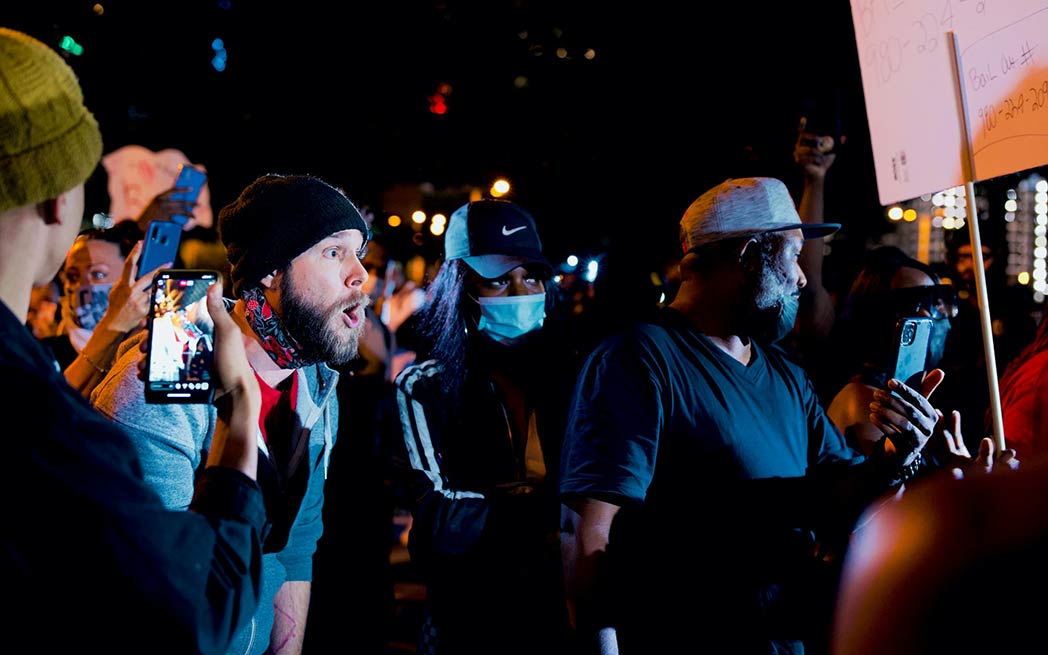
As news of Pretti’s death spread, Minneapolis residents poured into the streets near the scene, not only to grieve and express anger but to continue bearing witness. Many arrived with their phones already out, recording the crowds, the agents, the speeches, and the tense standoffs that followed. The day before, more than 15,000 people had marched against the operation, which had already seized over 3,000 people—most with no criminal record—and sent many directly to distant public and private detention centres. The killing turned that broad unease into a sharpened outrage, and the footage of it ensured that the story could not be reduced to a line in a press release.
City leaders were forced to respond. Minneapolis Mayor Jacob Frey quickly held a news conference to condemn the killing and a pattern of violent conduct, and to demand that President Donald Trump withdraw ICE and Border Patrol personnel from his city and state. That demand carried weight because the public had seen what happened with their own eyes. It was no longer one side’s word against another’s; it was a confrontation between official statements and high‑definition evidence. Since January 24, hundreds of millions of people have seen the video of the shooting and heard the falsehoods pushed by the Trump administration.
From that point on, the struggle over meaning and truth centred not on whether the events had occurred, but on how they would be interpreted. Trump administration officials and conservative, MAGA‑aligned pundits on Fox News and Newsmax moved swiftly to construct a counter‑narrative. They branded Pretti a “domestic terrorist,” claimed he had been brandishing a gun, and insisted that agents had fired in self‑defence. In another era, such framing might have stuck; many readers and viewers would have had no competing account to consult. This time, hundreds of millions of people had access to the raw recordings themselves. Clips circulated online, were slowed down, zoomed in, and analyzed. The more people watched, the less credible the official version became.
A similar dynamic had already unfolded earlier in the month. On January 7, Renée Nicole Macklin Good, a 37‑year‑old American and mother of three, was shot and killed by ICE agent Jonathan Ross as she slowly drove away from the scene of a raid in her suburban neighbourhood. Officials immediately cast her as a would‑be murderer who had “weaponized” her car. But protesters had filmed the encounter from multiple vantage points, capturing the trajectory of her vehicle, the position of the agents, and the timing of the shots. Their recordings contradicted the claim that Ross and his colleagues were in imminent mortal danger. When DHS later released a video filmed from Ross’s perspective in an attempt to justify his actions, viewers could compare it with the already‑circulating civilian footage. Rather than vindicating him, the official clip underscored how disproportionate and chaotic the response had been.
Taken together, the deaths of Pretti and Good—and the wounding of a Venezuelan migrant shot as he tried to reach his home—have revealed a consistent pattern: agents detain first and ask questions later, disregard identity documents, and single people out based on skin colour, accents, and neighbourhoods. More than 170 American citizens have been caught up in these sweeps, some held for hours, others for days. Footage of Good’s and Pretti’s deaths is painful to watch, but essential to exposing Donald Trump’s mass‑deportation drive, engineered by his policy chief and homeland security adviser Stephen Miller, a figure long associated with extremist, white‑nationalist views.
This ‘witnessing’ trail exists because ordinary people have refused to look away. Minnesotans in particular have developed a culture of rapid, visual response. When word spreads of a raid—through text messages, encrypted chats, and social media—people converge on the scene, not just to protest but to document. They film agents entering apartment buildings and workplaces, stopping cars, questioning passers‑by. They record badge numbers, patrol vehicles, and the faces of those taken into custody. They upload clips in real time and send them to journalists and lawyers. It has become rare for these operations to unfold without cameras present and witnesses standing by.
‘Each incident might once have vanished into bureaucratic files and internal reports. Instead, many now leave a trail of video evidence that cannot easily be erased.’
Minnesotans continue to endure bitterly cold temperatures to organize large demonstrations, shadow ICE patrols, and be present during operations. Thousands of Minnesotans have stood up to ICE, organizing at the grassroots to shield their neighbours from being snatched and disappeared, and using their smartphones with great skill to record ICE actions and share this crucial evidence online and with news outlets. Once an alarm is raised, word spreads rapidly through text messages and social media to the point that it is extremely rare for ICE to conduct raids on homes and businesses without cameras rolling and witnesses present.
In some cases, the presence of cameras and crowds has caused agents to back off, abandon searches, or release people they might otherwise have detained. In others, video has provided crucial evidence in court cases and complaints, undermining official accounts and supporting survivors’ claims of abuse. Documentation creates leverage. What might otherwise be framed as a debate over “border security” or “law and order” now includes indelible images of nurses, mothers, and neighbours bleeding in streets and parking lots. Those images have helped turn these killings into a defining issue in the midterm election campaign, forcing candidates to take clear positions and shaping public opinion far beyond Minnesota.
Although ICE agents threaten witnesses with arrest, watchlists, and intimidation with loaded weapons, the number of citizens who openly defy such authoritarian tactics continues to grow. The resistance is contagious and spreading. Only a few days ago, ICE called off Operation Catch of the Day in Maine, targeting Somali and other immigrant communities. Inspired by Minnesotans, Maine residents responded accordingly. A local television report—Portland man files legal claim against DHS after encounter with ICE agents—describes how a Portland resident is suing the federal government for intimidation and threats after he followed ICE vehicles.
ICE’s short-lived crackdown in Maine raised tensions on the Canadian side when DHS positioned ICE agents along the New Brunswick–Maine border. In Vancouver, protesters gathered outside the headquarters of Hootsuite, which had provided social media services to ICE, and later that day rallied in front of the Jim Pattison Group’s offices, successfully pressuring the conglomerate to abandon a planned sale of a large Virginia warehouse that would have housed ICE detainees. Good’s death ignited a wave of opposition in Minneapolis and across the United States, reinforcing campaigns already underway in cities like Chicago, Los Angeles, and Portland.
Of course, visibility alone does not guarantee justice. A crowdfunding campaign has already raised more than a million dollars for Jonathan Ross, and reactionary media ecosystems continue to reframe victims as threats and agents as heroes. There is always a risk that repeated exposure to violence—especially when packaged in shareable clips—can numb viewers or turn suffering into just another consumable spectacle. The line between documentation and voyeurism is thin. Yet without visual proof, the state’s version of events would likely stand uncontested, and the families of the dead would have little more than grief and rumours to bring to the public square.
That tension points to the broader cultural stakes. Over the past two decades, reality‑based entertainment has pushed audiences to accept ever more invasive, humiliating, and sometimes dangerous forms of “content.” At the same time, political leaders like Donald Trump, steeped in the language of shows, ratings, and viral moments, have learned to stage and exploit spectacle for power. In this environment, the camera can serve either as a tool of distraction or as a tool of accountability. What distinguishes one from the other is who holds it, what they choose to show, and how the rest of us respond.
‘The line between documentation and voyeurism is thin. Yet without visual proof, the state’s version of events would likely stand uncontested.’
During the 2024 campaign, Trump and his vice-presidential running mate J.D. Vance infamously recycled a vicious lie that Haitians in Springfield were eating household pets—cats and dogs that had gone missing. The Department of Homeland Security (DHS), which oversees ICE, is reportedly planning its next major operation against Ohio’s Haitian community, many of whose members will soon lose their legal status when federal measures allowing them to remain in the United States expire.
In the streets of Minneapolis and other cities, smartphones have become something more than personal devices. In the hands of protesters and bystanders, they are small, portable printing presses of the twenty‑first century, instantly broadcasting images that once would have been filtered, delayed, or buried. For journalists, they provide both raw material and a safeguard against isolation: witnesses can compare notes, verify timelines, and resist attempts to rewrite the record. For those targeted by raids and sweeps, the presence of cameras offers at least a measure of protection—and, when that fails, a record that can speak for the dead.
In an age when official lies travel quickly, and power often operates in the shadows, the steady, unblinking gaze of a lens can make the difference between denial and reckoning. Smartphones, protesters, and journalists together form a kind of distributed public eye, one that cannot be entirely switched off or controlled. Every time they press “record,” they create the possibility that violence will not just happen, but be seen; not just be seen, but be remembered; and not just be remembered, but be challenged.
Disclaimer: The opinions expressed in this article are those of the author and do not necessarily reflect the opinions of WestmountMag.ca or its publishers.
Feature image: Keith Helfrich – Unsplash

More articles by Irwin Rapoport
Other recent articles

Irwin Rapoport is a freelance journalist and community advocate from Westmount with bachelor’s degrees in History and Political Science from Concordia University. He writes extensively on local politics, education, and environmental issues, and promotes informed public discourse and democracy through his writing and activism.

 March 17, 2026" />
 Montreal Museum of Fine Arts" />
 takes a stand again" />
 Mint and parsley dog cookies" />
 your public speaking skills" />
 Thornhill Avenue" />
 Glasnost & Perestroika" />
 in Quebec Stores" />
 Censorship in practice" />
 With or without warranty" />
 Oriental musical poetry" />
 in shades of the Caucasus" />
 Roasted grapes with mozzarella" />
 passive-aggressive people" />
 Surrey Gardens" />
 never seen before" />
 My work here is done" />

 Purchase process in 2026" />
 as the climate changes" />
 and business goals" />
 Winchester Avenue" />
 Scorched eggplant" />
 Michael Hawkes /99" />