
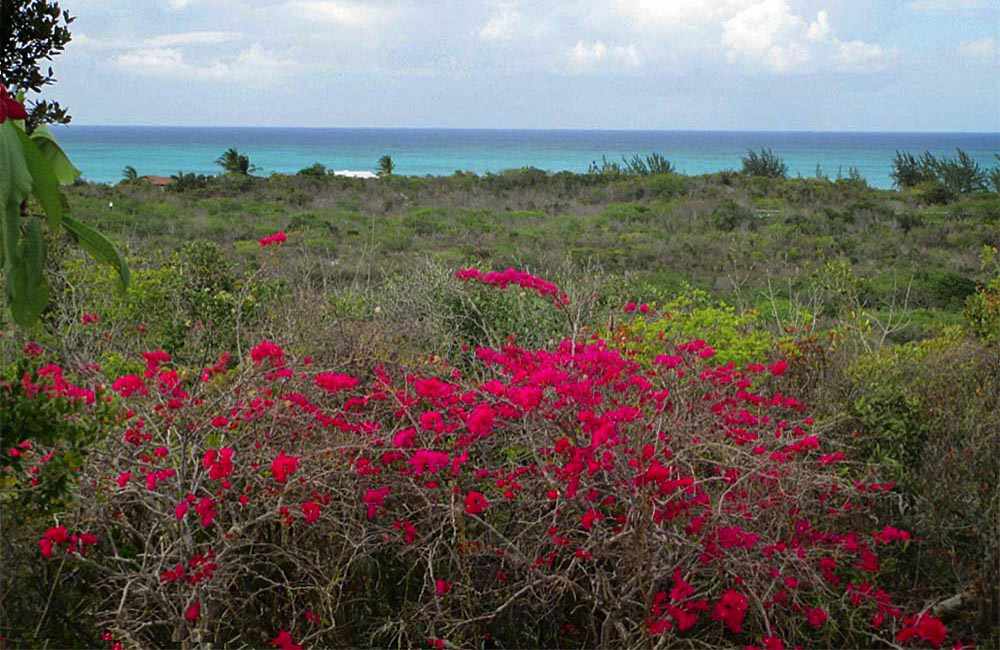
Finding the infamous Manchineel tree in the Turks & Caicos Islands
By Michael Walsh
Previously published in WestmountMag.ca
Of all the trees we could’ve hit, we had to get one that hits back.
J.K. Rowling, Harry Potter and the Chamber of Secrets
Many of you are well aware of my fascination with trees. It all started, many years ago, as a research assistant with the Canadian Forest Service investigating diseases specific to white pines. Since then, I have noticed many people pay as much attention to trees as they do to people on a bus! Hopefully, these short articles will offer insight into the many tree species that grace our shared environment.
In this particular case, I was on a recent flight to the Turks and Caicos Islands – an on-board magazine article entitled Tree of Death caught my attention. It described a tree growing on the islands that was so toxic the Guinness Book of World Records ranks it as the “world’s most dangerous tree”.
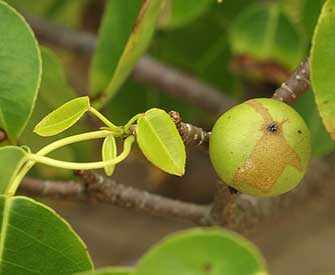
The species is known as Hippomane Mancinella (literally “little apple that makes horses mad”), a member of the Euphorbiaceae family whose closest relative is the Poinsettia.
Also known as the beach apple, manzanilla de la muerte (little apple of death), and arbol de la muerte (tree of death), it is found in Florida, the Caribbean and the Bahamas.
The species has a well-deserved reputation: the tree’s toxicity is staggering.
Every portion of the Manchineel tree is toxic – even the nearby circulating air contains toxins, many of which have not been identified.
The sap is caustic and can cause severe dermatitis on exposed skin. Standing under the tree’s canopy in a rainstorm can cause severe burns – even cars are not spared – their paint can be damaged from rainwater dripping from the leaves.
The bark contains a cocktail of toxins. In fact, smoke from the burning bark can cause temporary, if not permanent, blindness. In addition, the tree’s fruit, if ingested, can be fatal. Interestingly, the black-spined iguana and several species of birds are immune to the tree’s toxins.
Every portion of the manchaneel tree is toxic – even the nearby circulating air contains toxins, many of which have not been identified.
The more I read about the manchineel, the more I wondered how nature can, on occasion, make evolutionary mistakes. Specifically, for what purpose would a tree species evolve to the point that all its parts are toxic to humans?
All these parts made me realize that seeing one in its native habitat would be a fascinating experience. Upon arrival in Providenciales, armed with my camera and a description of the tree, I started walking down the many unpaved limestone secondary roads lined with impenetrable bushes. Many of these bear berries with a multitude of colours.
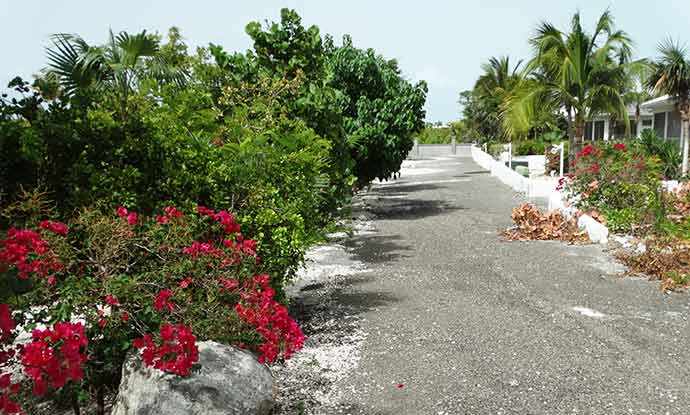
After several hours, with temperatures approaching 90 F and my only companions comprised of the occasional feral dog and small geckos scurrying in the underbrush, I realized this was the proverbial “needle in a haystack” quest.
For what purpose would a tree species evolve to the point that all its parts are toxic to humans?
Luckily, the next morning, I met Enorse Julessaint, originally from Haiti and currently working as a gardener at a nearby resort. Explaining my dilemma, he replied, “You mean the poison tree! When we find them growing near the resort we cut them down”. He added that they were still plentiful; however, you have to know where to look.
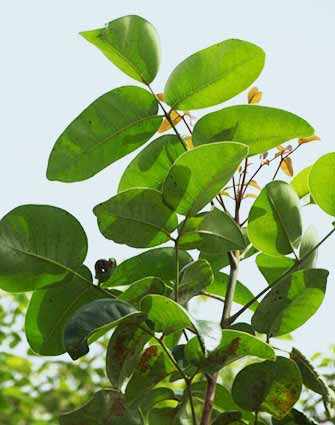
Having said that, the two of us headed down an unpaved road and directly into the bush. It didn’t take long to locate three Manchineel saplings adjacent to a residential building.
“Don’t touch the leaves”, Enorse warned me, “they will burn your skin!”
At first appearance, the saplings looked unassuming – more like a spindly tree that I wouldn’t think twice about brushing against or stepping over.
Standing close to these 12-foot saplings was a slight anticlimax. In my mind’s eye, I expected a menacing-looking tree that was easily distinguished from its neighbours.
The takeaway lesson from this experience is that nature is consistently surprising – even when it makes evolutionary mistakes!
For those wondering what the most toxic plant is – it is Florida’s spotted water hemlock (Cicuta maculata). A quarter-inch of the stem contains sufficient toxin to kill a person.
I would like to thank Enorse Julessaint for his assistance in researching this article.
Images: Michael Walsh (unless indicated otherwise)

More articles by Michael Walsh
RECENT ARTICLES

Michael Walsh is a long-time resident of Westmount. Now happily retired after nearly forty years in higher-education technology, he enjoys exploring the city on foot, uncovering its past and bringing to light the history behind its familiar places. michaelld2003@ hotmail.com • Westmount Overlooked blog

What a great article! We’ll have to make a trip down to Florida soon to find the spotted water hemlock!
Very informative.
Only one point I might take issue with.
If this tree species evolved into such toxicity to us humans, it is most likely NOT a mistake of evolutionary nature.
Linda