
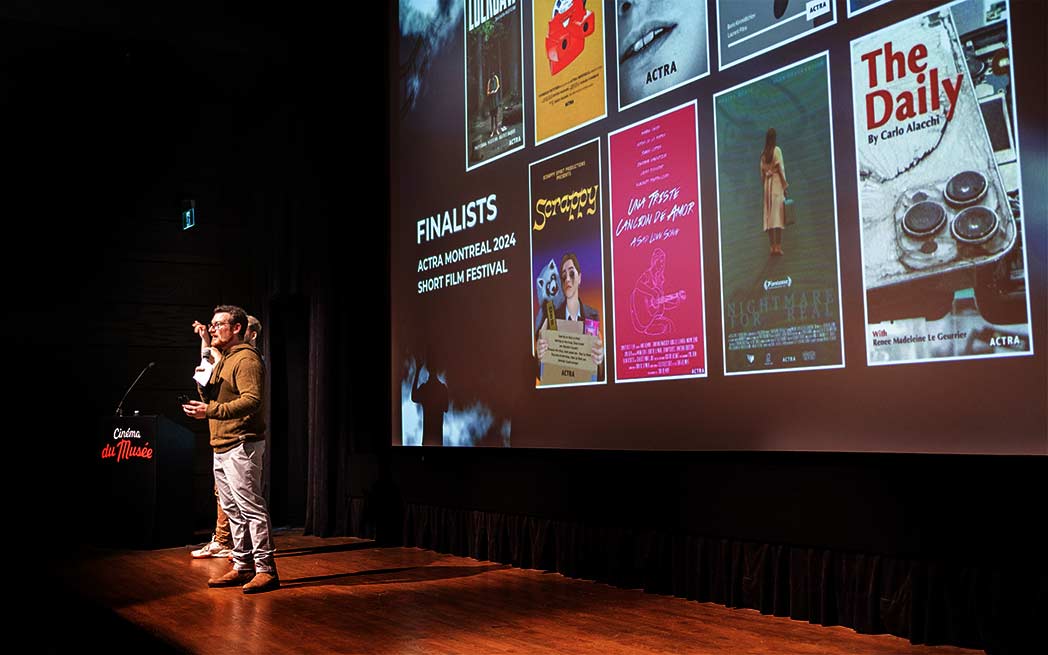
Short Film Festival
highlights local talent
Eleven English-language short films to be presented on October 7 at Cinéma du Musée
By Irwin Rapoport
October 1, 2025
Montreal is home to many fine young actors, directors, producers, and production personnel involved in the film industry, and next Tuesday, October 7, we have an opportunity to watch eleven English-language short films produced, directed, and starring local talent at the ACTRA Montreal Short Film Festival at the Montreal Museum of Fine Arts’ Cinéma du Musée.
The Alliance of Canadian Cinema, Television and Radio Artists’ Montreal members submitted twenty-eight films. This year’s selections range between 1:40 and 12 minutes. The schedule and information for each film are available here.
The Festival is open to ACTRA Montreal members, offering them an opportunity to create, learn, and improve their skills. It allows them to explore their craft from both sides of the camera, giving them a greater understanding of the medium that will only make them stronger performers.
“But maybe most importantly, it fosters community in a way that no other event does,” said Julian Stamboulieh, ACTRA Montreal’s Short Film Festival Committee chair. “When production is down in this city, and opportunities are scarce, it gives ACTRA Montreal’s members the motivation to create their own works, express their own ideas, keep morale up and tools sharp, and another chance to celebrate their peers.’’
The Festival is open to ACTRA Montreal members, offering them an opportunity to create, learn, and improve their skills. It allows them to explore their craft from both sides of the camera, giving them a greater understanding of the medium that will only make them stronger performers.
This video teaser features finalists from last year.
The festival, which is free, starts at 6:30 pm and with over 300 seats, it’s best to arrive early. Following introductory speeches by Stamboulieh and Teneisha Collins, co-chair of the Young Emerging Artists Assembly (YEAA) committee at 7 pm, the films will be screened for a duration of 108 minutes. After the awards are presented, an After-Party catered by YEAA (guests pay for their own drinks) will be held at nearby McKibbin’s Pub, 1426 Bishop Street. The Cinéma du Musée is located at 1379 Sherbrooke W.
Julian Stamboulieh, actor, director, ACTRA Montreal Council member, and Chair of the Young Emerging Artists Assembly (YEAA) replied to a few questions about the festival, as did Casey Ecker, who produced, wrote and performs in the film Mr. Darcy & Me and Rana Liu, director and playwright, who directed the short film shot in an NDG backyard, and Gabrielle Banville, who portrays Mr. Darcy.
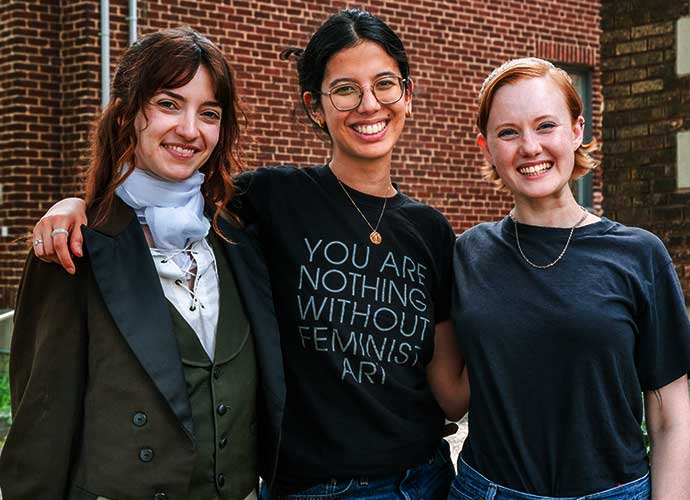
Gabrielle Banville, Rana Liu and Casey Ecker – Image: courtesy of Casey Ecker
WM: Who is behind the Festival, and what role does it play in promoting Canadian content?
Stamboulieh: ACTRA is a union representing over 30,000 performers and stunt professionals in Canada who work in English-language recorded media, including 4,000 members in Montreal. A champion of Canadian culture since 1943, ACTRA also promotes and protects the economic, professional and social interests of its members.
ACTRA Montreal has different committees allowing members to get the best out of their ACTRA experience through volunteer work. And the Short Film Festival is a membership initiative. Launched in 2003 and run by ACTRA Montreal’s Young Emerging Artists Assembly, the Short Film Festival is a celebration of members’ productions and creative work, offering them an opportunity to create “Member Initiated Productions” where everyone volunteers to put together great short films, some of which get the chance to be celebrated in other renowned festivals like Fantasia.
WM: What does the application process look like?
Stamboulieh: A call for submissions and key delivery dates are announced roughly six months ahead, though many actors and new filmmakers are already inspired to get started on development upon leaving the previous year’s festival.
After receiving all films, a selection committee composed of ACTRA Montreal council and committee members views the films, scores them, and convenes to select the top 10 to 12 films that will be screened at the Festival. Those films are then shared with a jury consisting of industry professionals, from producers and directors to casting agents and cinephiles. They then vote using a ranked point system to determine who wins in each of the award categories.
WM: What makes this festival different from other festivals?
Stamboulieh: The Festival is a creators’ hub. We receive short films of all kinds: comedy, drama, thriller, action and even animation. Our members put their diverse talents towards creating great productions, both in front of and behind the camera.
WM: What do Festival winners receive?
Stamboulieh: It’s fair to say that for some members, the opportunity to have their short film screened at a cinema in front of hundreds of viewers is a big incentive. But we do also have a collection of awards that honour the top performances of cast and crew.
This year, we will be presenting seven awards: Best Film, Best Directing, two Best Performances, Best Cinematography, Best Writing, and Audience Choice Award.
While all awardees get recognition trophies, the QEPC (Quebec English Language Production Council) has been a Festival partner for the past three years, awarding the Best Film with the chance to join an exclusive webinar session as part of their annual mentorship program, funded by the Canadian Media Fund, aiming to help emerging and mid-career producers develop the skills and networks they need to thrive.
ACTRA is a union representing over 30,000 performers and stunt professionals in Canada who work in English-language recorded media, including 4,000 members in Montreal. A champion of Canadian culture since 1943, ACTRA also promotes and protects the economic, professional and social interests of its members.
Julian Stamboulieh, ACTRA Montreal Council member
WM: How did you prepare to direct Mr. Darcy & Me, and what was the experience like?
Liu: When I was asked to direct the short film Mr. Darcy & Me, I dove straight into the world of Jane Austen. I did my homework (and the best kind): rewatching the iconic 90s TV adaptation and Joe Wright’s 2005 film, and rereading Pride & Prejudice. As a fan of the period drama genre (like Bridgerton, My Lady Jane, and Gentleman Jack), the chance to direct a modern queer twist on a beloved classic was really exciting for me.
I focused my preparation on translating the romantic tension of Austen’s world through subtle directorial choices – finding ways to accentuate meaningful glances and the emotional weight of a feather-light touch to romanticize every little moment. I worked closely with writer/star/producer Casey Marie Ecker and co-star Gabrielle Blainville to rehearse the material and build a shared world for Mr. Darcy & Me that felt authentic to the script.
The on-set experience was a testament to our devoted, collaborative crew. We organized through virtual meetings, vision boards, and detailed production schedules – the full scope of professional prep, all on a shoestring budget. A passionate and dedicated cast and crew will make magic out of thin air. I’m especially grateful for the partnership with Dalia Allocca (DOP) and Sam Beaton (AD), who were instrumental in maintaining our creative vision and keeping our shoot on schedule. Mr. Darcy & Me was a labour of love, and I am proud of the talented group of creatives who brought Mr. Darcy & Me to life – a huge kudos to our producer, Casey, for bringing us all together.
WM: Tell us about your experience directing plays and short films, and what drove you to directing?
Lui: My journey in the arts started long before I formally became a director. I spent years building my foundation as a choreographer, movement teacher, and arts educator, all while actively producing creative works. This deep expertise in physical storytelling and collaboration is essential to my directing practice.
I began directing in 2021 by writing and directing my own play, Generations, which premiered at the Montreal Fringe Festival. Created as a direct response to rising anti-Asian hate, the work was a deliberate effort to take up space and explore the complex intergenerational dynamic between an immigrant mother and daughter. Following this debut, I directed A Little Bit Pregnant (written by Kate Lavut), which led to a successful tour to Toronto and New York City. Beyond theatre, I’ve also applied my directorial skills to video production in a professional capacity.
My directorial debut is the short film Mr. Darcy & Me, and it was a privilege to be entrusted with the script. It’s a joy (and wild!) to announce that our film has been selected for the ACTRA Montreal Short Film Festival! I’m truly grateful to be a part of this amazing creative team.
‘My journey in the arts started long before I formally became a director. I spent years building my foundation as a choreographer, movement teacher, and arts educator, all while actively producing creative works. This deep expertise in physical storytelling and collaboration is essential to my directing practice.’
Rana Liu, director
WM: As an actor, what was it like to produce, write, and act in the film?
Ecker: It was definitely a labour of love, driven more by passion than profit. I had been carrying this concept in my head for a while, originally imagining it as a Fringe piece. Earlier in the year, I helped produce my wife’s Fringe show (a real trial by fire) that taught me how to manage logistics, troubleshoot roadblocks and create a supportive working atmosphere. When I came out of that process with my sanity still intact, I thought, “Why not try producing my own work and submit it to ACTRA MTL’s Film Festival?”
From there, the film almost wrote itself! As someone with ADHD, I rarely finish writing projects with such ease. The whole process reaffirmed not only my love for storytelling but also my ability to see a project through from start to finish.
This film is, at its core, about healing. After five years of therapy, I’m finally beginning to witness the impact of that work. In many ways, the film is both a reflection of my healing process and an extension of my queer identity. I also wanted the story to feel as relatable as possible, and what’s more universal than running into an ex? The awkwardness, the anxiety… and then, of course, Mr. Darcy! Jane Austen has always been a huge inspiration for me. She was a true master of human behaviour. Her narrative prose can be wordy, but there is a depth to it that I find no other writer has. I’m also such a sucker for the Regency style, the clothing, the English countryside, the social norms. There is so much richness in that time period. I could ramble about the difference between a corset and regency stays, but I will refrain from making your editing harder.
WM: How would you describe the experience of the production of this film? What was it like from start to finish?
Ecker: We tried to take it step by step. First, I needed to assemble a team made up of people I wanted to work with. Everyone was so keen once I pitched them the idea! From there, it was all about logistics, deadlines, and a ton of meetings. Pre-production truly sets the tone for the process, and the team I assembled really made the most with our minimal budget/timeframe.
WM: How do you feel about your first film being accepted? And what are your future plans?
Ecker: It’s kinda mind-boggling to be honest. I knew I would be happy with our film, whether we got into the festival or not, but damn does it feel good when you do! My future plans are simple: keep telling stories that are important to me (and maybe one day get paid).
WM: What was it like working on the film?
Banville: It was wonderful! I’ve wanted to be a part of a short film in Montreal for a while now, and I’m glad I got to do it with a bunch of artists and collaborators that I admire. I was part of Playwrights Workshop Montreal’s Young Creators Unit in 2023, and that’s where I met Rana and our first AD, Sam. I’ve seen Casey perform with multiple Montreal musical theatre companies, and always thought they had a great eye for quirky and poignant queer characters. Getting the chance to all work together on this queer Austen love story just felt right; I felt like I was able to take risks with my performance and ask for feedback without fear of rejection, which is something I truly treasured.
WM: When Casey approached you with the idea, what made you say yes?
Banville: My obsession with Pride & Prejudice came a lot later than others (I think I watched the 2005 remake for the first time in 2021 during lockdown). But I quickly became a Mr. Darcy lover; his hardened exterior slowly melting away as he falls in love is so delicious to watch. This newfound obsession came around the same time that I realized I was bisexual, and when I came to terms with all the ways I had tried to hide my attraction to people of other genders. Those ways were very similar to how Mr. Darcy handled his affection for Elizabeth for most of the story: with spitefulness, judgment, fear, and terrible communication. So when Casey told me about their script, I knew I had to be a part of it, not only because they wrote about queer affection and longing that isn’t seen a lot on screen, but also because I got to play a role that truthfully represents how a rocky queer relationship can be healed (all while wearing a suit in my favourite shade of green, no less).
Feature image: courtesy of ACTRA Montreal

More articles by Irwin Rapoport
Other recent articles

Irwin Rapoport is a freelance journalist and community advocate from Westmount with bachelor’s degrees in History and Political Science from Concordia University. He writes extensively on local politics, education, and environmental issues, and promotes informed public discourse and democracy through his writing and activism.

 February 6, 2026" />
 Arvo Pärt’s 90th birthday" />
 becomes Reality TV" />
 Westmount—Saint-Louis" />
 La Jeune Fille et l’Amour" />
 Commercial lease" />
 Seed-crusted roasted fries" />
 Forden Avenue and Crescent" />
 a preventable trap" />
 to the Centaur Theatre" />
 Letter of intent" />
 recycling breakthrough" />
 To go or not to go" />
 Tropical Grilled Peppers" />
 and their stories" />
 Trump backs down" />
 celebrates its 34th season" />
 Commercial financing" />
 smart answer to tariffs" />
 Thai cauliflower florets" />
 legacy with purpose" />
 Lewis Avenue" />
 resistance and unity" />