
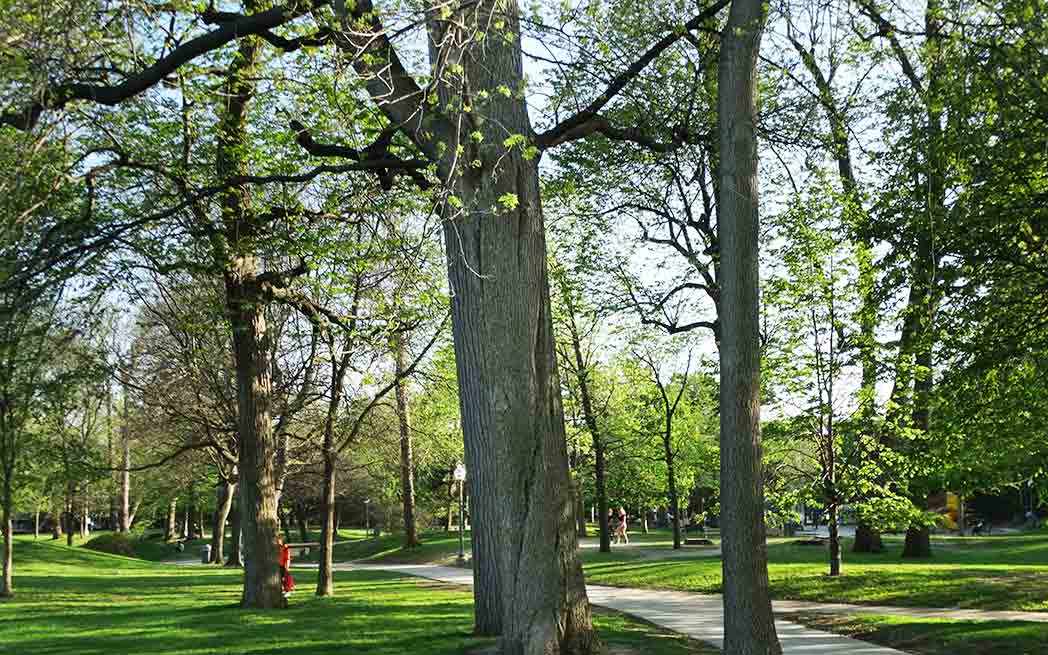
Westmount Park trees:
A living natural heritage /5
The Basswoods mark the course of a former stream in Westmount Park
By Michael Walsh
Previously published in WestmountMag.ca
O the scent of the limes on the linden tree!
How it brings the love-days back to me,
How it wakens the mem’ries of long ago
Of summer months with their sunlit glow
And the hum of bees in pastures green
And the purling of streams that wound between,
And sequestered haunts we used to know
When we were young in the Long Ago.
Linden blossoms, Jeffrey Dolezal Hrbek
Have you ever wondered why Montreal’s residential streets run as narrow strips from north to south – and the commercial ones run in an east-to-west direction? The answer is quite an interesting story. It began when the Champlain Sea retreated (10,000 years ago), leaving behind a myriad of rivers and streams. Jumping forward to 1627, France’s seigneurial land-distribution system capitalized on these waterways. Specifically, long narrow pieces of farm land (‘rangs’) were divided into lots, measuring 3 x 30 arpents that assured farmers had access to water, which typically flowed from north to south. (The exception is Côte des Neiges road, which followed a stream called the Ruisseau Rainbault.)
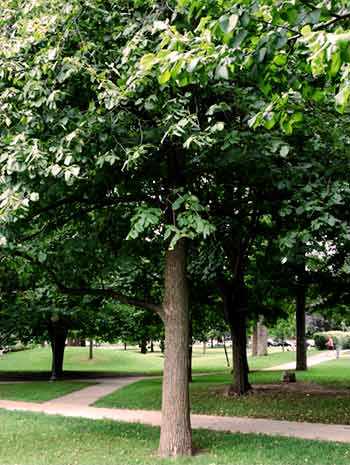 In Westmount, several streams flowed through today’s Westmount Park and converged into the Glen stream (present-day Glen Road and Saint Catherine Street intersection). The former’s name was chosen in the 1800s because the area resembled a deep Scottish valley. It has been described as a “cool stream… towards a pool where ducks and geese are fed”. The stream flowed into Lac St. Pierre at St. Henri des Tanneries. Interestingly, under Glen Road’s stone arch bridge, there is a manhole where one can still hear the stream’s water flowing. (This is not something I would recommend!)
At this point, one might ask what this has to do with trees – quite a lot, actually – some species are water-loving and mark the locations of the park’s original streams. Specifically, the basswoods that line a path at the park’s Melbourne Avenue entrance mark the course of a former stream that ran from Mount Royal into Saint-Henri.
‘The tree’s name originates from fibre (‘bast’) obtained from the inner bark. In fact, in 1991 a 5,300 year-old Iceman, discovered in the Ötztal Alps, was wearing a knife sheath and shoe linings made from bast fibers.’
These trees are known as American basswoods (Tilia Americana). In Europe, they are called lindens and in England limes (not to be confused with the citrus fruit). The tree’s name originates from fibre (‘bast’) obtained from the inner bark. In fact, in 1991, a 5,300-year-old Iceman, discovered in the Ötztal Alps, was wearing a knife sheath and shoe linings made from bast fibres.
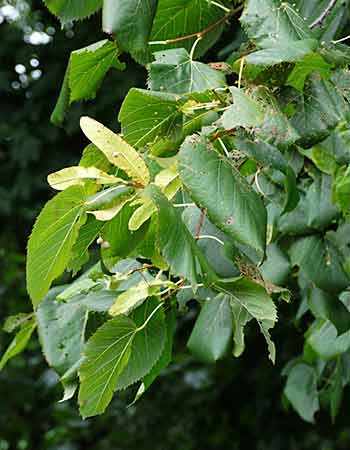
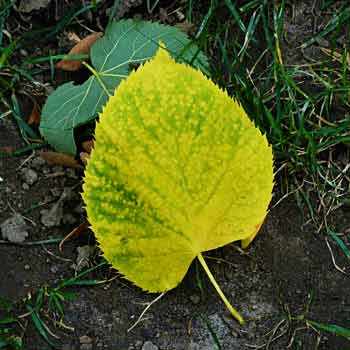 Basswoods are easily identified by their asymmetrical heart-shaped leaves with serrated edges. A unique feature is a modified leaf (‘bract’) that is attached to the tree’s flowers and pea-sized fruit. The leaves and flowers are used to make Tilleul – a calming herbal tea with a ‘woodsy’ flavour. The tree’s strongly scented flowers (similar to jasmine) can produce large quantities of nectar that bees convert into honey of a whitish colour, described as having a minty taste. The trees’ copious nectar production is reflected in a beehive in Iowa that reportedly produced 600 pounds of basswood honey in 30 days. The trees’ natural habitat extends from New Brunswick to Manitoba and south to Texas.
‘In Europe they are called lindens and in England limes (not to be confused with the citrus fruit).’
 Finally, mythology tells the story of the sea nymph Philyra, daughter of Tethys (goddess of the seas) and Oceanus (god of the oceans), who bore a centaur named Chiron. Grieving that she had produced a child that was half man and half horse, Philyra asked the gods to relieve her in her human form. The gods obliged by transforming her into a beautiful lime tree. Cheiron stayed with his mother, at the base of the tree, where she educated him with wisdom and kindness. That is why, to this very day, limes are associated with love and care.
Images: Michael Walsh

More articles by Michael Walsh
Other recent articles

 July 21, 2026" />
 lakeshore and horizon" />
 and green apple salad" />
 voice communication" />
 A living natural heritage /7" />
 from a home office /2" />
 Buying a country home" />
 Treat your vehicle to a beauty makeover" />
 in the Laurentians" />
 from a home office /1" />
 Lima Bean Hummus" />
 mistakes to avoid" />
 A living natural heritage /6" />
 The buyer’s visit" />
 environmentalism?" />
 the classical mandolin" />
 between matter and light" />
 goes bonkers circus" />
 Caramelized Beet Carpaccio" />
 of emotional labour" />
 A living natural heritage /5" />
 what takes Trump down?" />
 Summer doldrums" />
 30th edition unveilled" />
insightful and beautifully written
reading this again i learn more about the trees and the cityscape of westmount . plus the myth is lovely