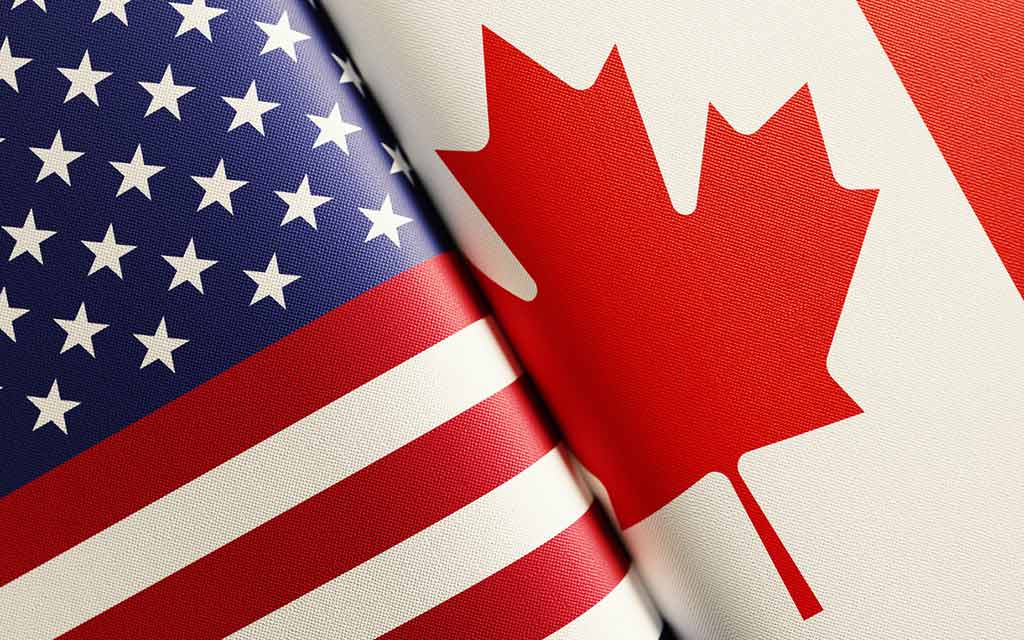
As Washington rattles markets, a rare investment opportunity emerges here
By Andrew Burlone
August 31, 2026 • Opinion
The story practically writes itself. General Motors shifts some production north. German farm-equipment giant CLAAS takes a closer look at Canada. Energy company Uniper puts a major U.S. green-hydrogen project on hold. Donald Trump’s tariffs rattle the global economy, and suddenly companies appear to be packing up for Canada and Europe. “Businesses are fleeing the U.S.” is an irresistible headline—particularly for Canadians who have spent decades watching investment, jobs and corporate decisions move in the opposite direction. But this is not a stampede. It is better understood as a series of highly specific warning signals.
Companies react when the rules become too unpredictable, too expensive or too politically charged to ignore.
Companies do not move factories, supply chains or billion-dollar energy projects on a whim. They react when the rules become too unpredictable, too expensive or too politically charged to ignore. Tariffs may be sold as a show of strength, but to a manufacturer they can look like an extra bill arriving without a clear expiry date. To an energy developer, they can be one more reason to delay an already complicated project. To an exporter, they can turn a dependable market into a gamble.
That does not mean the United States is about to become an economic ghost town. It remains one of the world’s largest consumer markets, a major centre for innovation and a country with enormous industrial capacity. A few high-profile decisions do not prove that corporations are abandoning it. But they do suggest that some boardrooms are beginning to ask a question they once took for granted: is the U.S. still the most reliable place to put the next dollar?
Canada gets an opening
For Canada, the opportunity is real, but it comes with its own warning label. The country has long relied on the United States as its overwhelmingly dominant trading partner. That relationship isn’t disappearing, and it shouldn’t. Our economies are deeply connected, from auto parts and food to energy, aerospace and technology. Yet every tariff threat reminds us that dependence can feel comfortable right up until it becomes a vulnerability.
Canada’s gradual effort to broaden its export relationships is therefore more than a diplomatic talking point. It is common sense. If Canadian businesses can sell more to Europe, Asia and other markets, they are less exposed when Washington changes the rules, or changes its mind.
Canada cannot simply wait and hope that risk-averse foreign companies will choose to invest here.
The same principle applies to investment: Canada cannot simply wait and hope that risk-averse foreign companies will choose to invest here. It has to offer what investors want: dependable policy, skilled workers, competitive infrastructure, affordable and reliable energy, and a process that does not bury projects in years of paperwork. If the U.S. creates uncertainty, Canada still has to prove that it can offer certainty.
The GM, CLAAS and Uniper stories matter less as proof of a grand corporate migration than as a snapshot of a changing business mood. Global companies are adjusting their maps. They are looking for safer supply chains, more stable trade relationships and markets where political surprises are less likely to ruin a long-term plan. That should not inspire triumphalism in Canada. A neighbour’s uncertainty is not a national economic strategy. But it should encourage Canada to be alert, practical and ready.
The central lesson is straightforward: investment follows confidence. If the United States continues to make the international business environment less predictable, some companies may begin looking elsewhere. Canada will not automatically secure that investment—but it will be better positioned to compete if it is ready to make a compelling case.
Disclaimer: The opinions expressed in this article are those of the author and do not necessarily reflect the opinion of WestmountMag.ca.
Featured image: Susy Hazelwood – Pexels

More articles by Andrew Burlone
RECENT ARTICLES
 Andrew Burlone, co-founder and editor-in-chief of WestmountMag, started his media journey at NOUS magazine. His interests include journalism and communications, with a particular appreciation for architecture, culture, visual arts, and social issues.