

Barbara Steele
Just for her eyes
Fantasy cinema is a film genre whose history dates back to the dawn of cinema
By Francis Ouellet
October 20, 2025
As autumn settles in, with its lengthening nights and the chill creeping into the air, my mind naturally drifts toward the season’s signature celebrations. Approaching Halloween, one can almost picture the streets alive with ragtag processions of adolescent vampires, pint-sized witches, and a menagerie of miniature monsters, all on their perennial quest for treats. It is within this atmospheric context that I found it fitting to turn my gaze toward fantasy cinema, a genre as rich in history as it is in imagination, tracing back to cinema’s very dawn.
A testament to early cinematic ingenuity and the timeless allure of the fantastic, the inaugural fantasy film, Le manoir du diable, crafted by French visionary Georges Méliès in 1896—merely a year after the official birth of cinema—still holds its place of significance. This brief, two-minute marvel features a shadowy figure, half demon, half vampire, who metamorphoses right before our eyes into a bat.
Over the decades, many great figures in cinema have been associated with the fantastic genre, including the beautiful and mysterious Barbara Steele.
Often considered quite naive by today’s standards, the film nonetheless shows the deep attachment we have had to the fantastic and the marvellous ever since the dawn of humanity. We have always loved tales and legends, so it is only natural that the seventh art has drawn on this fascination for the strange and mysterious within each of us with a simple, unique goal: to scare us.
Over the years, numerous actors and directors have made their mark in fantastic cinema, becoming icons and even legends within this beloved genre. Among them stands the enigmatic and beautiful Barbara Steele, whose contributions have left an indelible mark on fans and aficionados of fantastic film worldwide.
Barbara Steele’s career, spanning from her breakthrough in Mario Bava’s Le masque du démon (1960) to her lasting legacy as a queen of horror cinema, exemplifies the profound impact of this genre and the allure it holds for both creators and audiences alike.
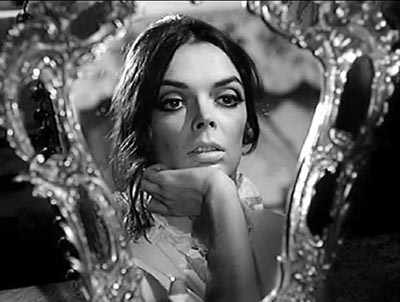
Born in England in 1937, Barbara Steele began her career as a model before leaping into cinema. With her beautiful, slender face framed by dark hair, her pouty mouth, and especially her large, expressive, and captivating eyes, she quickly caught attention.
In the late 1950s, she played various minor supporting roles in England. But it was in Italy that she found fame and recognition. In 1960, she starred in the leading role in Mario Bava’s The House of the Devil, a masterpiece of gothic cinema that set a standard for the genre and is still considered a must-watch in fantastic cinema today.
From that point forward, sometimes against her will, Barbara Steele became the true queen of horror cinema, working with the greatest directors in the genre across Italy, England, and the United States. She also made some forays into auteur cinema, notably with Federico Fellini, Volker Schlöndorff, and Louis Malle. Still, it is for her roles in horror films that she became a legend.
‘In 1960, she starred in the leading role in Mario Bava’s The House of the Devil, a masterpiece of gothic cinema.’
Unfortunately, her career lost momentum in the early 1970s, and her appearances on screen became increasingly rare. She then moved into production, mainly for television, while still occasionally gracing us with her presence in various film productions.
To discover or rediscover this great lady of fantasy cinema, I am suggesting here two important works from her filmography. As I mentioned earlier, Black Sunday is unquestionably the most important film of her career. Still, the following two films are of the same calibre and can easily stand comparison with Mario Bava’s dark gem.
Castle of Blood / La Danza Macabra
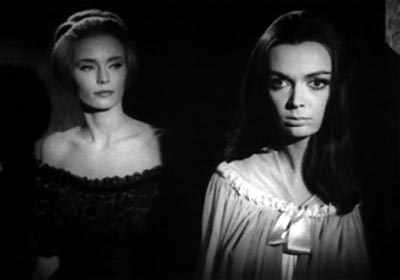
Freely inspired by Edgar Allan Poe’s stories—with Poe himself portrayed in the opening scene by Italian actor Silvano Tranquilli—the film tells the story of a journalist, Georges Rivière, who accepts a wager to spend an entire night in a manor reputedly haunted. Of course, the ghosts appear to him, determined to take his life. His only hope lies in the help of the beautiful Elisabeth, brilliantly played by Barbara Steele, a luminous and tragic character, herself a prisoner of this infernal place.
In this film, where nothing seems to be quite as it should, even death appears somehow beneficial—perhaps a necessary passage to a different, possibly better existence. Directed in 1964 by Antonio Margheriti, another major name in Italian Gothic cinema, Castle of Blood is an atmospheric, haunting work, unfolding as if in a dream—or rather, a nightmare.
Its unreal ambiance, magnificently rendered in striking black and white, is pure delight. The opening scene alone, with Edgar Allan Poe in a remote inn at night reciting the end of Berenice, one of his most famous tales, suffices to establish a morbid sense of anxiety that lingers throughout the film. Enhanced by Riz Ortolani’s autumnal score, this film ranks among the most beautiful achievements of Italian cinema of the period.
Nightmare Castle (Amanti d’oltretomba
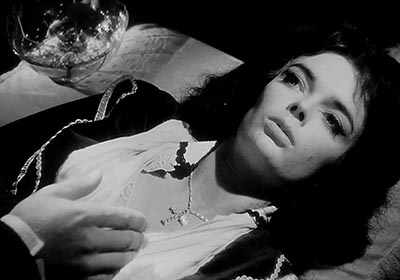
Throughout his directing career, Mario Caiano worked in nearly all popular Italian film genres (horror, peplum, spaghetti western, crime, Nazi pornography…), all marked by a glaring lack of talent. Yet hidden within this collection of often poor and rushed movies is one of the most beautiful Gothic tales of Italian cinema: Nightmare Castle (Amanti d’oltretomba), shot in 1965.
A classic story of revenge from beyond the grave, it tells of a young woman and her lover who, tortured and then murdered by her husband, return from the dead to torment their tormentor. Caiano illustrates this scenario with superb images, deeply baroque in lyricism, transporting us into a romantic and macabre world where misty cemeteries and vast dilapidated mansions, always shrouded in threatening shadows, create a striking expressionist effect.
The magnificent black-and-white photography by Enzo Barboni and the haunting music by Ennio Morricone add even more to this work, a gloomy poem dedicated to the venomous beauty of Barbara Steele. It is strange to note that this gem is the work of a simple journeyman. Caiano, who credited this film under the pseudonym Allan Grünewald, never again reached such heights. But at least, through this film, he left an important legacy to the genre.
The Italian Gothic horror cinema of the 1960s represents a rich and evocative period in genre filmmaking. Other notable films from this period starring Steele include The Horrible Dr. Hichcock (1962), The Ghost (1963), The Long Hair of Death (1964), and Castle of Blood (1964). These films frequently explore themes of duality, revenge, and entrapment within dark, misty settings and decaying mansions. They are marked by striking black-and-white cinematography, evocative use of shadows, and music that intensifies the macabre atmosphere.

These works not only defined an era but also shaped Barbara Steele’s legacy as the queen of Italian Gothic horror, her iconic presence emblematic of the genre’s blend of sensuality and terror. Collectively, they remain essential viewing for fans of classic horror and gothic cinema, illustrating a period when style and mood were paramount, and storytelling embraced the eerie and the supernatural with poetic depth. Key works from this era to explore include:
- Black Sunday (1960, dir. Mario Bava)
- The Horrible Dr. Hichcock (1962, dir. Riccardo Freda)
- The Ghost (1963, dir. Riccardo Freda)
- The Long Hair of Death (1964, dir. Antonio Margheriti)
- Castle of Blood (Danse macabre, 1964, dir. Antonio Margheriti)
- Nightmare Castle (Amanti d’oltretomba, 1965, dir. Mario Caiano)
- These films collectively highlight the Gothic revival in Italian cinema and Barbara Steele’s status as an enduring icon of the genre.
Images: bavatuesdays – StockPholio.com Other recent articles


 January 6, 2026" />
 through digital innovation" />
 looks back at 2025" />
 online betting rules?" />
 a film by Andrés Livov" />
 for its 16th edition" />
 Passion fruit meringue verrine" />
 playful clownish escapade" />
 World rhythms on stage" />
 management mistakes" />
 Kensington Avenue" />
 Vegan Chili Chocolate Cake" />
 Bethune tunnel" />
 Left out of breath" />
 of business strategy" />
 damage before it starts" />


 into a professional career" />

 plumbing issues at home" />
 embraces bold cinema" />
 Red snapper papillote" />
 the Legend of Pepita" />