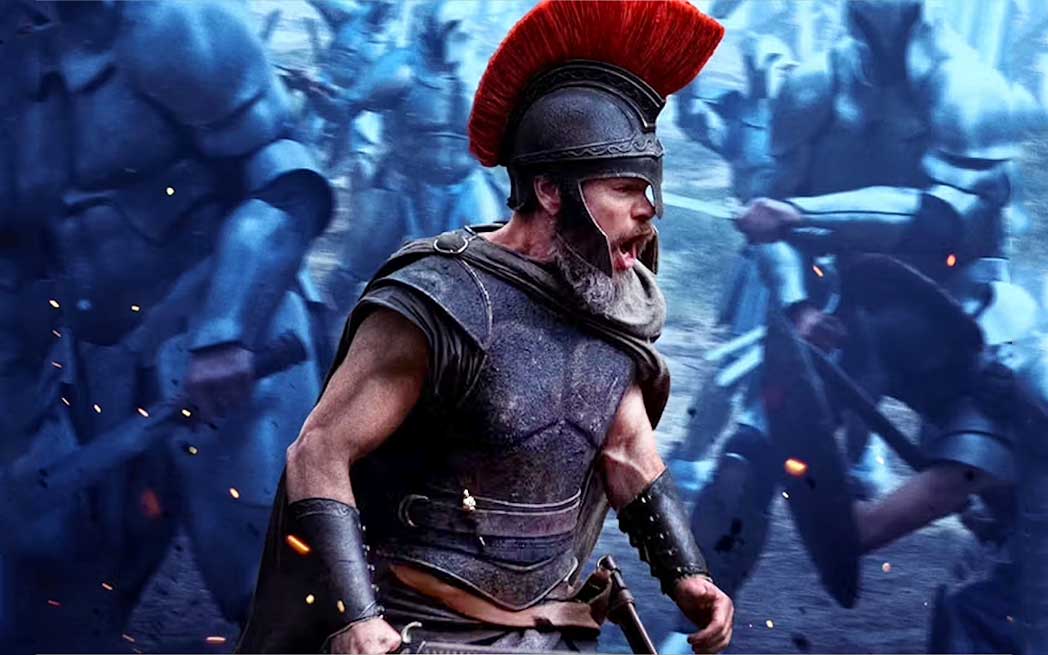
My eyes were glued to the cinema screen as the story stayed true to the poem
By Irwin Rapoport
September 10, 2026
Christopher Nolan’s The Odyssey is a brilliant, must-see cinematic experience. Based on Homer’s epic poem, The Odyssey, the film resplendently brings the tale of Odysseus’s journey home ten years after the fall of Troy to life on the silver screen.
There are plenty of action scenes; this is no action film – it is thought-provoking and haunting. The nearly three-hour spectacle is a solid, realistic presentation of the story that has intrigued the imagination of millions who have listened to the poem, read the numerous translations, and watched film and television productions.
Based on Homer’s epic poem, The Odyssey, the film resplendently brings the tale of Odysseus’s journey home ten years after the fall of Troy to life on the silver screen.
The first audiences to encounter the Odyssey and the Iliad, which recounts the origins and execution of the Trojan War, did so by hearing storytellers who memorized the poem travel to Greek city-states and colonies throughout the Mediterranean. These multi-day performances must have been mesmerizing, depending on the storytellers’ skills and whether they took place in town squares or amphitheatres. Today, you can still experience this through audiobooks. One can listen alone or with a group of friends.
The Greek and later Roman audiences contained a mix of those whose knowledge of the gods was more than sufficient and younger attendees whose education and awareness were just beginning. Some had travelled by land and sea, while others had never left home. In a society where television, films, and radio did not exist, and where many were unable to read, and hand-written scrolls were expensive, listening to poems and tales of the gods, demigods, and heroes was the norm, and the power of words and concepts sparked the imagination. Even at the height of classical Greek and Hellenistic civilization, literacy rates were still very low. Hence, the ability to listen and absorb new knowledge was de rigueur.
In the video above, British actor and master storyteller Stephen Fry gives us a taste of the power of the ancient storytellers as he talks about the origins of the Trojan War as part of the launch of his book, Troy. Ali Velsi, the host of MS Now’s The 11th Hour with Ali Velsi, interviews Emily Wilson, whose recent translation of the Odyssey inspired Nolan’s production. The discussion provides the essential background to understanding the poem and the film.
Several film versions of The Odyssey exist, including a 1950s production in which Kirk Douglas portrayed Odysseus. Two years before Nolan’s film was released this summer, Ralph Fiennes took on the role in the 2024 film The Return, which did not receive the hype and fanfare that Nolan’s film is receiving.
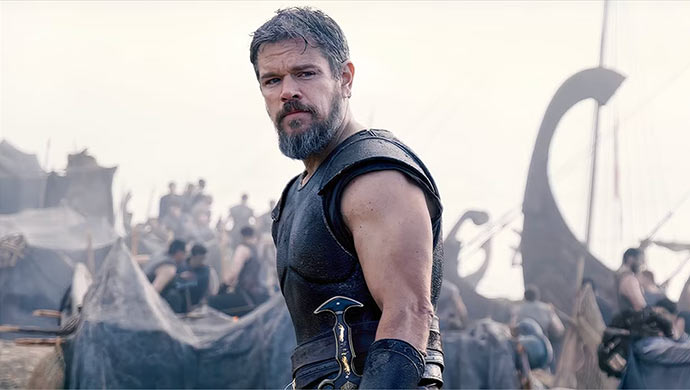
Nolan’s film repertoire speaks for itself, and he is a master storyteller. Realism is a key element of his movies, and although he uses CGI to great effect, he revels in realistic special effects. In his Odyssey, he goes all out with full-scale replications of the wooden horse, the ship Odysseus and his crew sail, the weapons and armour worn by Greek and Trojan warriors, and numerous sets. The world of Trojan War-era Greece is authentic in every sense.
Nolan goes all out with full-scale replications of the wooden horse, the ship Odysseus and his crew sail, the weapons and armour worn by Greek and Trojan warriors, and numerous sets. The world of Trojan War-era Greece is authentic in every sense.
My eyes were glued to the screen as the story, through flashbacks, stayed true to the poem. We follow the many threads that lead to the finale when Odysseus returns to Ithaca and metes out justice to the suitors who sought to marry Penelope and seize the kingdom, usurping Telemachus, Odysseus’s son, the rightful heir before he comes of age to claim the throne.
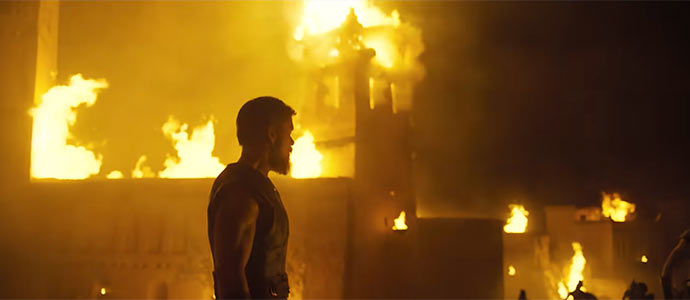
Nolan, with the help of an amazing production crew, gives audiences a roller-coaster experience. When Odysseus’s ship is sailing through a horrendous storm, you feel as if you are on board. When a landing party hits the shore and explores an island, you are with them, and when battle takes place, you are in the midst of it. Likewise, when Telemachus visits the palace of Menelaus, and the suitors strut about the palace in Ithaca, you experience those and other scenes as if you are in the background. Nolan’s directorial abilities shine in this film, and no doubt, he will be rewarded with Academy Awards for best director and best film, along with nominations and awards for the cast – Matt Damon and Anne Hathaway – and the production crews.
Every actor, major and minor, is more than up to the challenge of being absorbed by the characters. Without this dedication and Nolan’s guiding vision, the film would never have achieved its goals of recreating a lost world and giving Homer an opportunity to inspire new generations.
Damon, who portrays Odysseus, is superb. He transforms himself into the character, as does Hathaway as Penelope. Every actor, major and minor, is more than up to the challenge of being absorbed by the characters. Without this dedication and Nolan’s guiding vision, the film would never have achieved its goals of recreating a lost world and giving Homer an opportunity to inspire new generations.
I purposely have not included a link for the film as I have no intention of spoiling the experience. Nolan explores and fleshes out themes associated with the era and those that are universal, as the poet intended.
Wolfgang Petersen directed the 2004 film Troy, a retelling of the Iliad. This movie, despite some complaints concerning the minimal role of the gods, is well worth watching. It features an all-star cast that also immerses the actors in their characters. The film takes us from Paris seducing Helen, the wife of Menelaus, king of Sparta, to the sack of Troy. Watching this movie before seeing Nolan’s film helps to set the scene, as does listening to or reading The Odyssey.
I’m not sure how long Nolan’s film will be shown in local theatres, but definitely see it before it disappears. Ultimately it will be available on streaming services, but that experience pales in comparison to the big screen.
Images: Universal Pictures

Other articles by Irwin Rapoport
RECENT ARTICLES
 Irwin Rapoport is a freelance journalist and community advocate from Westmount with bachelor’s degrees in History and Political Science from Concordia University. He writes extensively on local politics, education, and environmental issues, and promotes informed public discourse and democracy.