
The Revolutionary Power
of Protest Art
Creative expression plays a vital role in shaping movements and inspiring change
By Andrew Burlone
July 15, 2025
Art is one of the most powerful weapons protesters have in their fight for change. Throughout history, art has been inextricably linked to movements advocating for justice. It can capture people’s attention in a way that speeches and pamphlets cannot. Art distils complex issues into images, songs, symbols and performances that can both express anger and inspire hope. It is immediate and visceral, capable of moving people regardless of the language they speak.
Art has been inextricably linked to movements advocating for justice, capturing people’s attention in a way that speeches and pamphlets cannot.
Art gives voice to those who are not always heard. Many times, protesters feel their demands and rights are ignored by institutions and the media. Through murals, posters, and street performances, they can reclaim abandoned buildings, busy intersections or digital spaces, turning them into platforms for marginalized stories. Those who walk by or scroll through their phones become witnesses. Suddenly, issues that might have seemed distant become impossible to ignore.
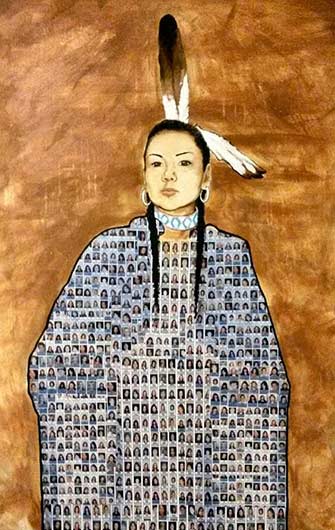
Still Dancing • Artist: Jonathan Labillois
This is as true in Canada as anywhere. Art commemorating missing and murdered Indigenous women, for example, has brought national attention to a tragedy long pushed to the margins. The series of red dresses seen hanging in trees or on lamp posts across Canadian cities is a silent but unforgettable reminder of ongoing violence. It’s an act of protest that asks the public to stop and reflect, even for a moment. These installations both mourn loss and demand action.
Visual protest is not the only effective form. Songs and chants have also played a crucial part in Canadian protests. During the Idle No More movement, round dances in shopping malls and on Parliament Hill brought traditional Indigenous music into public spaces, and performance art has been central to recent protests for climate action, like the die-ins staged during climate marches or the creative flash mobs at public transit hubs.
One of the reasons art works so well is that it creates strong emotional connections. People may not remember the wording of a protest’s demands, but they remember a striking poster or melody. Art sticks in the mind, shaping not just how a protest is seen in the moment, but how it is remembered years later. The Montreal student protests of 2012, for example, are recalled through the clatter of red square pins and the banging of pots and pans. This imagery lived on well after the picket lines dispersed.
‘Art sticks in the mind, shaping not just how a protest is seen in the moment, but how it is remembered years later.’
The Black Lives Matter movement harnessed the power of art to honour those lost to racial violence and amplify demands for justice. Large-scale murals, protest posters, street art, graffiti, and moving performances appeared across North America, transforming public spaces into vibrant, urgent calls for change. Art within the movement not only memorialized lives lost to police brutality but also fostered solidarity, spread awareness, and mobilized communities around the movement’s core message: the necessity of dismantling systemic racism.
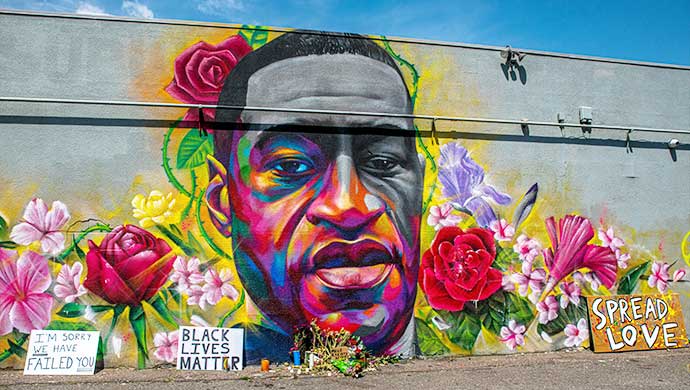
Black Lives Matter • Photo: Mana
With the internet and smartphones, art created during protests spreads faster and farther than ever before. What starts as a painted mural on a wall can become a viral image on Instagram, inspiring similar actions around the world. The sharing of protest art online builds community and unity between people fighting for similar causes, even if they are separated by thousands of kilometres.
The power of protest art is not just in its reach, but in its accessibility. While not everyone is confident speaking into a megaphone or writing opinion pieces, almost anyone can contribute to protest art. Drawing, singing, painting banners, or crafting signs are all ways to get involved. That inclusiveness broadens movements and brings new people into activism.
‘While not everyone is confident speaking into a megaphone or writing opinion pieces, almost anyone can contribute to protest art.’
Art also challenges the official story. Governments, corporations and institutions often control the narrative through official statements and media releases. Protest art disrupts that control. It offers a different perspective, one that is creative, bold, and sometimes inconvenient for those in power. The creation of protest art can itself be risky—artists sometimes face censorship, arrest or removal of their creations. Still, erasing a painted wall or seizing a banner rarely makes the message disappear. It often draws more attention to the art and strengthens the resolve of a movement.
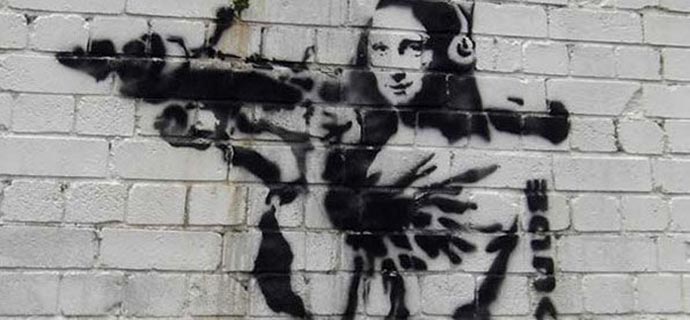
Mona Lisa • Artist: Bansky
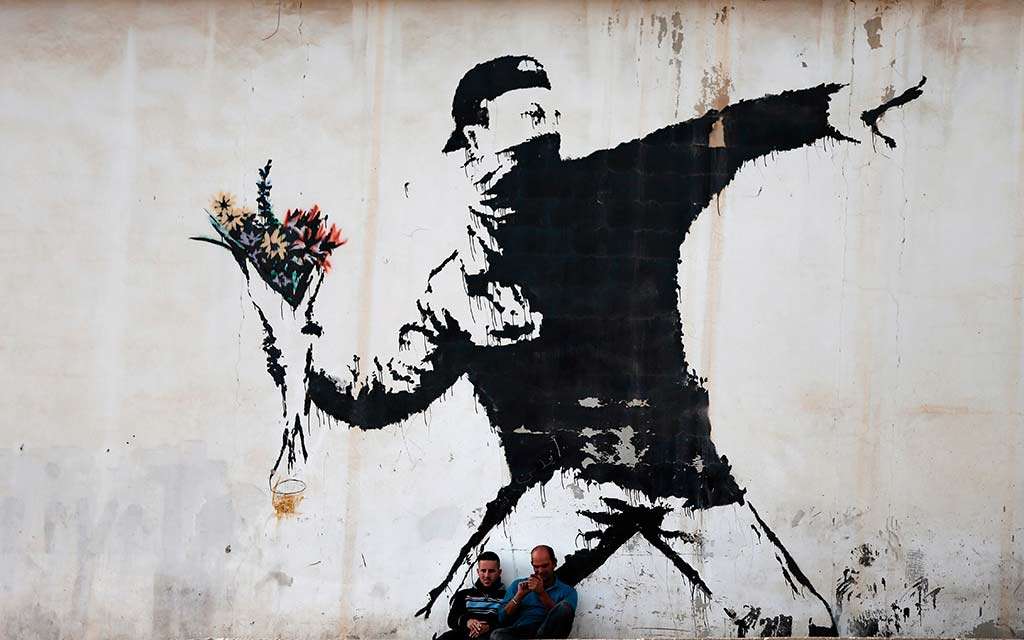
Banksy’s protest art is renowned for its subtlety and incisive wit, using carefully crafted stencils and striking imagery to challenge authority and provoke thought. His works often appear overnight in public spaces, transforming ordinary walls into platforms for political statements against war, consumerism, and oppression. Through pieces like Love is in the Air, which replaces a protester’s Molotov cocktail with a bouquet, Banksy highlights the paradoxes of aggression and peace. Rather than confront viewers with overt didacticism, Banksy’s visual metaphors and satirical juxtapositions invite reflection, dialogue, and sometimes controversy.
‘Protest art offers a different perspective, one that is creative, bold, and sometimes inconvenient for those in power.’
Pablo Picasso’s Guernica stands as one of the most powerful and enduring anti-war artworks of the twentieth century. Painted in 1937 in response to the bombing of the Basque town of Guernica during the Spanish Civil War, this massive oil mural uses a stark palette of black, white, and grey to convey the terror and suffering inflicted on civilians. The composition features a chaotic procession of anguished figures—most notably a screaming horse, a raging bull, and a grieving mother clutching her dead child, set amidst flames, shattered architecture, and nightmarish dismemberment.

Guernica (1937) • Artist: Pablo Picasso
Through a blend of Cubism and Surrealism, Picasso immerses viewers in the violence and chaos of war, forgoing colour to heighten the painting’s bleak impact and universalize its message. Guernica quickly became a symbol of protest against war and fascism and a rallying cry for peace. Today, it remains a haunting testament to the profound human cost of conflict and the capacity of art to bear witness and resist oppression.
The symbols and images forged in events become part of a country’s cultural memory, shaping how later generations understand the fight for justice. The legacy of protest art can be traced back to influential figures like Francisco Goya, whose work remains a powerful example of how visual art can challenge authority and expose brutality. Living through war and political upheaval in 18th and 19th-century Spain, Goya created a haunting series of etchings titled The Disasters of War, portraying the horrors committed during the Peninsular War.
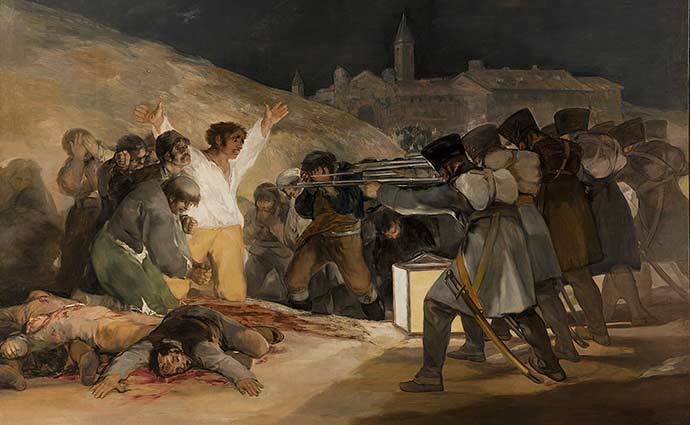
El Tres de Mayo • Artist: Francisco Goya
Unlike romanticized depictions of battle, Goya’s work laid bare the suffering of civilians and the cruelty of both occupying and domestic forces. His emotionally charged, often graphic images served not only as artistic expression but also as historical witness and vehement protest against injustice. Goya’s courage to depict such raw truth set a precedent that continues to inspire protest artists today, including many in Canada who use similar visual strategies to confront colonialism, violence, and systemic oppression.
‘Art lets protesters imagine the future they want, not just the systems they oppose.’
Art lets protesters imagine the future they want, not just the systems they oppose. In demanding change, it’s easy to focus on what is wrong. But protest art can point towards what could be better by offering a vision to rally behind. It might be a hopeful song, a bright mural showing a healed community or sculptures symbolizing solidarity. These creative acts help sustain movements through difficult times and keep hope alive.
In every movement, from Indigenous rights to gender equality and climate action, art has been a driving force that turns protest into history. As long as people organize and demand a better world, art will be their most powerful weapon—bringing change closer, one brushstroke, note and banner at a time.
Feature image: Banksy – Love is in the Air, 2005 • Photo: Dylan Shaw – Unsplash
Other articles by Andrew Burlone
Other recent articles
Andrew Burlone, co-founder of WestmountMag.ca, began his media journey at NOUS magazine. Subsequently, he launched Visionnaires, holding the position of creative director for over 30 years. Andrew is passionate about culture and politics, with a keen interest in visual arts and architecture.

 January 6, 2026" />
 through digital innovation" />
 looks back at 2025" />
 online betting rules?" />
 a film by Andrés Livov" />
 for its 16th edition" />
 Passion fruit meringue verrine" />
 playful clownish escapade" />
 World rhythms on stage" />
 management mistakes" />
 Kensington Avenue" />
 Vegan Chili Chocolate Cake" />
 Bethune tunnel" />
 Left out of breath" />
 of business strategy" />
 damage before it starts" />


 into a professional career" />

 plumbing issues at home" />
 embraces bold cinema" />
 Red snapper papillote" />
 the Legend of Pepita" />