
Westmount places
Academy Road
The history behind the familiar: The story of a lost opportunity
By Michael Walsh
Previously published in WestmountMag.ca
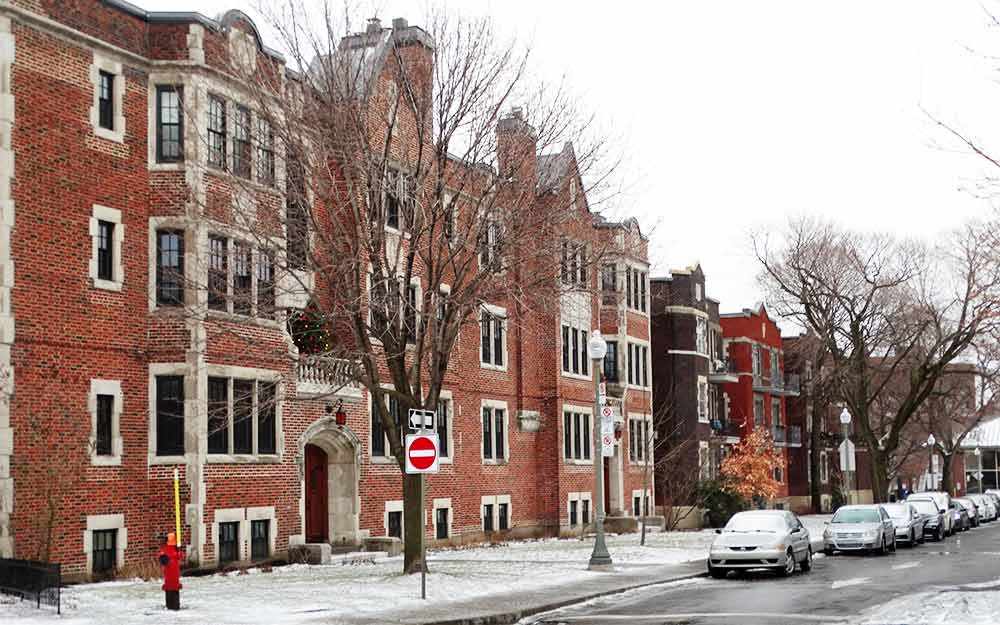
Can a street be “unassuming”? Or is one bestowing a human quality on an inanimate object? Academy Road is that type of street. In its present configuration, one would not assume it has any historical significance. In fact, Academy Road’s “backstory” is intertwined with the historical background covering the proposed expansion (and shrinkage) of today’s Westmount Park. In short, it is the story of an opportunity lost.
Parks and playgrounds are the soul of a city.
Marty Rubin
The area, originally part of several estates, featured prominently in the town’s park extension proposal, whereby “Westmount will have one of the finest laid out parks on the continent”.
– Westmount News, August 5, 1910
We are all familiar with the expression “seeing through a different lens”. Let’s see how our perspective changes after taking a journey through the street’s past.
The story begins in the early 1900s, when Council took out a $300,000 loan to acquire five additional acres of park property. Specifically, the area between Western Avenue (Boulevard de Maisonneuve) and Saint Catherine Street, the Glen Road, Lansdowne Avenue and the area bordering Elgin Avenue (Melville Avenue).
‘… Academy Road’s “backstory” is intertwined with the historical background covering the proposed expansion (and shrinkage) of today’s Westmount Park.’
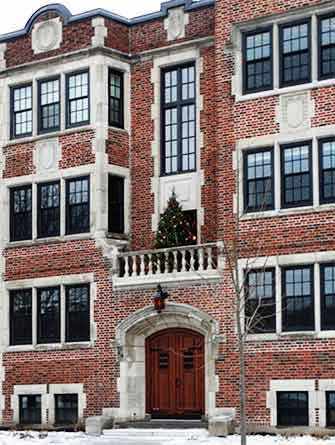
44 Academy Road
In addition, a proposed boulevard entrance to the park would connect from Saint Catherine Street, providing a stately entrance to the park and, as the council described it, enhancing the city’s beauty.
Interestingly, ten years earlier, the park could have extended all the way north to Cote Sainte Antoine, with several residents offering “at no obligation” large tracts of their properties for use as a public park.
Former Mayor Lighthall and the town council stated:
“The town has already incurred sufficient obligations for the purchase of park property… while thanking the several citizens for their offers, they must decline the same…”
– Town of Westmount, Council Minutes, September 17, 1900
At this point, let’s step back into the 1890s and trace the story of the property bordering and containing today’s Academy Road.
Our story continues with a letter from David Yuile offering the town council one of the many parcels of land in his possession:
“Gentlemen, I beg to offer you for sale the following property in the Town of Cote St. Antoine, Parish of Montreal… cadastral lots 283, 284, 374… containing from 1,750,000 to 2,000,000 feet. The price to be 6 cents per superficial foot English measure… payment in cash, bonds or debentures… being 4 percent interest payable half-yearly… at a period not exceeding 40 years. I wish… to be allowed to reserve a strip of land of sufficient width for the purpose of a street railway through any portion of the property.”
– Town of Cote St. Antoine, Council Minutes, June 5, 1898
One week later, the Town made a counter-offer (later accepted) of 4 cents per superficial foot before sending the matter to the Parks Committee.
‘A proposed boulevard entrance to the park would connect from Saint Catherine street, giving a stately entrance to the park, and increase the beautification of the city.’
The town’s park expansion programme, now By-Law 221, continued into the early 1900s with the acquisition of two more large tracts of land between Western Avenue and Saint Catherine Street.
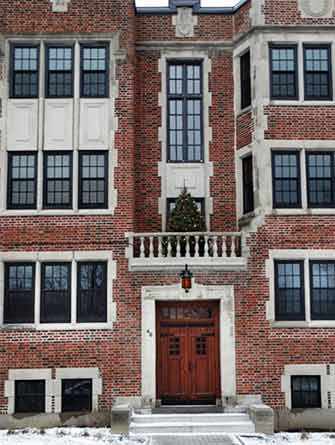
46 Academy Road
‘The Parks Committee recommends that Council authorize the purchase of the following properties: (A) from Dame Margaret Smith et al, a property containing 201,610 superficial feet, between Western Avenue and St. Catherine street… at 50 cents per foot; and (B) the property of the estate of late Wm. Smith, containing 124,896 superficial feet between Western Avenue and St. Catherine street, at a price not to exceed 50 cents per foot… authorized by By-Law 221, and that the Mayor and City Clerk be authorized to sign the deeds of said properties”.
– Town of Westmount, Council Minutes, October 12, 1910)
(In 1916, the town sold the entire property to John Alexander for $24,617).
In addition, the city acquired the following three properties:
“The recommendation of the Parks Committee… Council authorized for the purpose of a public park the following properties (1) The property of Harold C. Hitch… containing 128,659 superficial feet on Western Avenue, Lansdowne Avenue and St. Catherine Street at a price of $55,000… (2) The property of Robertson Brothers containing 5,000 square feet on Lansdowne Avenue below Western Avenue… at a price of 43 cents per foot (3) The property of Dame Isabel Ferguson et al… containing 4,992 superficial feet between Western Avenue and St. Catherine Street… at a cost of 50 cents per foot…”
– Town of Westmount Council Minutes, December 5, 1910
‘… the park could have extended all the way north to Cote Sainte Antoine with several residents offering “at no obligation” large tracts of their properties for use as a public park.’
Unfortunately, one year later, Council voted against their ambitious park expansion scheme and started to unload the parcels of properties acquired over the years.
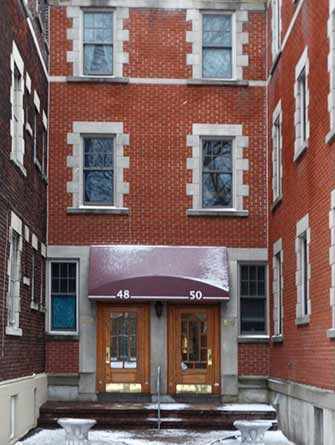
48-50 Academy Road
The Victoria Rifles Armoury Association was offered a lot at the corner of Elgin Avenue and St. Catherine Street.
“… a tract of land, 35,000 square feet at the southwest corner of St. Catherine Street and Elgin Avenue… one dollar per superficial foot said land for the purpose of an armoury.”
– Town of Westmount, Council Minutes, December 16, 1911
Surprisingly, one month later, Council acquired another plot of land further north on Sherbrooke Street, today occupied by an apartment building.
“That the Council authorize the purchase of a block of land in the south-westerly corner of Sherbrooke Street and Lansdowne Avenue… 18,971 superficial square feet… $1.50 per superficial foot…”
– Town of Westmount, Council Minutes, January 16. 1912
Later that same year, several lots of park property (on what is today Park Place and Academy Road) were sold to W.T. Rodden for the construction of apartment buildings.
“Your committee begs to report having arranged the sale of the lots… of the new Park, running from 4919 St. Catherine Street to the proposed road (today Academy Road) and the two lots on the east side of said proposed road… containing 129,000 square feet… price $1.00 per superficial foot. The City to permit the erection of apartment houses…”
– Town of Westmount, Council Minutes, April 15, 1912
‘Academy Road (and Park Place) were constructed in May 1917 and paid, in fourteen annual instalments, by the proprietors of the fronting properties.’
At the time, Academy Road was referred to as “B Street”, with water mains laid in 1913 to service the park’s two outdoor skating rinks.
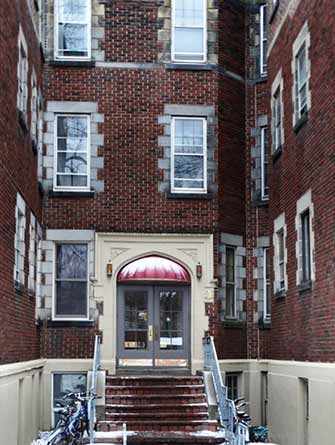
52 Academy Road
That same year, the Protestant School of Greater Montreal opened a Junior High School that straddled Academy Road with a main entrance on Park Place. In the 1940s, the school was named Westmount Intermediate School and housed the Office of the Board of the School Commissioners of the City of Westmount.
Academy Road (and Park Place) were constructed in May 1917 and paid for in fourteen annual instalments by the proprietors of the fronting properties.
Once the roads were constructed, apartment buildings began to appear along Academy Road.
“Your committee recommends that Council authorize… Badgley Construction Company (to erect) a three-story apartment home… (on the) south side of Academy Road (with) bay windows on Park Place (and a) light court enclosed to more than three sides…”
Town of Westmount, Council Minutes, January 13, 1925
During the 1940s, a children’s playground was nearby; as a result, residents complained that their property values were diminished by the “nuisance” of both the playground and the Armoury.
Interestingly, in 1952, a Synagogue was established at Academy Road:
“… permit granted for a period not exceeding three years to Temple Beth Sholom to establish a Synagogue in the basement of the apartment building (at) 52 Academy Road…”
– Town of Westmount, Council Minutes, November 23, 1952
‘Three years later, council reconsidered their earlier conclusion and enacted By-Law 744 that closed Academy Road – describing it as turning it into a play street.’
In the 1960s (until quite recently), the city maintained two baseball diamonds (referred to as #1 and #2) facing Academy Road.
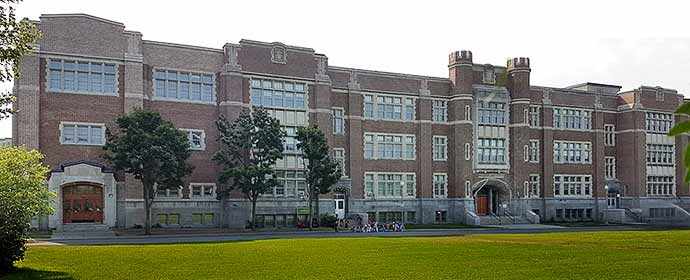
Westmount Park School • Image: Nufwps18 [CC BY-SA 4.0], from Wikimedia Commons
“Despite school safety measures put in place 1963-1964 in conjunction with the Westmount Home and School Association and the Westmount Municipal Association… that the survey by the Police Department (there) hasn’t been an accident involving a school-age child in the past eight years… (it is) not in the best interest of the children to close Academy Road…”
Town of Westmount, Council Minutes, September 3, 1969
Three years later, council reconsidered their earlier conclusion and enacted By-Law 744 that closed Academy Road – describing it as “turning it into a play street”.
“By-law 744 to close that portion of Academy Road from the west side of Melville Avenue to the east side of Park Place was hereby adopted…”
Town of Westmount, Council Minutes, August 18, 1970
Several years later, the city sold (for a nominal sum) the portion of Academy Road from Melville Avenue to Park Place to the Protestant School Board of Greater Montreal.
Following the closure of the portion of De Maisonneuve running through Westmount Park, Council began landscaping “the section of De Maisonneuve between Melville Avenue to Academy Road with a view to integrating this area into Westmount Park”.
Town of Westmount, Council Minutes, September 3, 1985
‘In April 2000 a fire destroyed 50 Academy Road. Fortunately, nobody was injured – damages were estimated at $800,000 for both the building and its contents.’
During that period, residential life was largely uneventful. However, in April 2000, a fire destroyed 50 Academy Road. Fortunately, nobody was injured – the damage to the building and its contents was estimated at $800,000.
This brings us to the end of our journey along the “unassuming” street named Academy Road. Hopefully, during your next walk along this road, you will be able to view it with a new perspective and visualize what Westmount Park could have been.
Finally, in terms of “notable” residents, in the 1940s, one name stands out: Ernie David Lewis, 2nd Baron Chatfield, at 46 Academy Road. He was Aide-de-Camp to the Governor-General of Canada between 1940-1945. His father, Alfred Ernie Montacute Chatfield, 1st Baron Chatfield, had a distinguished career in the Royal Navy and, by 1935, had risen to the highest rank of Admiral of the Fleet.
Images: Michael Walsh (unless indicated otherwise)
 Other articles by Michael Walsh
Other recent articles



 January 6, 2026" />
 through digital innovation" />
 looks back at 2025" />
 online betting rules?" />
 a film by Andrés Livov" />
 for its 16th edition" />
 Passion fruit meringue verrine" />
 playful clownish escapade" />
 World rhythms on stage" />
 management mistakes" />
 Kensington Avenue" />
 Vegan Chili Chocolate Cake" />
 Bethune tunnel" />
 Left out of breath" />
 of business strategy" />
 damage before it starts" />


 into a professional career" />

 plumbing issues at home" />
 embraces bold cinema" />
 Red snapper papillote" />
 the Legend of Pepita" />

I do not live in Westmount (Brossard) but I do a lot of (property inspection) work in Westmount. I much enjoy the history of Westmount and in particular this column. Excellent and bravo!
Is there still a street named “GRAND” in Westmount? I had an aunt on Grand almost on Monkland as it was the first large apartment building on the right side of the street if you were walking walking up from Monkland.