

Westmount places
Kitchener Avenue
The history behind the familiar: Exploring the avenue’s historical roots
By Michael Walsh
Previously published in WestmountMag.ca
Do you recall seeing this recruiting poster? First published in 1914, variations of this poster’s theme are still used today, particularly in the United States.
Don’t talk to me about atrocities in war; all war is an atrocity.
– Lord Kitchener
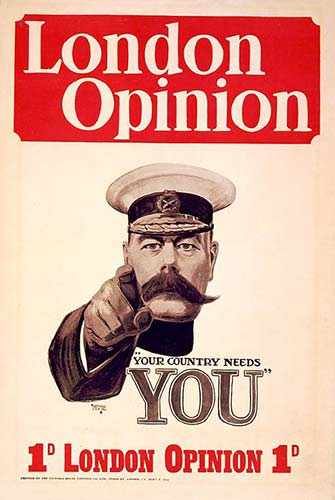
British World War I recruiting poster, 1914 • Image: Wikimedia Commons
The original image featured Field-Marshal Horatio Herbert Kitchener, 1st Earl Kitchener of Khartoum and of Broome. A man of many facets – regarded as a military hero during the Victorian age for victories in Britain’s colonial wars with Sudan and Egypt, and despised by others for the inhumane treatment of captors and the senseless destruction of ancient tombs. His reputation was so powerful that any criticism faced huge repercussions:
“Lord Northcliffe, owner of The Times and Daily Mail, attacked Kitchener over the ‘shells scandal’ of 1915 when he was reproached for allegedly not supplying the army in France with enough military ammunition. The result was that Northcliffe’s papers saw a huge drop in circulation, and The Daily Mail was publicly burnt.”
– More than a Great Poster, K. Surridge, 2001
Kitchener’s demise occurred in 1916 while sailing to Russia; his boat struck a mine near the Orkney Islands.
Many published accounts attribute the street’s origins from land ceded by the Grey Nuns as payment of municipal taxation.
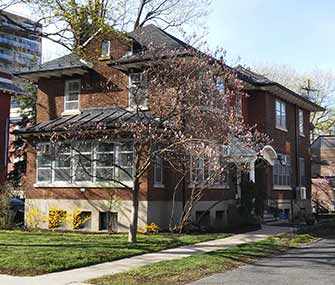
340 Kitchener
That, in short, is a succinct history of Lord Kitchener. His public adulation makes one think of how many serving senior army commanders can we name today?
Let us move on to the street in the City of Westmount that bears his name.
The street was originally named Oxford Avenue and was changed to Kitchener Avenue in 1915 to avoid confusion with Oxford Avenue in Notre-Dame-de-Grâce.
Many published accounts attribute the street’s origins to land ceded by the Grey Nuns as payment of municipal taxation. This is, in part, true; however, it is an oversimplification. The Sisters of Charity of the General Hospital of Montreal (Grey Nuns) did cede 50,710 feet of property to the town in 1901.
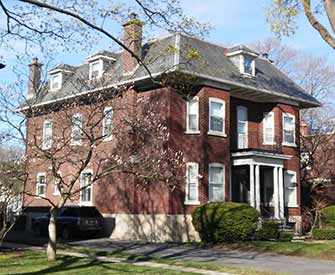
342 Kitchener
Other proprietors also ceded (or sold) portions of their properties: Robert MacKay, Alexander Hutchison, James Jackson and John Coward.
These additional properties allowed the town to extend Kensington Avenue to Saint Catherine Street and open Redfern and Kitchener Avenues.
In 1916, the Grey Nuns also ceded a lane on the northwest side of Western Avenue (today de Maisonneuve) running westward from Kitchener Avenue.
‘The street was originally named Oxford Avenue and changed to Kitchener Avenue in 1915 to avoid confusion with Oxford Avenue in Notre Dame de Grace.’
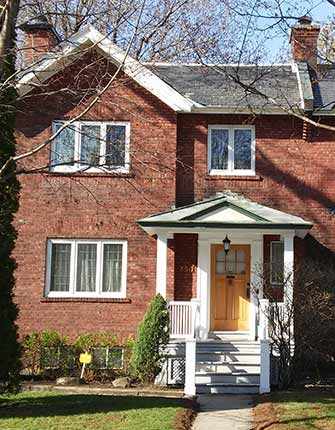
350 Kitchener
That brings us to the end of the street’s origins and the etymology of its name. Interestingly, the word ‘kitchener’ entered the English vocabulary in 1897, as a noun describing a person who, like Lord Kitchener, had an imposing personality.
At this point, we will step back in time and become acquainted with some of the street’s former residents
336 Kitchener (former civic number)
Lt.-Col. William Barton Clark, President, C. O. Clark & Brothers Ltd., bell manufacturers (1949)
340 Kitchener
Leopold M. Fortier, President, Fortier & Company, stockbrokers (1949)
342 Kitchener
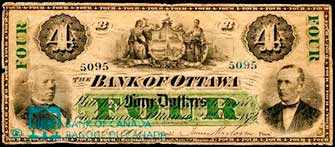
Denis T. O’Brien, Engineer-Superintendent, Montreal Harbour
Construction Engineer, Lachine Canal (1930)
canadiancurrency.com
350 Kitchener
(formerly 352 – the civic number was changed in 1957)
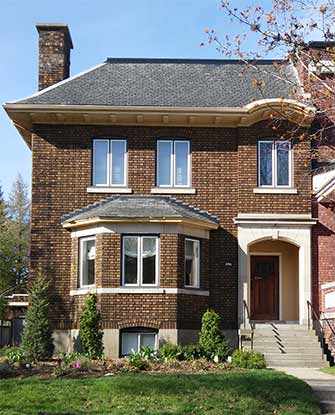
Nevil Norton Evans, Chemistry Professor, McGill University (1948)
Author of Laboratory Manual to Accompany Elementary Chemistry for High Schools
358 Kitchener
358 Kitchener
Francis Cole, Manager, Bank of Ottawa (1922)
Established in 1874, comprising 96 branches, eventually merged in 1919 with the Bank of Nova Scotia.
366 Kitchener
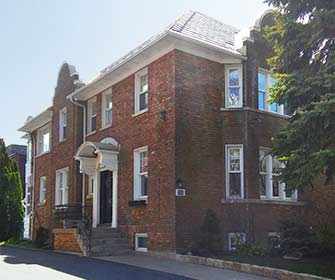
Major-General J. P. E. Bernatchez (1952)
The property was purchased, that same year, by Her Majesty the Queen in the right of Canada. It was used by the Department of National Defence as married quarters. (Government properties are exempt from municipal taxes.)
375 Kitchener
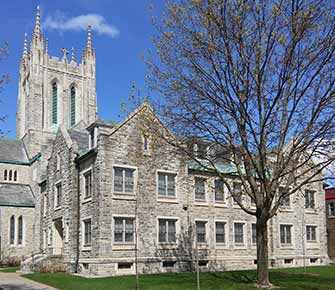
Rectory, Church of the Ascension of Our Lord
Msgr. Wilfrid Emmett McDonagh, pastor (1954)
366 Kitchener
375 Kitchener
Images: © Andrew Burlone

More articles by Michael Walsh
Other recent articles



 February 24, 2026" />
 Emotional Intelligence" />
 Lemon blueberry sauce cake" />
 Kitchener Avenue" />
 where water meets fire" />
 Market process in 2026" />
 and resilient leadership" />
 to rules–based trade" />

 Crunchy Asian Slaw" />
 a new management role" />
 Un mar de músicas" />
 Retail fixturing" />
 and stilts, oh my!" />
 An East Van Memoir" />
 the passion of Argentina" />
 of speaking kindly" />
 Tupper Street" />
 Preserved Lemons" />

 becomes Reality TV" />
 La Jeune Fille et l’Amour" />
 Commercial lease" />
I have walked this street many, many times and not realised the fascinating history of the street. Indeed the houses are imposing-and the inhabitants quite impressive -professors, bank managers, married quarters for the army, and a rectory. I love the research that provides social context-the bank of ottawa note and of course the bellicose poster being appropriated by americans’ and still used.