
Local animator’s short in consideration for the Oscars’ Animated Short Film category
By Irwin Rapoport
November 19, 2026
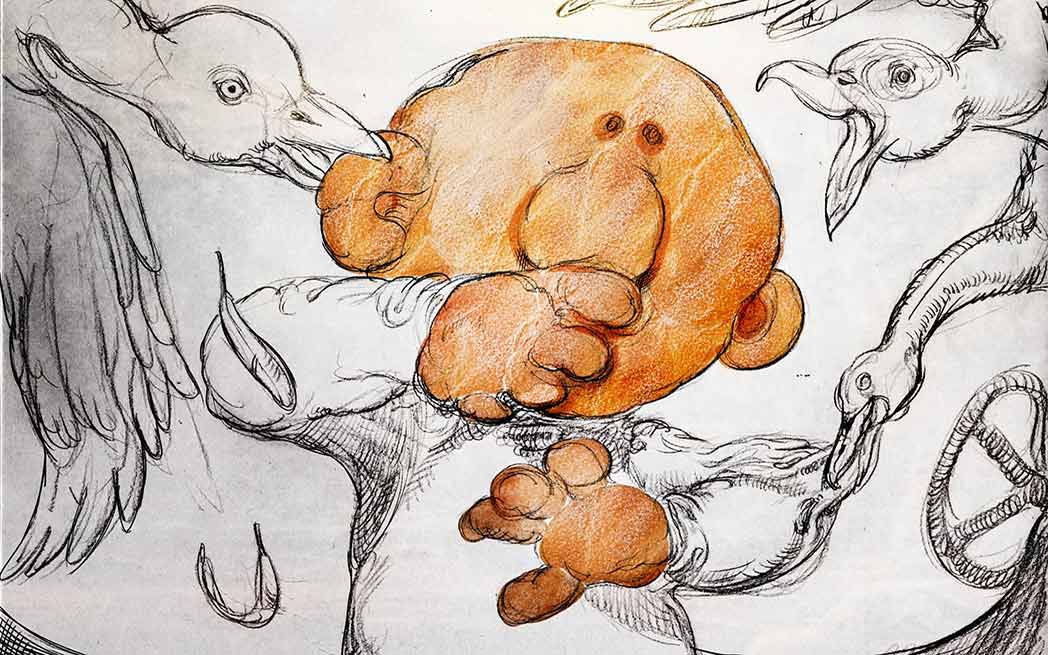
Alex Boya’s latest animated short, Bread Will Walk, is an exceptional, entertaining, heartwarming, and sharply satirical film. Produced by the National Film Board of Canada and voiced by Jay Baruchel in its English version, the 11-minute work is eligible for consideration in the Animated Short Film category at the 99th Academy Awards.
A Montreal-based animator and filmmaker who grew up in Westmount, Boya brings both technical mastery and personal perspective to the project. His third NFB production, Bread Will Walk, grew out of a script he wrote and refined at the Westmount Public Library, and the film carries unmistakable traces of the community that shaped him. It is also the product of extraordinary dedication: Boya spent four years creating more than 4,000 hand-drawn ink-on-paper frames, which he then combined with digital collage to achieve the film’s distinctive, continuously morphing visual style.
His [Boya’s] third NFB production, Bread Will Walk, grew out of a script he wrote and refined at the Westmount Public Library, and the film carries unmistakable traces of the community that shaped him.
Bread Will Walk premiered in the Directors’ Fortnight at the 2025 Cannes Film Festival and was subsequently selected for the Official Competition at the Annecy International Animation Film Festival. The NFB describes it as “a frenetic, surrealist satire of our dehumanizing society, designed as a continuous shot.”
The film cleverly turns the zombie genre on its head. In a world gripped by hunger, a devoted sister flees with her brother, transformed into a benevolent, walking loaf of bread. Pursued by a ravenous mob through streets that twist into mazes, the siblings confront a society in which reason dissolves and appetite rules. At its core, the film asks whether love can defy hunger.
Boya’s surreal, hand-drawn storytelling has earned international recognition. A graduate of Concordia University’s Mel Hoppenheim School of Cinema, he previously directed the NFB shorts Focus (2014) and Turbine (2018), both of which received Special Mentions at the Ottawa International Animation Festival; Turbine also won Best Animation Short at NYC Shorts. With Bread Will Walk, he continues to create worlds where poetry, technology, and absurdity intertwine.
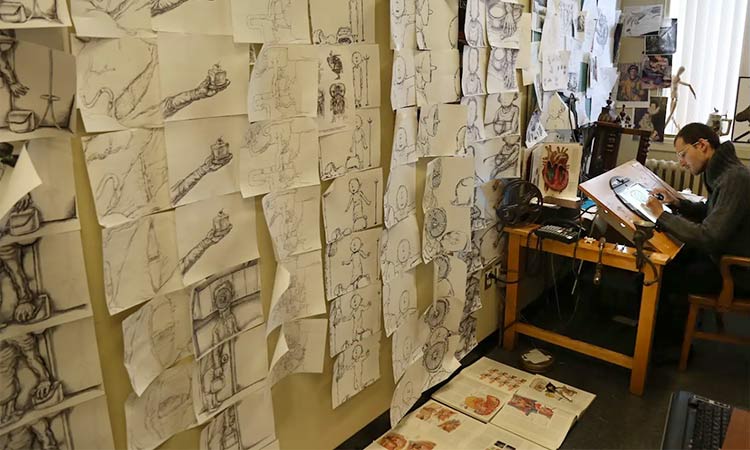
Boya talks about Bread Will Walk and the evolution of his career in the Q&A below.
WM: How did you choose the theme, and how long did the script and preparation take?
Boya: The zombies are the ones being chased. They are not trying to eat anyone. They are made of delicious bread, so the hungry townspeople want to eat them. That puts the supposed monster in a rather helpless position. An older sister tries to protect her little brother, now turned into bread, while the town discovers a use for him. For her, he is still the little brother she knows. I was interested in how much that counts for when everyone around them sees something to eat. Keeping him safe becomes harder precisely because the crowd finds its own behaviour reasonable.
The world came from my graphic novel The Mill, completed in 2018. I brought the project to the NFB in 2019, and production began in May 2021. Over four years, the story developed alongside the drawings and technical experiments. There was more in that world than one short could hold, so I had to choose a story to follow.
WM: How are your childhood in Westmount and the city itself reflected in the movie?
Boya: I grew up in Westmount. I attended Garderie KIDS Westmount, then École Saint-Léon-de-Westmount and the primary school at École internationale de Montréal, which follows the International Baccalaureate (IB) programme. Later, I studied illustration at Dawson College.
I took part in classes and activities at Victoria Hall Community Centre, played with the Westmount Soccer Club and went to the teen centre at the old Westmount Arena. We often met at the Westmount Park gazebo.
My mother, Daniela Zekina, and my father, Peter Boyadjieff, have both exhibited in Westmount and are amongst the co-founders of Art Westmount, giving our family another connection to the city’s artistic life.
I also worked as a page at Westmount Public Library, shelving books. Sometimes I would read a line from one book and another from the next, imagining they were part of the same story. A passage of fiction might suddenly lead into something about nutrition.
I wrote both the graphic novel The Mill and the script for Bread Will Walk at the library. So when people ask where the film began, I can point to a place they may know quite well. The neighbourhoods I grew up in inspired the look of the streets and corners, rather than the story itself.
The film combines thousands of hand-drawn images with photographic textures, including real bread. We explored stop-motion and other techniques, but drawing gave me the freedom to let a street or a body change before the viewer had quite understood it.
WM: Tell us about the animation style and production. How does this film differ from your previous work?
Boya: The film combines thousands of hand-drawn images with photographic textures, including real bread. We explored stop-motion and other techniques, but drawing gave me the freedom to let a street or a body change before the viewer had quite understood it. The bread textures make those impossible bodies feel almost edible. The film also plays out in one continuous shot, so the audience stays in the chase with the characters. The difficulty was keeping the older sister’s effort to protect her little brother clear amid all the changing bodies and streets. However much the surroundings twist, I want us to worry about whether they can stay together.
Transformation is also present in my earlier work. Here, the crowd treats the brother’s new body as permission to behave differently towards him. He has had no say in the matter.
WM: This is your third NFB film. How did you meet Westmount filmmaker Donald McWilliams, and what was your creative process with him?
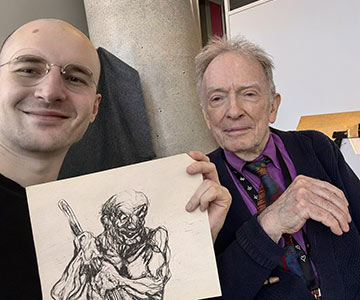
Boya: I met Don during the NFB’s Hothouse animation program in 2014. I particularly like his film The Passerby, so I appreciate being able to discuss my own work with him. We kept in touch, and he later shared archival photographs for a project I made around the NFB’s 80th anniversary.
After seeing Bread Will Walk in April 2025, Don shared some thoughts on rhythm that stayed with me. He suggested that moments such as the tractor in the ditch or the windmill might benefit from a little stillness, perhaps sixteen extra frames. He also described charting shot lengths to understand the rhythm of his own films. He was offering this for my next film, and was careful to acknowledge that we feel movement differently. It made me consider where I might let an image hold a little longer.
I am also grateful for his help during the November 2025 evening at Westmount Public Library with librarian Katherine Kasirer. Afterwards, I thanked him because his warmth had made my parents feel part of the community. I was glad my family could share that evening with him.
WM: Bread Will Walk is now eligible for the 2027 Oscars. How did you react when the NFB chose to produce and distribute your film as a Canadian story?
Boya: By then, I had made Focus and Turbine at the NFB. They knew my work, which made it easier to discuss an idea like this. My producer, Jelena Popović, and the team gave me time to test different techniques and find what suited the story.
I was born in Bulgaria and grew up in Westmount. I think there is room in Canadian filmmaking for that mixture, including the strangeness and dark humour.
Writing at the library, working with the NFB and then seeing the film at Cannes’ Directors’ Fortnight were very different experiences. Through all of that, I kept coming back to the sister and her little brother. Their predicament had to matter to someone watching.
I came to animation through drawing and medical illustration… Medical illustration taught me to look closely at how bodies work. With animation, I could take that knowledge into rather unlikely situations.
WM: What attracted you to animation, and how old were you when you made your first film?
Boya: I came to animation through drawing and medical illustration. After illustration at Dawson, I went on to Concordia’s Mel Hoppenheim School of Cinema. Medical illustration taught me to look closely at how bodies work. With animation, I could take that knowledge into rather unlikely situations.
I began making films as a student. In my early twenties, I made Focus (2014) through Hothouse, my first film with the NFB. It gave me a chance to take that interest in anatomy further. I could change a body to suggest how someone felt, or how other people treated them. I still draw on that background in Bread Will Walk, especially when trying to make an impossible body seem vulnerable.
WM: Which animated films and filmmakers inspire you?
Boya: Peter Foldès’s Hunger, made at the NFB in 1974, is an important reference for me. It uses changing bodies to explore appetite and excess, and it was an early experiment in computer animation. What interests me is how the changing shapes make the man’s appetite visible. Jan Švankmajer is another influence, particularly the way familiar materials can become unsettling. Food has such an immediate physical presence: you recognize it before you begin interpreting it. I like an image that gets a reaction before I have worked out what to make of it. I try to leave some of that room for the people watching my films.
WM: Tell us more about the courses you teach at McGill.
Boya: I teach at McGill’s School of Continuing Studies, in Technology and Innovation. My courses include Exploring the World of STEM. My recent work has explored how tools affect teaching, learning, and creative decisions. We discuss how to judge the answers these tools give us, where they fall short and who takes responsibility for using them. My filmmaking provides practical examples. On Bread Will Walk, we tested several approaches, and the most useful technique was the one that served the story. I bring that same question into teaching: what are you trying to do, and does this tool help you do it? It is easy to spend time learning a tool before asking whether we need it.
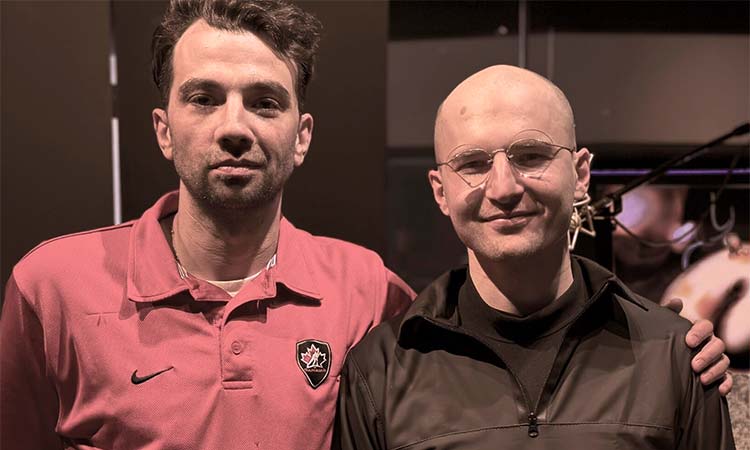
WM: What was it like working with Jay Baruchel, and how did you bring him on board for this Oscar-eligible film?
Boya: Jay grew up nearby in Notre-Dame-de-Grâce. Our first conversation was on the phone. Before Jay joined, I had decided that one actor would voice every character in the English version. He had to give an entire town distinct personalities. What I appreciate in his performance is that you can hear past the grotesque appearance. Each character sounds like someone, however peculiar the drawing may be. There is also something troubling about hearing him as both the pursuer and the pursued. The frightened person and the hungry one do not sound quite so far apart.
To learn more about Bread Will Walk and Alex Boya, check out these two links:
Cartoon Brew — Oscar qualification
NFB — Cannes and Jay Baruchel
Images: courtesy of Alex Boya

More articles by Irwin Rapoport
RECENT ARTICLES

Irwin Rapoport is a freelance journalist and community advocate from Westmount with bachelor’s degrees in History and Political Science from Concordia University. He writes extensively on local politics, education, and environmental issues, and promotes informed public discourse and democracy through his writing and activism.