
Westmounters focus
on choices before them
Former Mayor Peter Trent comments on issues facing the city and its residents
By Irwin Rapoport
October 28, 2025
Election fever is gripping Westmount, and the only cure is to cast a ballot on this Sunday, November 2, at the various polling stations to elect a new mayor and councillors for seven of eight districts. Residents have a choice of three mayoral candidates – Mary Gallery, Lynne Casgrain, and Michael Stern – and 21 candidates seeking to represent Districts 1, 2, 4, 5, 6, 7, and 8.
This election is definitely on the minds of Westmounters, as reported in Wanda Potrykus‘s View from the Voting Booth / 1 and View from the Voting Booth / 2. My article, Westmount municipal elections, November 2, 2025, provides information on who is running and where, and contains a link for the city’s election web page.
This is an important election, and on October 23, more than 400 people attended the Westmount Municipal Association’s mayoral debate at Victoria Hall. The interest was such that more than 1,000 viewed the debate online.
Based on reports I have received, a steady stream of voters cast ballots at the advance poll locations on Sunday. This bodes well for a large, if not record-breaking, turnout on November 2. This is an important election, and on October 23, more than 400 people attended the Westmount Municipal Association‘s mayoral debate at Victoria Hall. The interest was such that more than 1,000 viewed the debate online.
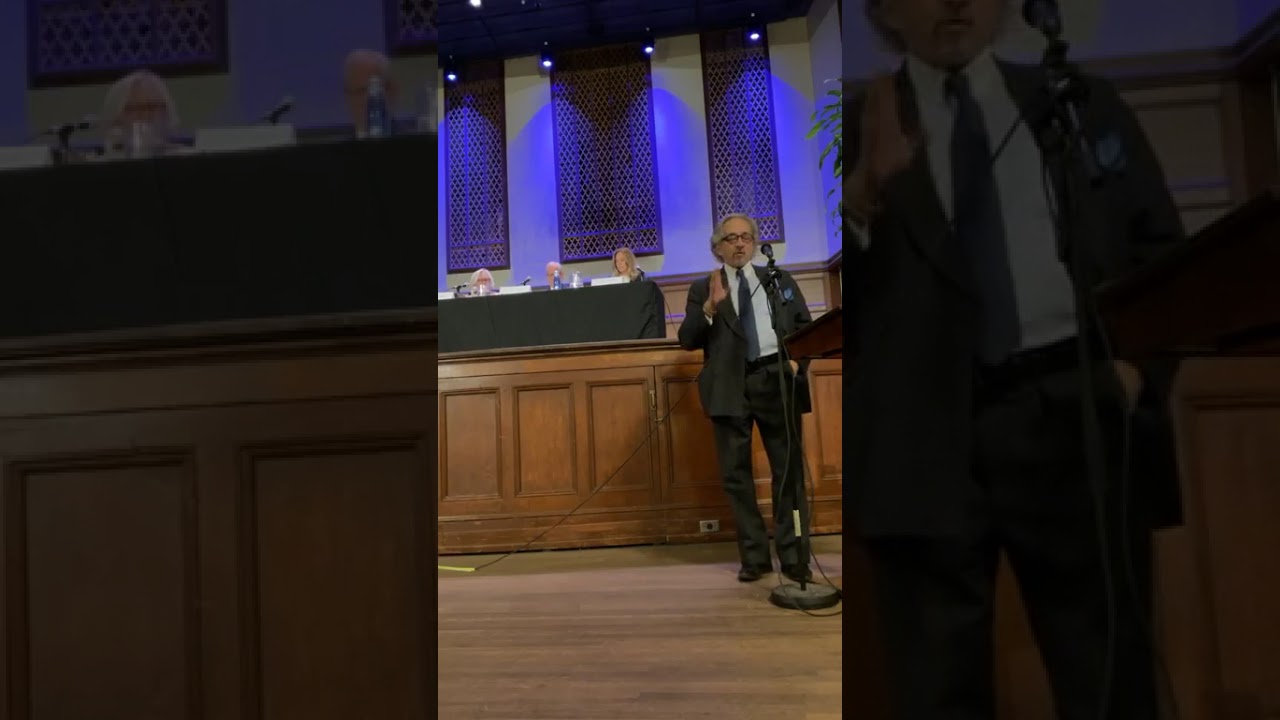
A week earlier, more than 200 people attended the WMA’s council candidates’ debate also at Victoria Hall. A central issue that has shaped much of the discussion has been the Imagine Westmount Southeast Special Planning Programme. This development plan was passed by a narrow 5 to 3 vote in September, just before the election, despite more than 1,000 residents signing a petition to delay the vote until a new council and mayor could be elected.
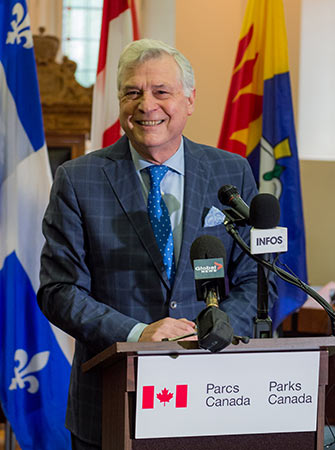
Peter Trent at Parks Canada presentation in City Hall, 2016 • Image: courtesy of Peter Trent
Former Mayor Peter Trent, along with like-minded individuals and many residents, opposes the development plan and explains his reasons in the article “Southeast redevelopment: Heritage vs. density.”
In the Q&A below, Trent, who served as mayor from 1991 to 2001 and from 2009 to 2017, answered several questions about the election. Westmount Magazine hope that his thoughts and points will provide additional perspectives on the elections and the issues and challenges facing the city now and in the future.
WM: In your view, what are the key qualities that define responsible and effective mayoral and Council candidates?
Trent: While experience on Council is normally a very important asset for a would-be mayor, experience as a councillor in a generally poorly-performing Council, such as the last one, is arguably a liability in seeking the mayor’s job. The current mayor and a majority of her councillors have learned to do all the wrong things: how to shut down communication between City Hall and the citizens they are supposed to serve; how to avoid any public consultation on key matters such as garbage collection; how to allow the number of employees to increase by 25 per cent with poorer service levels to show for it; how to see their role as simply supporting the civil service rather than guiding it; and how to allow the City to slide into debt because of the cash diverted to pay for a bloated bureaucracy.
As for councillors, a solid experience in business, academic, or governmental fields is important. A personal code of ethics and a desire to work hard for both one’s district and for the entire City of Westmount are paramount. A sense of humour is also a prerequisite to get you through the sticky situations that always crop up. Council ideally should be made up of a heteroclite collection of ages, styles, backgrounds, philosophies, and disciplines – all united by the same goal: to recreate the spirit of consultation and respect for taxpayers that has been sorely missing of late.
‘While experience on Council is normally a very important asset for a would-be mayor, experience as a councillor in a generally poorly-performing Council, such as the last one, is arguably a liability in seeking the mayor’s job.’
– Former Mayor Peter Trent
WM: What do you consider the top three overall issues that Westmounters should be concerned about, and what are their implications?
Trent: 1. Urban planning using a Westmount template. There must be a scaling-down of the current grandiose urban plan for the southeast using a vision that is Westmount in inspiration, not Griffintown; an interim plan for the area during the 5-10 years before buildings start to go up; and a realistic financial analysis, including upfront infrastructure costs, prior to any development. Simply slapping up a phalanx of high-rises and hoping for the best does not a community make. While consulting developers is of course necessary, developers cannot be calling the shots, either publicly or privately. We must learn from the Square Children’s project and why it suffers from poor planning, particularly a lack of basic facilities needed by families .
2. Listening to citizens, not ignoring them. Emphasis must be on knitting back the threads that once connected Westmount citizens to their City Hall, with consultation before implementation. Regular polling of citizens, for example, ensures that a vocal few do not get to dictate the direction of Council.
3. An end to financial incontinence. A 25 per cent increase in the number of employees (full-time equivalents) from 2017 to 2024, with no service improvement, is completely unacceptable. Going from zero net debt in 2015 to $76 million by the end of 2027 is equally unacceptable. Westmount was once known for tight management and fiscal prudence. We have become almost a City of Montreal in miniature – the very City we took pains to leave.
WM: Based on your knowledge, how would you describe the state of the city’s finances, roads and infrastructure, sports and recreation programs, environment, and other key dossiers?
Trent: The small City of Westmount has acquired or built far more City buildings than is typical for a City our size. Their upkeep is very costly. Talk of an indoor pool without a partner (a college or the YMCA) to shoulder the operating costs is financially irresponsible, given how much more municipal employees make than the rest of the public sector. And indoor tennis courts, as one mayoral candidate is suggesting, are a pure financial folly. The 1995 Library expansion/restoration and the 2013 WRC, compared to which the more recent (and questionable) work on the main greenhouse or the repairing of City Hall are bagatelles. Still, all our main buildings designed for sports, recreation, and culture are in fairly good shape.
Rather than doubling or tripling the investments we make in roads, the outgoing Council has resorted to blaming former Councils. In 2015, I publicly admitted that the WRC had taken up much of our energies, and we had now to address road infrastructure. So we hired engineers to crank up our capacity to plan and supervise roadwork. Why? The approved budgets were always far bigger than what we actually accomplished. But by 2017, we completed $12 million of roadwork in today’s dollars, which the last two Councils have yet to surpass.
‘I think the sheer number of Westmounters who have heeded the call of duty and are out there seeking to be elected is a healthy sign. But I have to say that it is also evidence of an unprecedented widespread dissatisfaction with the leadership of Mayor Smith and the majority of her Council.’
– Former Mayor Peter Trent
WM: This is one of the most contested municipal elections in many years. Why is it important to have a large voter turnout?
Trent: I think the sheer number of Westmounters who have heeded the call of duty and are out there seeking to be elected is a healthy sign. But I have to say that it is also evidence of an unprecedented widespread dissatisfaction with the leadership of Mayor Smith and the majority of her Council.
WM: How should accountability and transparency be ensured in Council decisions once the new mayor and Councillors are elected?
Trent: Accountability is a state of mind, not a line item. You have to poll, consult, test out ideas, challenge the community, be open and honest as to what is feasible and what is not, and, finally, to under-promise and over-deliver. You have to reach out to take the pulse of the citizenry, not make them do all the work to find out via the City website. Citizens have busy lives and should not have to winkle out information. The current habit of forcing citizens and possibly even councillors to file access-to-information requests is shameful. The bunker mentality of most of the current Council must be dumped.
WM: How can the city better engage younger residents and families in civic life and decision-making?
Trent: Keep in mind that young working families don’t have the time to guess where City Hall is going. The much-overused word, transparency, should also mean clarity. Economy, simplicity, and a commonsense approach should drive City communications, while avoiding cant and bureaucratese.
WM: In terms of long-term planning, where do you see the city in ten years — and what are the main priorities to get there?
Trent: Long-term planning should treat ten years as medium-term planning. In 2016, Westmount produced a twenty-year Asset Management Plan that the next Council never updated. Likewise, a Traffic Master Plan was equally ignored. There must be more continuity of vision between successive Councils. And a Director-General’s office with a revolving door only ensures administrative ad hockery.
The pachyderm in the parlour is Hydro Westmount, which has been left to its own threadbare fate for eight years. The original plan was to make it almost a PME, rather than a simple City department. Did the current City Council even take advantage of the fact that, for quite some time, the head of Hydro Quebec was a Westmounter? No. Until we solve the double-headed problem of Hydro Westmount’s diminishing gross margin, caused by a price for bulk electricity that is too high and increasingly decrepit equipment, it is a nettle that must be grasped. That requires intensive planning following the adoption of a clear vision as to what Hydro Westmount should become.
Disclaimer: The opinions expressed in this article are those of its author and do not reflect the views of WestmountMag.ca, its publishers or editors.
Feature image: © Andrew Burlone

Other articles by Irwin Rapoport
Other recent articles
 Irwin Rapoport is a freelance journalist and community advocate from Westmount with bachelor’s degrees in History and Political Science from Concordia University. He writes extensively on local politics, education, and environmental issues, and promotes informed public discourse and local democracy through his writing and activism.



 January 6, 2026" />
 through digital innovation" />
 looks back at 2025" />
 online betting rules?" />
 a film by Andrés Livov" />
 for its 16th edition" />
 Passion fruit meringue verrine" />
 playful clownish escapade" />
 World rhythms on stage" />
 management mistakes" />
 Kensington Avenue" />
 Vegan Chili Chocolate Cake" />
 Bethune tunnel" />
 Left out of breath" />
 of business strategy" />
 damage before it starts" />


 into a professional career" />

 plumbing issues at home" />
 embraces bold cinema" />
 Red snapper papillote" />
 the Legend of Pepita" />