Whalefall plunges into
the world of a stray whale
Infinithéâtre’s innovative play recalls a humpback whale’s visit to Montreal through puppets
By Irwin Rapoport
February 26, 2026
The unexpected arrival of a young humpback whale at Montreal’s Old Port in late May/early June 2020 was just the tonic a city in the midst of the COVID-19 pandemic needed. Sadly, the three-year-old’s body was discovered floating down the St. Lawrence River near Ile Beauregard, about 40 kilometres northeast of the city, just a few days later.
The CTV news report, Montreal’s wayward humpback whale has died, chronicled the first time a humpback had travelled this far into fresh water and how its appearance drew thousands eager to catch a glimpse of it swimming and breaching.
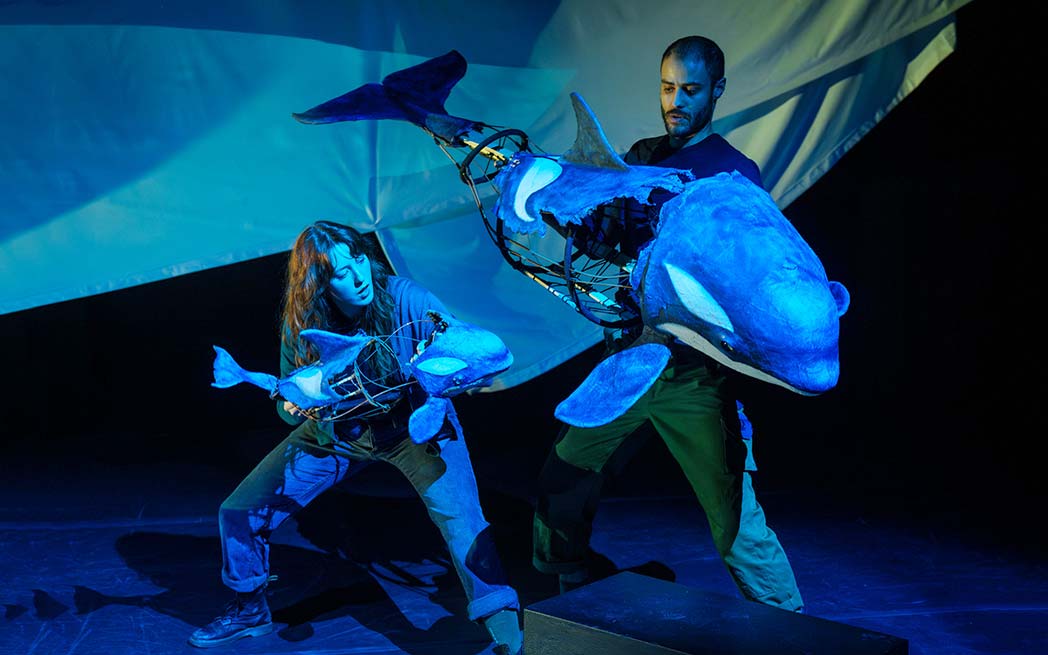
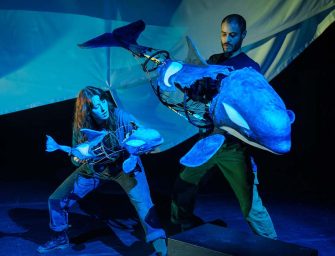
The creature’s arrival and death inspired many to learn more about whales and to take a greater interest in protecting the environment. It had a similar effect on Zach Fraser, Ashe Lang, and Riley Wilson from Infinithéâtre, the co-creators of the unique and innovative concept for Whalefall, an “original piece of documentary theatre born from a profound love of whales and the oceans they inhabit,” being performed at La Chapelle Scènes Contemporaines from February 23 to March 7. The play is also part of the Festival international de Casteliers puppetry festival lineup.
“In May 2020, Montrealers awoke to an unlikely and magical sight,” states the press release for the play. “Between the Clock Tower and the iconic Ferris Wheel, a fluke broke the water, announcing the arrival of a young humpback whale that had strayed over 400 km upriver. Her presence captured the city and the nation at a time of isolation and confusion. Using large-scale puppetry, low-fi projections, and original live music, Whalefall poetically conveys findings from interviews with various scientists and experts who have dedicated their lives to the whales of the St. Lawrence and beyond.”
My mind is often blown when I think about the fact that we have these neighbours that live in the St Lawrence, right beside us, and yet we know so little about them. And we might be interested in space travel and understanding aliens from another planet, but there are these massive, majestic species that are right next door to us, right there.
– Zach Fraser, Director, Co-Creator, Co-Puppet Designer
Whalefall draws from conversations with Robert Michaud, director of the Group for Research and Education on Marine Mammals; Simon Lebrun, the maritime pilot who first spotted the whale in Montreal; and Rebecca Giggs, author of Fathoms: The World in the Whale, among others.
The Whalefall development process, noted Fraser, is “uniquely experimental and collaborative.” The dynamic cast consists of Riley Wilson and Jeremy Lewis, joined on stage by Violette Kay (live music) and Félix Robitaille (live projection design).
Whalefall is presented in English with surtitles in French. The translations by Elaine Normandeau are made possible through the generous support of The Cole Foundation
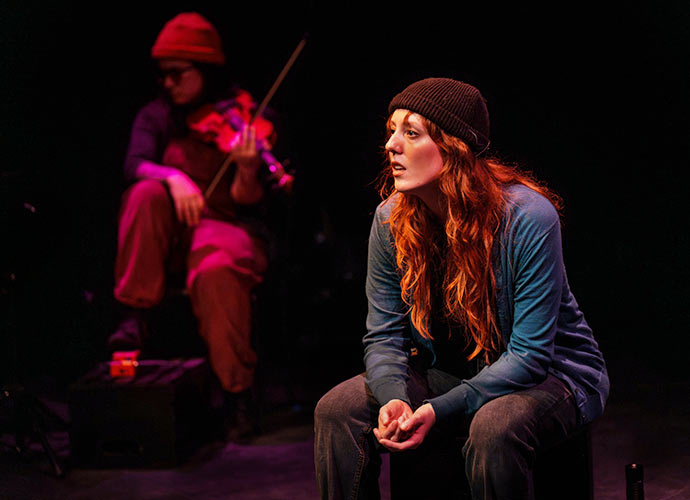
Zach Fraser, Ashe Lang, Set Designer Stavri Papadopoulou, and Sound Designer Violette Kay shared insights on the creative process behind the play:
WM: What inspired you to plunge into this universe and to tell this story?
Lang: The long and the short of it? A lifelong passion for whales. I grew up near the ocean, and every time I’m back by the water, it’s impossible to have a proper conversation with me, because I’m just scanning for a whale. When the humpback came to Montreal in 2020, I spent three days with her and saw a resilient, terrified, yet curious little animal swimming up to seadoos to see people, or up to the clock tower where the crowd gathered. She was extraordinary, but equally so, I was also smitten by the people on the docks and their reactions to her… that’s going to stay with me my whole life. They were truly awed… and I think many people, as a result, left caring about an animal they had known very little about. So our goal is to introduce Montréal to many very special animals with real stories that highlight just how incredible they are.
Fraser: The young humpback whale arrived in Montreal during a period when many of us were isolated and had extra time to think. We watched her and wanted to know what was going on in her mind. This show is our way of trying to better understand these creatures that live beside us.
We’ve enjoyed delving into the vast universe of whales; we’ve spoken with experts and whale enthusiasts and been awed by their complexity, sophistication, culture, and intelligence. We’re also lucky to be exploring this topic in good company, as part of the Festival international de Casteliers and in partnership with La Chapelle Scènes Contemporaines.
WM: What can you tell us about the puppets in this show?
Lang: Very mixed medium! Shadow work, projection, 2D puppets and some very active larger whales. The play isn’t linear in the traditional sense. Imagine woven little love songs to whales, so each section lives in its own world with its own style, yet they’re still woven together within the piece’s universe. There are a lot of visuals that accompany each section, but without spoiling too much, we’re definitely trying to put our audience underwater eye-to-eye with these creatures.
WM: What led you to decide that puppets would be a good fit for this play?
Lang: I think there’s a challenge to capture the grandeur of a whale in theatre, but puppets and shadow work felt to us like the right fit to give people a look into the world of these animals. They’re highly sophisticated beings with extraordinary behaviours that we seldom see above water. Even those lucky enough to see them whale watching usually catch a dorsal fin, a fluke, so we really wanted a medium to capture the scale and beauty of the whale. Thematically, there’s also an importance to us for letting the audience really see a whale eye to eye.
‘The young humpback whale arrived in Montreal during a period when many of us were isolated and had extra time to think. We watched her and wanted to know what was going on in her mind. This show is our way of trying to better understand these creatures that live beside us.’
– Zach Fraser, Director, Co-Creator, Co-Puppet Designer
WM: What can you tell us about the puppets and the creative process?
Fraser: As Puppet Co-Designers, Ashe and I have complementary skill sets. I was primarily responsible for the structural design — how they move — and for their rougher, perhaps more industrial qualities. Ashe was responsible for their final aesthetic and the accuracy of each distinct whale. Very few of us ever get to see whales up close, so we’ve tried to create an artistic way of making that possible.
Apart from being a play about whales, I was also just really keen to delve into an organic, experimental creation process with a team of people I really like as humans and respect as artists. As I get older, I think I’m less concerned with everything landing perfectly and more excited by the creative process itself. This show has several moving pieces, and even as we enter tech week, the creative process continues. Everyone on the team has been really great about that, accepting that it’s okay not to always know where we’re going, as long as we’re always moving toward the same goal: creating a compelling evening of theatre.
WM: What do you hope audiences will take away from this show?
Lang: In a perfect world? Awe. A contemplation of where we as humans fit in the cycle of the world. I think awe inspires care… and I hope people leave the theatre a little more caring.
Fraser: My hope is to invite the audience into a creative space to reflect, gather around ideas, and share a bit of magic.
WM: What were your inspirations in creating your design for this work?
Papadopoulou: I was drawn early on to the vastness and depth of the ocean, the slow, monumental movement of whales, and the negative space they carve through water. For Whalefall, it felt natural to evoke a sense of suspension and submersion through layered fabrics. I wanted to create an atmosphere that plays with light and darkness, that feels both calm and powerful, and at times is experienced as if we are in the same world as the whales.
WM: How do you feel the set design interacts with the other elements in this piece?
Papadopoulou: The set is designed to support all the different elements of the piece. Our suspended fabrics function as structure, projection surface, and sculptural form, allowing the space to transform through light and movement. What appears as a fixed backdrop becomes a responsive landscape, where projections, shadows, puppetry, music, and performance shape the atmosphere together.
‘I see the live music and sounds as sort of a conversation between humans and whales, which the whole piece is really. What would we say if we could understand each other?’
– Violette Kay, Sound Designer
WM: I understand you’re relatively new to Montreal, but this is already your second collaboration with Infinithéâtre. Can you tell us a little about the artistic journey that led you here?
Papadopoulou: My path started with a degree in architecture and interior design, and I eventually trained as a theatre designer at the Bristol Old Vic Theatre School, discovering my love for scenography and creating ephemeral moments within time. Soon after, I began working not only as a set and costume designer for film and theatre, but also as a producer of my own performative spatial installations and as a supporter of other artists in bringing their work to life.
I moved to Montreal from Cyprus two years ago, taking a big personal and artistic leap. With determination and curiosity, I embraced the challenge of exploring a new creative environment and connecting with the artistic community. I hadn’t fully calculated the resilience it would take, but everything happens for a reason, and I am slowly finding my place.
My first interaction with Infinithéâtre was just a few months after moving to Montreal, when I saw their production The Sighlence of Sky. It was one of those serendipitous moments. I was so moved that I reached out to Zach to explore whether their work could travel to Cyprus as part of the Larnaca Biennale, where I was involved as an event coordinator. And we made it happen! That experience marked the beginning of our relationship, which has led to our current collaboration, for which I am very grateful.
WM: What can you tell us about your creative process on this show, and has it differed from others?
Kay: Usually, when I compose music for a show, it is pre-recorded, I do a million takes to get it right, and it sounds exactly the same every time. On this show, playing and looping live is a different experience for sure. Some musical elements are set in stone, there is a thoughtfully crafted structure, but within that structure, there’s a lot of improvisation. The score keeps evolving, and I’m just along for the ride.
WM: What role do you feel sound plays in the world of this piece?
Kay: I find that whales make such unique and interesting sounds. I’ve had a lot of fun trying to replicate them on the violin, which I’m sure at times the rest of the team found annoying as hell, haha. But I thought it was fun. Not all of those sounds made it into the show, but I see the live music and sounds as sort of a conversation between humans and whales, which the whole piece is really. What would we say if we could understand each other?
For more info about Infinithéâtre’s programming:infinitheatre.com
Images: Maxime Côté

Other articles by Irwin Rapoport
Other recent articles

Irwin Rapoport is a freelance journalist and community advocate from Westmount with bachelor’s degrees in History and Political Science from Concordia University. He writes extensively on local politics, education, and environmental issues, and promotes informed public discourse and democracy through his writing and activism.

 February 27, 2026" />
 where water meets fire" />
 Michael Hawkes /99" />
 the world of a stray whale" />
 Selling process in 2026" />
 Emotional Intelligence" />
 Lemon blueberry sauce cake" />
 Kitchener Avenue" />
 Market process in 2026" />
 and resilient leadership" />
 to rules–based trade" />

 Crunchy Asian Slaw" />
 a new management role" />
 Un mar de músicas" />
 Retail fixturing" />
 and stilts, oh my!" />
 An East Van Memoir" />
 the passion of Argentina" />
 of speaking kindly" />
 Tupper Street" />
 Preserved Lemons" />