

Kebaowek Nation celebrates two major court decisions that will impact indigenous and environmental law
By Louise Legault
May 29, 2025
We published earlier in Westmount Magazine an article on the battle the Kebaowek Nation is waging to defend its territory from the construction of a near-surface disposal facility – it will be up to five stories high! – to store radioactive waste near Chalk River, Ontario. Situated a little over a kilometre from the Ottawa River, the NSDF will not only endanger the Kebaowek territory but also the drinking water of anybody living downstream from these installations, both along the Ottawa and the St. Lawrence Rivers.
Although the project was approved in 2024 by the Canadian Nuclear Safety Commission (CNSC), the Kebaowek have not thrown in the towel and have turned to the courts to challenge the ruling.
A landmark victory in indigenous law
The first decision of the Federal Court in the Chalk River case pertains to the duty to consult and obtain prior and informed consent, rights set out in the United Nations Declaration on the Rights of Indigenous Peoples. This is one of the first cases to deal with the application of the Declaration implemented in Canada in 2021. Justice Julie Blackhawk found in favour of the Kebaowek and gave the operator of the future installations, Canadian Nuclear Laboratories (CNL), until September 30, 2026, to hold more “robust” consultations.
Situated a little over a kilometre from the Ottawa River, the NSDF will not only endanger the Kebaowek territory but also the drinking water of anybody living downstream from these installations, both along the Ottawa and the St. Lawrence Rivers.
Major law firms have taken note of this decision. Going forward, it will affect consultations and projects on indigenous land, at a time when the oil industry is salivating at the thought of the pipelines it will be able to stretch in all directions to counter tariff rates in this Trump era. As for the mining industry, it is hard at work locating critical and strategic minerals such as graphite, niobium, zinc, cobalt, nickel, titanium and lithium to “help” in the energy transition.
Closer to us, we can think of the Technoparc wetlands north of the Montréal-Trudeau International Airport that Aéroports de Montréal (ADM) firmly intends to develop to the last drop. There might be some new hurdles along the way…
Second victory
The second Kebaowek victory in Federal Court puts a bit of a damper on the Chalk River project.
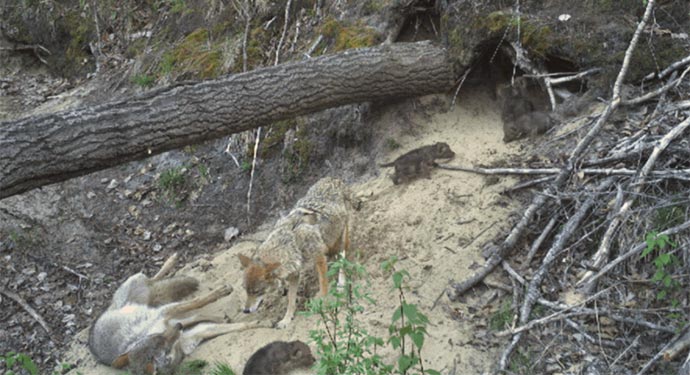
The Kebaowek and their allies argued that the project would endanger threatened species living on the territory. Justice Russel Zinn recognized that the construction of these installations on unceded Kebaowek territory would endanger species such as the Blanding’s turtle, the small brown bat, the Northern myotis, the three-coloured bat, the monarch butterfly, the Canada warbler, the whip-poor-will, the wood thrush and the gold-wing warbler. CNL had not proven that the planned site was the best among several alternatives and that mitigation measures were sufficient to ensure the survival of endangered species.
CNL Reaction
What was the Canadian Nuclear Laboratories reaction? Nothing new: appealing both decisions to buy time.
The nuclear industry is enjoying a heyday in Ontario. It is touted as a clean technology (!) that doesn’t produce greenhouse gases and contributes to the energy transition. Nowhere is the radioactive waste produced by these installations ever mentioned. A bit disingenuous, when one considers that the Chalk River project is meant to store legacy low and medium-level radioactive waste, while the village of Ignace, Ontario, will be the site of a high-level radioactive disposal facility where waste will be buried deep down in the Canadian Shield.
Ontario Power Generation (OPG) is piloting a massive refurbishment project of its four nuclear reactors in Darlington, Ontario. It is positioning itself as a leader in small modular reactors (SMR), the next new thing to hit the planet. At the beginning of May, OPG announced that it would be building four SMRs for $20 billion at its Darlington site. These new facilities will produce even more waste that will need to be disposed of.
Support the Kebaowek Nation
The Kebaowek victories come at a cost. The Kebaowek are on their way to the Federal Appeals Court and will need still more financing. To support the Kebaowek Nation in its opposition to the Chalk River project, please visit their website and donate to the Raven Trust (Respecting Aboriginal Values and Environmental Needs), an organization that supports First Nations in their court battles.
Meegwech!
Feature image: Members of the Kebaowek Nation on the grand staircase of the Federal Court in Ottawa, courtesy of raventrust.com
 Other articles by Louise Legault
Other articles about the environment
Other recent articles
[row cols_nr=”2″][col size=”2″]
 [/col][col size=”10″]Louise Legault is a member of the Les Amis du Parc Meadowbrook steering committee. The group has defended the St. Pierre River and the Meadowbrook golf course from residential development for 30 years in order to create a nature park linked to the Falaise Saint-Jacques and the Sud-Ouest through the Dalle-Parc lesamisdemeadowbrook.org[/col][/row]
[row cols_nr=”2″][col size=”2″]