
Westmount Park trees:
A living natural heritage /4
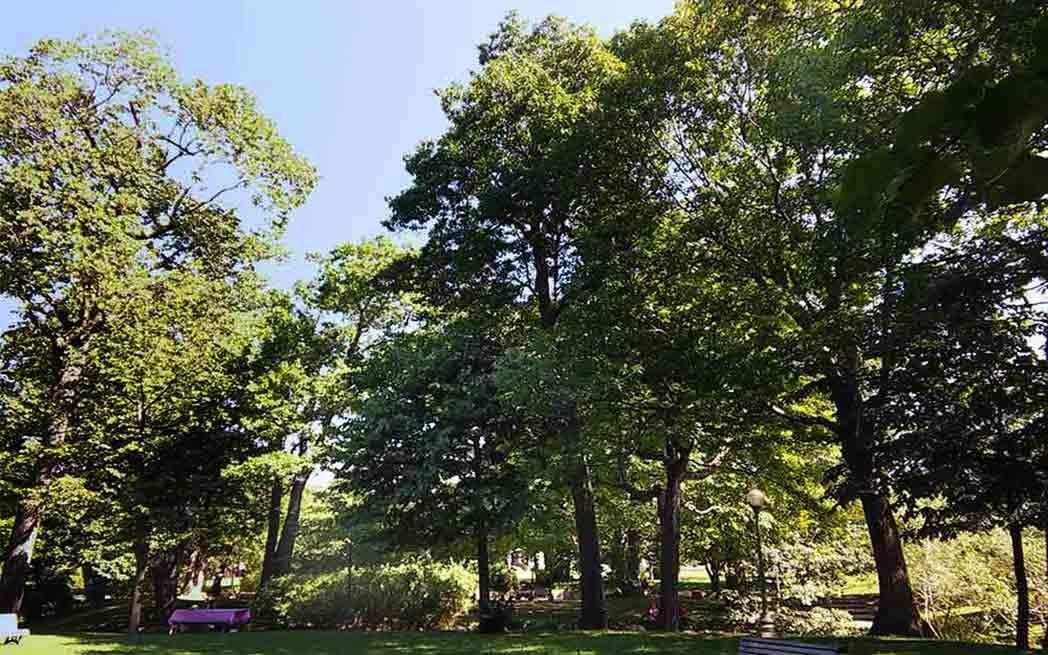
The Oak Tree Grove, next to the lagoon, is a quiet, largely overlooked area in Westmount Park
By Michael Walsh
Previously published in WestmountMag.ca
There is a quiet, largely overlooked area in Westmount Park where one can enjoy a tranquil moment. It’s an area that at one time was bustling with shuffle board players and people sitting on benches playing chess and checkers on oversized boards embedded on the ground.
The lofty oak from a small acorn grows.
Lewis Duncombe 1711-1730
Fading vestiges of these game boards still exist; however, today, it’s a quiet place comprising rambling bushes where a variety of birds make their summer home.
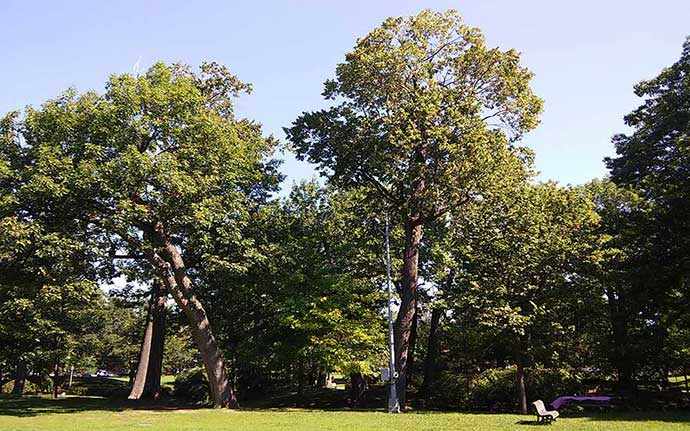
Within that area, next to the lagoon, are five massive Oaks, their huge girth suggesting that they were saplings when the original Glen stream coursed through the park. Looking closely, one can notice their longevity is due in part to a concrete-like substance, applied decades ago, to fill large cracks that developed in their trunks.
Next to the lagoon are five massive Oaks, their huge girth suggesting that they were saplings when the original Glen stream coursed through the park.
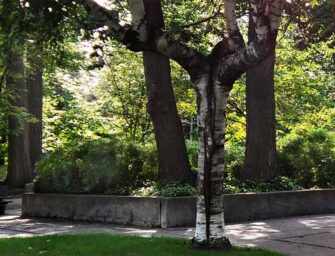
This type of treatment enhances the trees’ structural integrity, preventing damage from storms and pathogens. In addition, one of the trees has developed two trunks, and a metal wire prevents either from breaking during strong winds, heavy snow or ice storms.
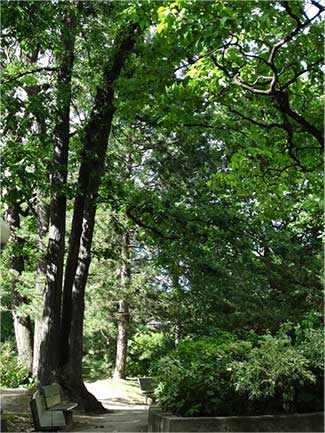 Wandering along the base of these trees, one can notice a variety of different leaf shapes – all Oaks; however, each comprising a different species.
As a child in Ireland, recognizing (and drawing) oak leaves starts very early. I suspect six to seven-year-olds from the Emerald Isle can recognize the tree’s different species more easily than their North American counterparts.
For example, a primary school teacher’s book published by the Meath County Council, in Ireland (Wild Things at School) has a lesson plan for first-class students (in Canada this is grade one) that includes the oak, along with the Primrose, fox, and the Woodlouse. Children were instructed to “draw outlines of the leaves so that they will learn their characteristic shape”.
Children were also taught that the tree’s Irish name is “dair” and is the origin of many Irish place names: “Counties Kildare and Derry are called after the oak, as are all the place names starting with Derry, such as Derrynaflan and Derrynane”.
‘The word oak can be traced to “ac” in Old English, a strongly Germanized language.’
There is an oak in Westmount Park that bears the species’ largest leaves and acorns. It is known as the Bur Oak or by its Latin name, Quercus macrocarpa (large-seed oak). It is also known as the Mossycup Oak for the woolly fringe around the acorns – this has been described as a woolly cap pulled over the seeds.
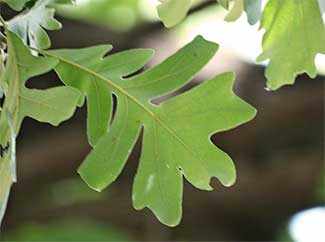 The leaves can grow up to 12 inches long and contain multiple lobes – called “sinuses” – with those in the middle deep and appearing to touch the midrib of the veins – sometimes described as fiddle-shaped. Native to North America, the Bur Oak ranges from New Brunswick to the Central States and then the Northeast, where it grows as a small shrub. The tree’s slow growth contributes to its longevity, which can exceed 300 years. Everything about the tree is massive: its girth, bark (which is fire resistant), branches and acorns that can grow to over 2 inches! In fact, even the tree’s root system is massive and, by weight, exceeds the portion above ground.
Finally, did you know why window blinds have a toggle shaped like an acorn? This was from the (mistaken) belief that lightning never struck oak trees.
Next time you walk through Westmount Park, spend a few minutes in this quiet corner, and appreciate these massive oaks while thinking of the changes they have witnessed.
Images: Michael Walsh

More articles by Michael Walsh
Other recent articles
 July 21, 2026" />
 lakeshore and horizon" />
 and green apple salad" />
 voice communication" />
 A living natural heritage /7" />
 from a home office /2" />
 Buying a country home" />
 Treat your vehicle to a beauty makeover" />
 in the Laurentians" />
 from a home office /1" />
 Lima Bean Hummus" />
 mistakes to avoid" />
 A living natural heritage /6" />
 The buyer’s visit" />
 environmentalism?" />
 the classical mandolin" />
 between matter and light" />
 goes bonkers circus" />
 Caramelized Beet Carpaccio" />
 of emotional labour" />
 A living natural heritage /5" />
 what takes Trump down?" />
 Summer doldrums" />
 30th edition unveilled" />
i have forgotten how evocative these articles are of the park. the information is adroitly presented as always.