
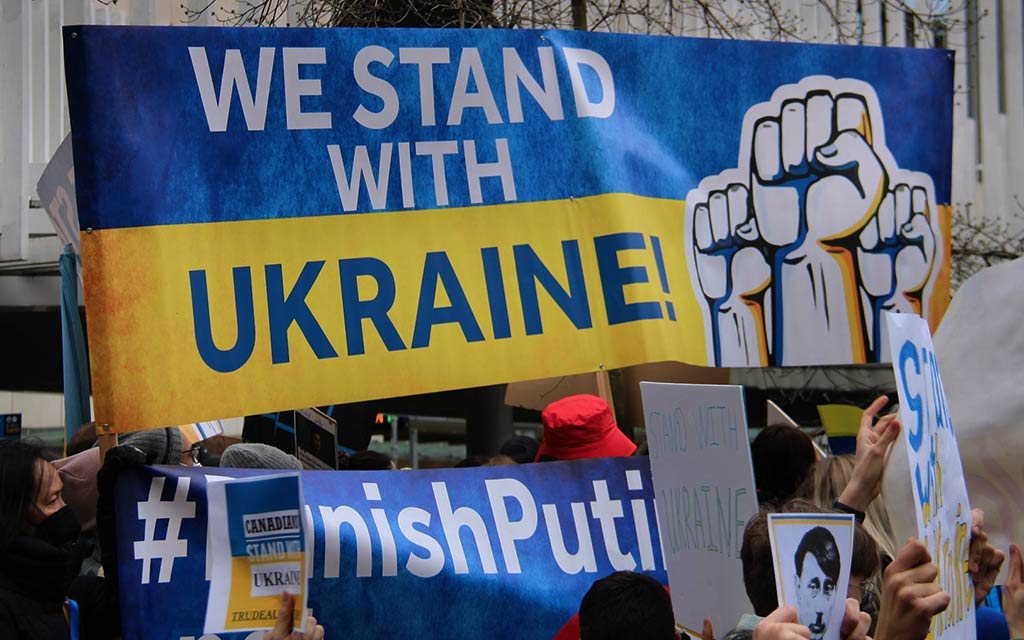
Russia-Ukraine war:
fight for freedom goes on
Can peace be achieved to end the war and satisfy the demands and honour of Ukraine?
By Irwin Rapoport
February 29, 2024
February 24 heralded the second anniversary of Russia’s invasion of Ukraine, a conflict that has resulted in the deaths of more than 31,000 Ukrainian soldiers and 10,582 civilians, with over 120,000 soldiers and over 20,000 civilians wounded. No doubt, the number of soldiers and civilians suffering from psychological wounds is in the hundreds of thousands.
Nor can we forget the more than eight million refugees who have fled the country for neighbouring European nations and far-flung places such as Canada, and a similar number displaced to other parts of the country.
I can only imagine how it feels to be a refugee, but I am sure some of our readers can tell us first-hand, along with the harrowing tales of what caused them to leave and how they escaped. We are witnessing a tragedy not experienced since World War II. Putin has directed his forces to deliberately attack civilians as a means to force Ukraine to surrender.
Unless Putin and his cabal are removed, either via a coup or a general uprising by the people of the Russian Federation, I fear the war will continue unabated. That is a frightful thought and should worry us all as the conflict has repercussions locally and globally, both politically and economically. There are no winners in this war. The Greek god Ares is enjoying himself, along with those enjoying the fighting and benefiting from it financially.
Putin has directed his forces to deliberately attack civilians as a means to force Ukraine to surrender.
I expect the conflict to rage for another two years at a minimum unless the Russians agree to a truce and consent to enter peace talks. The Russians could simply hold the line, stay behind a frontline studded with mines and wait it out, all the while showering Ukraine with missiles, bombing raids, and drone attacks. It would allow them to rebuild their armed forces and replenish their depleted stockpile of weapons with emergency deliveries from North Korea, China, and Iran.
The Russians did not anticipate the fierce and determined Ukrainian resistance and inspiring leadership of Ukrainian president Volodymyr Zelenskyy, nor the tremendous and constant amount of military, financial, and political support from Europe, the United States, Canada, Australia, and other countries.
It has been crucial to the success of Ukraine’s survival and recapture of several occupied territories. More and more sophisticated and modern weapons are being sent to Ukraine, such as F-16 planes, Leopard tanks, and missile systems. Check out the article Ukraine needs more than armoured forces.
The Ukrainian army, navy, and air force have performed skillfully and are to be congratulated for their stalwart efforts that go above the call of duty. They are putting their lives on the line for family, friends and country. The “never give up” attitude of the men and women on the front lines and the countless people pitching in on the home front is exceptional.
They are unwavering and fully committed to staying the course until victory is achieved and the Ukrainian people can live in peace and not worry about being attacked at a moment’s notice. We in Canada can do our part by donating to many worthy charities helping Ukrainians in their country and as refugees. This support is crucial as it bolsters their morale and perseverance.
‘The “never give up” attitude of the men and women on the front lines and the countless people pitching in on the home front is exceptional.’
Should the conflict continue for another two years and an authentic peace be secured, the rebuilding of Ukraine will take a minimum of five or six years. It includes repairing the damage caused by Russian attacks, the removal of millions of mines and unexploded bombs and shells, cleaning up the extensive environmental damage, and the resettling of millions of refugees.
The rebuilding alone entails the residential sector, commercial centers and factories, the road network, port and airport facilities, and communications infrastructure. The economy also needs help to recover to pre-war levels, and Ukraine will require serious military support to ensure it has the modern weaponry necessary to repel a future Russian invasion. It is no small task, but I am confident the Ukrainian people are up to the challenge.
The question is whether the world will commit to such a programme. After World War II, the Americans via the Marshall Plan, rebuilt Europe and via the occupation of Japan between 1945-1952, the defeated nation’s economy was reconstructed and democracy restored.
We in the developed world know what to do and cannot let the people of Ukraine down. During WW II, the Lend-Lease agreement, provided military, financial, and civilian support, such as food and medical supplies, to the British people. It ended two years after the war stopped.
But let’s not get ahead of ourselves. The war is still raging, and the Ukrainian people are resisting. Men and women are being drafted into the armed forces, and soldiers, sailors, and air force personnel are fighting daily.
Unless severely wounded and discharged, they are in it for the long haul. It takes a toll on the fighting forces and the civilians – young, middle-aged, and seniors – who never know when death might visit them. Putin declared Ukraine is not and never has been a nation, be it as a country or a people, who have a rich and distinct culture and history.
‘We must consider the stress Ukrainians continually experience and how our support, large or small, has a definite impact.’
It requires courage and fortitude to face “shot and shell” daily. Most soldiers who fought in the trenches of World War I had it. Some of our readers fought in WW II, the Korean War, and other conflicts or served as peacekeepers. Mind and body can only take so much until each individual reaches a breaking point. We must consider the stress Ukrainians continually experience and how our support, large or small, has a definite impact.
We can adopt families, help them financially or with moral support, and befriend individual Ukrainians, letting them know we care about them with letters, emails, gifts, donations, etc. We may not be able to fight or help on the home front, but we can brighten their days by giving them hope and letting them know they’re not alone.
The Ukrainian people are doing their part to stop Russian aggression and prevent its spread to other countries. We can step up to the plate in easy and simple ways, our actions brightening dark days and providing opportunities to smile and laugh.
I distinctly recall the experience of soldiers and civilians trapped in tunnels and bunkers in the battle for Mariupol, who endured daily bombardments and only escaped with their lives when a truce permitted their evacuation.
I also vividly recall the troops from one Ukrainian unit who were isolated early in the war and refused to surrender. They were willing to put their lives on the line to make the ultimate sacrifice to defend their country and inspire others to be just as courageous and heroic. Fortunately, a deal was struck whereby they were safely removed and sent back to Ukraine.
How this war ends is a question asked by pundits aplenty and hundreds of millions of people. It could stop with Russia agreeing to a truce and not entering formal peace talks that would reflect the situation in the Korean peninsula. We have a truce, and both sides are armed to the teeth, with troops posted along either side of the border.
Russia could also unilaterally declare that the war is over and that it will retain the parts of Ukraine it captured. It would place Ukraine and its allies in a difficult position. The war would be technically over, but Russia annexes territory and forces Ukrainian citizens to become Russian citizens.
‘It will be difficult to have the Russian government willingly admit to having started the war, let alone pay compensation, even a small amount.’
Should Russia enter formal peace negotiations, I imagine the Ukrainian position would be for the return of captured lands, the return of the children the Russian government has abducted and placed with Russian families, massive reparation payments to cover the damages caused by the war and the cost of rebuilding, environmental clean-up, removal of mines and unexploded weapons, compensation for families that lost loved ones and for the wounded, compensation for economic losses, and a multitude of other impacts.
It will be difficult to have the Russian government willingly admit to having started the war, let alone pay compensation, even a small amount. And in any event, successfully concluding a peace deal could take a very long time. Nor can we expect Putin’s regime to admit to committing war crimes and crimes against humanity.
Of course, we want the war to end, but peace at any price may not be worth it. The last thing I want to do is tell the Ukrainian people and government what to do. They have to live with being next-door neighbours to Russia.
Whatever decisions the people of Ukraine agree to, they will have the support of those among us who, unlike others, still stand behind them. They are on the front lines and experiencing Russian aggression and terror tactics every day. I know that they can prevail and that they love their country.
Thus, on behalf of many who are solid with the people of Ukraine, I say: Slava Ukraini!
Feature image: Sima Ghaffarzadeh
Other articles by Irwin Rapoport
Other recent articles
 Irwin Rapoport is a freelance journalist with Bachelor’s degrees in History and Political Science from Concordia University.

 January 9, 2026" />
 through digital innovation" />
 looks back at 2025" />
 online betting rules?" />
 a film by Andrés Livov" />
 for its 16th edition" />
 Passion fruit meringue verrine" />
 playful clownish escapade" />
 World rhythms on stage" />
 management mistakes" />
 Kensington Avenue" />
 Vegan Chili Chocolate Cake" />
 Bethune tunnel" />
 Left out of breath" />
 of business strategy" />
 damage before it starts" />


 into a professional career" />

 plumbing issues at home" />
 embraces bold cinema" />
 Red snapper papillote" />
 the Legend of Pepita" />
The quick answer is NO – until Putin is GONE by any means necessary ❗️
It is hard to know where to begin in response to this article! Russia did not start the war in 2022. It began in 2014 with the U.S. backed coup which overthrew the democratically elected Ukrainian government. When Crimea and the eastern Donbas chose independence through referendum Kiev, with the help of the Nazi Azov Battalion, shelled the ethnic Russian Donbas for eight years, killing over 15,000 people – mostly civilians.
Make no mistake. This is a U.S. proxy war. President Biden could stop it today! NATO broke its promise not to move one inch closer to the Russian border, the Minsk Accords were sabotaged and the signed Istanbul peace agreement was broken with the help of Boris Johnson! In the meantime innocent people are dying on both sides. More military hardware will only kill more people and will not change the outcome. The U.S. Military Industrial Complex is laughing all the way to the bank and U.S. boot are not on the ground and coming home in body bags – all in all a pretty good deal for the U.S. in its attempt to weaken Russian.
In closing I would like to draw attention to your shout out “Slava Ukraini”. Perhaps you are unaware that this is a well known Nazi Banderite slogan.
Seems like you are just quoting russian propaganda. Moreover, “Slava Ukraini” is translated as glory to Ukraine, why Ukrainians should be ashamed for those words?
The Ukrainian coup in 2014, known as the Revolution of Dignity or Euromaidan, was triggered by a series of events including President Yanukovych’s rejection of an agreement with the European Union, under pressure from Putin for closer ties with Russia.
This decision led to widespread protests against government corruption, abuse of power, and human rights violations. The protests escalated into violent clashes between protesters and state forces, culminating in Yanukovych fleeing the country for Russia and being removed from office by parliament. The U.S. and European Union had urged Yanukovych to negotiate a peaceful resolution with protesters.
The coup was described by Moscow as an anti-constitutional armed overthrow orchestrated by the United States and supported by European allies, leading to significant political turmoil and ultimately the illegal Russian annexation of Crimea and pro-Russian unrest in Eastern Ukraine, started by separatists covertly supported by the Russians, leading to armed conflict in the region and heightened tensions between the two countries.
The coup marked a turning point in the relationship, pushing Ukraine towards closer ties with the West while deepening the divide with Russia. The conflict between Ukraine and Russia has had a profound impact on the people of Ukraine, leading to extensive human rights violations, a humanitarian crisis, and significant displacement.
The Russian invasion triggered indiscriminate attacks resulting in thousands of civilian casualties, including torture, sexual violence, and unlawful killings. Attacks on civilian infrastructure violated rights to housing, health, and education, exacerbating existing inequalities for women and increasing gender-based violence. The war also forced almost 8 million Ukrainians to flee the country, creating the largest refugee population in Europe since World War II.
Additionally, nearly 7 million people were internally displaced within Ukraine due to the conflict. The environmental degradation caused by the war, including the destruction of habitats and pollution of air, water, and soil with toxic substances, further added to the challenges faced by the Ukrainian population.
The phrase “Slava Ukraini” (Glory to Ukraine) has historical roots dating back to the 19th century and has been used as a patriotic rallying cry among Ukrainians for generations. While some critics associate it with far-right movements like the Organization of Ukrainian Nationalists (OUN) and its leader Stepan Bandera, who collaborated with Nazi Germany during World War II, the slogan itself is deeply tied to Ukrainian identity and aspirations for independence.
Despite attempts to depict it negatively, “Slava Ukraini” remains a widely recognized expression of Ukrainian patriotism and resilience.