

Single motherhood
and resilient leadership
What raising children on my own taught me about power and responsibility
By Mona Andrei
february 18, 2026
There was a night early in my single motherhood journey when I sat on the living room floor long after my children had fallen asleep, staring at a bill I wasn’t sure how I was going to pay. The house was quiet — the kind of quiet that amplifies your concerns. There was no one to consult. No second opinion to seek. No one to share the weight of the decision I had to make.
At the time, I didn’t think of that moment as leadership. I thought of it as survival.
It would take years before I recognized what was happening in those small, unglamorous moments. Leadership does not always announce itself with authority or confidence. Sometimes it looks like steady breathing when you feel anything but steady. It looks like making decisions with incomplete information and moving forward anyway. It looks like absorbing uncertainty so that others feel secure.
We tend to reserve the word leader for boardrooms, elected officials, founders, and executives. We imagine it accompanied by titles, formal authority, or public recognition. But there exists another form of leadership — quieter, less visible, and often unnamed — that unfolds in kitchens, at school pick-ups, and in late-night budgeting sessions.
Leadership does not always announce itself with authority or confidence.
Single motherhood is an unexpected training ground for this kind of leadership.
When you’re the sole decision-maker in a household, hesitation carries consequences. There is no luxury of deferring difficult calls. You learn to assess risk quickly. You prioritize with precision. You develop a tolerance for uncertainty because you have no other choice. Over time, you begin to trust your judgment — not because it’s flawless, but because there’s no alternative.
What struck me later in life was not simply that these were survival skills. They were leadership skills — just without the applause.
If single motherhood taught me anything, it’s that leadership is less about control and more about responsibility.
Responsibility without an audience.
Responsibility without a safety net.
Responsibility without the luxury of escape.
When you’re the only adult in the room, you quickly learn that your emotional state is not entirely your own. Children borrow your nervous system. If you panic, they feel it. If you steady yourself, they steady too. Emotional regulation becomes less of a wellness concept and more of an operational necessity.
You learn to pause before reacting. To respond instead of erupting. To carry worry privately so the household remains stable. This, too, is leadership — though it rarely receives that label.
You also become intimately acquainted with resource management — not just financial, but emotional and physical. Energy must be allocated wisely. Time becomes strategic. Boundaries shift from preference to protection.
Burnout is not an inconvenience; it is a threat to the entire structure you’re holding up.
In boardrooms, we call this sustainability. At home, we call it getting through the week.
‘When you’re the sole decision-maker in a household, hesitation carries consequences. There is no luxury of deferring difficult calls.’
There is something clarifying about making decisions alone. Consensus is a beautiful thing, but it’s not always available. When there’s no one to defer to, you sharpen your instincts. You gather information quickly, assess impact, and commit. Doubt may sit beside you, but paralysis cannot.
Over time, that decisiveness becomes muscle memory.
Perhaps the most overlooked aspect of this kind of leadership is accountability. When something goes wrong, there is no delegation of blame. The outcome rests with you. And while that weight can feel heavy, it also builds an internal compass. You become less concerned with optics and more concerned with consequence. You focus on what works, not what appears impressive.
It took me years to understand that what I had been practicing was not simply coping — it was leadership in its most refined form.
Yet culturally, we rarely frame it this way.
We romanticize visible leadership and overlook invisible labour. We celebrate authority but minimize responsibility. We recognize titles but fail to acknowledge the countless individuals leading quietly in their homes and communities every day.
Single mothers are not the only ones who occupy this invisible leadership space. Caregivers of all kinds, adult children supporting aging parents, community volunteers holding things together behind the scenes — many operate without formal recognition. They are decisive without applause. Strategic without a podium. Steady without a spotlight.
What makes this form of leadership powerful is precisely its anonymity. It is driven not by status, but by necessity. Not by ambition, but by commitment.
There is something deeply instructive about that.
In a culture that often equates leadership with visibility, perhaps we need to broaden our understanding. Leadership is not always loud. It is not always charismatic. It is not always accompanied by confidence.
‘We romanticize visible leadership and overlook invisible labour. We celebrate authority but minimize responsibility. We recognize titles but fail to acknowledge the countless individuals leading quietly in their homes and communities every day.’
Sometimes leadership is sitting on the living room floor late at night, calculating, recalibrating, and choosing courage in the absence of certainty.
Sometimes it’s holding the emotional climate of a household steady.
Sometimes it’s setting boundaries that protect long-term stability.
Sometimes it’s showing up, day after day, without anyone formally acknowledging that what you’re doing requires extraordinary strength.
I don’t romanticize single motherhood. It’s hard. It’s exhausting. It’s often isolating. But it’s also clarifying. It strips leadership down to its essentials: responsibility, steadiness, accountability, and forward motion.
We may not always define it this way.
But perhaps we should.
Because when we expand our definition of leadership to include the quiet, unseen work that sustains families and communities, we begin to recognize power in places we previously overlooked.
And in doing so, we may discover that many of the strongest leaders among us have never once called themselves that.
Superwoman
A Funny and Reflective Look at Single Motherhood
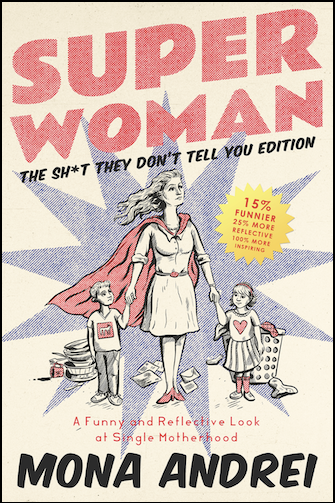 The Sh*t They Don’t Tell You Edition
By Mona Andrei
‘In this newly expanded edition, Mona Andrei dives deeper into the messy, maddening, but magical world of motherhood done solo.’
When they placed the tiny, red-faced bundle in her arms, time stood still. Gazing into that puckered little face, she whispered, Welcome to the world, baby girl.
Within weeks, she’d become a single mother. Not exactly what she’d planned.
In this newly expanded edition of Superwoman, award-winning humour blogger Mona Andrei dives deeper into the messy, maddening, but magical world of motherhood done solo — whether you’re a single mom in fact or in essence. With her signature blend of wit and warmth, she reflects on the triumphs and facepalm moments that come with raising kids alone.
To be released March 3, 2026, by Cynren Press
Feature image: Matilda Wormwood – Pexels

More articles by Mona Andrei
Other recent articles

Mona Andrei is a Montreal-based writer and author of Superwoman: A Funny and Reflective Look at Single Motherhood. An award-winning humour blogger, she writes about resilience, leadership, and the unseen work that shapes strong women.



 February 24, 2026" />
 Emotional Intelligence" />
 Lemon blueberry sauce cake" />
 Kitchener Avenue" />
 where water meets fire" />
 Market process in 2026" />
 and resilient leadership" />
 to rules–based trade" />

 Crunchy Asian Slaw" />
 a new management role" />
 Un mar de músicas" />
 Retail fixturing" />
 and stilts, oh my!" />
 An East Van Memoir" />
 the passion of Argentina" />
 of speaking kindly" />
 Tupper Street" />
 Preserved Lemons" />

 becomes Reality TV" />
 La Jeune Fille et l’Amour" />
 Commercial lease" />
Mona, You do such a great job sharing the challenges of single motherhood. It must be a great feeling of satisfaction years later to know you did it, and did it well. Be proud.
This landed so powerfully for me:
If single motherhood taught me anything, it’s that leadership is less about control and more about responsibility.
Responsibility without an audience.
Responsibility without a safety net.
Responsibility without the luxury of escape.
Thanks for sharing.