
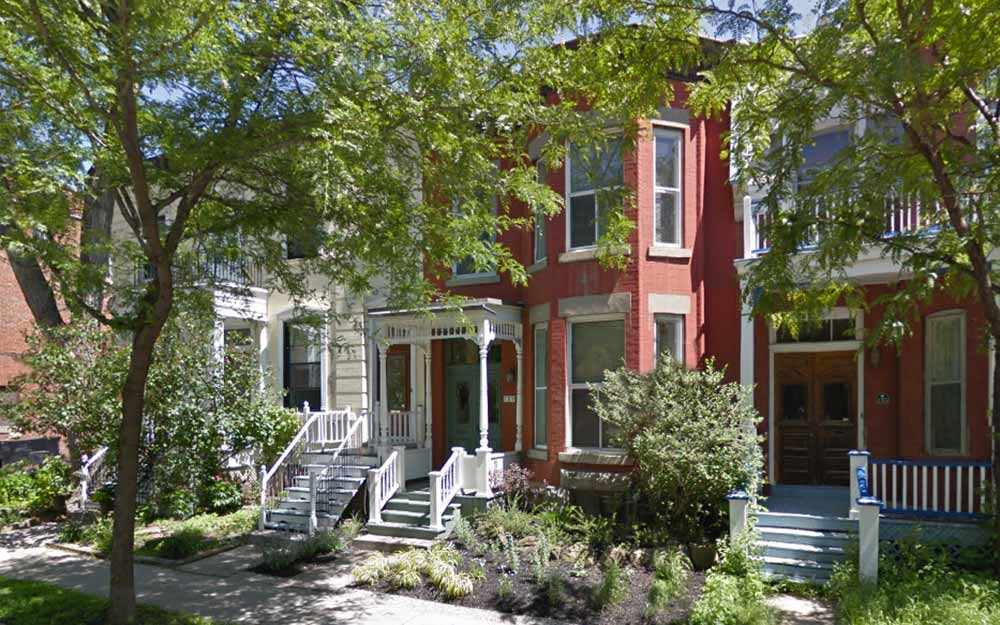
A remarkable city for walking and discovering Westmount’s best-kept secrets
By Michael Walsh
Previously published in WestmountMag.ca
Westmount is quite a remarkable city for walking and discovering areas, houses, hidden parks and massive boulders – each of which has a story. Much of what we see today lining the city’s streets and lanes hasn’t changed in centuries – it’s a comforting feeling walking in the same steps of those before us and being able to perceive their legacy. What follows is a continuation of our many walks over a two-year period, and many of the stories we have discovered.
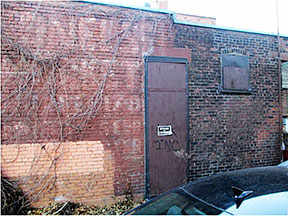
39 Somerville
Boarded-up door and windows, covered with bricks, on the side of the former 1920s Falle’s grocery market.
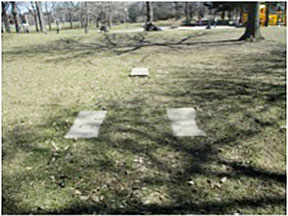
Westmount Park – Cannon Footprints
Footprints of one of two large artillery pieces – manufactured by I. H. King in England, in 1801, and believed to be used in the War of 1812- 14. They were placed in the park in 1899 by the Westmount Lodge Sons of England. Children used to love playing on these!
 Former Reddy Memorial Hospital – Tupper Avenue
Sign on a loading dock door, attesting to the former staff’s deep attachment to the hospital before its closure. The hospital was one of nine area hospitals, closed in 1997, by the Quebec government as a cost-cutting measure. The building now houses the YMCA and the Batshaw Youth & Family Centres.
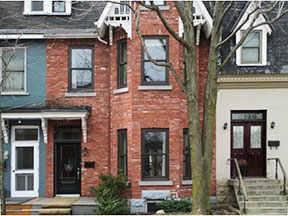
110 Abbott
George M. Webster residence (1897) – Webster Brothers & Parkes – manufacturers of wood mantels, mosaic floors and fireplace goods. Their offices were located at 694 Craig Street.
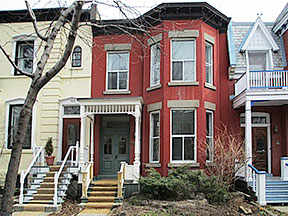
139 Abbott
H. S. Dunning residence (1897) – manager of the Windsor Hotel.
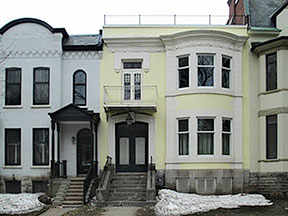
332 Wood
Henry Herdt residence (1920) – Supervisor of the Dominion Glass Company.
From Industry ’67 Centennial Perspective, published by The Canadian Manufacturers’ Association in May 1967: “In 1890 they changed the name of their company to Diamond Glass Co. (Ltd.), absorbed four glass companies located as far apart as Nova Scotia and Hamilton, Ont., and continued a vigorous program of expansion. The name changed again in 1903, this time to Diamond Flint Glass Company; other companies were absorbed, and in 1906 a subsidiary, The Canadian Glass Company, opened in Montreal and was fully equipped with automatic bottle-making machines. Still another factory was established in 1913 in Redcliff, Alberta, to take advantage of the plentiful supply of natural gas.”
Much of what we see today lining the city’s streets and lanes hasn’t changed in centuries – it’s a comforting feeling walking the same steps of those before us and being able to perceive their legacy.
“From the viewpoint of the historian, Dominion Glass Company Limited is one of the few active Canadian manufacturing establishments which may authoritatively claim to have provided a major contribution to the Canadian decorative arts. Indeed, any and all glass objects, including containers, which were produced in the preceding and extant glass factories during the period 1855-1925 have some claim to artistic beauty, rarity and/or social significance. The free-blown, non-commercial glass paperweights, whimsical bird forms, and “drapes,” produced to exhibit an individual command of the medium, depict in three-dimensional form the ethnic and regional origins of specific glass blowers. The commercial containers (i.e., bottles and preserving jars) changed the Canadian housewife’s concept of preserving foods and are presently acquired by discriminating collectors and exhibited in the Royal Ontario Museum.”
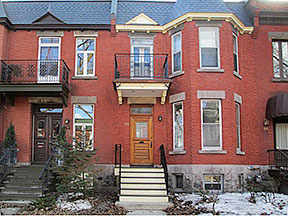
66 Bruce
Philip Thos. Le Maistre, sea captain (1897).
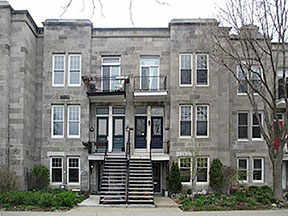
261 Melville
Eben Dowie – construction engineer.
Eben Dowie & James Oxley were the first to patent the use of chilli powder in 1899 as an extermination ingredient. This substance is still used to this day.
From the USPO, Aug 22, 1899, Publication number US631738 A: “Be it known that we, EBEN DOWIE, consulting engineer, and JAMES MACDONALD OXLEY, insurance manager, of the city of Montreal, in the county of Hochelaga, in the Province of Quebec, Canada, have invented a certain new and useful Composition of Matter to be Used for Evicting Rats and other Vermin, of which the following is a specification.
Our composition consists of the following ingredients, combined in the proportions stated, viz: Chilli pepper, twenty percent; hellebore, five percent; sulphate of lime, eight percent; phosphate of lime, eight percent; carbonate of lime, fifty-four percent; oxide of iron, five percent. This mixture is thoroughly mingled and makes a fine powder.”
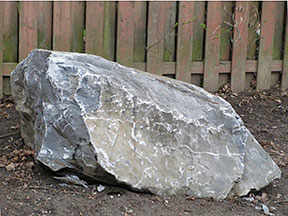 Westmount Park – Boulders
A boulder behind the clay tennis courts in Westmount Park. One wonders about its origin. More are located nearby beside the greenhouses as well as in the park’s lagoon. The park originally had ravines that were used as landfill by the City of Montreal. Most notably, during the construction period for the downtown Ogilvy department store.
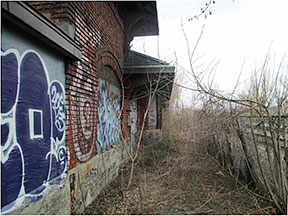
Former Westmount Train Station
Facing the C.P.R. tracks at the back of the closed Westmount train station.
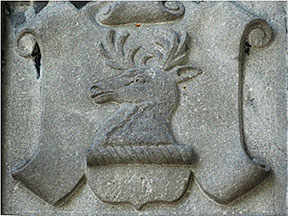
426 Metcalfe
Stone detail on 426 Metcalfe Avenue.
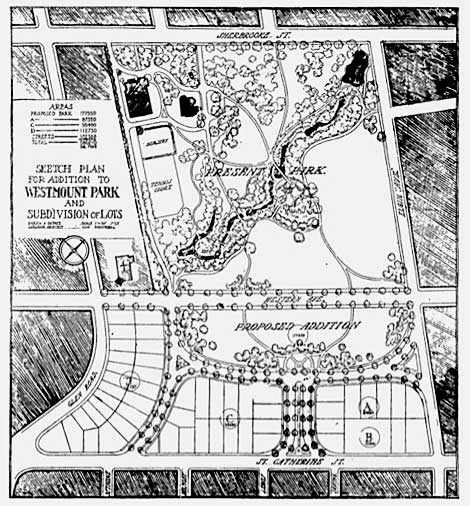 Westmount Park Plan 1910
What could have been – and should have been.
In the process of researching various Westmount-related topics, a newspaper headline, “Westmount Will Have One Of The Finest Laid Out Parks on the Continent,” caught my attention.
The article appeared in the Westmount News on August 5, 1910. It detailed a new Park Extension By-Law (221) passed by City Council. The City was taking a $300,000 loan to purchase 5 additional acres to extend the current park. A large portion of this land was from “Dame Margaret Smith et. al.” and the Estate of William Smith. This comprised the area between Western Avenue (now Boulevard De Maisonneuve) and St. Catherine Street, Glen Road, Lansdowne Avenue, and Elgin Avenue (now Melville Avenue). The City’s landscape architect, R. A. Outhet, proposed two crescent driveways joining Western Avenue: one from Elgin Ave. and the other following the path of Glen Road.
In addition, a boulevard entrance to the park would connect from St. Catherine Street “giving a stately entrance to the park”. Council stated that this would “increase the beautification of the city which so far has been laid out too much of straight lines”.
The By-Law also gave Council the power to sell land fronting St. Catherine St. and Lansdowne Ave. to pay for the park extension.
On another note, the same 1910 edition of the Westmount News had the following item: “The council is now considering a proposal to erect a Museum, towards which substantial support has been generously promised by Mr. David Ross McCord, K.C., the well-known antiquarian of Temple Grove, whose collection of historic relics is the best and most complete in the continent.”
For some reason, eleven years later, David McCord donated his entire collection elsewhere, forming the McCord National Museum located in a building provided by McGill University. Today, the museum is known as the McCord Museum and is located at 690 Sherbrooke Street West.
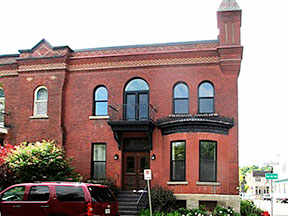 1 Winchester
John A. Pitt (1900) – William Dow & Company.
From the Canadian Bibliography: “The son of a brewmaster, William Dow emigrated to Canada in 1818 or 1819 with substantial experience in brewing. He was employed as a foreman at Thomas Dunn’s brewery, one of the few in Montreal at the time; by November 1829, Dow was a partner, and his younger brother, Andrew, also trained as a brewer, joined him.
Known as William Dow and Company after 1834, the year of Dunn’s death, the firm prospered and became one of Molson’s principal competitors in Montreal, the largest brewery in the city. Like some of his competitors, William Dow was also engaged in distilling and in this business too he was a major local supplier.
By 1863 his plant was producing some 700,000 gallons of beer in comparison to Molson’s 142,000 gallons. As his business grew, Dow took in other partners besides his brother (who died in 1853). During the early 1860s, he was joined by a group of associates, headed by Gilbert Scott, to whom he eventually sold the business for £77,877 in 1864; it kept his name.”
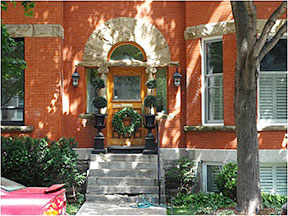 311 Elm
Thomas Binmore, Manager, Shoe Wire Grip Company (1899) – Formerly The English and Canadian Wire Fastening Company of Montreal.
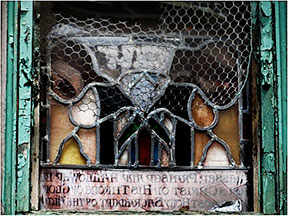
Former Anglican Church of Canada (near Greene Avenue)
One of the church’s stained glass windows is now covered in security wire.
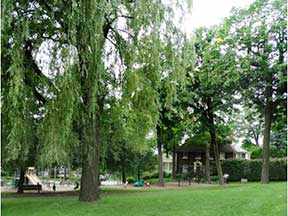 Devon Park
One of Westmount’s best-kept secrets: a small “gem” located off Upper Lansdowne.
Images: Michael Walsh

More articles by Michael Walsh
RECENT ARTICLES

Michael Walsh is a long-time resident of Westmount. Now happily retired after nearly forty years in higher-education technology, he enjoys exploring the city on foot, uncovering its past and bringing to light the history behind its familiar places. michaelld2003@ hotmail.com • Westmount Overlooked blog

Westmount owes Michael Walsh a huge debt of gratitude for his “Westmount Overlooked” series and his “Westmount places and their stories.” I find them fascinating and expertly done. They are a celebration on Westmount’s complex history, a work that puts the lie to our stereotypical image. Bravo.
Do you have any pictures of Melville right across from the park in Westmount?
There was a library on far side of the park. This is the area between St Catherine and Sherbrooke.
Again, bravo to Michael Walsh! I am not a Westmount resident but find this series very educational and fascinating! May it continue!