
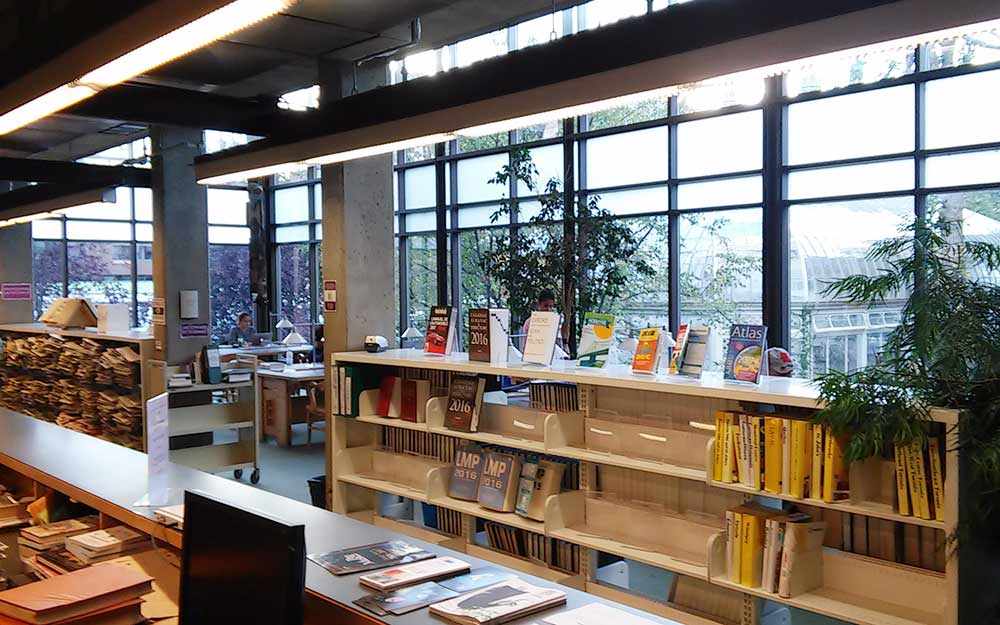
Public library innovation
through changing eras
Westmount Public Library’s journey from card catalogues to an RFID system
By Michael Walsh
Previously published in WestmountMag.ca
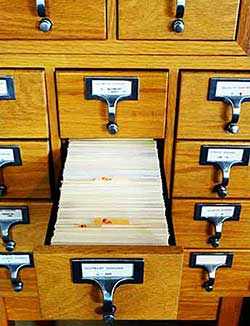
Card catalogue – reference department
Those of us of a certain age fondly remember using card catalogues, sorted by author and subject, to locate library books. Housed in beautiful oak or cherry wood, cabinets – one would patiently thumb through the well-worn cards to find a book’s location.
Interestingly, the library card catalogue first appeared in France during the revolutionary government. In 1789, the French government established a system of public libraries using books confiscated from the country’s religious institutions. By creating a listing of these holdings, a cataloguing system using the blank sides of playing cards was devised and widely adopted as the French Cataloguing Code of 1791.
By 1877, standardized sizes of library cards were adopted by the American Library Association. One was termed the Harvard College size (5 by 12.5 cm), the other was a Postal size (7.5 by 12.5 cm).
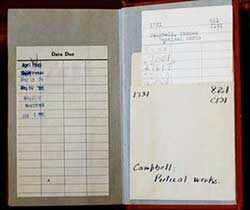 The card catalogue remained a ‘fixture’ of libraries until the early 1970s, when barcodes began to appear in public libraries. The first library to adopt this new technology was the Kent branch of the Camden Public Library. Specifically, in 1972, a Plessey Light Pen system was installed to read printed barcodes attached to library materials. From that point onward, automated circulation systems became a standard feature of libraries.
A casualty of this new technology was the card catalogue, relegated to storage rooms or discarded. They still appear for sale, depending on size, at prices ranging from $500 to $5,000. The Westmount Public Library has repurposed one for its Seed Lending Library. Another is still in use, in the library’s reference department, to index copies of the Westmount Examiner.
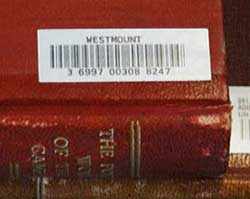 Nostalgia aside, computerized database systems do have many advantages over manual systems. For example, in the latter it is difficult of determine if a book is currently on loan and reserving a title is a cumbersome process.
Bar codes assign a unique control number to a record (including all its pertinent information) in a database. Different patterns of light are reflected from a barcode as it is scanned by an optical reader. Software converts these light patterns to programming commands that select the appropriate database records associated with the item.
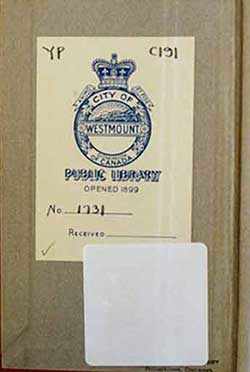
A library item containing an RFID tag
In library systems, an optical reader scans the barcode on the patron’s library card. Once scanned, the software retrieves the appropriate database record associated with the library card. A second barcode scan of the borrowed material pulls up the record associated with the item. Information on the former record includes patron information and outstanding fines. The latter’s record displays the item’s information, such as title, author and any hold requests. Finally, the two records are linked in the software, and the due date is calculated. One last scan degausses the magnetic strips placed inside library material (“tattle tape”), allowing the item to pass through the detection systems installed near the library’s entrances.
As barcodes became a ubiquitous technology in libraries, in the 1980s a newer management system using radio waves started to appear along Europe’s highway toll collection points. These technologies encompass the term “Radio Frequency Identification” – more commonly known as RFID.
An RFID system (broadly) consists of three components: an RFID ‘tag’ attached to an object (animate or inanimate), a transceiver known as a “tag reader,” comprising an antenna and communication software that transmits this information to an enterprise system.
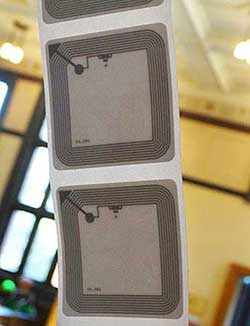
A strip of paper-thin, RFID tags held up to the light, revealing their spiral antennae – Image: Michael Walsh & Julie Bouchard
First described by Harry Stockman’s seminal 1948 paper, “Communications by Means of Reflected Power,” the concept had to wait several decades until microprocessors, integrated circuits, and communication networks were developed. By the 1960s, RFID systems became commercially available and were first used as anti-theft devices – physically attached to valuable merchandise.
The 1980s saw the advent of the personal computer, which enabled cost-effective processing of RFID data. During that same period, RFID systems were used in Europe for electronic highway toll collections. A decade later, as integrated circuits became smaller in size and more powerful (Moore’s Law) RFID technology appeared in railway transportation and access control.
In wasn’t until 1998 when libraries started to streamline their functions to reduce long-term costs that these organizations started to adopt RFID technology. By 1999, Rockefeller University and the Farmington Community Library in Michigan were the first to adopt RFID technologies.
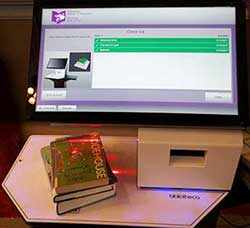
Self-serve kiosk – note multiple items being scanned simultaneously – Image: Michael Walsh & Julie Bouchard
These were the first to capitalize on the technology’s ability to provide additional functionality to all areas of library workflow, particularly: circulation, security and inventory control.
Libraries (public and academic) have been slow in adopting RFID technologies. In 2012, only ten percent of libraries in the United States used RFID. In other countries, however, the adoption rate is higher – during that same year, approximately 3,000 libraries had installed RFID systems.
In 2012, the Westmount Public Library implemented its RFID system during a period when the library was closed for minor renovations, which included new carpeting, additional furniture, and a reconfiguration of reading spaces.
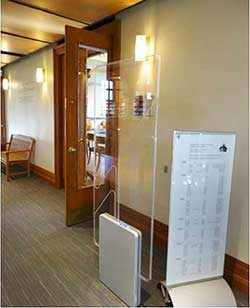
RFID security pedestals
A few weeks later, I was fortunate to meet with Julie Bouchard (Librarian – Systems and Technical Services) and Julie-Anne Cardella (Director) to discuss the library’s implementation of RFID technology. The library staff had managed to attach RFID tags to their collection of approximately 167,000 items. “The process was seamless”, Ms. Cardella mentioned, adding that minimal staff training was required for the new system. The tagging process was simplified because all items already had a barcode associated with the library information system (V-Smart). Once an RFID tag was placed on the item, it was a simple matter to copy the barcode onto the tag.
The solution used by the library was provided by Bibliotheca. This included a touchscreen self-check kiosk that uses a barcode login from the patron’s library card. The kiosk is configured with proprietary software (quickConnect) that communicates with the library’s information system. One huge improvement over prior self-check kiosks is that RFID tags do not rely on “line of sight”. More specifically, one can stack up to 5 items at a time on the kiosk – regardless of orientation – during the same transaction.
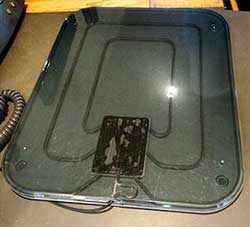
A shielded RFID workstation at the circulation desk
Additional hardware included two RFID gates installed close to the library’s entrances. Looking closely at each transparent (white aluminum) panel, what appears as a design feature is actually an antenna that reads RFID tags as items pass through the gate. Interestingly, the gates are normally in a “power saver” state until people enter with a tagged item – at that point, they enter an RFID detection state. The tags (read at the rate of 8 per second) determine if an item is allowed to pass through the gates – if not, an audible alarm is triggered, coupled with visible red LED lights. In addition, each gate has a “people counter sensor” that provides staff with data on patron traffic patterns.
An additional piece of hardware used by library staff is the RFID workstation, which circulation desk staff use for checking out and returning items. It comprises an antenna that, because it is shielded, only detects RFID tags when items are placed directly on the surface. Similar to the self-service kiosk, multiple items can be stacked, regardless of orientation.
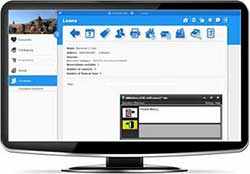
V-Smart with the RFID overlay in black – Image: Julie Bouchard
The final part is the Library Management System, which integrates all these components into a web-based system used by library staff. The system used is V-smart, originally developed in 1974 (as VUBIS) at the University of Brussels, now distributed by Infor.
Next time you use the self-service kiosk and have your receipt emailed to you, remember how far we have come from the days when library books were chained to their shelves.
I would like to thank Julie Bouchard (Librarian, Systems and Technical Services) and Julie-Anne Cardella (Director, Westmount Public Library) for their time and assistance in researching this article.
Images: Michael Walsh, unless indicated otherwise
 Other articles by Michael Walsh
Other recent articles




 January 6, 2026" />
 through digital innovation" />
 looks back at 2025" />
 online betting rules?" />
 a film by Andrés Livov" />
 for its 16th edition" />
 Passion fruit meringue verrine" />
 playful clownish escapade" />
 World rhythms on stage" />
 management mistakes" />
 Kensington Avenue" />
 Vegan Chili Chocolate Cake" />
 Bethune tunnel" />
 Left out of breath" />
 of business strategy" />
 damage before it starts" />


 into a professional career" />

 plumbing issues at home" />
 embraces bold cinema" />
 Red snapper papillote" />
 the Legend of Pepita" />
i forgot this piece. fascinating and so well written . teaches us to appreciate our local library more.