In search of whales
off the Azores coast
A hands-on marine conservation expedition with Biosphere Expeditions
By Patricia Dumais
June 24, 2026
Even in the choppy waters off Faial, with the horizon tilting and stomachs turning, the call came from the vigia onshore: a blow on the water! Minutes later, the immense back of a Blue whale arched above the waves – our first encounter with the largest animal on Earth.
Wildlife travel is changing. Increasingly, travellers are moving beyond passive observation to active participation, contributing to real scientific research through ethical conservation volunteering. In a time when biodiversity loss is tied to mounting global threats, this kind of citizen science is one of the most meaningful ways to experience the planet.
This year, I finally joined such an expedition: a 10-day marine conservation volunteer project in the Azores archipelago with Biosphere Expeditions, a non-profit whose citizen science model has become an industry benchmark for transparency, scientific rigour, and ethical integrity. The project focuses on whales, dolphins, and sea turtles in the channels between three of the central Azorean islands, using a sailing catamaran as both a platform and a field station.
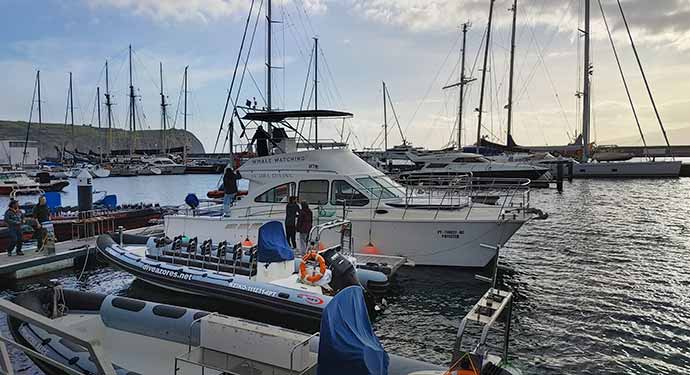
Early morning preparation for departure on our catamaran, Physeter • Image: © Biosphere Expeditions
I have always been fascinated by the natural world. My greatest pleasure is spending time outdoors, observing nature in my own neighbourhood or halfway across the globe. This expedition promised not only close encounters with marine wildlife but also the opportunity to contribute directly to long-term research in the North Atlantic.
The Azores: Atlantic crossroads
I visited the Azores in 1992, more than 30 years ago. These volcanic Portuguese islands sit in the mid-Atlantic, at the meeting point of three tectonic plates and roughly at the latitude of New York. There are nine major islands in three groups: Flores and Corvo to the west; Graciosa, Terceira, São Jorge, Pico and Faial in the centre; and São Miguel and Santa Maria to the east. São Miguel is the main gateway for international flights, with onward connections by local air service or ferry.
This expedition promised not only close encounters with marine wildlife but also the opportunity to contribute directly to long-term research.
We were based in Horta, on the island of Faial in the central group. The climate is surprisingly mild for such a northerly location, thanks to the Gulf Stream. Daytime temperatures generally range between 16 and 25 °C, depending on the season. During our stay, it hovered around 16 °C – cooler than usual for that time of year – so I was glad to have packed multiple layers and a fully waterproof jacket and pants for the much colder conditions at sea.
The Azorean economy rests on agriculture, dairy farming, livestock, fishing, and an increasingly important tourism sector, with marine wildlife tourism forming a significant part of that activity.
Horta and life on base
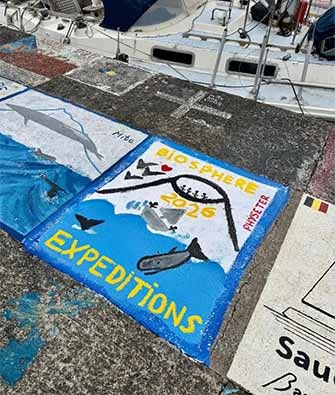
Biosphere Expeditions walkway painting 2026 • Image: © Biosphere Expeditions
Horta is Faial’s main town, with around 7,000 residents. Perched on the channel between Faial and Pico, it faces Pico’s dramatic volcano, which dominates the horizon. The marina is a major stopover for yachts crossing the Atlantic, and its walls and walkways are covered with colourful paintings left by visiting crews – names, dates, and symbols forming a living logbook of ocean voyagers.
Our group stayed in a lovely guesthouse on the Bay of Porto Pim, about a 15-minute walk from the marina where our boat, the catamaran Physeter, was docked. We had the house to ourselves, with a well-equipped kitchen and dining area for our mostly catered vegetarian meals, and a comfortable living room where we held evening briefings, listened to guest speaker talks, and unwound after long days at sea. A dedicated area was set aside for daily data entry.
The team consisted of expedition leader Craig Turner, expedition scientist Lisa Steiner, PhD student Maria Inês Silva, and nine volunteers from around the world. One of the great pleasures of the expedition was working with an international team, with participants from Asia, Europe and North America, all united by a shared fascination for the ocean.
Saturday was our orientation day. We familiarized ourselves with the town, the marina, and our roles on board. We learned to use various pieces of equipment, data recording apps, and spreadsheets. Chores were rotated so everyone could take turns as lookout for cetaceans, record environmental data, register water temperature, take identification photographs, operate the hydrophone, help dock the boat, and more.
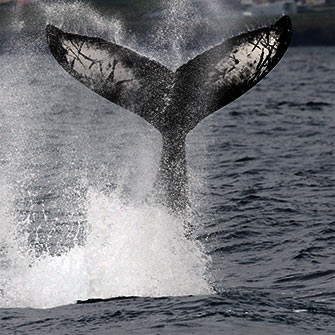
Humpback whale fluke • Image: © Biosphere Expeditions
A key task was to photograph whale flukes – the powerful, two-lobed tails used for propulsion – which bear unique patterns of pigmentation and scarring on their underside. For species such as the Humpback whale, these markings function like fingerprints, allowing researchers to identify and track individual whales using international databases like Happywhale. Our photos would later be compared and, in some cases, matched to known individuals.
Biosphere Expeditions’ pre-departure documentation was clear and detailed, outlining expectations, required gear, and the mindset needed for a successful field experience. From the outset, I felt confident this trip would live up to my hopes – weather and cetaceans permitting.
A week at sea: whales, dolphins and turtles
Day 1 – A choppy start and giants of the deep
On Sunday, we met at the dock around 9 am as our skipper, Pedro, prepared the Physeter for departure. (Physeter is the Latin name for the Sperm whale.) Guided by sightings from the vigias – watchers posted on hilltops scanning the horizon for whale blows – we set off into rather choppy seas that tested everyone’s sea legs. Even those who normally do not get seasick were looking a little queasy, myself included. I vowed to buy seasickness pills at the first opportunity.
Our first whale of the expedition was a Fin whale, the second-largest species, which can reach up to 24 metres in length and weigh up to 80 tonnes. These baleen whales feed on krill and small fish around the Azores as they migrate towards feeding grounds further north.
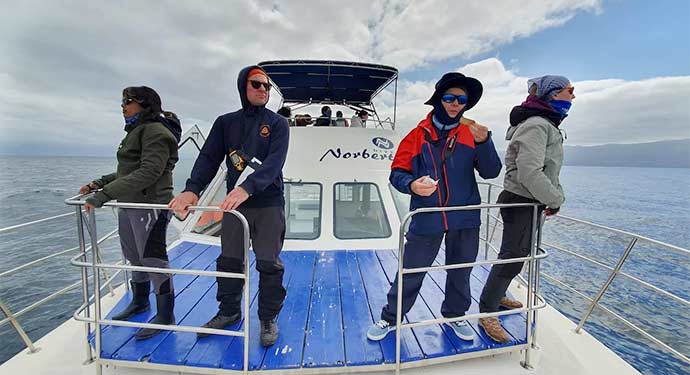
On the lookout from the front deck of the Physeter • Image: © Biosphere Expeditions
Then came one of my personal wishes: not one but two Blue whales, just off the coast of Pico. Males can grow to over 35 metres and weigh around 120 tonnes, making them the largest life form ever known. Blue whales are not truly blue; their mottled grey skin appears a vibrant blue or turquoise underwater because of how light is filtered and reflected. The mottling pattern also helps researchers identify individuals.
Despite the rough conditions, it was a remarkable start to our week. As the days went on, the ocean calmed considerably, and we ultimately managed seven consecutive days at sea.
Day 2 – Dolphins, a Humpback whale and a Loggerhead turtle
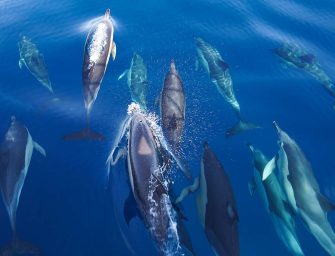
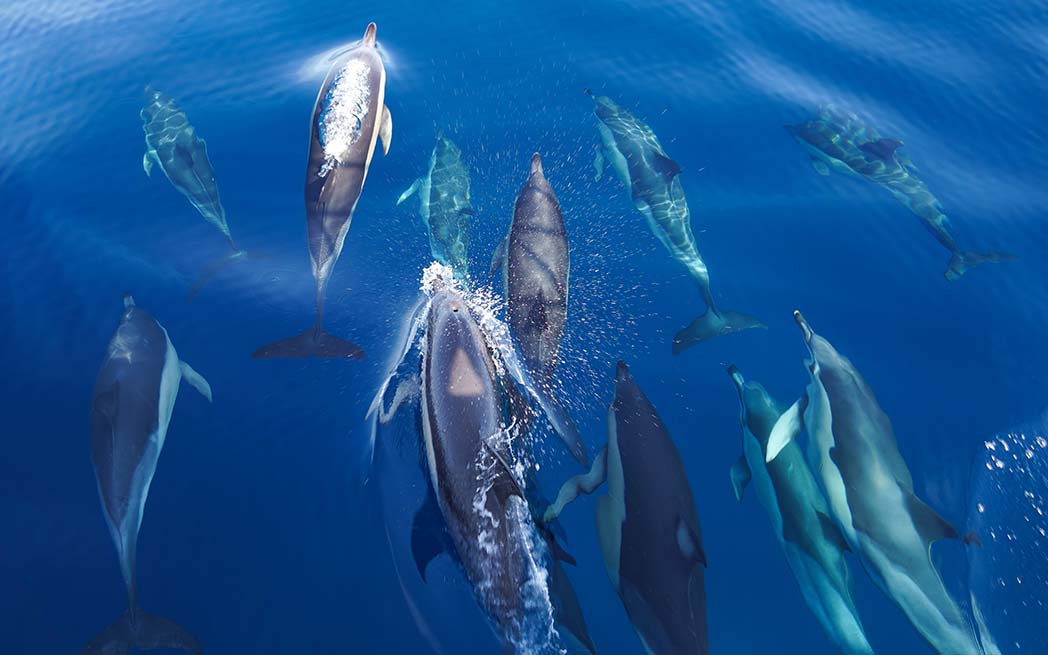
On Monday, the seas were still rough, so the decision was made to go out for only a half-day. Even so, it proved highly rewarding. We encountered a lively pod of Common dolphins and later sighted a Humpback whale just south of Pico. Common dolphins are among the most abundant and frequently observed resident species in the Azores. Recognizable for their yellowish-grey, hourglass-patterned flanks and high-speed, acrobatic behaviour, they often travel in large groups, sometimes in the hundreds, and readily ride the bow waves of boats.
Humpback whales are the species most people associate with whale watching worldwide. They are the most acrobatic of the baleen whales, known for breaching, lobtailing, and slapping their long pectoral fins on the water’s surface. Intensively hunted in the past, North Atlantic humpback populations came close to collapse but have since recovered. The individuals seen in the Azores at this time of year are likely en route to their breeding grounds in the Cape Verde region.
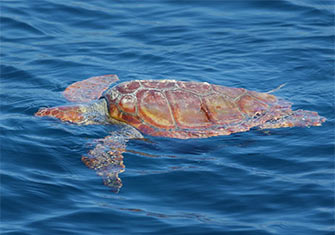
Loggerhead sea turtle • Image: © Biosphere Expeditions
A Loggerhead sea turtle also drifted by our boat. The Azores are a crucial developmental habitat and “nursery” for juvenile Loggerheads originating from the southeastern United States. Carried by the Gulf Stream, these young turtles spend approximately 9 to 12 years in the region, feeding and growing in the warm North Atlantic currents.
Later that day, back on land, I visited the Porto Pim Whale Factory Museum, located just across the bay from our guesthouse. Housed in a former whaling factory that once processed Sperm whale blubber into oil, the museum presents a sobering history. Much of the original equipment remains in place, and films and exhibits walk visitors through each step of a process that claimed the lives of countless animals. A life-sized model and an actual skeleton of a Sperm whale underscore the majesty of these animals and the scale of the industry that once targeted them.
Day 3 – A record day: eight species spotted
Tuesday turned into a record day, with sightings of eight cetacean species: Blue whale, Fin whale, Humpback whale and Sperm whale, along with four dolphin species, Common dolphin, Bottlenose dolphin, Striped dolphin and Risso’s dolphin. We began with a Humpback south of Faial, followed by our first Sperm whale of the expedition, though neither fluked, making identification impossible.
‘Unlike many other dolphins, they lack a prominent beak and have a robust, almost torpedo-like shape.’
As we continued south of Pico, we encountered a pod of Common dolphins and another Humpback. Soon, we came across a group of Risso’s dolphins, which I found particularly intriguing. Unlike many other dolphins, they lack a prominent beak and have a robust, almost torpedo-like shape. As they age, their original dark grey skin becomes increasingly marked by scars from interactions with other Risso’s and possibly sharks, eventually turning very pale; some older individuals are nearly white. These distinctive scar patterns help identify individuals.
Later in the day, we encountered two Fin whales, followed by an unusual sighting of four Fin whales travelling together – a rare event, we were told. We also saw more Common dolphins, another Blue whale, and Striped dolphins, recognizable by the two dark, tapering stripes down each side of their bodies, beginning behind the eye. The day ended with a sighting of Bottlenose dolphins, the species made famous by television’s Flipper and often seen in captivity. In the wild, they are powerful, social animals known for their acrobatics and for forming large “super-pods” of up to 200 individuals.
This day stood out as particularly exceptional for encounters, highlighting the Azores’ rich marine biodiversity.
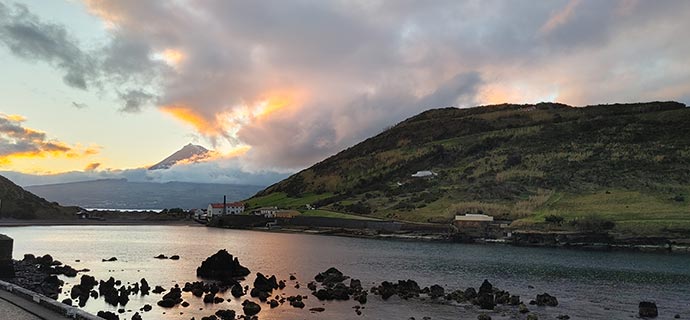
Early morning view from our guesthouse of Porto Pim bay with Pico volcano in the background and the Whale Factory Museum on its shore • Image: Patricia Dumais
Days 4 to 7 – Sperm whales, Sei whales and a wild chase
On Wednesday, we headed north towards São Jorge Island, following reports of a large group of Sperm whales in the channel between São Jorge and Pico. We located the group and identified several individuals by their flukes and dorsal features.
Thursday brought more Common dolphins and another Humpback, as well as a new group of Sperm whales south of Faial. It was a long, busy, and productive day of data collection and photo-identification work.
Friday, our last full day at sea, delivered sightings of Common and Bottlenose dolphins, a Humpback, and more than twenty Sperm whales north of Faial. At one point, we received reports of another Humpback and possibly Pilot whales near Pico, prompting a change of course. Despite our best efforts, those animals remained elusive, but we did encounter yet another distinct group of Sperm whales.
On Saturday, during a half-day at sea, we were rewarded with a small group of Sei whales, the third-largest whale species and similar in appearance to Fin whales. As they swim just below the surface, Sei whales often leave a series of smooth “footprints” on the water, making it easier to anticipate where they will surface.
Back at the marina, we thanked our captain, Pedro, and, in the afternoon, turned to the meticulous work of sorting and comparing fluke photographs to match and, where possible, identify individual whales for the research database.
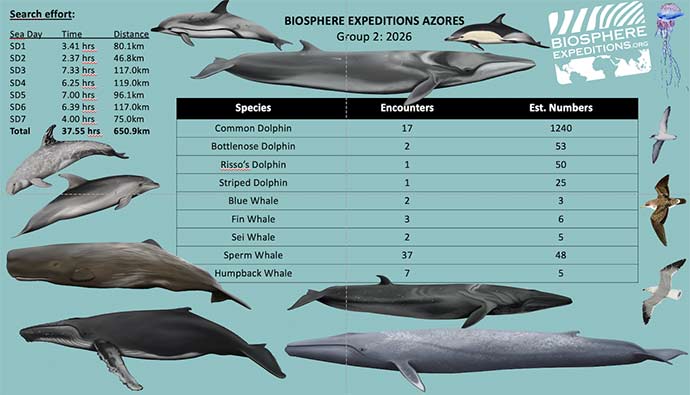
Image: © Biosphere Expeditions
Citizen science and conservation impact
What distinguished this trip from a standard whale-watching holiday was the level of involvement in genuine research. Every sighting, GPS coordinate, environmental measurement and identification photograph contributed to long-term monitoring of cetacean populations in the Azores and the wider North Atlantic.
Over the course of the expedition, we recorded nine cetacean species and logged 72 encounters. Our work helped document seasonal presence, group composition, behaviour, and movement patterns – data that feed into larger studies on migration routes, population health, and the impacts of climate and human activity on marine ecosystems. The experience demonstrates that participation in conservation efforts does not necessarily require formal scientific training; curiosity, availability, and respect for animals and their environment can make a significant contribution to data collection.
‘The experience demonstrates that participation in conservation efforts does not necessarily require formal scientific training.
Exploring Faial
Sunday was our rest day, and a group of us set out to explore Faial by land. In the centre of the island lies the Caldeira, a vast crater roughly 400 metres deep and 2 kilometres in diameter. You can hike down into it with a guide, but on our visit, the weather did not cooperate. Fog and wind limited visibility, though the brief glimpse we caught from the crater’s rim was still impressive.
Later, we visited another volcanic site, Capelinhos, formed during the 1957 eruption. The Capelinhos Interpretation Centre offers a compelling account of the eruption and its aftermath, showing how fertile countryside and an entire village were transformed into a stark, inhospitable landscape of ash and lava.
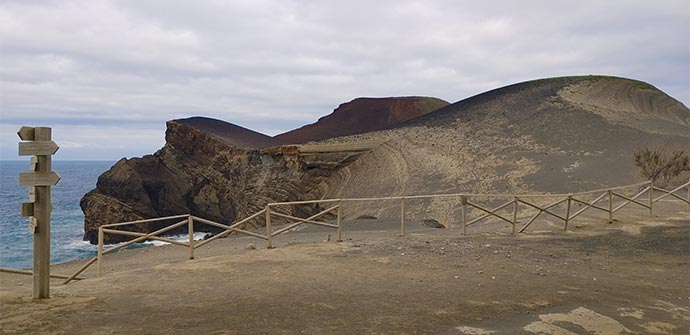
Capelinhos volcano • Image: Patricia Dumais
Continuing north along the coast, we stopped at the spectacular black sand beach of Praia do Norte. It was too cold to swim, but it was easy to imagine surfers riding its powerful waves on a warm summer day.
That evening, we gathered for a farewell dinner at a local restaurant in Horta, where some of us enjoyed fresh-caught Azorean seafood. We shared impressions of the week, traded stories, and thanked our hosts and team leaders for their guidance and dedication.
Homeward reflections
I returned home exhausted but fulfilled. The expedition had met – and in many ways exceeded – my expectations. I had the opportunity to meet and work alongside fascinating, generous people from around the world, to add a new and captivating Azorean island to my travel map, and to contribute directly to important scientific research. Most of all, I came away with a deeper appreciation for the cetaceans of the Azores and the fragile ocean ecosystems they inhabit. Watching a Sperm whale raise its fluke before a deep dive, or a pod of dolphins weaving effortlessly through the bow wave, is an unforgettable experience. Knowing that these moments also support research and conservation efforts makes them even more meaningful.
‘Watching a Sperm whale raise its fluke before a deep dive, or a pod of dolphins weaving effortlessly through the bow wave, is an unforgettable experience.’
For travellers seeking a more engaged, responsible way to explore the natural world, marine conservation volunteering offers a powerful alternative to traditional tourism. It allows us to be not just spectators, but participants in the effort to understand and protect the ocean’s most remarkable inhabitants.
To learn more about this and other volunteer expeditions, visit Biosphere Expeditions’ website and explore their current projects.
Feature image: pod of Common dolphins © Biosphere Expeditions
More articles by Patricia Dumais
Other recent articles