
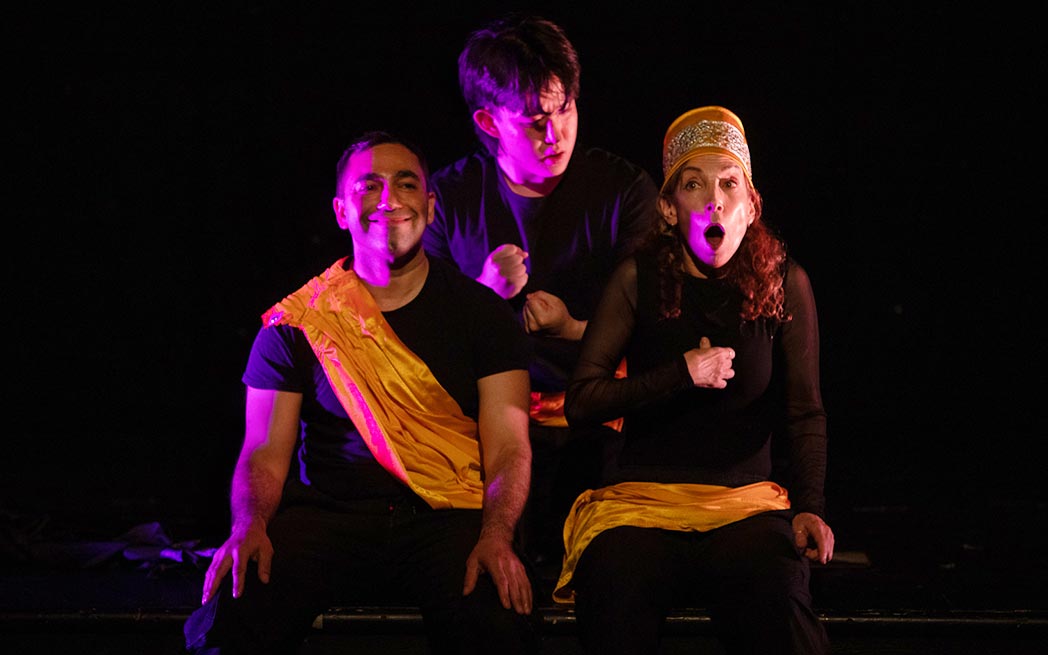
The Paranoid King reigns at Montreal Fringe Festival
A fast-paced, goofy comedy on the life and times of King Ashurhaddon
By Irwin Rapoport
June 17, 2026
King Ashurhaddon, who briefly ruled over the ancient Assyrian empire between 680 and 669 BC, was extremely paranoid, or so clay tablets say. If you were unaware of this ancient ruler, don’t worry, as former Gazette journalist Olivia Collette turned her nerdy obsession with ancient civilizations into The Paranoid King, a fast-paced, goofy comedy premiering at the Montreal Fringe Festival.
“It’s easy to give ancient rulers a wash of magnificence and mystique, even if they died young or did relatively mediocre things,” says Collette, who co-wrote The Paranoid King with Carlos Karan and Jenna Mars. “You can’t do that with Ashurhaddon. He was full of anxiety, chronically ill, terrified of the gods, and not entirely wrong about enemies wanting him dead. For an imperial overlord, he was surprisingly human!”
In researching the story, Collette found comedy in Ashurhaddon’s penchant to find bad omens in just about any ordinary event, like a mongoose casually walking under his chariot.
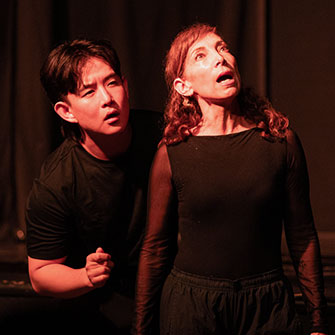 According to the play’s press release, Collette also drew on his hilarious historical context, including the countless gods his people believed in and the religious professionals – exorcists, astrologers, diviners – who acted as “scientific” advisors to the king. Ashurhaddon’s paranoia is set against the backdrop of a world that couldn’t possibly help him with his problems, so naturally, his solutions are doomed to fail. The Paranoid King is also punctuated by commercial breaks for products like opium, olive oil, and pyramid timeshares, all set in ancient times.
“I like combining ‘then’ things with ‘now’ language,” says Collette. “It gives us laughs, but it also weirdly helps us understand the logic of the ancient world.”
The play is directed by Keith Fernandez, who helmed Hedwig and the Angry Inch (Fringe 2024) and was the winner of YES Employment’s Most Promising Emerging Theatre Producer award (2024). His other directing credits include Crash (Associate Director, Imago Theatre 2026), An Uncomfortable Dinner Party (Fringe 2025), and Sinkhole (Infinitheatre 2024).
“I’m excited to develop this bold new work with a writer eager to play and let the piece evolve,” he said. “The Fringe is the perfect playground for new theatre, and we’re thrilled to bring laughter to the festival with The Paranoid King.”
Collette honed her comedic skills at The Second City.
“The world seems especially crazy right now,” Collette says. “Laughter’s going to help with that.”
The Paranoid King will be showing on June 12, 14, 16, 17, 20, and 21 at Théâtre La Comédie de Montréal, 1113 Maisonneuve East.
In the discussion below, Olivia Collette talks about writing The Paranoid King and Director Keith Fernandez speaks on his preparations to direct the play and bring it to life.
WM: Who is Olivia Collette?
Collette: I’m first and foremost a writer. I was a journalist for almost 20 years, writing for the Montreal Gazette, Vulture, RogerEbert.com, and several other publications. I’m a nerd about a lot of things: ancient civilizations and their religions, music (I play several instruments), architecture, and films, all of which I wrote about as a journalist. I also love gardening and crocheting.
WM: Can you tell us more about the play?
Collette: The Paranoid King is an utterly goofy comedy about King Ashurhaddon, who ruled the ancient Assyrian empire between 680 and 669 BC, and was known as “The Paranoid King” because he saw bad omens in every little thing, and was terribly insecure for most of his reign. The play is also sometimes interrupted by commercial breaks, which are also set in ancient Assyria, and promote products that would have been used in those days (e.g., olive oil, chariots, exorcists, opium).
… what inspired me to write a comedy about this subject … is a podcast… about Ashurhaddon and the many, many paranoia-tinged clay tablets he sent to his advisors. He’d ask them about whether or not some random thing was a bad omen, and they’d answer back, clearly trying to appease him and get him to stop panicking… It was all so neurotic and hilarious, I just knew this was my Fringe story.
– Olivia Collette, co-writer, The Paranoid King
WM: What inspired you to write a comedic play?
Collette: It’s been a longtime goal of mine to write a Fringe show. I just love the variety of the programming, and I felt like it could be a good place for my wacky ideas.
But what inspired me to write a comedy about this subject in particular is a podcast my friend had me listen to. It was about Ashurhaddon and the many, many paranoia-tinged clay tablets he sent to his advisors. He’d ask them about whether or not some random thing was a bad omen, and they’d answer back, clearly trying to appease him and get him to stop panicking. Then there was this especially long tablet naming really random palace employees, and even their houseguests, and asking one of his gods to make sure none of them would rebel against him and kill him. And I kept imagining his poor scribe, painstakingly carving each cuneiform character into slabs of clay. It was all so neurotic and hilarious, I just knew this was my Fringe story.
WM: What was the writing process like?
Collette: I had the idea for the play, then I enlisted the help of co-writers Carlos Karan and Jenna Mars, who I met in sketch comedy writing classes at The Second City. The three of us met almost every weekend for a couple of months; we had a very messy shared Google Sheet to track our scene-writing progress; and we had a few intense weeks of marathon writing and editing.
Blake Snyder’s Save the Cat also helped us map out the purpose of each scene to build a logical story arc.
Otherwise, just discipline, discipline, discipline.
WM: The Paranoid King is based on an actual historical figure. Why were you drawn to his story and what type of research did you do?
Collette: I was drawn to Ashurhaddon’s story because I could relate to him. I have anxiety, and I totally understood how being promoted to a position you weren’t prepared for – which is what
happened to him – might trigger a bunch of irrational fears.
When my incredibly thoughtful husband realized I was going through with this project, he bought me a history book specifically about Ashurhaddon’s life and reign. The book definitely helped the story arc take shape because the beginning, middle and end were all in there. I made up a lot of stuff for the play, but there’s usually a basic historical fact at the core of every scene.
I also tried to take in some historical comedy while I was writing. The Great is a favourite.
WM: Comedy writing seems like such a departure from journalism. What drew you to it?
Collette: I never thought of journalism as an endgame. To me, it was a vehicle for writing, which was the number-one thing I wanted to do. I’d tried to take on creative projects before, but I had trouble getting them off the ground. Then the pandemic happened, and I got on TikTok. There, I gravitated towards the TikTokers who were doing sketches. So I decided to study sketch comedy writing at The Second City. I didn’t just love it; I also found that I was responding well to having homework. It turns out I’m quite capable of following through on creative projects as long as there’s structure and purpose to what I’m doing. And since I enjoyed writing comedy so much, here we are.
‘I have never directed something so camp and something so stupid! Though the story is based on true events and people, Olivia has brought it into the 21st century through its delivery with modern-day text, language that plays between times, and we are absolutely committed to having a good time and being as silly as possible when telling this story.’
– Keith Fernandez, director, The Paranoid King
WM: It’s one thing to have an idea; it’s another to get it on paper. How did you make it work?
Collette: Like most people, I have tons of ideas floating around in my head. But what actually compels me to get something on paper is a deadline. I’m not motivated just by artistic fulfillment. I need something to write for, and a drop-dead date tends to do the trick. I had deadlines as a journalist, homework at The Second City, and the Fringe gave me a responsibility when they picked my production company’s name in their lottery.
WM: You’re also producing the play. Why did you choose to be a producer rather than a director?
Collette: I’ve done production work before as a journalist, so I knew I’d feel comfortable in that role. A lot of people will tell you to step outside your comfort zone, but I don’t have any real experience with directing, and putting on an indie play is already a lot of work. Since this is my first production, I wanted to stick with responsibilities I’m familiar with. I was very lucky to find Keith Fernandez, who’s directing The Paranoid King. Keith has so much experience directing, acting and dramaturgy, so it was a match made in heaven. Everything he’s doing with and for the actors is things I don’t have to worry about, and things he’s doing much better than I could have. So I love that.
Same goes for our stage manager, Alan Fregtman, who is extremely knowledgeable and has brought so many ideas to the table that will simplify my life.
WM: I understand that your actors will play multiple characters in the play. How do you write for that?
Collette: Firstly, you try to whittle down the number of actors in your most populous scene. Then in every other scene, you try to have fewer characters than that. It really forces you to think about who’s essential to moving the story forward.
WM: Did someone, maybe a friend, read the play before you finished it to tell you what worked, what didn’t? What did you learn from that experience?
Collette: I had a colleague of mine read the play cold. She had some very useful feedback and pointed out that the first scene might not work. So I changed it. I also actioned all of her other feedback.
I think getting someone to read your work cold is crucial to the process. It tells you exactly how your material is landing, because you won’t get a chance to explain yourself when the work is being performed. Fresh eyes will spot the kinks and let you work them out.
WM: When you write a scene, how do you see it play out? Do the actors match what you had in your mind? How do you process that?
Collette: Writers definitely have an idea about how their lines are going to be delivered. But I also respect the craft of acting, and I love it when an actor does something unexpected. It’s very exciting watching them do something completely different with your words.
WM: What advice do you have for up-and-coming writers?
Collette: If you’re struggling to write, start setting aside time for writing every day. It doesn’t have to be long hours; one or two will do. Do that until it becomes a habit. It’ll surprise you how easy it is to sit down and write once it’s a habit.
I also think the Fringe Festival is a great event for new writers. They give you resources you wouldn’t be able to tap into as a first-timer, and they set you up for success.
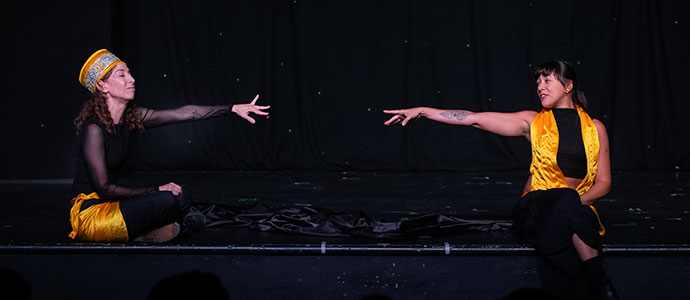
WM: How did you prepare to direct The Paranoid King? How did you select the cast?
Fernandez: Well, the first thing that I asked for was the script. Olivia provided me with a lot of context for where the idea for the play began, and at our first meeting, I took the time to understand why she wanted to tell this story, how it sparked her imagination and what she had hoped to achieve with the play. I then read the play three times – once purely to imagine what I could bring to it! A second time for what the characters were doing to each other. And one final time, to imagine who would be right to play the multiple characters in the show.
Once Olivia and I confirmed we wanted to work together, I stepped in as director of the show and began researching the Assyrian Empire, reading as much as possible about it. The script really became my best friend – I had to learn about each character like the back of my hand so I could cast the show accordingly. I also worked closely with Olivia to build a dramaturgical container to continue to push the script forward. So much is informed by the way lines are delivered, by what we are trying to say and do to each other as characters in this play. It was such a gift to work with a new playwright who was excited to open the rehearsal space to developing the work while also allowing her to focus on the story she needed to tell.
We held an open audition call and received over fifty amazing artist submissions for the roles in the show. We had five roles to cast, which is a big challenge! I held online auditions in which the performers were asked to prepare short sides from the script. I always trust my gut and remember all the tips that my mentors have shared with me about casting. The alchemy of a cast is just as important as the talent they bring as performers. In a show like this where they really play off each other, having a room where fun can be fostered is key! We’re so lucky – we have such a diverse and talented cast!
WM: In this play, you have six actors portraying multiple characters. What are the keys to directing a fast-paced script and sustaining the humour, irony, and sarcasm?
Fernandez: Having everyone understand the script’s purpose and delivery is important – we established this on day two of our rehearsals so we could all get on the same page. Pace is important, and timing is everything when it comes to comedy. I always keep in mind that the most honest delivery will yield the best outcome in comedy. We have to believe in what these actors are saying as audience members – no matter how ridiculous the proposition. If these actors believe it with every inch of their minds and bodies, we will buy it as audience members and see the humour in it. This is a very fast-paced comedy! The actors are on the go and don’t have too much room to rest. Once the train is running, they have to commit to the energy and go go go! It’s been a lot of fun to inject this sense of fun and energy into the process.
WM: How does this experience differ from previous comedies that you directed?
Fernandez: With all the respect in the world – I have never directed something so camp and something so stupid! Though the story is based on true events and people, Olivia has brought it into the 21st century through its delivery with modern-day text, language that plays between times, and we are absolutely committed to having a good time and being as silly as possible when telling this story. I often play with this level of camp and stupidity within my drag persona KAJOL, but having to create an understanding of this kind of humour has been a unique challenge for me as a director and one I hope will come my way again very soon!
Images: Ariane Laget
More articles by Irwin Rapoport
Other recent articles

Irwin Rapoport is a freelance journalist and community advocate from Westmount with bachelor’s degrees in History and Political Science from Concordia University. He writes extensively on local politics, education, and environmental issues, and promotes informed public discourse and democracy through his writing and activism.
 June 16, 2026" />
 marriage prevents disputes" />
 2026 summer season" />
 downtime strategically?" />
 A living natural heritage /2" />

 at the Fringe Festival" />
 Opportunities to sell" />
 from a credit union" />
 at the Fringe Festival" />
 helps you feel more" />
 A living natural heritage /1" />
 Suzy’s vegan cookies" />
 to save Tamaracouta" />
 Rewards of investing" />
 playing in Pointe-Claire" />
 A jewel worth preserving" />
 Chocolate Raspberry Tart" />
 without burning out" />
 Lansdowne Avenue" />
 but at what cost" />
 around Alberta separation" />
 The power of clarity" />