
Award-winning Wine & Halva
is back for a new run!
The play explores friendship, immigration, and the human condition
By Irwin Rapoport
May 14, 2026
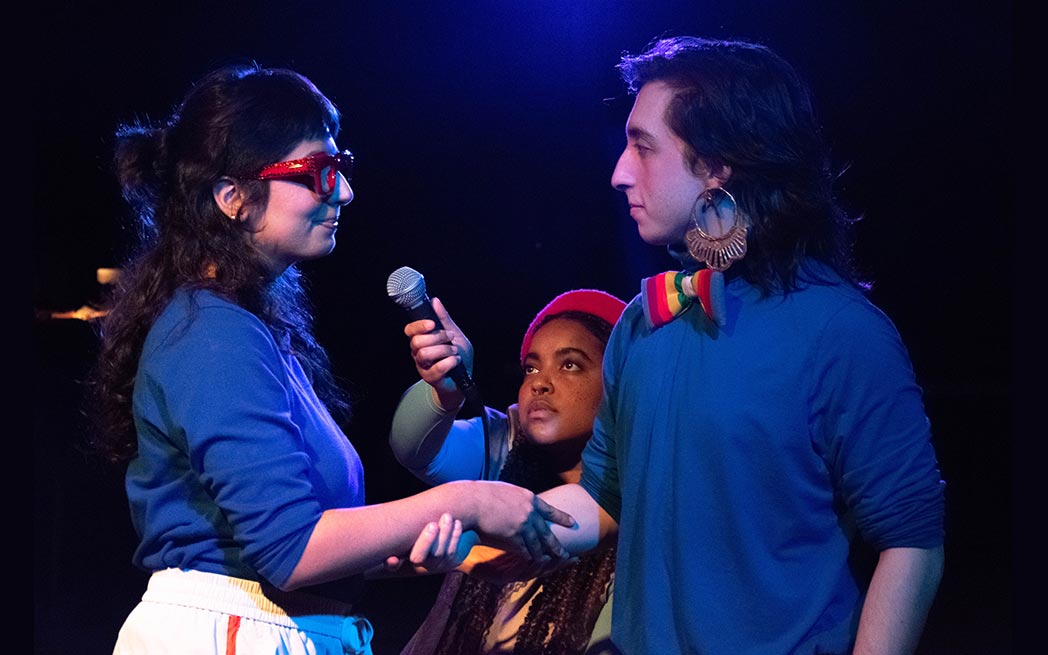
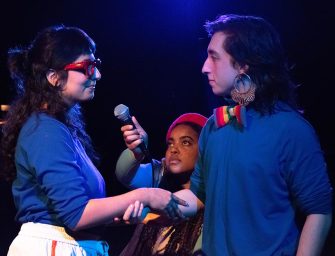
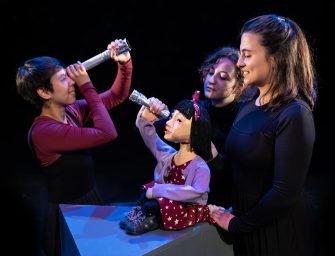
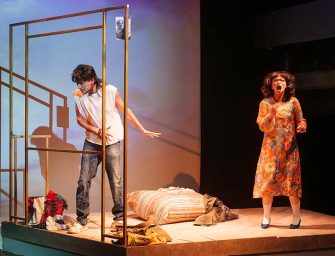
Deniz Başar’s award-winning play Wine & Halva has returned to Montreal after its sold-out run in 2024, now showing at Rangshala in the Cité-des-Hospitalières through May 23. The production, presented by Sort Of Productions and Art Babayants in association with Postmarginal and in collaboration with Teesri Duniya Theatre, opened its latest run last Saturday, May 9, under Babayants’ direction. It features performances by esi callender, Banafsheh Hassani, and Corbeau Sandoval.
At its core, Wine & Halva explores the unexpected friendship between Derya, a Turkish woman, and Farias, a white, gay Canadian man. Their relationship unfolds against a backdrop of migration, identity, and the psychological strain of living in precarious circumstances. The play questions easy assumptions about diversity and belonging, often using humour to expose uncomfortable contradictions – captured in lines like, “How can I be racist? I’m vegan!” and “I actually really like diversity when it is all there to pamper me. But I just don’t like conflict, you know?”
At its core, Wine & Halva explores the unexpected friendship between Derya, a Turkish woman, and Farias, a white Canadian gay man.
The story unfolds in a richly imagined setting inspired by an Istanbul coffee house, where music, poetry, and conversation mingle amid underlying political tension. Three narrators guide the audience through the story, creating an intimate yet expansive atmosphere that blends warmth, resistance, and moments of fragile hope. The structure draws on storytelling traditions from West Asia and the Middle East, emphasizing the fluid and shifting nature of identity.
Farias – whose name means “lighthouse”– comes from a fictional North American city and finds himself stuck in a low-paying service job, struggling to find direction. Derya — whose name means “sea”— arrives in North America to pursue a PhD, only to confront the reality of being a visible minority in her new environment. Their connection raises a central question: how can two people with so little in common truly understand and support each other?
Through humour, tension, and emotional honesty, Wine & Halva portrays friendship as both challenging and transformative — an act that can bridge cultural divides while revealing just how complicated connection can be.
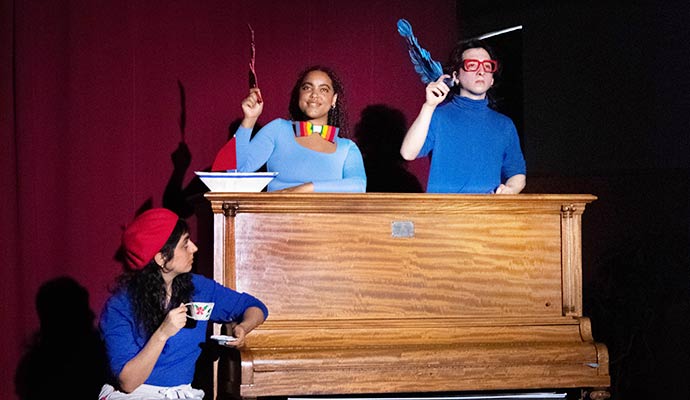
Playwright Deniz Başar, director Art Babayants, actor/producer esi callender and actors Corbeau Sandoval and Banafsheh Hassani hold forth on the play and the forces that brought everything together.
WM: How did your life experience as an immigrant in Canada influence the play? How would you describe the writing process?
Başar: The plays I wrote in Canada, all of them, were written primarily because I came to Canada due to invisible yet insidious forces of global hegemonies. As Derya asks, “Why would you leave the most beautiful place in the entire world?”, and as the play answers: because fascism is the legitimate child of capitalism and democracy (which has obviously and unapologetically become devoid of rights due to global colonial-capitalism). Therefore, none of our choices is purely our individual choice.
Derya’s choice to pursue her education at the University of Royal New Stockholm is not purely her own; my choices, similar to Derya’s, were tainted by the forces that bent my agency, too. Wine and Halva are among the many responses I gave to these forces that bend me (and regularly break me). Writing becomes an act of survival and result of the responsibilities of an archivist: I keep the score for the future.
WM: What do you hope audiences will take away from the play?
Başar: Many, many things. But most importantly, perhaps this: Another world is possible. Let me explain this with a multilayered quote from the one and only Cemal Süreya, which I translated here for you:
Now we are coming together and multiplying
But when we sync the tune of freedom in unison
On that day, not even the gods can save you.
These lines are from the poem 555K, which refers to the first mass protests against the right-wing Democrat Party government in Turkey on the 5th of May 1960. The 555K protests (short for “5th hour of the 5th day of the 5th month at Kızılay Square”) are known as the first act of civil disobedience in the history of the Republic of Turkey. I apply the sentiment in these lines to the entire world today, which is much bigger than just Canada or Turkey.
WM: How did you prepare to direct the play, assemble the cast and stage the play?
Babayants: It was probably the longest preparation period ever. I first read the play back in 2019, and then I spent a few years studying the contexts, history, and aesthetics of contemporary Istanbul theatres (both independent and state-owned). Thanks to Deniz, I also learned about traditional Ottoman theatre forms like karagöz (shadow puppetry), meddah (one-man storytelling), and orta oyuno (centre stage play performed in a circle) – something we never study in Canadian theatre schools. I
went to Istanbul twice and learned to be a “flâneur” there – I sensed the poetry and sadness of this eternal City, which, in Armenian, we often call simply Bolis or Polis, i.e., the City (not Istanbul). I cried in Hrank Dink’s Museum, along with my Turkish colleagues. Hrant Dink was a Turkish-Armenian journalist assassinated by a young Turkish nationalist in 2007 right in front of the door to the office of the bilingual newspaper Dink had founded.
Last but not least, thanks to the playwright’s generous gifts, I have also read the books that the characters of Wine & Halva consistently mention. It’s wonderful to have the playwright as your friend and let them “curate” your preparation. Overall, it took me five years to develop the conceptual staging for Wine & Halva – something I am very proud of. It’s a staging that offers multiple nods to various theatre forms, including Ottoman and contemporary Turkish, as well as some forms common in North America. The staging is very playful and full of surprises.
Oh, and the most important part: it took some time to find the young and wonderfully diverse cast of three (no tokenistic diversity here). I couldn’t be happier with how the three performers, Banafsheh, Corbeau, and Esi (who are also profoundly different – just like the characters in the play) gelled and learned to work together. All three of them are on the same wavelength throughout the whole performance. It’s a treat to watch them. The best thing is they (the performers) also became true friends. And friendship is “a major force of resistance” – as Wine & Halva teaches us. Something to keep in mind, perhaps?
WM: What attracts you to directing theatre? How are you establishing yourself as a director?
Babayants: The more I live, the more I dislike cameras and other convenient technologies that mediate direct human interaction. I know video technology is a necessary evil, and I use it. A LOT! Too much, perhaps. What I appreciate about live theatre is the real encounter between humans. The raw ritualistic nature of it. I do not resist technology – I use it for my staging too when needed. But when I can minimize its use and give full rein to the performer and the audience to connect with one another, it is much more precious to me as a director.
Theatre is a form of encounter – and often that encounter is between folks who do not share the same views, ideas or perceptions of the world. It’s a place where perspectives should clash, where people should question themselves. I do not care much for bourgeois theatre where the audience simply receives some sort of ideological confirmation or affirmation. That is the kind of theatre I desperately try to avoid (often unsuccessfully, as it is absolutely everywhere).
‘What I appreciate about live theatre is the real encounter between humans.
– Art Babayants, director, Wine & Halva
WM: How did you prepare for your roles? How did your experience in Turkey with the playwright provide you with a deeper understanding of the play’s concepts?
Sandoval: As with most performers, a large part of the preparation came from analyzing the script. And unlike any other script I’ve tackled, the particular shimmer of Deniz’s absolutely one-of-a-kind play lies in its academic offerings; by blending the minutiae with the macro, this play created an impeccably thorough lookout tower that brought a clarity to each character that simply isn’t as available in some other pieces.
With that said, there is a difference between learning and knowing. The opportunity to visit Turkey and spend time with Deniz allowed me to bridge part of that knowledge gap and notice the roots and stems of the play’s (and Deniz’s) garden. Additionally, I like to think that part of this trip helped jump-start my current interest in multiplicity because, as Deniz notes, “space holds the identity.”
Hassani: Istanbul feels like Tehran, my hometown, even though they look so different from each other. Being in Istanbul grounded the city in my mind as something familiar and known. I connect with the play better now that I know what I’m talking about as an Istanbulite. I’ve seen the city, but I’ve also lived there, only it was called Tehran.
callender: I’ve been dear friends with the playwright behind Wine & Halva, Denis Başar, since 2019, when she was working on the very first drafts of the text. Our friendship over the past seven years has been so transformative to my life, my craft, and my ability to produce and perform her work that it’s hard to summarize. When we first met Deniz, pulled me and Sort Of Productions co-founder oli aside after a reading of my play ineffable and told us that all the criticism I was getting about the play – that it was trying to do too much (dealing with queerness, race, displacement, love, sex, and family), that it was telling where it should be showing, that it had to be simplified – was actually a misunderstanding of the play’s dramaturgy, which was informed by my intersecting experiences and was attempting at a genre of theatre that I didn’t know existed: Narrational theatre.
Deniz, with the unbreakable confidence that Wine & Halva audiences will see in Derya, told us to come to her home the next day for tea so she could teach us about this genre. Not long after, we were reading, writing, and thinking together, and Oli and I organized and performed the first play reading of Wine & Halva. From there, Deniz pushed Oli and me, much like the character Derya pushes Farias, to get out of our comfort zones and to apply for scholarships to go study abroad. I spent two years in Europe and Ghana, my family’s home country, studying and learning in my bones that, as Deniz writes in Wine & Halva, space holds the identity.
During that time, I also took two cheap flights to Istanbul and Deniz’s hometown, and I got to see her in an entirely different light as she healed from the damage her immigration to Canada had caused and gathered the strength to venture out of her comfort zone once more. It became so obvious to me how uncomfortable those supposed comfort zones are, how they ask us to be small in certain ways and to go along with commonplace ignorances in order to buy into that comfort, even to buy into lies about ourselves.
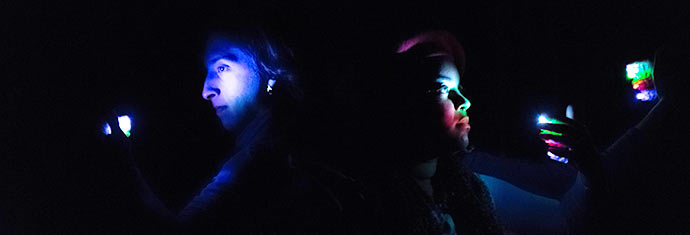
After our first workshop production of Wine & Halva in 2024, my castmates Corbeau and Banafsheh joined me on my third trip to visit Deniz in Istanbul, and Oli even came for a short visit. We jokingly called it our Istanbul pilgrimage. It wasn’t a vacation so much as a kind of immersion in Deniz’s world. We learned about the city through her particular references, her memories of different bookshops, alleyways, and historical buildings now turned into mosques, as well as its grand histories, which she recounted to us with critical attention. I see this as the labour, the deep labour, that Deniz does to be understood by people who don’t share her histories, and I see producing and performing her plays as a way of contributing my own labour to sharing that understanding further, to reach other friends and communities that Deniz doesn’t know, to reach audiences that I don’t know.
Now, when we’re memorizing the lines in the play, if one of us forgets something, the others don’t just say “Oh, you forgot the part about Derya’s home.” We can say, “Remember Deniz’s home in Istanbul? With the archives of her family in photographs and heirlooms on display like an intimate museum alongside the trinkets, puppets, and library’s worth of books that she’s gathered over the years?” Well, nobody really talks like that, but we say “Remember Deniz’s beautiful home?” and we all know what we mean.
WM: How do you manage wearing many hats, being a performer and an independent producer?
callender: I don’t know if you can call what I do “managing.” Basically, as an independent producer, I rely heavily on the mutual support between Oli and me, with whom I co-founded Sort Of Productions. Our work is driven by a very strong desire to bring plays to the stage that are too difficult, too intellectual, too grim, too strange, and not white enough for an established theatre company to just pick up and put on. But these are plays we really want to see and be part of. So for now, we just encourage each other through the intense stress and burnout, we shower each other with appreciation for one another’s dedication every chance that we get, and we try to be easy on ourselves:
Everything doesn’t have to be perfect; we can just do what’s doable and forgive ourselves when we can’t. It’s not sustainable, and over the years, we’ve been trying to learn to be more balanced, to bring in more collaborators who can share that weight, but that’s highly dependent on securing funding, so it often comes back to just the two of us. Though we are slowly growing an ensemble of people who want to bring these works into existence just as badly as we do. Next year, we’ll take a break from producing to gain back our strength, if we collaborate it’ll only be as artists, with no money and no expectation of an outcome.
For me, balancing both producing and performing mostly means taking off the producer hat during rehearsals and putting it back on on my days “off”.
WM: How long have you been performing? What is it like to bring a character to life?
Sandoval: Having started in music when I was younger, I’ve been performing for the majority of my life. From concerts and recitals to plays and films, I’m incredibly grateful I’ve been able to perform consistently and just simply work in the arts. Because of this start in music, part of bringing a character to life for me comes from listening to their score as written. This is especially necessary for this particular production, where we’ve been asked to fluctuate between three distinct characters. After practicing each character’s ins and outs, I can let go of the reins and exist in relation to my partners. But if you’re looking to know the feeling of bringing a character to life, you’ll have to give it a shot yourself.
Hassani: I’ve been performing for a little over ten years now, first in school art projects and now professionally. Every time I’m supposed to act, it’s as if I’ve never done this before. Every time, it’s a new endeavour. I discover how to act and bring a character to life during each rehearsal process I am a part of.
Images: Jules Chanvillard

More articles by Irwin Rapoport
Other recent articles

Irwin Rapoport is a freelance journalist and community advocate from Westmount with bachelor’s degrees in History and Political Science from Concordia University. He writes extensively on local politics, education, and environmental issues, and promotes informed public discourse and democracy through his writing and activism.

 May 15, 2026" />
 through gesture and gaze" />
 spring and summer" />
 is back for a new run!" />
 the Colorado Rockies" />
 Sherbrooke Street /1" />
 of decision-making" />
 Thai Lemongrass Soup" />
 its 2026-2027 season" />
 Investing with life insurance" />
 Stories and emotions" />
 Gentle speech as resistance" />
 strengthen their partnership" />
 Peanut Butter Dog Treats" />
 the ideal job candidate" />
 Costa Rica’s simpler living" />
 sings Orlando di Lasso" />
 for all seasons" />
 to master an art" />
 a play set in Westmount" />
 hen with preserved lemons" />
 facing new managers" />